The Heathens in Ireland796 CE
In 796, the Annals of Inisfallen briefly recorded heathens in Ireland, indicating the presence of non-Christian outsiders amid early Viking activity, but providing no evidence for a raid, landing site, settlement or permanent colony. Nearby annals record attacks on islands and churches, though chronology and corroboration remain uncertain. The same year saw the deaths of Colla son of Fergus, king of Connacht and rival to the rising Muirgius, and Máel Coba, king of Ciarraige Luachra. These events reveal politically fragmented, rural Ireland, where powerful churches and coastal communities faced emerging maritime threats without abandoning established dynastic, economic and religious life.
Dateline
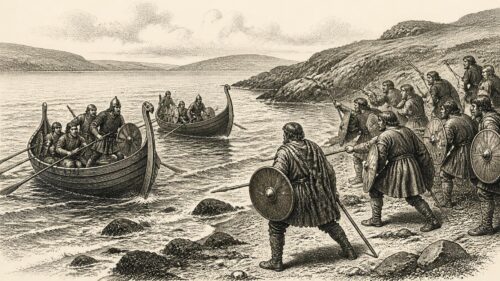
In the Annals of Inisfallen, 796 is marked by one of the most compressed and consequential notices in early Irish history: “The heathens in Ireland.” The entry supplies no place-name, leader, ship-count, battle or victim. It does not even say that a raid occurred. Yet its very brevity matters. It records that people whom the annalist identified as outsiders and non-Christians were present in Ireland, at a moment when seaborne violence around the Irish Sea had begun to register in the written record.
This should not be turned into a dramatic first landing or the beginning of permanent Scandinavian settlement. The evidence does not permit either claim. Rather, 796 offers a narrow but revealing view of Ireland at a threshold: coastal communities and island churches were becoming exposed to new dangers from the sea, while political rivalries within Connacht continued to shape power on land. The death of Colla son of Fergus, called king of Connacht, was recorded in the same annal; so too was the death of Máel Coba, king of Ciarraige Luachra. These notices show that the year was not defined only by strangers arriving from abroad. It was also part of an Irish contest over kingship, territory and local authority.
A Notice, Not a Narrative
The phrase “the heathens in Ireland” deserves close reading. Medieval Irish annals were concise yearly records, not continuous chronicles. Their entries could preserve a death, a battle, a church foundation, bad weather or an invasion in only a few words. Silence is therefore not proof that nothing happened; equally, a terse notice cannot responsibly be expanded into details it does not contain. We do not know where the newcomers landed in 796, how long they remained, whether they travelled in one fleet or several, or whether local rulers met them in diplomacy, trade or conflict.
The annal is best read alongside the entries immediately around it. Under 795, the Annals of Inisfallen record the plundering of Iona, Inis Muiredaig and Inis Bó Finne, though that notice does not name the attackers. The Annals of Ulster, meanwhile, explicitly attributes the burning of Rechru to heathens. Modern scholarship treats these notices as evidence for the opening phase of Viking activity in Ireland and its surrounding seas, but their dates and wording must be handled carefully. What can firmly be said for 796 is that the Inisfallen annalist considered the presence of heathens in Ireland important enough to record.
There are limits to corroboration. The surviving Annals of Tigernach break off after 766 and do not resume until much later, while Chronicon Scotorum has a gap between 722 and 804. Different annalistic compilations also preserve different chronological systems. Such gaps and discrepancies are a warning against treating 796 as a day-by-day account. The year survives as a carefully preserved fragment rather than a full report.
Connacht After Colla
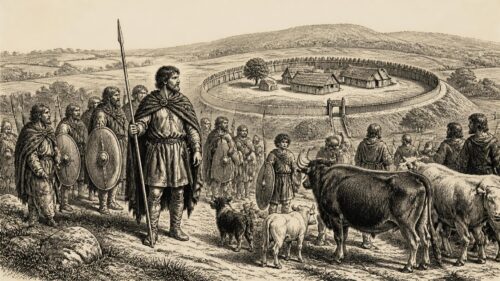
The other principal Irish development securely assigned to 796 was the death of Colla son of Fergus, whom the Annals of Inisfallen styles king of Connacht. The title should not suggest a compact state governed from a fixed capital. Connacht was a province of competing dynasties and smaller kingdoms, in which authority depended upon kinship, control of land and cattle, military followings, alliances with churches, and the capacity to compel or negotiate obedience.
Colla belonged to Síl Cellaig, a branch of the Uí Briúin. His death mattered because Muirgius son of Tommaltach, of the rival Síl Muiredaig, had been emerging as the most powerful claimant in Connacht since the early 790s. A modern biographical assessment judges Colla to have been Muirgius’s most serious remaining rival. That conclusion is an interpretation rather than an explicit annalistic statement, but it makes sense of the sparse evidence: a king’s death could remove a focal point for a rival coalition without automatically ending every local dispute.
Events close to this date underline the fragility of provincial authority. The Annals of Ulster record a battle at Áth Féne in which Muirgius escaped, apparently after a setback. Its internal dating is not securely identical with the calendar year 796, so it should not be presented as a firmly dated event of this year. It is, however, valuable context for the political world revealed by Colla’s obituary: Muirgius’s later dominance was neither instant nor uncontested. Connacht’s future leading dynasty was still making its position through struggle with rivals and dependent peoples.
Local Kings and Regional Landscapes
Máel Coba son of Flann Feórna, described as king of Ciarraige Luachra, also died in 796. This was a smaller kingship in Munster, rather than a provincial monarchy. His notice is a useful corrective to any picture of Ireland as ruled only by a handful of famous over-kings. Political life was layered. Provincial rulers sought supremacy, but local dynasties retained lands, followers and identities of their own. The standing of a king could be substantial within his district while remaining subordinate to greater powers beyond it.
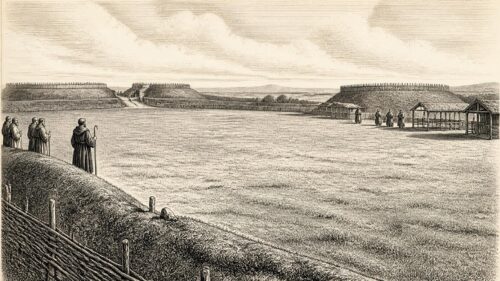
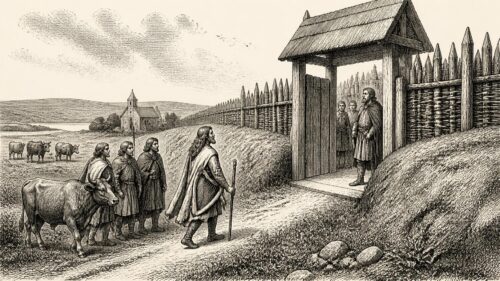
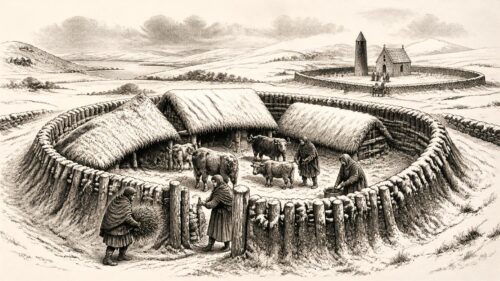
For most people, everyday life was shaped more directly by such local relationships than by the claims of distant kings. Ireland was overwhelmingly rural. Farmsteads, often within ringforts or stone cashels, formed a characteristic part of the early medieval landscape. Families raised cattle and other livestock, cultivated grain, managed woodland and pasture, and relied on skilled work in timber, iron, leather, cloth and bone. Cattle were central to wealth, food, dairy production and social exchange. A change of ruler, a feud between kindreds, or demands for renders could therefore affect the practical security of households as much as a battle did.
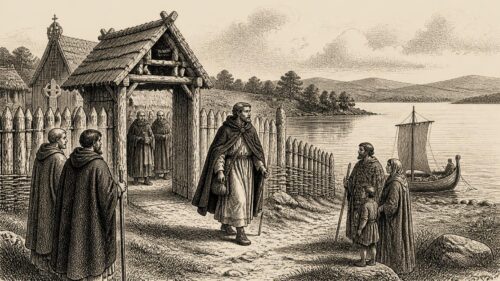
There is no evidence that every community in Ireland experienced the newcomers mentioned in the annal of 796. Inland settlements may have known of them only through rumour, travellers or the calculations of their rulers. But coastal and island communities were tied into an Irish Sea world by fishing, travel, pilgrimage and ecclesiastical connections. Ships brought opportunities as well as threats. The terse record of heathens in Ireland belongs to that maritime setting, even though it tells us nothing certain about trade or peaceful contact in that particular year.
Churches, Learning and Vulnerability
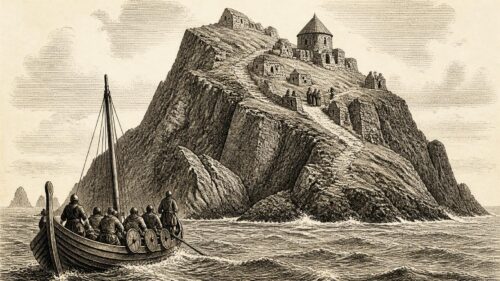
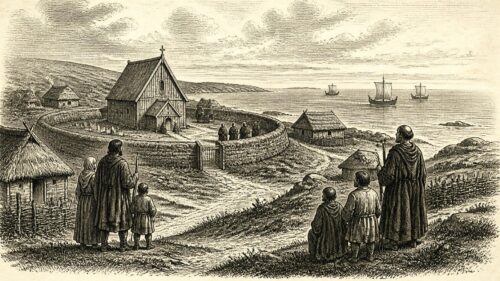
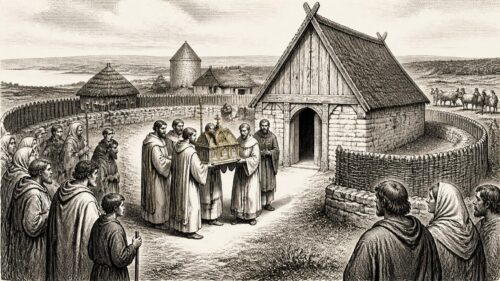
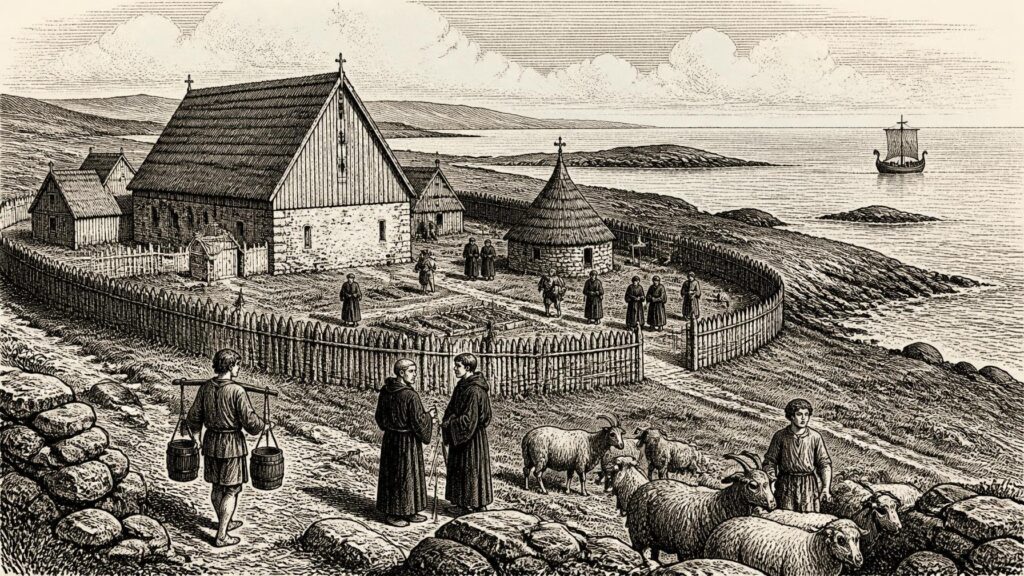
The most exposed institutions were often churches on islands, coasts and navigable waterways. These were not isolated places of prayer alone. Major ecclesiastical communities were landholders, centres of worship and burial, employers of craftspeople, hosts to travellers, and custodians of books, relics and precious church furnishings. Their enclosures could include churches, dwellings, workshops, storage areas, fields and cattle. Monasteries also stood within networks of patronage: kings and aristocrats endowed them, expected spiritual support and could use their prestige in political competition.
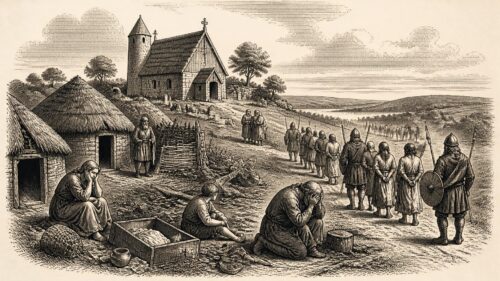
That social importance helps explain why attacks on churches appear so prominently in the early Viking record. A raid on an island monastery could seize portable wealth, livestock and captives, while also damaging a community’s spiritual standing and its patrons’ authority. Still, 796 must not be treated as a year in which Ireland’s monastic culture collapsed. Irish schools, scriptoria and ecclesiastical art remained vigorous. The learning associated with monasteries, including Latin scholarship and the copying of manuscripts, was a continuing feature of the age; the danger recorded in the annals was an emerging pressure upon an already sophisticated religious landscape.
Nor should “heathens” be read as an ethnic label of modern precision. It was the Christian annalist’s description, stressing religious otherness. Later evidence makes clear that Scandinavians in Ireland could raid, trade, settle, intermarry and participate in urban life, but those later developments should not be projected backwards into 796. Permanent fortified ship-bases, or longphuirt, are not recorded until the 840s, and the towns most associated with Viking Ireland developed later still. In 796, the record is of presence and uncertainty, not of a Scandinavian town or colony.
An Island at a Threshold
Thus 796 was not a single, all-Ireland turning point experienced uniformly from Ulster to Munster. Its evidence is too limited for that. It was, instead, a year in which two realities appear side by side. In the west, Colla’s death altered the balance among Connacht’s competing dynasties and helped clear the way for Muirgius’s eventual predominance. In the annalistic record of the wider island, the presence of heathens announced a new maritime factor whose full consequences were still unknowable.
The strength of the year lies in that contrast. Ireland was neither passive nor politically unformed before Viking activity: it possessed established local kingdoms, ambitious provincial rulers, productive rural communities and powerful churches embedded in secular society. The arrivals noted in 796 entered that complex world. They would change it over generations, but the annal’s economy of words reminds us that, at the time, the future had not yet been written.
Primary Sources
- Annals of Inisfallen: Annal AI796
- The Annals of Ulster
- Annals of the Four Masters: Annal M796
- Vikings in Irish Chronicles, 794–902: Data
- Muirgius
- Catalogue of Viking Raids on Irish Churches in the Annals, 795–1015
- The Earliest Wave of Viking Activity? The Norwegian Evidence Revisited
- The Vikings in Ninth-Century Ireland: Sources and Settlements
- The Powers of Kings
- The Cambridge History of Irish Literature: Chronology
- Annals of Tigernach
- Chronicon Scotorum
- Early Medieval
- Viking
- High Crosses
- Irish School of Illumination, c. 650–1100
- Monasteries and Abbeys
- Early Christian Monasteries
- Churches and Ecclesiastical Enclosures
- Irish Field Monuments: Ringforts
- The Winter Camp of the Viking Great Army, AD 872–3, Torksey, Lincolnshire
- Irish Texts at CELT