Armagh’s Battle at Emain759 CE
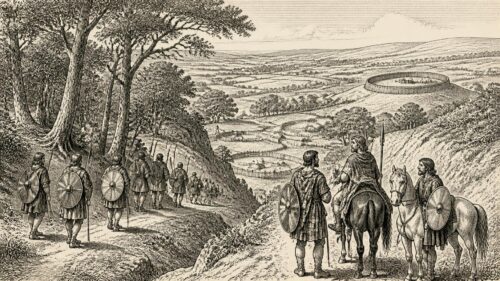
In 759, annals record conflict, death and weather across Ireland, though their dating differs slightly. At Emain Macha, rivalry between priest Airechtach and Armagh’s abbot Fer dá Chrích helped provoke battle between Ulaid and Uí Néill forces. Fiachnae of Ulaid prevailed; Dúngal grandson of Conaing and Donn Bó died. Anmchad, king of Osraige, defeated Leinstermen at Gabráin. Domnall of Leinster died, alongside kings Rechtabra and Ferdamal, several abbots and named scholars. A rainy summer and a remarkable fish-bearing stream were noted. These terse records reveal intertwined ecclesiastical authority, regional warfare, learning and environmental observation within contested local networks of authority.
Dateline
For Ireland in 759, the clearest surviving record is not a royal proclamation or a charter but a tightly written annalistic cluster: fighting at Emain Macha, a dispute within Armagh’s church, deaths among rulers and abbots, a Leinster battle, and an unusually wet summer. The year must nevertheless be approached with care. Medieval Irish annals did not all calculate years in precisely the same way. The Annals of Tigernach and Annals of Inisfallen place the battle of Emain Macha under 759; the parallel entry in the Annals of Ulster stands beneath an annal whose synchronisation is effectively one year earlier. The events belong securely to this short chronological horizon, but modern precision should not be imposed where the sources do not permit it.
A Church Quarrel Turns Violent
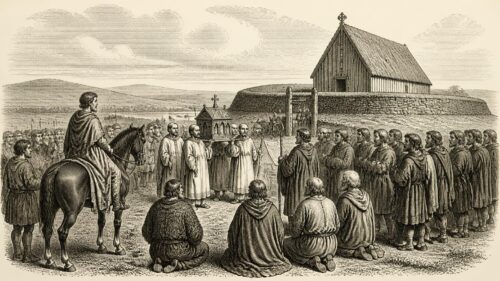
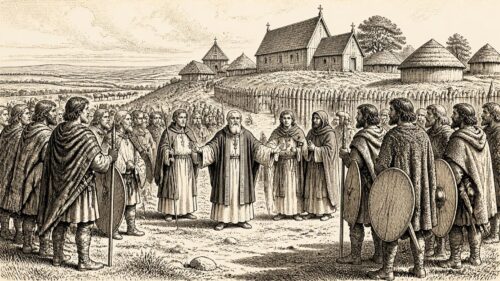
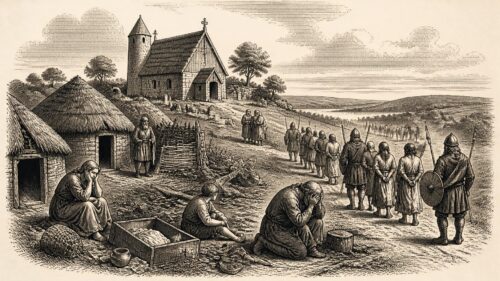
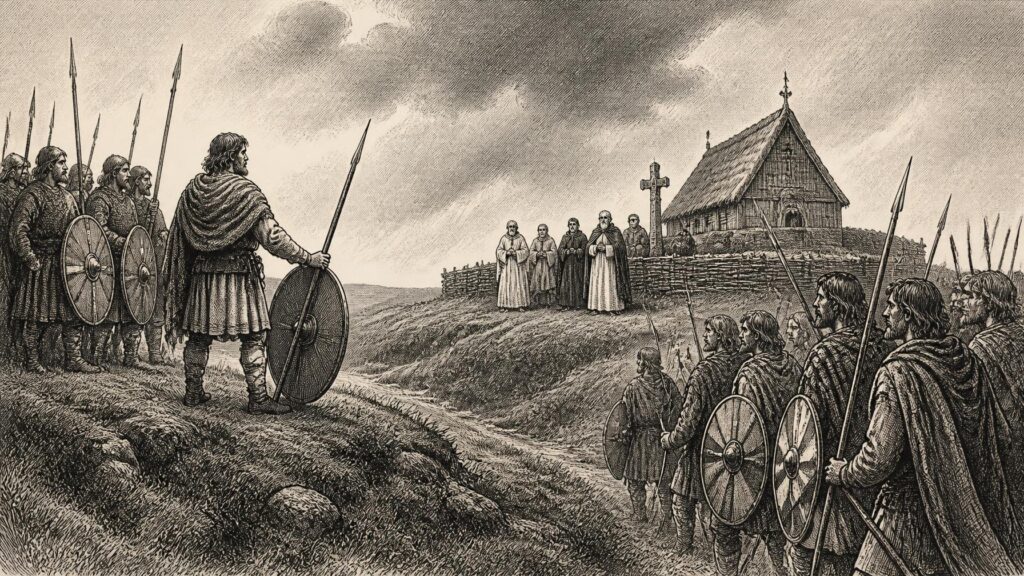
The principal event was the battle of Emain Macha. Tigernach describes it as a contest between the Ulaid and the Uí Néill, and supplies the most revealing explanation: Airechtach, a priest of Armagh, was fomenting discord against Fer dá Chrích, the abbot of Armagh. The result was fatal. Dúngal, grandson of Conaing, and Donn Bó were killed, while Fiachnae son of Áed Rón emerged victorious. Ulster preserves the same central outcome and adds verses mourning Donn Bó, whose grave and lost status were sufficiently memorable to attract poetic commemoration.
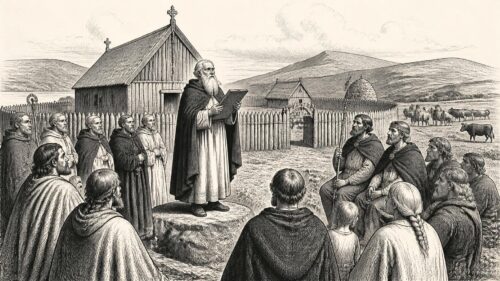
This was not simply an episode in which churchmen happened to be near warriors. The annal explicitly makes an ecclesiastical disagreement part of the cause of conflict. In eighth-century Ireland, an important church was at once a sacred community, a landholder, a centre of learning, a recipient of food-renders and gifts, and a political resource. Its leading office could therefore be contested with the support of kings and armed clients. The quarrel between Airechtach and Fer dá Chrích should not be reduced to a disagreement over doctrine: the source gives no theological issue. What it records is rivalry around authority at Armagh, expressed through a clash of regional powers.
Fer dá Chrích had only recently become abbot, following the death of his predecessor Célé Petair in the preceding annalistic sequence. The title “abbot” should not suggest a secluded superior detached from lay affairs. Armagh’s head stood within the tradition associated with Patrick and commanded exceptional prestige. The office connected a church community with dependent churches, cultivated lands, tenants and clients, relics, hospitality, scholarship and the right to receive patronage. A challenge to its holder could have consequences well beyond the enclosure of the church itself.
Ulaid, Uí Néill and Armagh
Fiachnae was overking of Ulaid and a member of the Dál Fiatach, the leading dynasty of eastern Ulster. His victory shows that Armagh’s internal tensions could draw in a ruler whose core lands lay to the east in what is now County Down, while the opposing force was identified broadly as Uí Néill. This was a political landscape of overlapping claims rather than fixed national frontiers. Kings exercised influence through kinship, military following, tribute, fosterage and alliances with churches; the reach of that influence rose and fell quickly.
Dúngal’s death gave the battle added weight. The annals call him grandson of Conaing, placing him among a highly connected Uí Néill kindred world, but they do not provide a full narrative of his intentions or command. Donn Bó’s death is similarly stark in the core record. Later identification of individual men and territories can be helpful, yet the responsible conclusion for 759 is narrower: Fiachnae’s side defeated a Uí Néill-led opposing force at Emain Macha, and two prominent participants were slain.
Even the victor’s name illustrates the limits of the evidence. Tigernach and Ulster name Fiachnae son of Áed Rón; Inisfallen calls the victor Fiachra, king of Ulaid. The agreement on an Ulaid victory is stronger than the disagreement in the personal name, which may reflect transmission or scribal variation. Nor can the battle be reconstructed blow by blow. The sources do not say how large the forces were, whether the fighting lasted hours or days, or whether the dispute began inside Armagh’s ecclesiastical community before spreading into armed confrontation.
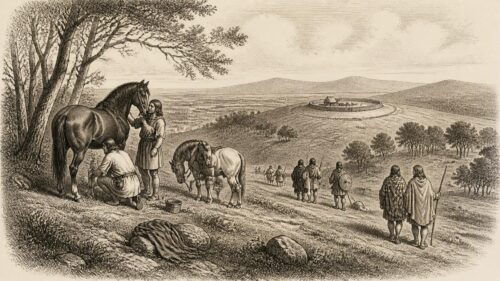
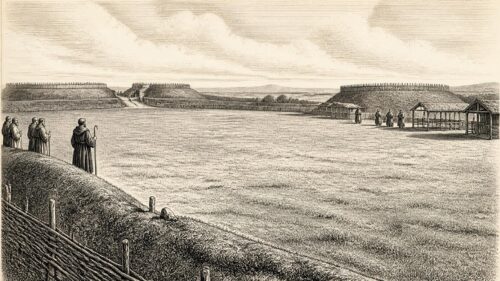
Emain Macha itself carried immense resonance. It was the old royal landscape associated in Irish tradition with the Ulaid, close to Armagh. By the eighth century its name could evoke a prestigious northern political past as well as identify a locality. It would be unsafe to imagine a battle staged neatly inside a surviving monument, or to equate every literary association of Emain with the events of 759. But the annal’s choice of place-name matters: an armed victory by the king of Ulaid beside Armagh was conducted in a landscape dense with royal and ecclesiastical authority.
Pressure on Leinster’s Border
The same year’s annals point to another struggle, farther south. Tigernach records that Anmchad won the battle of Gabráin over the Leinstermen. Gabráin is generally associated with the Gowran area, on the contested ground between Osraige and Leinster. The terse entry does not name the defeated Leinster leader, describe the cause, or quantify the losses. It does, however, show that military pressure was not confined to Armagh and the north.
Anmchad was king of Osraige, a kingdom centred broadly on the later counties of Kilkenny and western Laois. Its position made it a consequential neighbour of Leinster and Munster, not a passive borderland. The battle belongs to a longer pattern of rivalry between Osraige and Leinster, but the immediate event must stand on its own terms: in this annalistic year Anmchad won against the Leinstermen at Gabráin. The later Annals of the Four Masters preserve the same battle under a substantially earlier date, another reminder that the year-number attached by one medieval compilation cannot always be treated as an exact modern timestamp.
A death recorded in the northern annals may also reflect instability in Leinster’s political class. Domnall son of Áed, described in Ulster as “of Laigin”, died; Inisfallen calls a Domnall king of Leinster. The identification is plausible within the chronicle tradition, but the sparse notices do not tell us whether he died naturally, whether his death followed conflict, or who immediately profited. What can be said is that the annals of this period repeatedly couple the deaths of rulers with contests among neighbouring dynasties. Succession was not an administrative formality; it was a recurrent source of risk and opportunity.
Small Kingdoms and Church Communities
Other notices reveal a political map made up of smaller lordships as well as famous overkingdoms. Rechtabra son of Dúnchú, king of Mugdorna, was killed. Mugdorna lay in the wider northern Midlands and borderlands, and his death is a reminder that the annals did not reserve violence for the greatest kings. Ferdamal, son of Cenn Fáelad, was also killed, although the record gives no setting or explanation. Such entries are frustratingly brief, but their very brevity demonstrates how much early medieval conflict went unelaborated: a name and kin-group might be all that later readers received.
Church leadership changed as well. Eochaid son of Conall Menn, abbot of Fobren, died, alongside learned men named Siadal son of Luath and Eochaid son of Fiachra. Dub Drumán, abbot of Tuilén, died, and Tigernach additionally records Coisetach, abbot of Louth. These obits belong to different regions and institutions, yet together they show the density of ecclesiastical organisation. Churches needed leaders able to manage estates and dependencies, direct worship, preserve books and learning, receive travellers, negotiate with patrons and defend communal interests.
The word “learned” attached to Siadal and Eochaid is especially valuable. It confirms that intellectual standing was important enough to be recorded alongside royal and clerical rank. Learning in such communities involved Latin Christianity, biblical interpretation, computation of time, inherited genealogical and legal knowledge, and composition in Irish and Latin. It would be wrong to turn every named scholar into the head of a great school, because the annals do not say where or how they taught. Yet the notices offer a glimpse of a society in which expertise could be publicly recognised.
Rain, Water and the Limits of Evidence
Ulster’s report of “a rainy summer” brings climate directly into the year’s record. For an overwhelmingly rural population dependent on grain, cattle, dairying and seasonal labour, persistent rain could affect haymaking, harvesting, travel and the condition of roads and fords. No source, however, says that 759 brought famine in Ireland, and it would be a mistake to infer one merely from wet weather. A famine and a heavy mast crop are entered for the following annalistic year, not this one. The distinction matters.
Both Ulster and Tigernach also note that Benn Muilt, “the Wether’s Peak”, poured forth a stream with fish. The phrasing has the character of a marvel or remarkable natural occurrence. It may preserve a memory of sudden water flow after rain, but that is an inference rather than a certainty; the annal offers no location precise enough for confident environmental reconstruction and no explanation of what observers believed had happened. Its inclusion nevertheless shows that chroniclers noticed striking features of the natural world alongside wars and deaths.
Thus 759 appears not as a quiet interval between greater events but as a year in which institutional rivalry, regional warfare and weather all entered the historical record. At Emain Macha, Armagh’s disputed leadership was inseparable from the ambitions of kings. At Gabráin, Osraige demonstrated its capacity to defeat Leinster. Across the island, the deaths of rulers, abbots and scholars altered local networks that bound communities together. The sources cannot furnish a complete narrative, but they preserve a compelling truth about early medieval Ireland: political authority, religious office and everyday security were closely entwined.
Primary Sources
- The Annals of Tigernach, Annal T759
- Annals of Tigernach: diplomatic text and edition details
- The Annals of Ulster, Year U759
- The Annals of Ulster
- Annals of Inisfallen, Annal AI759
- Annals of Inisfallen: navigator
- Annals of the Four Masters, Annals M754–M755
- Annals of the Four Masters, Annals M757–M760
- Annals of the Four Masters: source description and edition details
- Chronicon Scotorum: bibliographic record
- Chronicon Scotorum, Annals CS699–CS703
- Fiachnae
- Donnchad Midi
- Áed Rón
- High Crosses
- Hill of Tara
- Clonmacnoise Monastic Site
- The Metrical Dindshenchas
- Book of Leinster, formerly Lebar na Núachongbála
- Chronological Synchronisation of the Irish Annals