The Acorn Famine760 CE
In 760, Irish annals recorded famine alongside an exceptional acorn crop, highlighting food insecurity despite local abundance and unequal access to resources. Political change followed the death of Leinster ruler Muiredach, while a battle at Belach Gabráin exposed rivalry between Leinster and Osraige. Ecclesiastical institutions were equally entangled in conflict: communities of Clonmacnoise and Birr fought, and a bishop was killed at Kildare’s altar, reportedly prompting a liturgical restriction. Death notices for rulers and churchmen reveal networks spanning Ireland. Though chronologically uncertain and selective, the annals portray a divided, interconnected society shaped by scarcity, dynastic competition, church power, and violence.
Dateline
A Year Recorded Unevenly
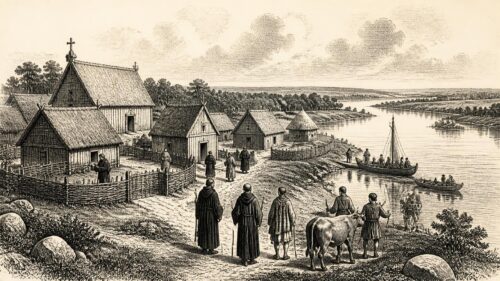
For Ireland in 760, the fullest surviving contemporary-style notice is also the most revealing: the Annals of Tigernach record “famine and a great crop of acorns”. It is a compact statement, but it places hunger beside an abundance from oak woods and opens an unusual view of conditions beyond royal warfare. The same annalistic year also preserves the death of a Leinster king, conflict between two major monastic communities, a killing at Kildare’s altar, and deaths linking churches from Bangor to Lismore. Yet the evidence needs careful handling. Irish annals were copied, rearranged and continued over centuries; their year headings can differ between compilations. They are indispensable evidence for 760, but not a day-by-day chronicle of an island-wide state.
The year was therefore not one single Irish story. Ireland was politically divided among many kingships, lordships and ecclesiastical jurisdictions. A powerful overking might exact recognition, hostages or tribute across a large area, but authority was negotiated locally. Monasteries were similarly influential without being merely religious retreats: they held land, organised labour, hosted learning, drew in gifts and controlled valuable forms of prestige. The notices surviving for 760 show a society in which food supplies, lordship and sacred institutions were closely entangled.
Hunger and the Oak Crop
The annal’s pairing of famine with a heavy acorn crop should not be turned into a falsely precise disaster narrative. It does not state where hunger was worst, how long it lasted, what caused it, or how many people died. Nor does it explicitly say that people ate acorns. It does, however, register both scarcity and an exceptional natural yield in the same year, suggesting that the condition was serious enough to enter a learned record and that oak mast was conspicuous enough to be remembered alongside it.
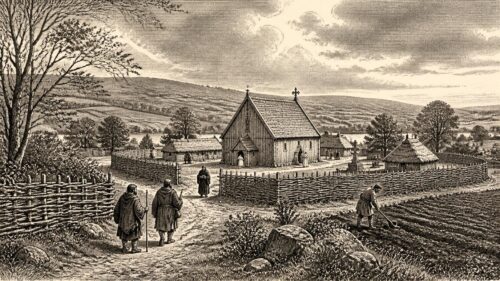
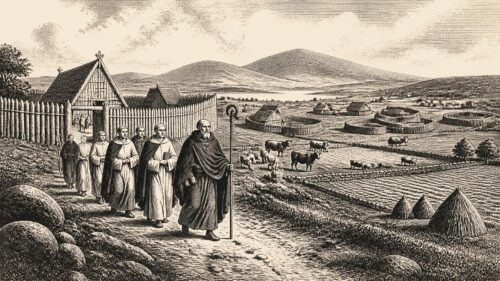
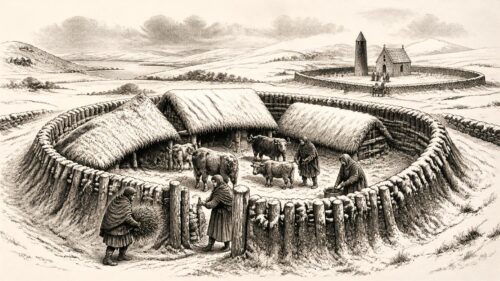
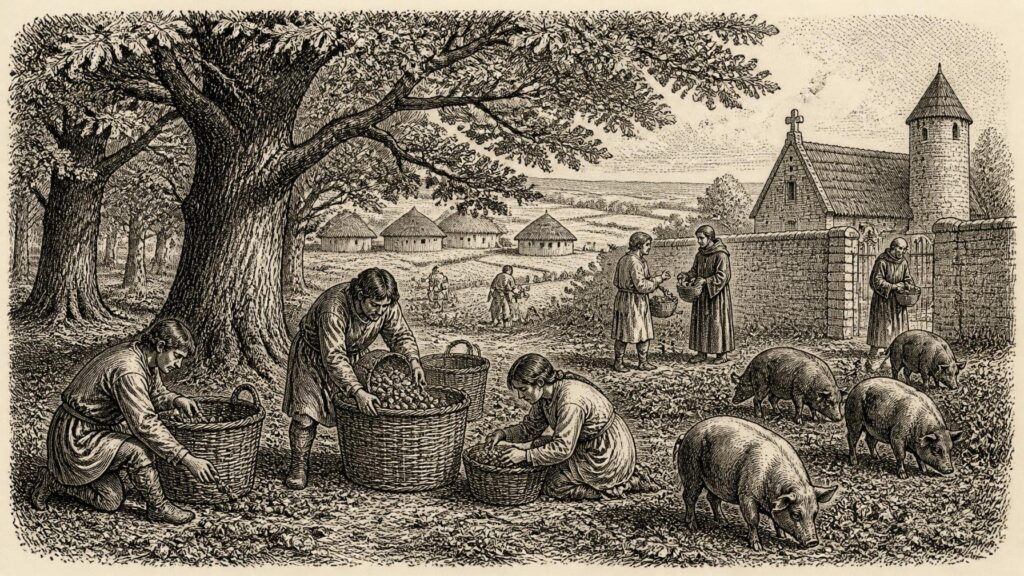
Acorns mattered in an early medieval landscape. Oak woodland supplied timber, fuel, forage and pannage for pigs; a good mast season could have immediate value for households with access to woodland and swine. Acorns could also be processed for human use, though this particular notice does not prove that this happened in 760. Its significance lies in the contrast: a society dependent on cereals, cattle, dairy produce and seasonal labour could experience acute food pressure even while one resource was abundant. Hunger was not simply a shortage of all food everywhere; it was a failure of secure, usable and socially accessible supplies.
That distinction matters. Land and livestock were unevenly controlled, and a bad season would have been experienced differently by kings, church estates, tenant farmers, dependants and people with little claim on cattle or grain. Cattle remained central to wealth and status, but cereals were increasingly important because grain could be stored, transported and rendered into dues. The 760 entry offers no licence to calculate harvest totals or reconstruct a national weather pattern. It does, nevertheless, bring the material vulnerability of early Irish life into sharp focus: food security depended on crops, animals, woodland, labour and the capacity of local communities to redistribute what they possessed.
A Change in Leinster
The Annals of Tigernach place the death of Muiredach son of Murchad, grandson of Bran, king of Leinster, in 760. The Annals of Inisfallen, compiled in a different milieu and with its own chronological problems, instead record the death of “Murchad, king of Laigin” under that year. The discrepancy warns against claiming more certainty than the sources allow. Modern historical reconstruction generally identifies the deceased ruler as Muiredach mac Murchada of the Uí Dúnlainge, but the variant itself is evidence of how names and regnal traditions shifted in transmission.
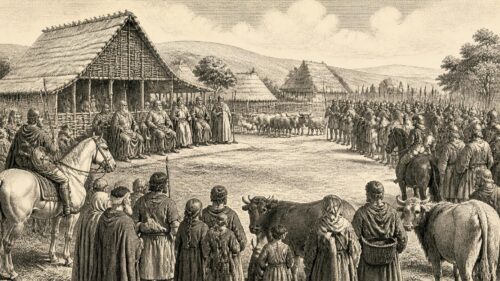
Muiredach’s death was politically important because Leinster was not a unified territorial kingdom in the modern sense. It was a hierarchy of competing dynastic interests, among them the Uí Dúnlainge in the north and the Uí Chennselaig in the south-east, with Osraige occupying a strategically important position to the west. The succession associated with 760 brought Cellach son of Dúnchad, another Uí Dúnlainge ruler, into the Leinster overkingship. That did not settle Leinster’s politics. Rather, it preserved the dominant standing of one branch while rival kindreds retained their own armed followings and territorial ambitions.
A battle at Belach Gabráin demonstrates the precariousness of that balance, although its exact calendar placement must be stated cautiously. The Annals of Ulster set it in their section U761 but explicitly label that material “AD 760”; the Annals of Tigernach place it in 761. Both describe a battle between the men of Leinster and Osraige in which Donngal son of Laidcnén, king of Uí Chennselaig, fell. Tigernach adds that the unnamed son of Cú Cherca won. It is thus securely connected to the transition around 760–61, but should not be represented as dated beyond dispute to a particular day, month or even annalistic year.
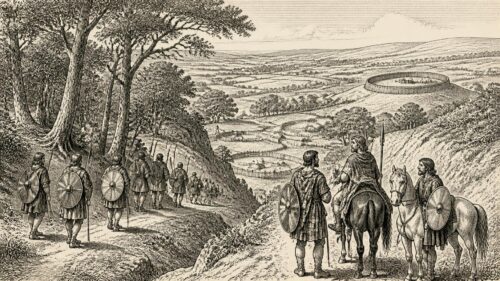
The encounter mattered because Belach Gabráin lay on a route linking Leinster and Osraige, near the later Gowran area. Donngal’s death removed a leading Uí Chennselaig king and advertised Osraige’s military capacity. No surviving entry explains the war’s immediate cause, its numbers or its settlement. Still, the battle shows that a change in Leinster’s senior kingship coincided with, or was quickly followed by, dangerous competition at its western and southern approaches. Political power was maintained through armed men, kin alliances, control of routes and the willingness to challenge a neighbour, not through fixed borders policed by a central government.
Monasteries in Conflict
The record for 760 is remarkable for what it says about churches. Tigernach notes a battle between the familia, or community, of Clonmacnoise and that of Birr at Móin Coisse Blai, a bog beside the River Blai. The entry gives neither cause nor victor. It does not permit the assumption that monks alone fought, or that the quarrel was theological. An Irish monastic community included clergy, scholars, tenants, clients, dependants and lay supporters; its interests could be territorial, economic and political as well as devotional.
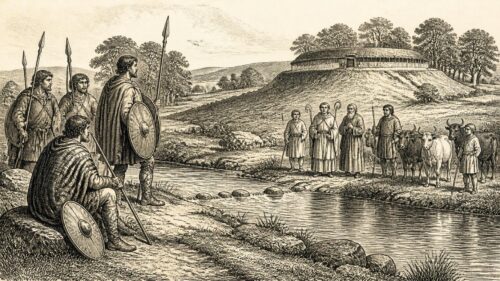
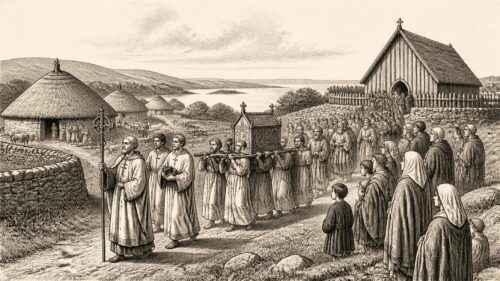
Clonmacnoise, on the Shannon, and Birr, in what is now County Offaly, were substantial ecclesiastical centres within the Irish midlands. Their communities were connected to networks of patronage and landholding that reached beyond their enclosures. A clash between them therefore indicates that sacred status did not remove institutions from worldly competition. Churches could provide sanctuary and learning, preserve books and liturgy, and serve local populations; they could also be actors in disputes over rights, resources, honour and jurisdiction. The annal offers no moral explanation, only the blunt fact of conflict.
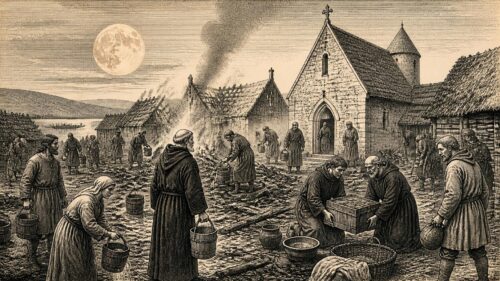
Another notice is still more unsettling. Tigernach records the killing of Echtigern, a bishop, by a priest at Brigit’s altar in Kildare, adding that thereafter no priest celebrated Mass at Kildare in a bishop’s presence. The same killing appears again under 762 in the received text, so the precise year cannot be treated as settled. Its association with the 760 annal, however, is clear enough to illuminate the period. The statement is not simply an anecdote of violence in a holy place. It claims that an institutional custom followed from the killing, preserving a memory of traumatic conflict as an explanation for liturgical practice.
Kildare was among Ireland’s most prominent churches, associated with Brigit and with extensive religious and social authority. An altar was a potent setting for a killing because it represented sanctuary, sacred order and the public standing of the community. The annal does not explain the priest’s motive, whether the bishop’s office was contested, or how universally the reported restriction was observed. What can responsibly be said is that ecclesiastical rank was not abstract. It was embodied in persons, ritual spaces and relationships whose breakdown could have lasting consequences.
Networks of Prayer and Power
The obituaries assigned to 760 make the island’s ecclesiastical connections visible. Tigernach names Conait, abbot of Lismore; Falartach son of Bricc, an anchorite; Suairlech, abbot of Bangor; and Ailgin son of Ganai, described as the second abbot of Clonard. The Annals of Inisfallen also record the deaths of Tríchmech of Lismore and Abnér of Imlech Ibuir, or Emly. These notices are not enough to write biographies, but they identify a dispersed landscape of religious institutions extending from the north-east through the midlands to Munster.
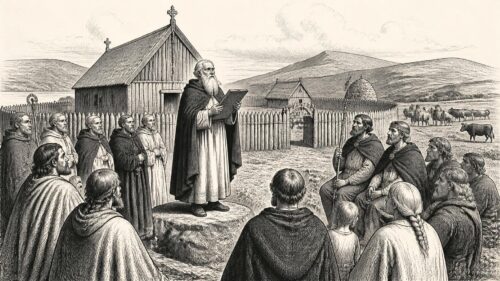
Such centres were places of worship, burial, hospitality, teaching and skilled production. Latin learning and vernacular tradition could coexist there; manuscripts, metalwork and stone carving were made within wider systems of patronage. Their populations were not insulated from scarcity or conflict. The famine notice, the Birr–Clonmacnoise battle and the Kildare killing all caution against imagining monasteries as quiet islands of prayer outside secular life. They were major communities embedded in rural economies and dynastic politics.
Tigernach also records the death of Flann son of Erc, king of Uí Fhidgeinte in Munster. In isolation the notice says little about his reign, but alongside the Leinster succession it underlines a basic feature of the year: political change occurred in several regions at once. No annal reports a single ruler directing these events across all Ireland. Instead, 760 emerges as a year of local pressures—food shortage, succession, institutional rivalry and violence—registered in short notices that only together reveal its texture.
What 760 Can Tell Us
The evidence for 760 is fragmentary, and its chronology is not mechanically reliable. That is not a weakness to be concealed; it is part of the history. The annals preserve what particular communities judged worth recording: the death of kings and abbots, exceptional hunger, battles and breaches of sacred order. They say very little directly about women, children, unfree people, craftsmen or ordinary cultivators, though all would have lived with the consequences of famine, lordship and church power.
Even so, the year has a distinctive profile. The phrase “famine and a great crop of acorns” captures an environment in which abundance in one part of the landscape did not guarantee security. Muiredach’s death and the closely connected struggle at Belach Gabráin expose Leinster’s unstable political geography. The clashes involving Clonmacnoise, Birr and Kildare reveal churches as powerful human institutions, capable of contest, violence and remembered reform. Ireland in 760 was neither isolated nor unified: it was a densely connected society whose local crises travelled through kinship, religious authority and the management of land and food.
Primary Sources
- The Annals of Tigernach, Part 14
- The Annals of Ulster, Part 331
- Annals of Inisfallen, Part 32
- Annals of the Four Masters
- CELT Project: The Annals of Tigernach
- CELT Project: The Annals of Ulster
- CELT Project: Annals of Inisfallen
- Annala Uladh: Annals of Ulster otherwise Annala Senait, Annals of Senat
- CELT Project: Annals of the Four Masters
- CELT Project: Fragmentary Annals of Ireland
- Exploring the Irish Annals
- Cellach
- Early Christian Monasteries
- Churches and Ecclesiastical Enclosures / Shéipéil agus Ráthanna
- Changing human-cattle relationships in Ireland: a 6000-year isotopic perspective
- Religion and Society in Ireland
- Land Use and Economy AD 500–1100
- Money in Early Christian Ireland According to the Irish Laws
- Reassessing the Irish ‘monastic town’
- A New Jerusalem ‘At the Ends of the Earth’: Interpreting Charles Thomas’s Excavations at Iona Abbey 1956–63
- County Kildare Urban Archaeology Survey
- County Offaly Urban Archaeology Survey
- Archaeological Survey
- The Chronicle of Ireland: an examination of the early Irish annals