Clonard’s Charred Stores750 CE
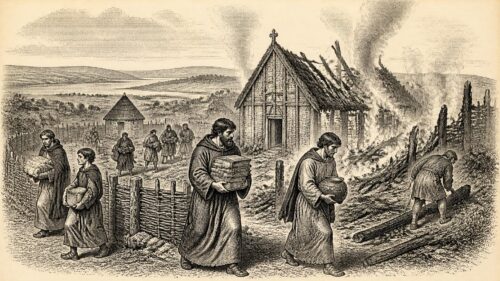
In 750 CE, the Annals of Ulster recorded that half the grain stores at Cluain Ioraird, or Clonard, County Meath, burned in a kiln or drying-house. The cause, quantity lost and consequences remain unknown, but the notice demonstrates the importance and vulnerability of a church settlement dependent on food, labour and reserves. Clonard, an established midland church linked later with learning, operated within networks of land, obligation and regional power. That year also saw the deaths of kings of Uí Fhailgi and southern Brega, illustrating fragmented political authority. The fire reveals material foundations supporting religious life, hospitality and institutional survival.
Dateline
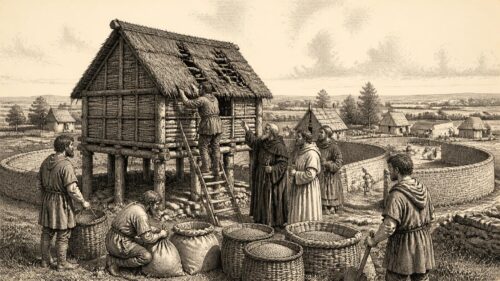
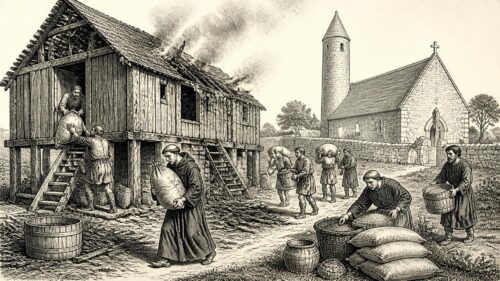
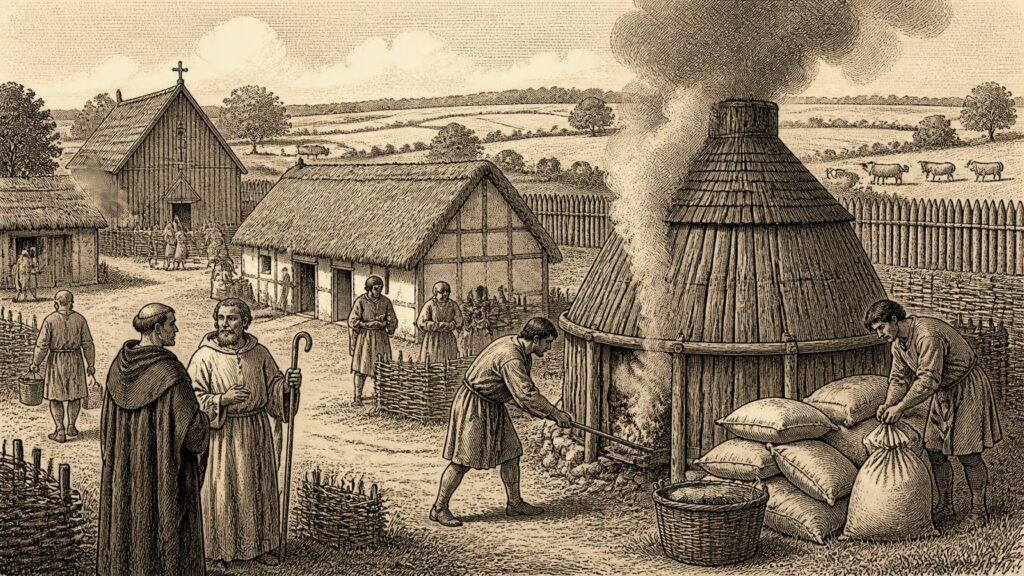
In 750 CE, a brief annalistic notice brings an unusually practical calamity into view: at Cluain Iraird, now Clonard in County Meath, half of the community’s stored grain was burned in a kiln or drying-house—the precise sense of the final word is uncertain. The record is laconic, and it gives neither cause nor consequence. It does not say that a harvest failed, that enemies attacked, or that people starved. Yet the loss was plainly large enough to enter a chronicle otherwise concerned chiefly with kings, clerics and battles. For one important church settlement in the Irish midlands, grain held in storage had become an asset of sufficient value to be counted, mourned and remembered.
A Record with Limits
The event belongs to the securely dated sequence represented by the Annals of Ulster. Its annal heading can be confusing to a modern reader: the manuscript’s running annal number and its modern calendar-year alignment do not always look identical. In the edition, the entry placed under U751 is assigned to AD 750. This is a useful warning against treating every medieval annal heading as mechanically equivalent to a modern date. The loss at Clonard can responsibly be placed in 750 CE; its details cannot be expanded beyond what the source supplies.
That restraint matters. Fire was a permanent danger in a landscape where most roofs, halls, storehouses and workshops were built largely of timber, wattle, thatch and other combustible materials. Grain could be dried near heat before long storage or milling, and the annal’s reference to a kiln suggests a vulnerable point in that process. But the wording does not identify the ignition: it may have been accidental, deliberate or connected with an activity now lost to us. Nor does “half” reveal the total quantity. It may denote part of a monastic reserve, grain owed in renders from dependent lands, food intended for residents and guests, or stores serving several of these purposes at once.
The value of the notice lies precisely in this modest specificity. It reminds us that early medieval Irish churches were not only places of prayer, burial and learning. Large ecclesiastical settlements depended on cultivated land, livestock, labour, kitchens, storehouses and the management of seasonal supplies. A loss of grain at the end of one agricultural cycle could affect meals, hospitality, almsgiving, seed grain and the capacity to support religious personnel through the next. It need not imply a general crisis across Ireland, but it reveals how closely spiritual institutions were tied to the material rhythm of farming.
Clonard in the Midland World
Clonard stood in the western part of modern County Meath, near routes linking the midlands with Leinster. Its Irish name, Cluain Ioraird, means “Iorard’s meadow”. By 750 it was an old and prestigious church, associated in later tradition with Finnian and with a celebrated school of saints. Such foundation traditions were repeatedly elaborated after the period they describe and should not be read as a census of sixth-century pupils. Still, the church’s continuing importance is beyond doubt: Clonard remained a major ecclesiastical centre through the early Middle Ages, and later sources repeatedly connect it with scholarship.
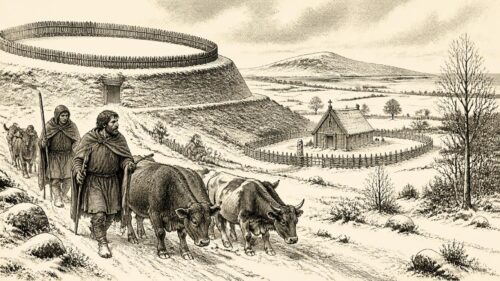
Its physical appearance in 750 cannot be reconstructed with confidence. Nothing standing at Clonard today can simply be called the building in which the grain burned. Modern geophysical work has found buried anomalies that may relate to the former monastic settlement, but it cannot assign them to this particular year or incident. The settlement was likely an enclosed complex rather than a single cloistered abbey in the later medieval sense: churches and burial ground, dwellings for clerics and workers, craft and service areas, animal enclosures, gardens and cultivated ground could form parts of a sizeable ecclesiastical community. Its boundary separated a protected sacred space, but not a world detached from ordinary rural production.
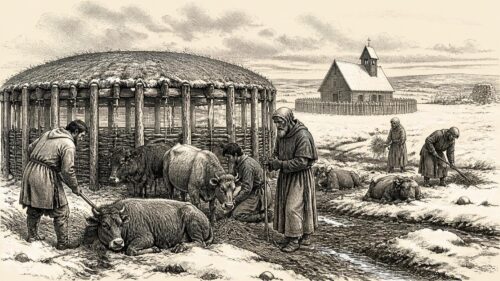
Clonard’s stores therefore belonged to a wider economy of land and obligation. Ireland in this period had no urban network comparable to that of the former Roman provinces, and coined money played only a limited role in many transactions. Wealth and status were commonly expressed through cattle, land, food-renders, precious objects and service. Grain was not the sole staple—dairying and cattle husbandry were central to life—but cereals remained essential for bread, porridge, ale and seed. A church able to accumulate grain was exercising both economic capacity and social authority.
Food, Labour and Vulnerability
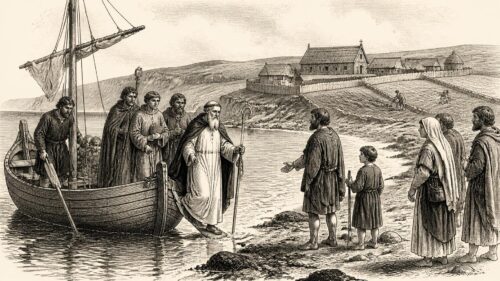
The people most directly affected by the fire remain unnamed. They may have included clerics, students, tenants, food-workers, labourers, dependants and travellers seeking hospitality. Irish annals almost never describe such people individually. Archaeology and law texts nevertheless make clear that early medieval society was highly graded. Kings and aristocrats held power through kinship, clientship, land and military followings; free farmers managed households and herds; people of lower status supplied labour and service. Churches occupied this same social landscape. Abbots, bishops and senior churchmen could belong to powerful dynasties, while ecclesiastical estates depended on the work and produce of surrounding communities.
The burned stores offer a rare route into the everyday pressures within that structure. Grain was harvested in late summer, processed by hand and kept against the months when fresh food was scarcer. Storage was a safeguard, but it concentrated risk. A fire could destroy labour already invested in ploughing, sowing, weeding, harvesting, threshing, drying and transport. Replacing the lost amount might require drawing on other reserves, seeking contributions from associated lands, reducing consumption or relying more heavily on cattle produce. These are possibilities, not reported outcomes. The annal’s silence prevents any claim that Clonard suffered hunger or that neighbouring communities were compelled to compensate it.
Nor should the episode be made into evidence for a nationwide environmental disaster. The notice concerns one named settlement, not the weather of Ireland. Its importance is local and institutional: it shows that food stores were sufficiently central to the functioning of a great church to be recorded alongside deaths of rulers and abbots. A single line preserves an otherwise invisible moment when the security offered by surplus gave way to loss.
Deaths and Political Change
Other entries assigned to 750 CE show how frequently politics appeared to contemporaries as a sequence of deaths. Flann grandson of Congal, king of Uí Fhailgi, died. Uí Fhailgi occupied territory in the central plain, broadly in parts of present-day Offaly and neighbouring districts. Fergal, or Fergus, son of Fogartach, king of southern Brega, also died. Southern Brega lay to the east of Clonard in the Boyne region. Neither entry describes succession, mourning, conflict or a change in allegiance. The deaths were nevertheless political events: the departure of a king could reopen rivalries within a dynasty and alter relations with neighbouring powers.
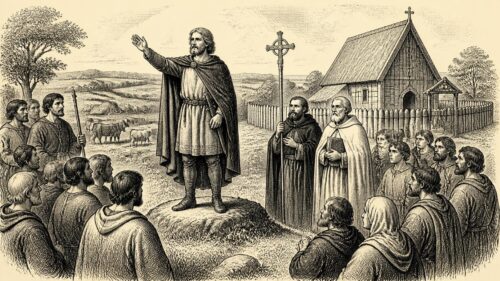
Clonard stood within the orbit of Mide, where Domnall mac Murchada—known as Domnall Midi—was the dominant Uí Néill ruler of the period. Later medieval regnal tradition presents him as king of Ireland, but that title should not suggest a unitary state with a capital, bureaucracy or fixed national administration. Authority was negotiated through personal lordship, hostages, tribute, church connections and armed expeditions. Regional kings retained substantial independence, and the deaths recorded in Uí Fhailgi and Brega underline the number of local political centres with which a midland ruler had to reckon.
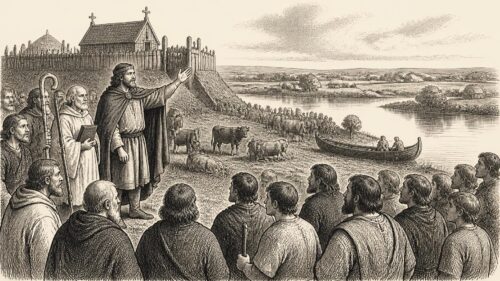
There is no annalistic statement that Domnall intervened at Clonard in 750, or that the grain fire had a political cause. Yet the monastery’s position near the meeting ground of Mide, Brega and Leinster helps explain why it mattered. A wealthy church could offer spiritual legitimacy, learned personnel, access to literate record-keeping and a place for elite burial or negotiation. Its stores, lands and personnel were part of the resources over which rulers and church leaders sought influence.
Learning, Memory and the Church
By the mid-eighth century, Irish ecclesiastical culture was both local and outward-looking. Latin learning, biblical study, computus—the calculation of the church calendar—genealogy and vernacular literary composition circulated through networks of churches. Manuscripts were laborious and valuable objects, copied on vellum by trained scribes. The church’s intellectual life was not confined to famous centres, and the evidence does not allow us to name Clonard’s teachers or books in 750. Its later reputation for learning, however, makes it reasonable to see the loss of food stores as affecting a community whose religious and educational work rested on mundane provisioning.
The year also belongs to a wider eighth-century moment of religious reform and intensified ascetic ideals in Ireland, later associated with the Céli Dé, or “clients of God”. Such currents should not be projected automatically onto every community. There is no surviving evidence that the Clonard fire resulted from reform, prompted a reform, or was discussed in devotional terms. What can be said is that communities were debating standards of worship, discipline and clerical life while remaining dependent on the productive countryside around them.
Thus 750 CE is not remembered for a great battle, royal assembly or new foundation. Its most revealing Irish event is smaller: the burning of part of a church’s grain supply. Alongside the deaths of two regional kings, it exposes the two scales on which power operated. Dynastic politics turned on fragile successions and territorial relationships. Daily institutional survival turned on stores of food, the security of buildings and the labour of people whose names the annals did not preserve. At Clonard, the fire made that hidden foundation briefly visible.
Primary Sources
- The Annals of Ulster
- The Annals of Tigernach
- Annals of Inisfallen
- Annals of the Four Masters
- Chronicon Scotorum
- Fragmentary Annals of Ireland
- The Martyrology of Oengus the Culdee
- Translated Texts at CELT
- Chronological Synchronisation of the Irish Annals
- Contributions towards the Political History of Munster, 450–800 A.D.
- The Chronicle of Iona: a Study of the Chronicle-Texts in the Irish Annals
- Geophysical Investigation of the Site of the Former Monastic Settlement, Clonard, County Meath, Ireland
- Literature and Learning in Early Medieval Meath
- Clonard Heritage Trail
- Cluain Ioraird/Clonard
- Earthen Banks and Broken Walls: Archaeology in Ireland
- Early Christian Monasteries
- Churches and Ecclesiastical Enclosures
- Land Use and Economy AD 500–1100
- Religion and Society in Ireland
- Money in Early Christian Ireland According to the Irish Laws
- Irish School of Illumination, c. 650–1100
- The Archaeology of Ecclesiastical Estates in Early Medieval Ireland: A Case Study of the Kingdom of Fir Maige
- Local Churches and Social Power in Early Medieval Ireland: A Case Study of Fir Maige