Ard Ciannachta’s Counterstroke749 CE
In 749, Irish annals recorded warfare, killings, fires, ecclesiastical deaths and ominous phenomena. At Ard Ciannachta near the Boyne, Dúngal son of Amalgaid won a battle in which Ailill son of Dub dá Crích fell, while Domnall son of Cináed, initially victorious, died in a counter-attack. Cathusach, king of the Cruithin, was killed in Ulaid. Clonfert and Cell Mór burned, and several abbots and rulers died. Iona’s community suffered drowning, while a great windstorm was noted. Ships reportedly appeared above Clonmacnoise, a prodigy reflecting annalists’ providential outlook. Together, these sparse records reveal political fragmentation, vulnerable religious institutions and environmental dangers.
Dateline
In 749 CE, Ireland’s annals register a year of sharply local violence, destructive fires and alarming events at religious communities. The fullest entries centre on the battle of Ard Ciannachta, in the lower Boyne–Dee region, where an initial victor was himself killed in a counter-attack. Elsewhere, a king of the Cruithin was slain, Clonfert burned, members of the community of Iona were drowned, and a great windstorm was remembered alongside the deaths of rulers and churchmen. These notices are terse, but together they reveal an island in which political authority, monasteries and the hazards of weather and travel were closely entwined.
Reading a Year in the Annals
The evidence needs careful handling. The principal contemporary-looking record is preserved in much later manuscripts of the Annals of Ulster and Annals of Tigernach; their year headings and modern calendar equivalents do not always align neatly. Events conventionally placed in 749 should therefore not be given invented days, months or sequences. Nor do the annals normally explain motives, identify every combatant, or describe ordinary people directly. What they do preserve is a selective record of deaths, battles, ecclesiastical losses and prodigies considered significant by learned writers. The year’s value lies as much in this pattern of attention as in any single entry.
A Battle Near the Boyne
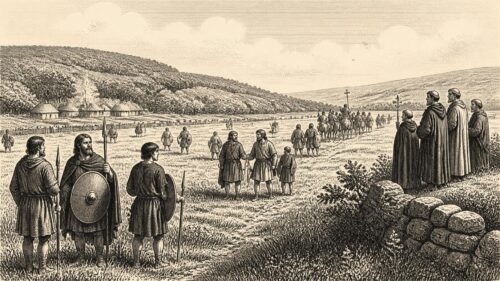
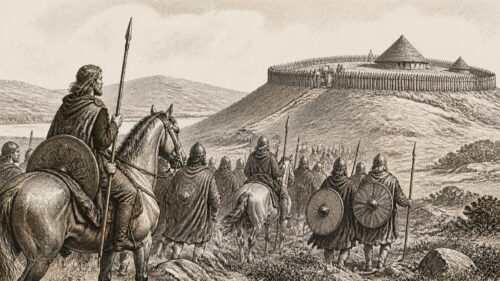
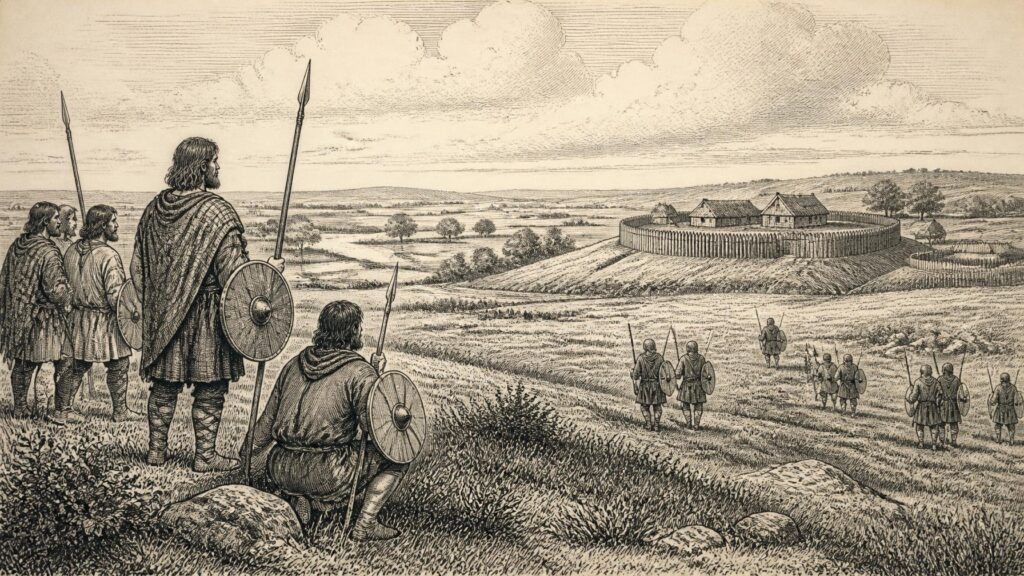
The principal political event was the battle of Ard Ciannachta. The Annals of Ulster say that Ailill son of Dub dá Crích, described as king of Ard Ua Cinn Fháelad, fell there. It then records the death, in a counter-attack, of Domnall son of Cináed, whom it calls “the king who had previously been victorious”. Tigernach supplies an important additional detail: Dúngal son of Amalgaid was the victor. The sources do not provide a date, a cause of war, troop numbers or a full account of the manoeuvres. Still, their agreement on the reversal in the fighting makes the battle a rare glimpse of how swiftly a local victory could become disaster.
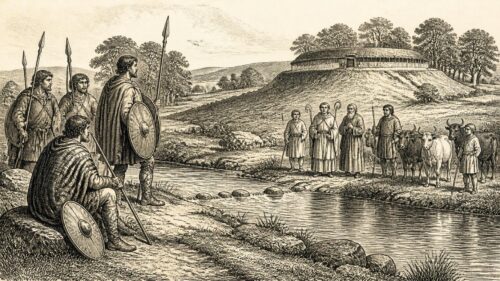
Ard Ciannachta was a small but strategically meaningful polity on the eastern approaches to the midlands, north of the Boyne and near the Irish Sea. Its position placed it amid the competing interests of Brega’s powerful kindreds. Dúngal belonged to the Uí Chonaing of Cnogba, centred on Knowth, while the Ciannachta had long faced pressure from neighbouring Brega dynasties. It would be unsafe to turn the annal’s bare report into a detailed conquest narrative. Yet Dúngal’s named victory and the deaths of Ailill and Domnall show that the contest mattered to several ruling families, not merely to one isolated district.
The wider political setting gives the struggle additional weight. Domnall Midi of Clann Cholmáin was king of Tara in 749 and was consolidating a new balance of power among the southern Uí Néill. His reign did not erase local kingship: Brega, the Ciannachta, Mide and the many smaller peoples retained their own rulers, rivalries and military followings. Ard Ciannachta’s battle accordingly illustrates the limits of any simple picture of a united kingdom. A ruler at Tara could be pre-eminent without directing every conflict along the Boyne or deciding every succession.
A Killing in Ulaid
In the north-east, Cathusach son of Ailill, “king of the Cruithin”, was killed at Ráith Beithech. The title reflects the language used by the annalists for the Dál nAraidi and related peoples of eastern Ulster; later historical writing often identifies Cathusach as a ruler within the shifting kingship of Ulaid. The entry calls his death a killing, while Tigernach uses the stronger word “murder”. Neither account names the assailants or offers a motive. It is therefore reasonable to recognise a violent change in leadership, but not to attribute it confidently to a named rival dynasty or a planned coup.
The loss of Cathusach reminds us that royal power rested on vulnerable personal networks. Kings led warbands, maintained alliances, dispensed food and prestige goods, and defended claims to tribute and territory. Their deaths could unsettle more than a household. They affected clients, ecclesiastical partners and competing branches of a lineage, especially in regions such as Ulaid where kingship was contested among several dynasties. Yet 749’s sources preserve the fact of Cathusach’s death rather than its aftermath. Silence about a successor is not evidence that succession was peaceful.
Fires at Religious Centres
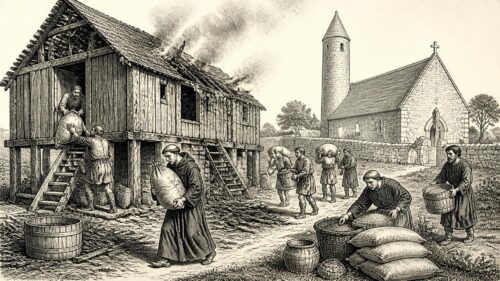
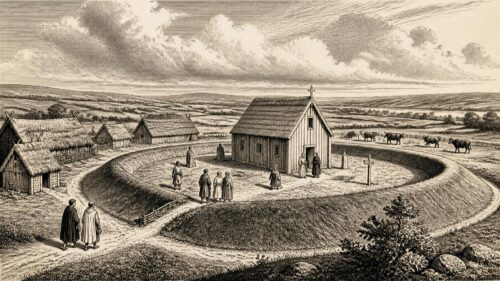
Two religious sites were recorded as burned. One was Cluain Ferta Brénainn, Clonfert, the important Shannon-side foundation associated with St Brendan. The other was Cell Mór of Aedán son of Aengus, a place named in the annal without a securely supplied location or explanation. Fire was a serious danger in settlements where churches, dwellings, storehouses, workshops and boundary structures commonly relied heavily on timber, thatch and other combustible materials. A burning could destroy books, food reserves, tools and housing even if a church community survived.
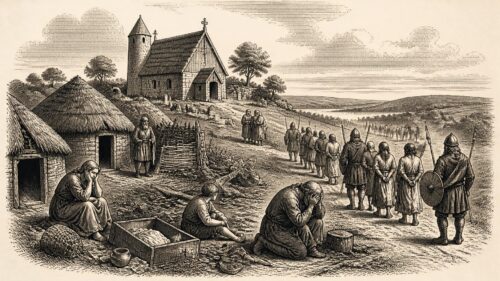
Neither annal identifies an attacker at Clonfert or Cell Mór, and neither should be presented as evidence of a raid. Accidental fire, deliberate local violence and other causes remain possible. At Clonfert, archaeological and later historical evidence confirms a long-lived ecclesiastical landscape rather than a single building: a church, burial ground, enclosure and dependent activity would have made up the institution. The notice of burning thus records a disruption to a community whose religious, agricultural and social functions extended well beyond worship. It does not tell us the scale of damage, the number of casualties, or how quickly rebuilding began.
Abbeys, Learning and Loss
The annals also note the deaths of Bresal son of Colgu, abbot of Ferns; Liber, abbot of Mag Bile, or Movilla; and Conall, abbot of Tuaim Gréine. These were not interchangeable clerics. Major monasteries were landholders, places of hospitality, schools of Latin learning, workshops and centres of memory as well as religious communities. Their abbots could belong to influential families and might exercise authority over tenants, clients and subsidiary churches. The passing of an abbot therefore mattered to a wider district, even when the annal grants him only a line.
Tigernach adds other deaths, including Ailill grandson of Daimine, king of Uí Maine, the sage Mac Cuanach and Segene of Clárach. Such additions show both the breadth and the unevenness of annalistic preservation. The Annals of Inisfallen, for its part, records only the death of Conall of Tuaim Gréine under this year. Rather than treating the longer list as a complete national obituary, it is better to see several related traditions preserving different selections from a year of notable losses.
Iona and the Wind
One of the bleakest notices is the “drowning of the community of Í”, Iona. The wording is stark. It does not state how many people died, whether they were monks, lay dependants or travellers, or whether a boat foundered in a storm. The same annal records a great windstorm in association with several deaths, but it does not explicitly connect that wind to Iona’s tragedy. The two notices may suggest a hazardous maritime year; they cannot prove a single catastrophe. Iona was a Columban centre with deep links to Irish churches and ruling families, so any loss there was directly relevant to Ireland’s religious and political world.
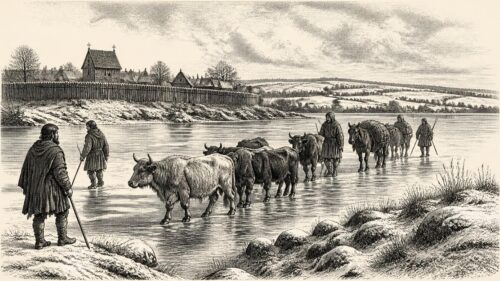
Sea crossings and river journeys were indispensable to that world. They carried people, news, books, food, animals and gifts between island, coast and inland monastery. They also exposed communities to sudden weather. The record of a great wind is not a climate history, and no harvest failure is securely reported for 749. It nevertheless offers a small, immediate reminder that wind and water could interrupt communications, threaten boats and inflict losses which even prestigious institutions could not prevent.
Ships Above Clonmacnoise
The year closes in the annalistic imagination with an extraordinary report: ships with their crews were seen in the air above Clonmacnoise. This should not be retold as a literal aerial event. It is a reported prodigy, preserved because a monastic chronicler considered it meaningful. Early medieval annals sometimes recorded eclipses, comets, strange weather and visions alongside political events, placing human conflict within a providential and unsettling cosmos. Whatever people actually saw—cloud, mirage, dream, story or an image shaped in recollection—the entry demonstrates the cultural authority of Clonmacnoise as a place where a marvel was worth recording.
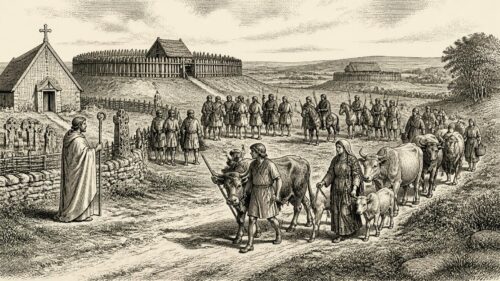
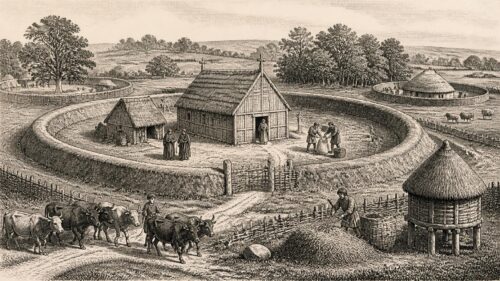
For most inhabitants, 749 was not experienced through annal headings. Families worked fields and managed cattle from dispersed rural settlements, travelled to churches and assemblies, and depended on fragile stores, buildings and kin ties. Yet the events the annals selected would have had practical consequences: warfare could alter obligations and security; a royal killing could rearrange patronage; a monastery fire could displace workers and worshippers; and deaths at abbeys could change control of land, learning and hospitality. The evidence cannot recreate every household’s experience, but it firmly shows that Ireland’s political and ecclesiastical landscape was neither settled nor insulated from environmental risk.
749 CE therefore stands out not for a single island-wide campaign, but for a cluster of reversals. At Ard Ciannachta, a counterstroke transformed victory into death. In Ulaid, a king was slain. At Clonfert and Cell Mór, fire damaged institutions central to local life. Iona suffered an unexplained drowning, while Clonmacnoise acquired a portent in the sky. The annals leave many questions unanswered, but their sparse notices preserve a year in which power, faith and everyday security could be overturned with striking speed.
Primary Sources
- The Annals of Ulster, Year U749
- The Annals of Ulster: Full Text
- Annals of Tigernach, Annal T749
- The Annals of Tigernach
- The Annals of Tigernach: Editorial Declaration
- Annals of Inisfallen
- Annals of the Kingdom of Ireland by the Four Masters, Volume 1
- Chronicon Scotorum
- Domnall Midi
- Domnall mac Murchada: High-King of Ireland
- Clonfert Conservation Plan
- Clonfert
- Clonfert: Galway Community Archaeology
- Clonfert Cathedral, Excavations 2001
- Early Christian Monasteries
- Early Monastic Churches
- Early Irish Monasticism
- Ordinary People in Early Christian Ireland
- Christian Ireland, Fifth to Eighth Centuries
- The Annals in Cotton MS. Titus A. XXV, Part 3
- The Annals of Ulster, Year U691