Inis Cathaig Seized974 CE
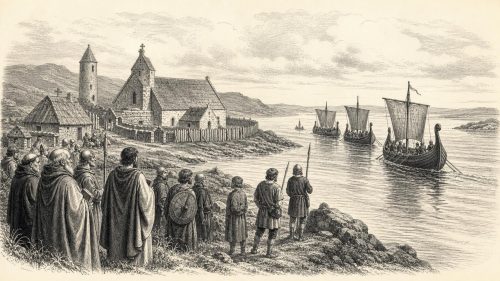
In 974, the son of Aralt led a large seaborne force to plunder Inis Cathaig in the Shannon estuary and capture Ímar, probably a Limerick Scandinavian leader. The island’s bishop and abbot, the learned Scandlán Ua hEirc, also died, though no link to the raid is recorded. The episode demonstrated the vulnerability and political importance of ecclesiastical centres. Meanwhile, Máel Muad challenged Mathgamain’s Munster authority through hostage-taking. Annals also report killings, expulsions and warfare in Ailech, Mide, Leinster and Osraige, revealing a politically fragmented Ireland where dynastic conflict, maritime power, churches and local communities were closely intertwined in this year.
Dateline
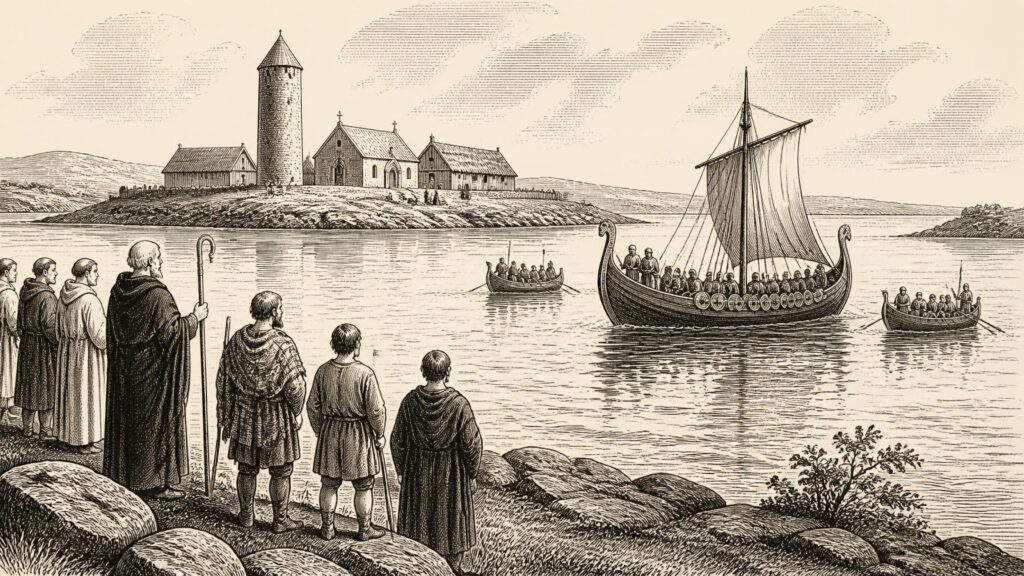
The most vivid Irish notice assigned to 974 concerns an island at the mouth of the Shannon. The Annals of Inisfallen record that the son of Aralt travelled around Ireland with a great company, plundered Inis Cathaig—Scattery Island—and carried Ímar away captive. The same annal also records the death of Scandlán Ua hEirc, described as both a learned bishop and abbot of the island. These are firmly dated annalistic notices, though they are brief. Together they make 974 a year in which a powerful ecclesiastical settlement, a Scandinavian ruler connected with Limerick, and maritime forces from the wider Irish Sea world abruptly met at one strategic place.
A Seizure on the Shannon
Inis Cathaig lay in the Shannon estuary, opposite the west Clare coast and below the river route to Limerick and Ireland’s midlands. Its position gave it religious prestige and practical importance. Founded, according to tradition, by Senán in the sixth century, it was a monastic community with churches, burial grounds and a resident clerical leadership. It also stood beside one of the greatest waterways in Ireland. Vessels moving between the Atlantic, the estuary and Limerick could not ignore it. The surviving archaeological landscape, although altered over many centuries, still conveys something of the island’s concentrated sacred and maritime character.
The annalist’s wording is striking. The attacker is not named personally, only as mac Arailt, ‘the son of Aralt’, and his force is called a great company. A later annalistic tradition identifies him as Maccus, son of Aralt or Harald, and says that he came with the lagmainn of the islands. That identification is widely accepted as plausible, but the contemporary-looking Inisfallen notice itself does not supply the personal name or the composition of the fleet. The safest conclusion is that a leader from the Norse-Gaelic Irish Sea zone arrived with a substantial seaborne following and possessed sufficient force to violate the island sanctuary.
Ímar was taken from Inis Cathaig alive. The later tradition styles him lord of the foreigners of Limerick, while the Inisfallen annal simply names him. His presence on the island may suggest that he had sought shelter there, but the annal does not explicitly say so, and it should not be turned into a certainty. What is certain is that capture at a monastery was politically charged. A church was not outside secular struggle: it could provide refuge, prestige, wealth, communications and a meeting point for rulers. Carrying a prominent man away from such a place was an assertion of command over both people and sacred space.
Church, Learning and Vulnerability
Scandlán Ua hEirc’s obituary gives the other side of Inis Cathaig’s importance. He was a bishop, an abbot and a learned man. In tenth-century Ireland these offices could overlap. Major churches were not merely places of worship run apart from society; they were communities of clergy and dependants, centres of landed resources, hospitality, literacy and commemoration, and participants in regional politics. To call Scandlán ‘learned’ indicates a standing within the intellectual culture sustained by such churches: the world of Latin learning, ecclesiastical memory, legal knowledge and the writing or preservation of texts.
His death cannot responsibly be connected in the sources to the raid. The annals place both notices in the same year but give no cause, sequence or explanation. Nor can the surviving round tower and stone churches on the island simply be imagined as the exact buildings seen in 974: parts of the visible complex belong to later phases. Yet the location itself was already an established ecclesiastical centre, and the pairing of seizure and obituary captures a real tension. Religious institutions could shelter powerful individuals and safeguard learning, but their stores, status and waterside sites also made them exposed in war.
The taking of Ímar also shows why ‘Viking’ and ‘Irish’ are inadequate opposites for this period. By 974, Scandinavian-speaking and Norse-Gaelic groups had long been embedded in Irish political and commercial life. Limerick was a Hiberno-Scandinavian port and power centre, while the attackers belonged to the interlinked sea routes of the Isles, western Britain and Ireland. Alliances and enmities crossed linguistic, religious and ethnic boundaries. The source calls the event a plundering, and later tradition condemns it as an outrage against Senán; nevertheless, it was also a calculated intervention in the balance of power around Limerick and Munster.
Munster’s Unsettled Kingship
The Scattery raid occurred during a tense contest in Munster. Mathgamain mac Cennétig, king of Munster in the Inisfallen annals, had built his position through conflict with the foreigners of Limerick and with rival Irish dynasties. His brother Brian, not yet the later famous high king, belonged to the same Dál Cais kindred. In 974, however, the annal does not portray Mathgamain as securely dominant. It says that the son of Bran took the hostages of Munster from Limerick southwards and marched against Mathgamain.
Hostages were central instruments of lordship, not incidental prisoners. Their transfer signalled submission, constrained the loyalty of subordinate rulers and gave a claimant leverage in negotiations or war. The entry therefore points to a serious challenge to Mathgamain’s authority. The son of Bran was Máel Muad, a rival ruler of the Eóganacht associated with Desmond in later accounts; but the 974 notice does not describe the result of his march. It is important not to read the dramatic events of 976–978 backwards into this year. In 974, the evidence establishes a mobilisation of hostages and an advance against Mathgamain, not a final settlement of the Munster struggle.
For households in the region, such contests had consequences beyond royal courts. A hosting required food, animals, transport and armed service. The movement of hostages and the approach of rival forces could unsettle estates, churches and riverine settlements. The annals rarely describe the labour of cultivators, herders, boatmen or clerical tenants who bore these pressures. Still, the terms they use—hosting, plunder, captives and hostages—make clear that political rivalry drew upon resources extracted from local communities.
Killings Across the Island
Other annals make 974 appear turbulent far beyond Munster. The Annals of Tigernach and Chronicon Scotorum record the killing of Murchad Glún re Lár, overking of Ailech, by Cenél Conaill. Ailech, in the north-west, was a major Uí Néill power, while Cenél Conaill were its formidable northern rivals. The sources do not offer a battle narrative, location or motive. Even so, the death of an overking at the hands of a neighbouring dynastic people marks a consequential rupture in northern politics. It reminds us that no single Munster conflict defined Ireland in 974.
In the midlands, Chronicon Scotorum records a rapid and confusing sequence involving Mide. Domnall son of Muirchertach was expelled from its kingship by the sons of Áed, returned, and devastated churches and people who opposed him. The same annal records the killing of Muirchertach son of Áed, identified as king of Mide, by Domnall son of Congalach. These notices probably preserve episodes from a fast-moving contest among branches of the southern Uí Néill and neighbouring Brega. They should not be forced into a neat linear story, but they plainly show that control of Mide remained disputed and that churches as well as lay populations could suffer in the struggle.
The killing of Donnchad Finn, son of Áed son of Flann, carries an especially revealing qualification. Both Tigernach and Chronicon Scotorum say that he was killed treacherously while under the protection of Bernán and Ciarán. The precise institutional setting is not explained, but the language of protection matters. Ecclesiastical guarantees and saintly patronage had moral and political weight. To break such protection was not simply homicide; it was a public breach of a recognised safeguard. Annalists recorded these violations because they measured the disorder of kingship against obligations owed to churches, saints and guests.
Leinster and Osraige also saw fighting. The annals report a defeat inflicted on Uí Chennselaig by the Osraige, with the death of Donnchad son of Cellach, king of Uí Chennselaig, and other nobles. Tigernach additionally preserves a defeat of Osraige by the men of Leinster, in which Diarmait son of Donnchad fell. These compressed reports may relate to connected campaigning, but the sources do not allow the course of operations to be reconstructed. They do establish that the Leinster–Osraige borderland was another arena where local kingship could be violently renegotiated.
An Island of Rival Powers
There is no evidence for an island-wide government directing events in 974. Ireland was a landscape of overkingdoms, regional dynasties, church federations and port polities, tied together by kinship, tribute, learning, pilgrimage and sea travel as much as by force. The deaths of rulers in Ailech, Mide, Leinster and Ulaid, the struggle for Munster, and the maritime seizure at Inis Cathaig belong to that fractured but connected political world. The same annals that preserve warfare also preserve ecclesiastical obituaries, because clerics and churches were indispensable actors within it.
What 974 most securely offers is not a single national turning point but a sharply observed cross-section of late tenth-century Ireland. At Scattery, a fleet showed that the Shannon was open to power projected from the Irish Sea. In Munster, hostages demonstrated that Mathgamain’s ascendancy was contested. In the north and midlands, killings and expulsions exposed the instability of royal succession. At the same time, the notice for Scandlán Ua hEirc recalls the learned communities through which memory of these events was preserved. The year’s surviving record is sparse, but it is enough to show an Ireland in which sacred islands, river ports and royal territories were all contested ground.
Primary Sources
- Annals of Inisfallen: Annal AI974
- CELT Project: Annals of Inisfallen
- Chronicon Scotorum: Annal CS974
- Chronicon Scotorum: Irish Text, Annal CS974
- Annals of Tigernach: Annal T974
- Annals of Tigernach: Translation Edition
- Annals of the Four Masters: Annal M974
- The Annals of Ulster: Year U975 (AD 974 alias 975)
- CELT: Irish Texts and Annalistic Sources
- CELT: List of Published Texts
- Donnchadh Ó Corráin, Vikings in Scotland and Ireland in the Ninth Century
- Colmán Etchingham, Vikings in Early Medieval Ireland: Catalogue of Viking Raids on Irish Churches in the Annals, 795–1015
- Brian Boru Lecture Series: New Viking Forces Active in Limerick and the Hebrides in the 970s
- M. R. Davidson, Medieval Irish Chronicles Reveal
- Clare Downham, Medieval Ireland
- The Cambridge History of Ireland, 600–1550
- Francis John Byrne, Irish Kings and High-Kings: Nation and Kingship in Ireland
- Laurence Dunne, 2001:095—Scattery Island, Clare
- Heritage Ireland: Scattery Island Monastic Site and Visitor Centre
- Clare Libraries Local Studies: Scattery Island—The Monastic Settlement
- Clare Libraries Local Studies: Islands—Scattery Island
- Viking Ship Museum: Limerick—The Viking Ship Museum
- Cork Open Research Archive: Theme and Variations—Christianity and Regional Landscapes in Early Medieval Ireland
- Trinity College Dublin: Transformation from Pre-Norman Monasticism to the Introduction of the Religious Orders in Ireland