Start Exploring
Choose a route into Ireland’s past: follow the newest additions, find a particular year or subject, or browse every available period.

Day By Day
Welcome to Emerald Archives, where Ireland’s past awaits discovery. Our homepage brings you the latest additions to our growing collection, from remarkable people and historic places to pivotal events and forgotten traditions. Browse our newest discoveries and follow the archive’s progress day by day.
Deep Research
When you ask, we listen and respond. Enter a question about any aspect of Irish history in our search box (above) to initiate Deep Research. Give us a few moments, and we’ll prepare a detailed, illustrated article with sources and citations to answer your question. Your article becomes a permanent part of Emerald Archives.
Editorial — How People Came Together
Archived: 22 November 2026
In today’s issue we look at how people came together to shape Irish history. We begin with the annals, where royal feasts, contested battles and the passing of church leaders survive in a few chosen lines. The writers sometimes disagree, and their differences help us see how the record was made. We then turn to people who left a more detailed trail through schools, families, workplaces and local societies. Their stories take us from the workshops and printing rooms of Dublin to Limerick, Cork and beyond, showing how practical skills and personal connections helped sustain movements for change in Ireland. Willie Pearse’s sculpture, Thomas MacDonagh’s teaching and literary interests, and the work of women such as Helena Molony, Rosie Hackett and Kathleen Lynn bring different kinds of contribution into view. Elsewhere, the lives of Dan Breen and Tom Barry lead into the War of Independence, while the Treaty papers show political negotiation taking shape. These stories meet in the theme of organisation. Someone had to arrange a gathering, print an argument, share a skill or bring people to a meeting. Follow the links within the editorial to see how each article pieces together the places and people behind those choices.
Tom Barry
Archived: 22 November 2026
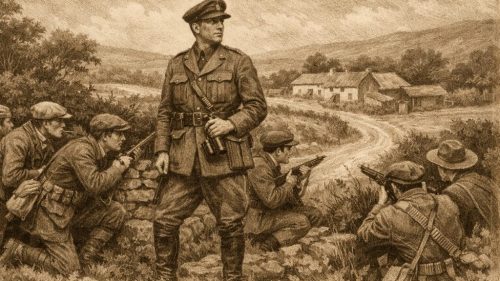
Tom Barry appears in archival and historical records as an Irish Republican Army commander connected with west Cork operations during the War of Independence. The archive record held by Cork City and County Archives identifies Barry as officer commanding the 3rd (West Cork) Brigade of the Irish Republican Army, and says that he later became Chief of Staff of the IRA. The same description notes manuscript material for his booklet, including copybooks that were written and corrected by Barry and then copied by his wife, Leslie Mary. University College Cork’s Irish Revolution material states that on 28 November Barry led an IRA party that ambushed a two-vehicle Auxiliary police convoy near Kilmichael.
Duma Aichir — Bri Ele
Archived: 22 November 2026
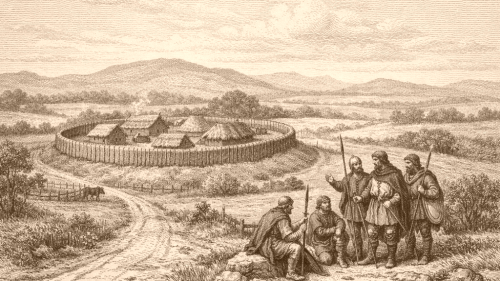
The surviving annals for 468 CE are sparse but not empty. The Annals of Ulster record the death of Bishop Isserninus and the battle of Duma Aichir; the Annals of the Four Masters give a different but related battle notice for the same year; and the Annals of Inisfallen and Chronicon Scotorum preserve nearby notices that help show how unevenly this period is transmitted. The evidence supports a cautious account of an annalistic year marked by brief entries and some chronological uncertainty.
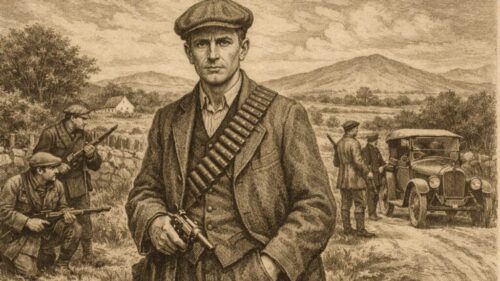
Dan Breen
Archived: 22 November 2026
Early Life Dan Breen was born in Donohill, South Tipperary, in 1894. He grew up in poverty, and his father died young. He was working by the age of 11, and by 1913 he was working on the railways. During the 1913 Labour Lockout, he was in Dublin, where the events around him helped shape his political outlook. A later documentary account also says that he joined the Irish Republican Brotherhood in 1912, and that Sean Treacy swore him in. Soloheadbeg Action Breen later remembered his frustration that there was no uprising in Tipperary in 1916.
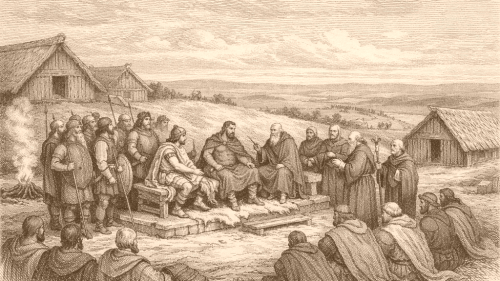
Temair Feast
Archived: 22 November 2026
The annal excerpts for 469 CE cluster around a notice of the Feast of Temair or Temuir associated with Ailill Molt, but they do not all place it in the same year. Annals of Ulster explicitly assigns the notice to 469 while also preserving an alternative reading; Chronicon Scotorum and Annals of Inisfallen record the same festival notice without secure AD dating in the excerpted material; the Four Masters places related Ailill Molt material under 467 and 468 rather than 469.
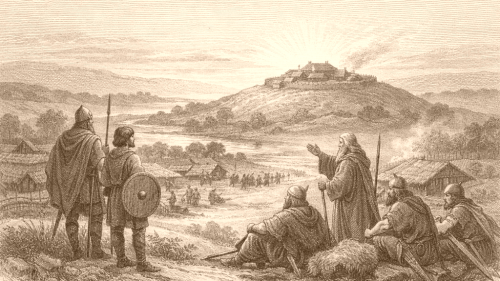
Duma Aichir — Sparse Coverage
Archived: 22 November 2026
The annals give only a sparse and uneven picture for 470 CE. One text places the Feast of Temair in that year, another records the battle of Dumha Aichir against Ailill Molt, and a third gives the same battle with Illann named as victor. A separate chronicle preserves only a bare chronological heading for 470, while its nearest narrative notice appears under 471. The result is a small cluster of notices with clear disagreement over placement.
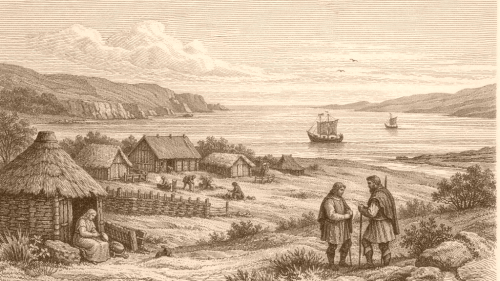
Saxon Prey
Archived: 22 November 2026
The annals preserved here give only brief notices for 471 CE. The Annals of Ulster and Annals of Inisfallen record the second taking of prey from Ireland by Saxons, while Chronicon Scotorum instead assigns that year a conflict at Brí Ele. The wording also shows uncertainty in the Ulster entry, which is attributed to alternative report and to a named authority.
Seán Russell
Archived: 22 November 2026
Seán Russell was born John Russell in Dublin in 1893. One source gives his birth date as 13 October 1893, and another places his birth in Fairview, Dublin. In the 1911 census he was 17 and working as a draper’s assistant. By then, the Russell family were living at 76 North Strand. Russell joined the Irish Volunteers in 1914. He fought in the Easter Rising with E Company of the 2nd Battalion, Dublin Brigade, and at the start of the rising he was appointed second-in-command to Oscar Traynor. Their group took over the Metropole Hotel as instructed by James Connolly.
Duma Aichir — Toca — Death
Archived: 22 November 2026
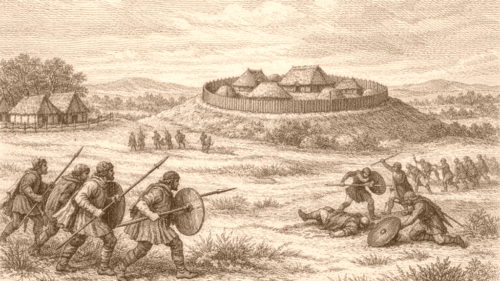
The surviving annal entries for 472 CE are sparse and uneven. Chronicon Scotorum records the battle of Dumagh Aicher as a Leinster victory over Oilill Molt; the Annals of the Four Masters record the death of Toca in Leinster; and the Annals of Ulster preserve only the year heading for 472 in the excerpt available here. Annals of Inisfallen offers a bare chronological marker for 472, while its nearby notices show how closely related entries can be placed under adjacent year headings without enough evidence to transfer them to 472 itself.
Seán MacBride
Archived: 22 November 2026
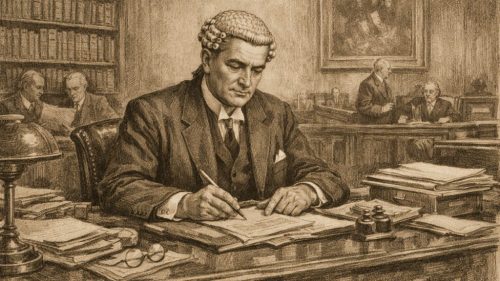
Early Life Seán MacBride was a republican activist, lawyer, and Clann na Poblachta politician. He was educated at Mount St Benedict’s College, Gorey and University College Dublin. One account says he arrived in Ireland in 1918 and, despite his youth, worked as a messenger for Sinn Féin and military leaders during the War of Independence. Political Career He was Chief of Staff of the IRA in 1936. He founded Clann na Poblachta in 1946. He was TD for Dublin County in 1947 and TD for Dublin South West from 1948 to 1957. He served as Minister for External Affairs from 1948 to 1951.
Duma Aichir — Dumagh Aicher
Archived: 22 November 2026
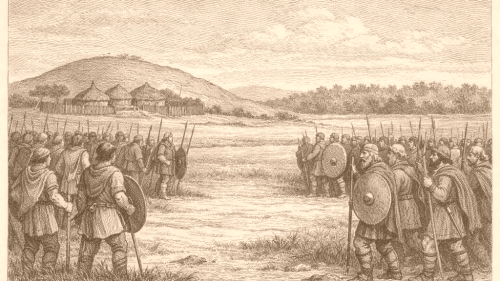
The surviving annals give only a narrow view of 474 CE. The Annals of Ulster place the battle of Duma Aichir in that year, naming Ailill Molt and the Laigin. The Annals of the Four Masters preserve the year 474 with other material, while Chronicon Scotorum places the same battle under 472, showing that the dating is not fully consistent across the record.
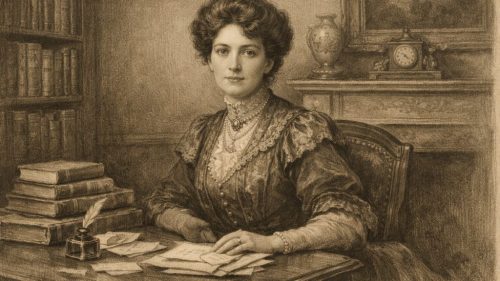
Molly Childers
Archived: 22 November 2026
Identity Molly Childers was Mary Alden Childers, née Osgood. Irish History Online gives her lifespan as 1875–1964, and also records her as Mary Alden Childers with a death year of 1964. The same record associates her with America and the United States. The entry identifies her as a person associated with the article “The American, Molly Childers and the Irish question,” by Anne Bunting, published in Éire-Ireland in 1988. Archival Record An archival description on the Irish Architectural Archive website notes correspondence of Molly Childers from 1894 to 1897, together with undated material.
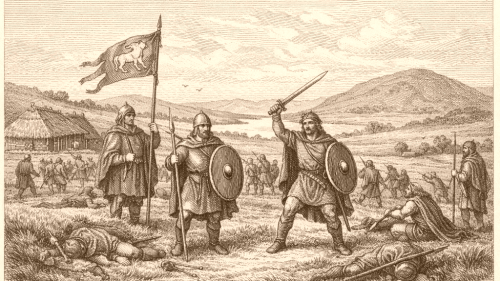
Brí Éile — Ulster Entry
Archived: 22 November 2026
The surviving excerpts for 475 CE are sparse and not fully aligned. The Annals of Ulster record a battle or mêlée at Brí Éile won by Ailill Molt over the Laigin, with an explicit note that the compiler found the entry in the Book of Cuanu. The Annals of the Four Masters preserve a different notice for 475, naming the death of Conall Crimhthann. The excerpted Chronicon Scotorum page shows the 475 heading, but no event is visible in the material provided here.
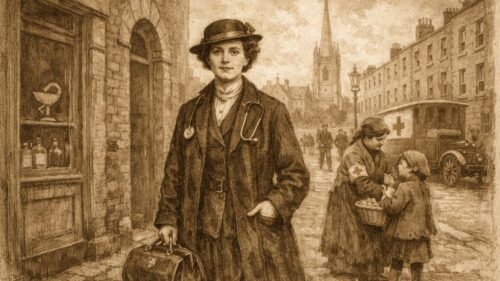
Kathleen Lynn
Archived: 22 November 2026
Kathleen Lynn was born in County Mayo and was the daughter of a Church of Ireland clergyman. She studied at the Catholic University Medical School and graduated from the Royal University of Ireland in 1899. By 1904 she was practising as a general practitioner from 9 Belgrave Road, Rathmines, and the same address later appears in records for 1911. Lynn’s medical work included private practice from her Rathmines home and service on the staff of several Dublin hospitals. She was refused a post at the Adelaide Hospital because of her gender, but later became a fellow of the Royal College of Physicians of Ireland.
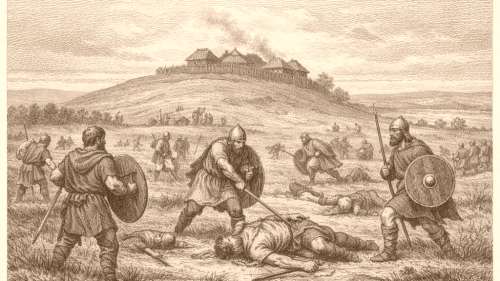
Granard Battle — Other Entries
Archived: 22 November 2026
The surviving annalistic notices for 476 CE are brief and varied. The Annals of Ulster records a battle of Duma Aichir against Ailill Molt by the Laigin; the Annals of the Four Masters records a battle at Granard in which Fraech, king of Leinster, fell; and Chronicon Scotorum records the death of Conall Crimhthann. The year is explicitly headed in the excerpts, but the notices do not describe a single shared event.
Mary Perolz
Archived: 22 November 2026
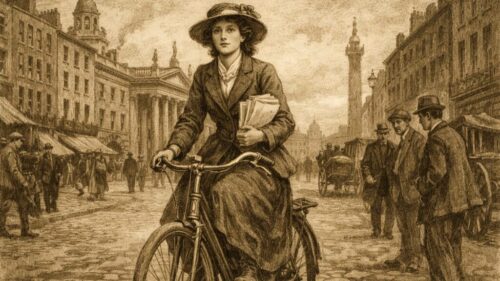
Mary Perolz was born in Market Alley, Limerick, on 7 May 1874. Her father, Richard Perolz, was a Dublin-born Protestant printer of French Huguenot origin, and the family later moved to Tralee and then to Cork city, where he worked on the Cork Examiner. She was educated by the Mercy sisters in Tralee and by the Presentation sisters in Cork and Dublin. Perolz joined the Gaelic League and became an early member of Inghinidhe na hÉireann in 1900. She taught history and Irish in classes organised by the organisation and acted in theatrical productions, including the first Dublin staging of Eilís agus an Bhean Deirce in December 1902.
Brí Éile
Archived: 22 November 2026
The surviving annal excerpts for 478 CE are sparse but not empty. The Annals of Ulster record a battle of Brí Éile under an explicit 478 heading, while the Annals of the Four Masters place a battle of Ocha in 478 and Chronicon Scotorum preserves only a bare 476 death notice followed by year headings in the retrieved passage. Taken together, these excerpts show a year with one clear Irish battle notice in one source, a different battle notice in another, and limited evidence for what each text preserves or omits.
Winifred Carney
Archived: 22 November 2026
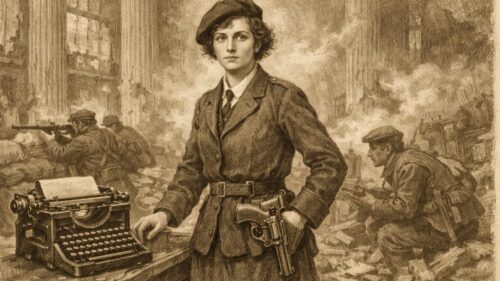
Early Life Winifred Carney was born in County Down in December 1887. Her father was Alfred Carney, a commercial traveller and Protestant, and her mother was Sarah Carney, née Cassidy, a Catholic. After her parents separated in her childhood, her mother supported the family by running a shop on the Falls Road in Belfast. Trade Union In 1912 Carney became secretary of the Irish Textile Workers’ Union in Belfast. During the Dublin Lockout of 1913 she took part in fundraising in Belfast for workers affected by the dispute.
Conall Cremthann
Archived: 22 November 2026
The annals for 480 CE are sparse and uneven. The Annals of Ulster and the Annals of Inisfallen record the death of Conall, son of Cremthann, son of Niall; the Annals of the Four Masters also give 480 an entry for the second year of Lughaidh and a battle at Granard in Leinster; Chronicon Scotorum preserves no detailed entry in the excerpted 480 line, but it places the major battle of Ocha in 482. The surviving notices therefore show a thin and partly discrepant annalistic record rather than a single securely dated narrative of events.
Rosie Hackett
Archived: 22 November 2026
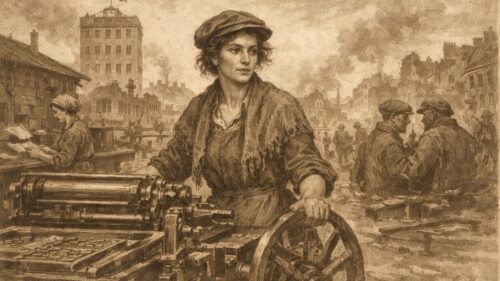
Rosie Hackett, christened Rosanna, was born in Dublin in 1892. She was living with her mother and sister in a tenement building on Bolton Street in 1901, after her father died when she was young. As a teenager, she worked as a packer in a paper store and later as a messenger for Jacob’s Biscuits. She joined the Irish Transport and General Workers Union in 1909. On 22 August 1911, she helped to galvanise and organise more than 3,000 women working in the factory, and they won better working conditions and increased pay.
Iarlaithe Repose
Archived: 22 November 2026
The annals preserved here give 481 CE a small but clear cluster of notices. All three Irish works cited record the death or repose of Iarlaithe of Armagh, while the Annals of Ulster also add a Roman ecclesiastical notice and a chronological statement for the year. The surviving excerpts do not securely place a major Irish battle in 481; nearby battle entries are dated differently and, in one case, explicitly presented as an alternative dating.
Helena Molony
Archived: 22 November 2026
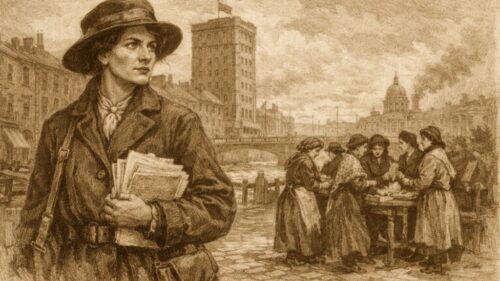
Helena Molony was born in Dublin in 1883. She joined Inghinidhe na hÉireann in 1903 after hearing an address by Maud Gonne, and she helped Gonne launch Bean na hÉireann, Ireland’s first women’s periodical. By 1908, Molony had become secretary and editor of Bean na hÉireann. She worked at the Abbey Theatre and appeared in support of suffrage and other political campaigns. In 1915, she became general secretary of the Irish Women Workers’ Union. Molony was also a very active member of the Irish Citizen Army. During Easter Week 1916, she assisted in establishing first-aid stations and overseeing provisions in Liberty Hall.
Battle Ochae
Archived: 22 November 2026
The surviving annals do not give a single, perfectly consistent date for the battle of Ochae. The Annals of Ulster and Chronicon Scotorum place the battle under 482, while the Annals of the Four Masters place a related battle notice under 480 and the Annals of Inisfallen links a battle notice to 482/483 with a different place-name. These entries also preserve varying lists of participants and a note of chronological uncertainty.
Archived: 22nd November 2026
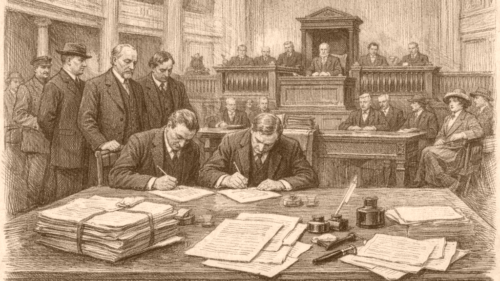
Treaty Constitution
The 1921 Anglo-Irish Treaty was turned into Irish law through the Constitution of the Irish Free State (Saorstát Éireann) Act, 1922. That act enacted a constitution, gave the treaty the force of law, and required the new state’s constitution to be read with the treaty. The resulting constitution proclaimed the Irish Free State, placed it within the British Commonwealth, and stated that government authority derived from the people.
Elizabeth O’Farrell
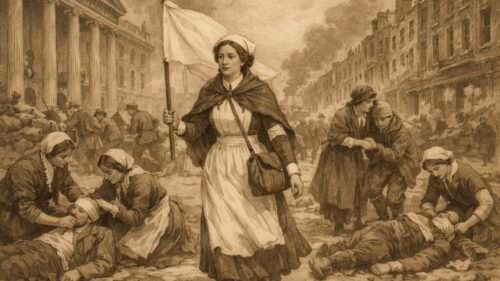
Archived: 22 November 2026
Elizabeth O'Farrell was born in Dublin in 1884. The 1901 census recorded her family at 9.1 Mark's Lane in Trinity, Dublin, with her father Christopher, a dock labourer, her mother Margaret, a housekeeper, and her sister Bridget, aged 19. The household was recorded as Farrell rather than O'Farrell. Elizabeth was the only person in the home who was proficient in Irish and English. She was educated by the Sisters of Mercy and trained as a nurse and midwife at the National Maternity Hospital, Holles Street, Dublin. The 1911 census recorded her as 27 and again noted that she was proficient in Irish and English.
