Castlepook Faunal Assemblage31967 BCE
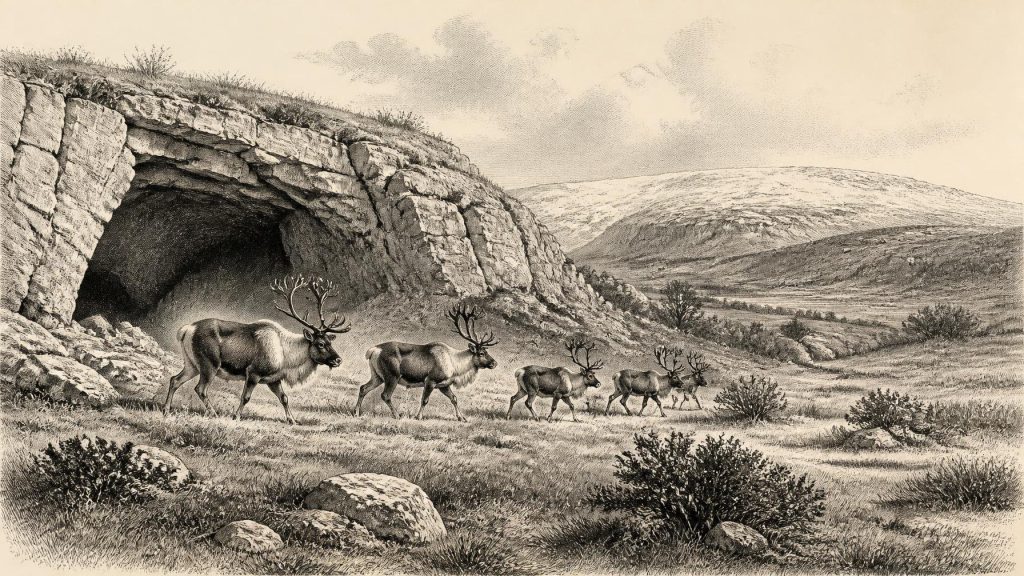
At roughly 31,967 BCE, Ireland was a climatically unstable Late Pleistocene landscape approaching expanded glaciation, rather than uniformly ice-covered. Lower sea levels reshaped coasts and connections with Britain, though no specific land route or migration can be demonstrated. Castlepook Cave, County Cork, preserves Ireland’s richest pre-Last Glacial Maximum vertebrate assemblage, including reindeer, mammoth, giant deer, hyena, wolf, Arctic fox and lemmings. Its bones accumulated over long periods and reflect carnivore activity as well as natural processes. A marked reindeer femur may indicate early human butchery, but remains unconfirmed. Evidence supports intermittent fauna and possible human visits, not permanent occupation then.
Dateline
The label 31,967 BCE is useful for ordering a long chronology, but it cannot describe a known Irish “year” in the ordinary historical sense. No written records, named individuals, dated settlements or year-specific events survive from this depth of time. In archaeological terms, it denotes a point roughly 33,900 calibrated years before 1950, within the Late Pleistocene. Even that conversion should not be mistaken for calendar precision: radiocarbon results are expressed as probability ranges after calibration, and the evidence available for Ireland belongs to spans of centuries or millennia.
A Land Before the Ice Maximum
Ireland at this point lay in the later part of Marine Isotope Stage 3, a prolonged cold phase within the last Ice Age. It was not yet the fullest extent of the last British–Irish Ice Sheet, whose major growth across the Irish and British region occurred later, especially between about 31,000 and 26,000 years ago. The familiar Last Glacial Maximum is generally placed much later, around 26,000–19,000 years ago. It is therefore misleading to picture all of Ireland in 31,967 BCE as buried beneath a single, static mass of ice. Ice cover, snowfields, permafrost, vegetation and coastlines changed markedly between regions and through time.
The best large-scale reconstruction suggests that, around 31,000 years before present, the British–Irish Ice Sheet was growing rather than fully developed. It was probably restricted to parts of Ireland and Britain before expanding over continental shelves. Such reconstructions are necessarily broad: they combine landforms, marine sediments, exposure ages and models, rather than offering a detailed map for every century. For the date in question, the responsible conclusion is that Ireland was a severe, climatically unstable northern landscape approaching a more extensive glacial phase, not a landscape whose every valley can be assigned a certain ice margin.
Coasts and Changing Connections
Global sea level was substantially lower than today because immense quantities of water were locked in continental ice sheets. Modelling for approximately 31,000 years before present indicates relative sea levels in the British–Irish region some 50–100 metres below modern levels, although local effects varied as the weight of ice bent the Earth’s crust. The coastline was consequently unlike the modern Atlantic island shore. Wider plains existed around parts of the continental shelf, and the Irish Sea basin had a different form.
Lower water does not, however, license a simple assertion that people or animals walked freely from Britain into Ireland in 31,967 BCE. Whether a continuous terrestrial route existed depended on local sea level, crustal movement, river channels, topography and advancing ice; these conditions also changed through the Ice Age. The evidence supports a changing physical relationship between Ireland, Britain and the exposed north-west European shelf. It does not yet document a particular crossing, route or migration in this putative year.
What the Caves Preserve
Most evidence that illuminates this remote Irish past comes not from open-air camps but from cave deposits and old museum collections. Castlepook Cave, near Doneraile in north County Cork, is especially important. Geological Survey Ireland describes it as the richest known Irish site for vertebrate fauna in the long period before the Last Glacial Maximum. Excavations conducted between 1904 and 1918 recovered more than 2,000 bones, while areas left undisturbed retain considerable research potential.
The cave assemblage demonstrates that a varied cold-climate mammal community reached Ireland during the middle and later Ice Age. Identified remains include reindeer, giant deer, woolly mammoth, brown bear, spotted hyena, wolf, Arctic fox and lemmings. This is powerful evidence against any notion of an entirely lifeless Ireland. Yet it is crucial not to turn the site’s species list into a single illustrated scene dated to 31,967 BCE. The bones accumulated across a very long interval—published dates from Castlepook range from about 45,700 to 19,950 radiocarbon years before present—and may have been brought in by carnivores, water and other processes.
Modern re-dating has transformed the chronology. Improved collagen preparation, including ultrafiltration, showed that several older Irish cave dates had underestimated the antiquity of the material. Work on Castlepook, Foley and Shandon caves indicates a significant Irish fauna during Marine Isotope Stage 3, and suggests that some animals, notably giant deer and spotted hyena, disappeared locally before the later ice maximum. The result is a stronger basis for reconstructing Ice Age ecosystems, but also a warning that dates and interpretations can change as techniques improve.
Climate, Animals and Habitat
The animal record points to open, cold environments rather than the wooded Ireland of later millennia. Reindeer and lemmings are particularly informative indicators of harsh conditions; mammoth and giant deer belong to the wider Pleistocene large-mammal world. Open grassland, herb-rich steppe-tundra, sparse shrubs and exposed mineral ground are plausible elements of the landscape. Valleys, limestone lowlands and river corridors may have offered different resources from uplands or glaciated tracts. But Ireland has a thin surviving environmental record for this exact age, partly because later ice repeatedly eroded, redistributed and buried older deposits. These habitat descriptions are informed reconstructions from fauna, regional climate evidence and comparable north-west European environments, not a direct pollen map for 31,967 BCE.
Predators mattered. Castlepook was not simply a natural archive into which animals wandered to die: its fauna and the condition of many bones indicate carnivore use. Hyenas could drag carcass parts into caves, consume them and leave fragmented assemblages; bears, wolves and other agents complicate the story further. This is why archaeological interpretation must distinguish a bone’s date from the date of its arrival in a cave, and animal damage from human modification. Caves offer rare preservation, but they are palimpsests rather than sealed time capsules.
The Question of People
There is a potentially momentous, but not yet fully settled, human dimension to Castlepook. A reindeer femur fragment from the cave has been reported as bearing deep marks consistent with butchery by a stone tool and as dating to roughly 33,000 radiocarbon years before present. If the marks are securely confirmed as human-made, they would push evidence for human activity in Ireland far back into the Upper Palaeolithic. That claim must be expressed carefully. The scientific re-dating of the cave’s fauna is published, but a full peer-reviewed technical publication of the human-modification case has remained awaited; the old excavations also left imperfect contextual records.
Accordingly, the femur is best described as candidate evidence for a very early human visit, not proof of a resident Irish population in this exact year. There is no securely dated house, hearth, lithic assemblage, burial or human skeleton from Ireland around 31,967 BCE. Nor can a butchered animal bone alone reveal the size, language, ancestry, seasonality or social structure of those who may have handled it. It may indicate a brief episode of carcass processing by mobile hunter-gatherers, perhaps connected to the exploitation of reindeer; it cannot establish a permanent settlement.
This distinction matters because the clearest evidence for repeated human occupation of Ireland belongs far later, after the major ice retreat. Terminal Pleistocene evidence from County Clare has generated debate of its own, while early Holocene hunter-gatherer settlement is far better represented. Absence of evidence at 31,967 BCE is partly an archaeological problem—glacial erosion, sea-level change and limited excavation have erased or submerged likely sites—but it remains absence of evidence. It should not be filled with invented camps, tribal territories or migrations.
No Politics, but a Human World Beyond Ireland
Political affairs, diplomacy and organised warfare cannot responsibly be recovered for Ireland at this date. There were no states, named polities, inscriptions or monuments from which to infer them. Likewise, there is no Irish evidence for religious rites, formal learning, art, farming, metalworking, trade networks or built villages. Agriculture lay tens of millennia in the future. If people did enter the island, their material economy would have depended on knowledge carried in bodies and tools: finding game, assessing weather, processing meat and hides, maintaining stone equipment, sharing food and moving through a demanding terrain. Those are reasonable general inferences from Upper Palaeolithic lifeways elsewhere, not documented facts about a particular Irish group.
In this sense, the most important development around 31,967 BCE was environmental rather than political. Ireland was part of a changing north-west European Ice Age zone, populated at least intermittently by animals able to exploit cold open country and increasingly affected by advancing ice. Castlepook Cave in Cork preserves a fragmentary record of that world. It makes Ireland relevant to the deep history of Pleistocene fauna and raises the possibility of an unexpectedly early human presence, while also demonstrating why caution is indispensable.
A Responsible Snapshot
For this date, Ireland cannot be narrated as a calendar year of kings, battles or discoveries. It can be understood as an Ice Age landscape in transition: colder than today, physically reconfigured by lower seas and growing ice, and inhabited by a changing assemblage of mammals documented most vividly in southern Irish caves. The evidence supports a pre-Last Glacial Maximum fauna and a possible Upper Palaeolithic human encounter at Castlepook; it does not support certainty about continuous occupation or ordinary social history. Future excavation, dating and microscopic analysis may refine this picture. For now, the archaeological record’s greatest lesson is both dramatic and restrained: Ice Age Ireland was not empty, but its human story at this depth remains only a faint and contested trace.
Primary Sources
- A Reconsideration of the Radiocarbon Dating of the Marine Isotope Stage 3 Fauna from Southern Ireland
- The Irish Quaternary Fauna Project
- New Insights on the Fauna of Ireland's Younger Dryas and Early Holocene from Alice & Gwendoline Cave
- Growth and Retreat of the Last British–Irish Ice Sheet, 31,000 to 15,000 Years Ago: The BRITICE-CHRONO Reconstruction
- Last Glacial Maximum Cirque Glaciation in Ireland and Implications for Reconstructions of the Irish Ice Sheet
- Trimlines, Blockfields and the Vertical Extent of the Last Ice Sheet in Southern Ireland
- Advance and Retreat of the Marine-Terminating Irish Sea Ice Stream into the Celtic Sea During the Last Glacial: Timing and Maximum Extent
- Oscillating Retreat of the Last British-Irish Ice Sheet on the Continental Shelf Offshore Galway Bay, Western Ireland
- Dimensions and Chronology of the Last Ice Sheet in Western Ireland
- Early Deglaciation of the British-Irish Ice Sheet on the Atlantic Margin of Ireland
- The IntCal20 Northern Hemisphere Radiocarbon Age Calibration Curve (0–55 cal kBP)
- Marine20—The Marine Radiocarbon Age Calibration Curve (0–55,000 cal BP)
- Castlepook Cave
- Quaternary
- Ireland Through Geological Time
- Archaeological Heritage of County Cork
- Heritage Artefacts of County Cork
- Archaeology Research Excavation Grant 2022: Final Report
- Castlepook Cave, Co. Cork: Excavations 2022
- The Mesolithic in Ireland: When Was It?