Before the Ice Maximum31966 BCE
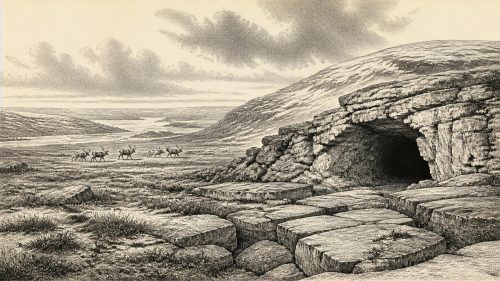
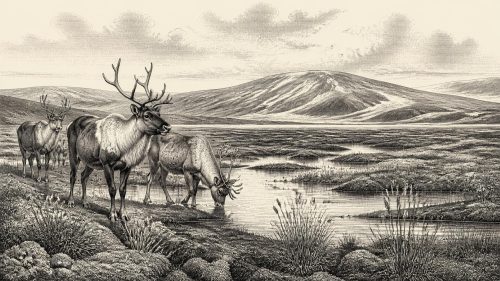
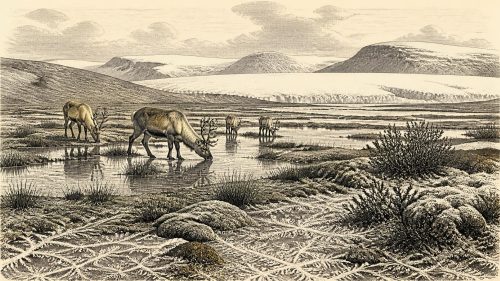
Around 31,966 BCE, Ireland lay in the unstable later Marine Isotope Stage 3, before the fullest advance of the Last Glacial Maximum. Sea levels were lower, coastlines and possible routes changed, and expanding ice later destroyed much evidence. Southern caves, especially Castlepook, preserve remains of reindeer, mammoth, giant deer, bears and hyaenas, indicating cold, open mosaic habitats. A cut-marked reindeer femur, dated about 33,000 years ago, may record an early hunter visit, but lacks archaeological context or settlement evidence. No peoples, polities, beliefs or permanent communities can be identified. Knowledge relies on radiocarbon dating, faunal analysis, stratigraphy and ice-sheet reconstruction.

Dateline
The label 31,966 BCE should not be mistaken for a date at which Ireland can be described year by year. No written records, rulers, settlements or securely dated events survive from this depth of time. In archaeological terms, it is a modern calendar shorthand for roughly 33,915 years before AD 1950, placing it in the later part of Marine Isotope Stage 3, a cold and climatically variable phase of the Late Pleistocene. Dates of this antiquity are normally reported as radiocarbon years before present or as calibrated ranges, not as precise BCE years. What can responsibly be reconstructed is an Irish landscape approaching the great cold of the Last Glacial Maximum, together with the exceptionally fragmentary traces left by animals, ice and perhaps occasional people.
A Cold, Changing Island
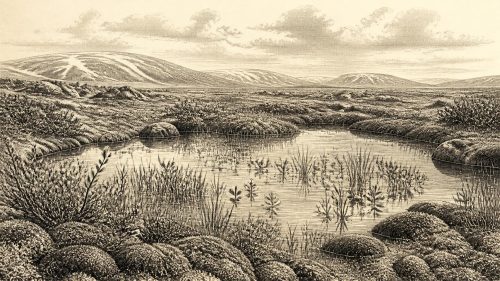
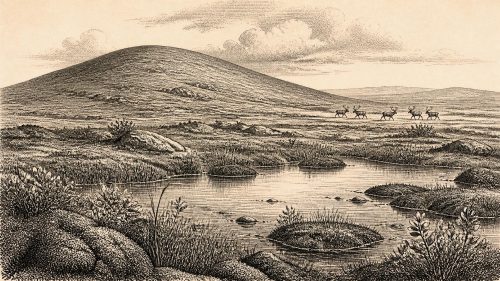
At this point Ireland was not the green, wooded island familiar today. It lay within the north-west European glacial world, exposed to severe climatic swings and profoundly altered sea levels. The Last Glacial Maximum proper came later: current syntheses place the last major advance of the Irish Ice Sheet broadly between about 27,000 and 23,000 calibrated years BP, although the timing and extent of ice varied markedly between regions. The British-Irish Ice Sheet was not a fixed white blanket that arrived everywhere at once. Its margins, flow routes and thickness altered over millennia, responding to climate, topography and the dynamics of fast-flowing ice streams.
Thus it would be wrong to state confidently that all of Ireland lay beneath continuous ice in 31,966 BCE. The date predates the clearest island-wide maximum. It belongs instead to the prolonged prelude to it: a period in which cold conditions, expanding upland and marine-based ice, exposed shelves and shifting coastlines made the geography of Ireland very different from the modern state. Later glaciation would reshape the land still further, carving valleys, depositing till and moraines, and eroding or burying earlier deposits. That destructive history is one reason evidence for human activity of this age is so scarce.
Lower global sea level exposed broad areas now submerged around Ireland and Britain. Yet exposed seabed is not automatically a dependable land bridge. Whether people or animals could travel between Ireland, Britain and continental Europe depended on local sea level, ice position, water channels, seasonal conditions and the practical ability to cross them. Scholars continue to debate the details of Late Quaternary connections. The safest conclusion is that the physical barriers and routes were changing, and that Ireland’s later insularity had deep consequences for its flora, fauna and human settlement history.
Evidence in Caves and Bones
The strongest direct evidence relevant to this era comes not from houses, tools or graves, but from animal remains in limestone caves, particularly in southern Ireland. Castlepook Cave near Doneraile, County Cork, is crucial because antiquarian excavations recovered a substantial Late Pleistocene faunal assemblage, while later dating and reassessment have demonstrated that some of its bones are much older than early radiocarbon determinations suggested. The cave has yielded remains attributed to animals suited to open, cold landscapes, including reindeer, mammoth, brown bear, giant deer, hare and predators such as spotted hyaena. These are not a complete census of an ancient Irish ecosystem: caves selectively preserve material, and carnivores as well as water, gravity and later disturbance can move bones into them. They nevertheless demonstrate that Ireland supported, or was visited by, a richer Pleistocene fauna than its modern fauna might suggest.
Faunal dates must also be handled with care. Recent work on Castlepook and other southern Irish caves has revised older chronologies through improved pretreatment and radiocarbon methods. Some animals once assigned to comparatively late phases are now thought to have lived in Ireland much earlier, within Marine Isotope Stage 3; giant deer and spotted hyaena may have disappeared locally before about 40,000 calibrated years BP. Consequently, a bone dated within a broad pre-glacial interval cannot establish that every species represented in a cave was alive in precisely 31,966 BCE. It does, however, support the wider picture of periodically open, cold-country habitats able to sustain large herbivores and their predators before the ice sheet reached its later maximum.
Such landscapes were likely mosaics rather than a uniform frozen waste: sparse grasses, sedges, herbs and low shrubs would have occupied suitable ground, while exposed rock, wind-blown sediment, snowfields, streams and ice margins formed obstacles and corridors. Mammoth, reindeer and giant deer point towards substantial grazing resources in at least some phases and places. Hyaena remains are especially important because they warn against a simple reading of caves as human camps. A cave assemblage may be the accumulated product of a carnivore den, scavenging and natural deposition rather than deliberate human storage or habitation.
The Human Question
One find has made this deep period newly important to Irish archaeology: a reindeer femur from Castlepook reported as bearing a cut mark consistent with a sharp stone tool and dated to approximately 33,000 years ago. Public accounts have presented it as evidence that Palaeolithic hunters butchered reindeer in Ireland around 31,000 BCE. If that interpretation is sustained, it would be the oldest presently reported indication of human activity on the island by a very large margin. It would suggest not a settled population in the modern sense, but a brief visit or small-scale use of the landscape by mobile Upper Palaeolithic hunter-gatherers.
But the distinction between a promising clue and a fully documented settlement is essential. The bone derives from early twentieth-century cave excavations, for which modern standards of stratigraphic recording were unavailable. No securely associated Palaeolithic stone-tool assemblage, hearth, built shelter, burial or occupation surface has yet been recovered from Castlepook. The renewed archaeological investigation of the cave in 2022 reflects both the importance of the discovery and the need to establish its context more securely. The cut-marked femur is best treated as potentially momentous evidence of human butchery, not as proof of a permanent Irish community or a foundation date for the country.
The contrast with later evidence is instructive. A butchered brown-bear bone from Alice and Gwendoline Cave, County Clare, has been independently radiocarbon dated to about 12,810–12,590 calibrated BP and is widely regarded as evidence for a much later Late Upper Palaeolithic human presence. Even that find is a single modified bone rather than a village. More substantial and enduring settlement is not visible until the early Mesolithic, thousands of years afterwards. Long gaps in the archaeological record may represent absence, small and intermittent populations, lost sites, or a combination of all three.
No Polities, No Recorded Wars
There is no responsible basis for naming an Irish people, language, leader, tribe or territory in 31,966 BCE. Political affairs, diplomacy and organised warfare leave no identifiable evidence in Ireland from this moment. Nor can religion be reconstructed: no shrine, burial rite, artwork or symbolic object securely belongs to this date. A cut bone may speak to the processing of an animal; it cannot reveal ceremonies, myths or beliefs. Later Irish traditions, medieval origin legends and modern national identities are separated from this period by tens of thousands of years and cannot fill the evidential gap.
If people did reach Ireland, their economy would have been based on hunting, scavenging and the use of animal and plant resources available in a cold environment. Following migratory or seasonally concentrated herds is a plausible interpretation, especially for reindeer, but it remains an inference from the animal evidence and wider European Upper Palaeolithic practice. There is no direct evidence for farming, herding, pottery, metalworking, long-distance trade, formal exchange networks or permanent dwellings. Nor is there evidence from which to infer a population size. The most that can be said is that a small, mobile party could leave remarkably little archaeological trace.
How This Past Is Known
Ireland around 31,966 BCE is therefore illuminated chiefly by Quaternary science. Radiocarbon dating estimates when organic material ceased exchanging carbon; calibration converts radiocarbon results into calendar probability ranges. Stratigraphy establishes the sequence of layers, while zooarchaeology identifies species and studies cut marks, gnawing and weathering. Ice-sheet reconstruction combines landforms, offshore geophysical surveys, sediment cores and methods such as cosmogenic exposure dating. Each technique has uncertainties, and none turns this era into an annual chronicle.
The main historical development appropriate to this date is environmental rather than political: Ireland was entering the severe phase that would culminate in extensive glaciation, while its animal populations and any human visitors faced a volatile northern landscape. Cave deposits at Castlepook preserve a rare window onto that world. They show that Late Pleistocene Ireland was not simply an empty stage before later settlement, but a changing habitat used by large mammals and predators, and possibly by hunters. The task now is not to make the evidence say more than it can, but to investigate it with methods capable of separating a fleeting human visit from the much longer histories of ice, animals and landscape.
Primary Sources
- Growth and retreat of the last British–Irish Ice Sheet, 31 000 to 15 000 years ago: the BRITICE-CHRONO reconstruction
- Response of the Irish Ice Sheet to abrupt climate change during the last deglaciation
- Ireland: Submerged Prehistoric Sites and Landscapes
- A reconsideration of the radiocarbon dating of the Marine Isotope Stage 3 fauna from southern Ireland
- The Irish Quaternary Fauna Project
- First evidence of a Late Upper Palaeolithic human presence in Ireland
- New insights on the fauna of Ireland's Younger Dryas and Early Holocene from Alice & Gwendoline Cave
- Stratigraphic and palaeo-geomorphological evidence for the glacial-deglacial history of the last British-Irish Ice Sheet in the north-western Irish Sea
- Timing and pace of ice-sheet withdrawal across the marine–terrestrial transition west of Ireland during the last glaciation
- Last Glacial Maximum cirque glaciation in Ireland and implications for reconstructions of the Irish Ice Sheet
- Trimlines, blockfields and the vertical extent of the last ice sheet in southern Ireland
- Early deglaciation of the British-Irish Ice Sheet on the Atlantic shelf northwest of Ireland driven by glacioisostatic depression and high relative sea level
- The deglaciation of the western sector of the Irish Ice Sheet from the inner continental shelf to its terrestrial margin
- Maximum extent and readvance dynamics of the Irish Sea Ice Stream and Irish Sea Glacier since the Last Glacial Maximum
- The problem of a late quaternary landbridge between Britain and Ireland
- Deglaciation, Earth crustal behaviour and sea-level changes in the determination of insularity: A perspective from Ireland
- Quaternary
- 2022:564 – CASTLEPOOK CAVE, Castlepook South, Cork
- Archaeology Research Excavation Grant 2022
- Heritage Artefacts of County Cork