Crag Cave Calcite Growth31965 BCE
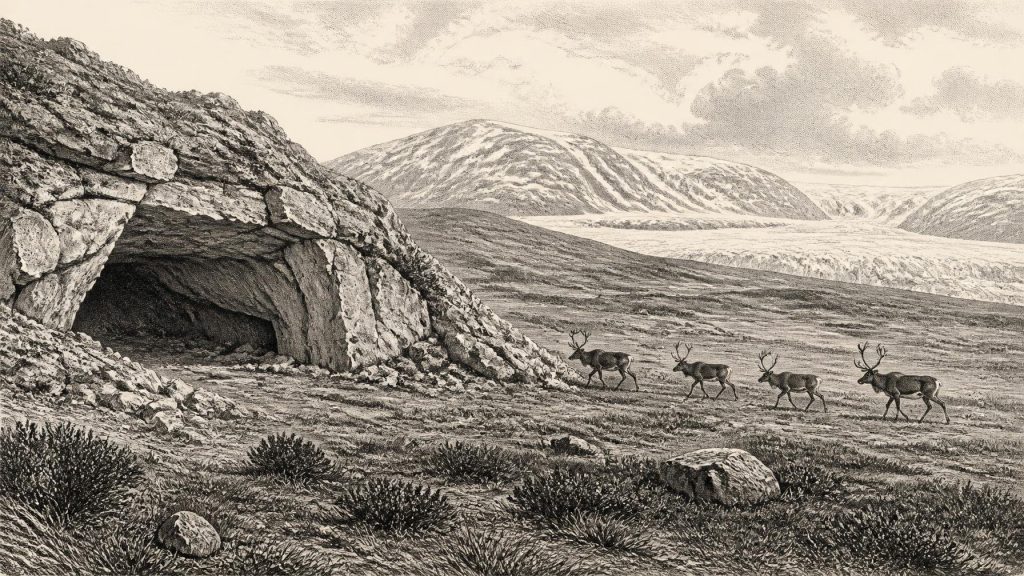
Around 31,965 BCE, a retrospective and imprecise date, Ireland lay within the climatically unstable Upper Palaeolithic. It was not yet uniformly covered by the later maximum ice sheet: Fermanagh sediments and calcite growth at Crag Cave indicate local ice-free or intermittently unfrozen ground, although regional glaciation was advancing. Lower sea levels altered coastlines without guaranteeing land access. Open steppe-tundra supported fauna including reindeer, giant deer, mammoth and hyaena, though cave deposits are complex. No secure human settlement is known. A possibly cut-marked reindeer bone suggests brief human visitation, but not occupation. This glacial era shaped Ireland’s terrain and remains uncertain.
Dateline
Modern calendar precision cannot be carried back reliably to 31,965 BCE. The number is a retrospective label, not a year recorded by anyone in Ireland, and it should not be treated as the date of a specific Irish event. In archaeological terms it corresponds only approximately to about 33,900 years before AD 1950, within the Upper Palaeolithic and Marine Isotope Stage 3, a long and climatically unstable part of the last Ice Age. The responsible history of Ireland at this point is therefore not a story of named communities, rulers or battles. It is an account of changing land, climate and animal life, reconstructed from caves, sediments, landforms and scientific dating.
A Date on a Vast Timescale
The distinction between calendar years, radiocarbon years and calibrated ages matters especially here. Radiocarbon measurements are not themselves calendar dates: their conversion into calibrated ranges depends on changing atmospheric carbon levels and carries margins of uncertainty. Nor do the available Irish deposits allow scholars to identify conditions in one numbered year. It is safer to speak of the interval around 34,000 calibrated years ago, and to test broad reconstructions against several independent forms of evidence.
That evidence places 31,965 BCE near an important transition in Ireland’s last glacial history. Research on the British–Irish Ice Sheet indicates that the great ice mass expanded substantially after roughly 34,000 years ago, reaching much more extensive limits later, principally between about 28,000 and 24,000 years ago in several sectors. The global Last Glacial Maximum followed, conventionally dated to about 26,500–19,000 years ago. Consequently, it would be misleading to picture the whole island at 31,965 BCE as already buried beneath the fully developed ice sheet of the later maximum.
Equally, the evidence does not justify an image of a mild or familiar Ireland. This was a cold-stage world in which the positions of ice, sea, tundra and open ground could change markedly over millennia. The island’s present coastline, woods, soils, bogs and fields did not exist. The landscape that can be discussed was a Pleistocene landscape, repeatedly altered by frost, moving water, ice advance and later erosion.
Ice-Free Ground, Growing Ice
The best direct clues come from particular places rather than from an island-wide snapshot. In north-central Ireland, organic sediments beneath later tills at Derryvree and Greenagho in County Fermanagh have produced calibrated ranges indicating ice-free conditions until at least about 34,000 years ago. In south-west Ireland, uranium-thorium dating of speleothems from Crag Cave, County Kerry, shows phases of cave-calcite growth between about 38,000–34,000 and 32,000–30,000 years ago. Because liquid water had to percolate through the limestone for such formations to grow, these records strongly suggest that the cave’s immediate landscape was not continuously sealed by glacier or permafrost during those intervals.
This is evidence with limits. A cave record is local, and a gap in calcite growth can arise through changes in water supply as well as severe cold. It cannot map every valley, mountain or shore. Yet taken with subglacial landforms, marine cores and later ice-sheet limits, it supports a cautious interpretation: around the requested date, parts of Ireland were likely still exposed or only beginning to be affected by major ice expansion, while the ice sheet was building in the wider British–Irish region. The exact boundary, thickness and timing remain subjects of active reconstruction.
Sea level was far lower globally than today because immense quantities of water were stored in continental ice sheets. This enlarged the continental shelves around Ireland, moving shorelines seawards in many areas. Low sea level did not automatically create a dependable land route from Ireland to Britain or continental Europe; the Irish Sea basin and its changing marine and glacial conditions remained a formidable barrier. Routes that may have existed at particular stages must be demonstrated, not assumed. For people or animals, access to Ireland depended on a shifting combination of water, ice, exposed shelf and local geography.
Animals in a Cold Landscape
Southern Irish caves preserve the most vivid evidence for life near this broad period. Castlepook Cave near Doneraile, County Cork, has yielded a rich but complicated assemblage of Pleistocene animal remains. Modern re-dating has shown that some of its fauna is considerably older than earlier laboratory results suggested. Mammoth, spotted hyaena, giant deer and reindeer are among animals represented in the wider Late Pleistocene record of southern Ireland. These are not merely exotic names: their remains show that, during suitable ice-free episodes, Ireland could support a cold-climate fauna unlike that of the modern island.
However, a bone’s discovery in a cave does not necessarily mean that the animal lived or died precisely there. Hyaenas could accumulate prey remains in dens; carnivores, water movement, collapse and nineteenth- or early twentieth-century excavation practices all complicate the deposits. The Castlepook assemblage is especially important because it was collected long ago and lacks the secure, layer-by-layer context expected of modern excavation. It provides compelling evidence for regional animal presence over long spans, but rarely a neatly dated scene.
The likely vegetation cannot be reconstructed tree by tree. During cold phases, open herb-rich grassland, steppe-tundra and sparse shrub communities are more plausible than closed woodland. Plant productivity would have fluctuated with abrupt climatic shifts. Such habitats could sustain grazing animals and their predators where terrain was exposed, but they were harsh places: windswept, seasonally severe and vulnerable to frost action. The giant deer often popularly called the “Irish elk” was not an emblem of a settled Irish landscape; at this date it was one component of a changing Pleistocene fauna whose distribution reached far beyond Ireland.
The Human Question
There is no securely excavated settlement, hearth, stone-tool assemblage, grave, house or artwork from Ireland that can responsibly be assigned to 31,965 BCE. There are no grounds for describing villages, kin groups, languages, religious rites, political authority, diplomacy, trade networks or organised warfare on the island in this particular year. Nor may later Irish traditions, medieval genealogies or modern national identities be projected into the Upper Palaeolithic. They belong to incomparably later worlds.
A recently publicised but still limited clue deserves careful notice. A reindeer femur from the old Castlepook Cave collection has been reported as bearing a cut mark made by a sharp stone tool and as dating to roughly 33,000 BCE. If the modification is confirmed as human-made and its dating and association withstand fuller scrutiny, it would point to a very early, probably brief Upper Palaeolithic human presence in Ireland. It would not establish continuous settlement, a population size, or an event in 31,965 BCE. One modified bone cannot answer those larger questions, particularly when its original excavated context is uncertain.
This caution is not an attempt to dismiss the find. It identifies why it is valuable: it directs future research towards caves, old museum collections and surviving undisturbed deposits. The possibility that hunters reached southern Ireland during a comparatively favourable window is archaeologically significant. They may have followed or encountered reindeer herds and used portable stone tools, as Upper Palaeolithic groups elsewhere in north-west Europe did. But this remains an interpretation informed by neighbouring evidence, not a demonstrated account of life at Castlepook.
The stronger published evidence for human activity in Ireland is much later. A brown-bear kneecap from Alice and Gwendoline Cave, County Clare, bears cut marks and has calibrated dates around 12,800–12,600 years before present, or approximately 10,800–10,500 BCE. Sustained Mesolithic settlement appears later again, from about 8000 BCE. These large chronological gaps are central to the story. They show why a single possible Palaeolithic signal cannot be converted into a continuous national prehistory.
Society, Exchange and Belief: What Cannot Be Seen
For the period around 31,965 BCE, archaeology records environmental opportunity more clearly than human society. There is no Irish evidence for farming, domesticated livestock, metalworking, pottery, monument building, writing, coinage or long-distance exchange. There is likewise no direct evidence for ritual activity. A cave was a geological feature and, in some cases, an animal den; it should not be labelled a sanctuary without human traces that support that conclusion.
If people did visit Ireland during a late Marine Isotope Stage 3 interval, their economy would almost certainly have been based on hunting, gathering and the use of perishable materials, rather than cultivation. That statement is a general inference from Upper Palaeolithic lifeways, not evidence for a documented Irish camp. Wood, hide, sinew, fibre and food remains rarely survive in exposed glacial landscapes, while subsequent ice movement could remove or rework surface sites altogether. The absence of evidence is therefore shaped both by genuine scarcity and by difficult preservation.
There can be no responsible discussion of Irish political affairs, conflict or diplomacy in the normal historical sense. At most, the wider European context suggests small, mobile human populations whose movements responded to animal migrations, climate and terrain. Whether any such groups crossed into Ireland at this time, how long they remained, and whether they returned, cannot yet be known. The most accurate word is possibility, not certainty.
Legacy Beneath the Modern Island
Though no event can be attached to 31,965 BCE, this interval helped create the physical Ireland later inhabitants encountered. Ice-sheet advance and retreat scoured rock, transported sediment, reshaped drainage and contributed to the terrain later occupied by Mesolithic foragers, Neolithic farmers and every subsequent society. Offshore channels and sea-floor landforms retain evidence of ice streams that once linked Irish landscapes to the wider British–Irish Ice Sheet.
The year therefore stands not at the beginning of a straightforward national narrative, but within a deep environmental prehistory. Around 34,000 years ago, Ireland was a cold, unstable and regionally varied place. Parts of it may still have offered exposed terrain and habitat for Pleistocene animals; major glaciation was gathering force; and a reported modified reindeer bone raises, but does not settle, the question of human visitation. That combination of firm evidence and disciplined uncertainty is the most truthful history available for Ireland around 31,965 BCE.
Primary Sources
- Prehistoric Details
- Trimlines, Blockfields and the Vertical Extent of the Last Ice Sheet in Southern Ireland
- Growth and Retreat of the Last British–Irish Ice Sheet, 31,000 to 15,000 Years Ago: The BRITICE-CHRONO Reconstruction
- Maximum Extent and Readvance Dynamics of the Irish Sea Ice Stream and Irish Sea Glacier Since the Last Glacial Maximum
- Stratigraphic and Palaeo-Geomorphological Evidence for the Glacial-Deglacial History of the Last British-Irish Ice Sheet in the North-Western Irish Sea
- Last Glacial Maximum Cirque Glaciation in Ireland and Implications for Reconstructions of the Irish Ice Sheet
- Late Pleistocene Chronostratigraphy and Ice Sheet Limits, Southern Ireland
- Timing and Pace of Ice-Sheet Withdrawal Across the Marine–Terrestrial Transition West of Ireland During the Last Glaciation
- Episodic Speleothem Deposition Tracks the Terrestrial Impact of Millennial-Scale Last Glacial Climate Variability in SW Ireland
- Spatio-Temporal Dynamics of Speleothem Growth and Glaciation in the British Isles
- Rapid Response of Climatic Conditions During the Last Glacial: Evidence from U-Series Dated Irish Speleothems
- A Reconsideration of the Radiocarbon Dating of the Marine Isotope Stage 3 Fauna from Southern Ireland
- Late Pleistocene and Holocene Brown Bears in Ireland: Evidence for a Population Continuity?
- The Irish Quaternary Fauna Project
- Late Quaternary Reindeer (Rangifer Tarandus) in Ireland: A Review of the Evidence
- First Evidence of a Late Upper Palaeolithic Human Presence in Ireland
- New Insights on the Fauna of Ireland's Younger Dryas and Early Holocene from Alice & Gwendoline Cave
- The Mesolithic in Ireland: When Was It?
- Quaternary Site Descriptions
- 32564 – Castlepook Cave, Castlepook South, Cork
- Archaeology Research Excavation Grant 2022: Final Report
- Heritage Artefacts of County Cork