Ice and Uncertainty31947 BCE
31,947 BCE is an approximate modern label for later Pleistocene Ireland, not a witnessed year. During Marine Isotope Stage 3, cooling fostered uneven ice growth, though much of Ireland may still have contained exposed grassland, rivers, caves and changing coasts before the Last Glacial Maximum. Glacial erosion explains the scarcity of archaeological evidence. Castlepook Cave preserves remains of mammoth, reindeer, giant deer, predators and other cold-adapted fauna, accumulated across different periods. A possibly stone-tool-marked reindeer bone, dated around 33,000 years ago, may indicate a brief human visit, not settlement. Ireland’s evidence chiefly records environmental transformation, while human activity remains uncertain.
Dateline
The label 31,947 BCE is useful as a point on a modern timeline, but it cannot identify a witnessed Irish ‘year’ in the historical sense. No written calendars, named people, settlements or events survive from this depth of time. In archaeological terms, it falls in the later Pleistocene, broadly within Marine Isotope Stage 3 and during the long build-up towards the Last Glacial Maximum. Converted only approximately, it lies around 33,900 calibrated years before present. Even that formulation must be handled cautiously: radiocarbon measurements, calibrated age ranges, ice-sheet models and cave deposits provide spans of time, not annual precision. The responsible question is therefore not what happened in Ireland in one exact year, but what the evidence can say about the island and its inhabitants—human and animal—around this phase of the Ice Age.
A Changing Ice-Age Island
Ireland was not yet simply the ice-covered land often imagined for the peak of the last glaciation. The British–Irish Ice Sheet reached its greatest overall volume much later, around 23,000 years ago, while its expansion was uneven and regionally complex. Research reconstructing the ice sheet suggests that from roughly 34,000 years ago ice was building across parts of Britain and Ireland. At about 31,000 years ago, modelled reconstructions show centres of ice accumulation on high ground, including Northern Ireland, but acknowledge major uncertainty in the exact margins. Thus, around the nominal date of 31,947 BCE, conditions could have differed dramatically between districts: uplands and northern areas may have supported expanding ice, while other zones retained exposed ground, lakes, rivers, caves and cold grassland.
This is an important corrective to any single map of ‘Ice Age Ireland’. Sediments beneath later glacial deposits in County Fermanagh indicate that north-central Ireland was ice-free until at least about 34,000 years ago. Evidence from western coasts and offshore sediments likewise records a fluctuating relationship between ice, sea and land before the Last Glacial Maximum. These records establish broad environmental possibilities rather than a day-by-day weather report. They show an island in transition: climatic cooling was encouraging glacier growth, but the ice sheet had not yet assumed the maximum extent that later reshaped much of the landscape.
Landscapes Beyond the Later Ice
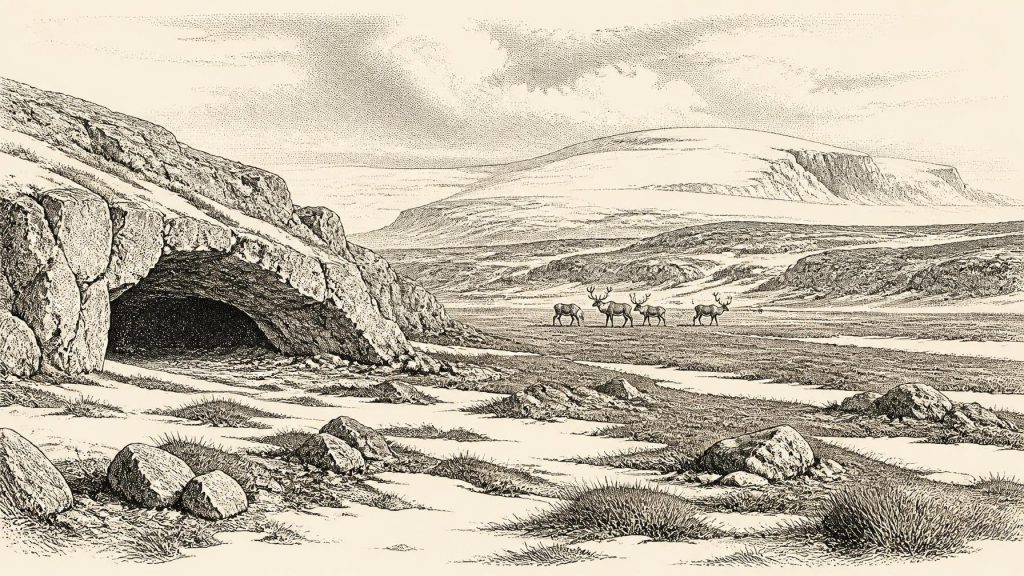
The Ireland of this period was colder, more open and less wooded than the familiar green island of recent millennia. Treeless or sparsely vegetated ground, grass-herb communities, patches of scrub and exposed rock would have formed habitats suited to cold-adapted animals. Rivers drained landscapes repeatedly altered by frost, snow, meltwater and shifting sea levels. Coastlines were also unlike those of today, because global sea level was much lower during the glacial cycle. Yet it would be wrong to draw a precise shoreline, or to assume a straightforward land bridge to Britain or continental Europe, for this particular date. Sea crossings, exposed shelves and routes across the north-west European landscape changed over long intervals and remain subjects of reconstruction.
The later advance of ice removed, buried and reworked many older surfaces. That geological history helps explain why archaeological evidence is exceptionally scarce. Open-air camps may have been destroyed by glacial erosion, concealed beneath later deposits, or now lie offshore beneath post-glacial seas. Limestone caves are consequently precious archives: they can preserve bones, sediments and occasional traces of activity that vanished elsewhere. But caves are not sealed time capsules. Water, burrowing animals, collapse, excavation practices and later human use can mix deposits. Every find therefore requires careful dating, analysis of context and comparison with other evidence.
The Castlepook Fauna
Castlepook Cave near Doneraile in north County Cork is central to understanding Ireland’s Middle Devensian, or later Pleistocene, fauna. Investigations and museum collections from the cave have produced remains attributed to animals including woolly mammoth, reindeer, giant deer, brown bear, wolf, fox, Arctic fox, lemmings and spotted hyaena. The assemblage demonstrates that, during parts of the period before the Last Glacial Maximum, Ireland supported or was reached by a strikingly different range of mammals from that of the present island. It evokes a cold, open environment in which large herbivores and carnivores could move through a wider north-west European ecological zone.
That list must not be turned into a single, crowded scene set in one year. Cave collections accumulated over time, and some deposits were disturbed or contain material of different ages. The value of Castlepook lies precisely in its potential to be re-examined using modern radiocarbon dating, zooarchaeology and stratigraphic methods. Published reassessments have stressed both the importance of the site and the complications created by antiquarian excavation. The fossils support the existence of cold-stage animal communities in Ireland; they do not allow historians to specify which animals stood in County Cork in 31,947 BCE, nor how many there were.
A Possible Human Trace
The most directly relevant, but still limited, claim concerns a reindeer femur from Castlepook Cave. In 2021, it was reported that the bone, dated to about 33,000 years ago, bore marks interpreted as cuts or chops made with a stone tool. If that interpretation and dating are upheld by fuller publication and contextual study, the find would place a human visit to Ireland broadly close to the timespan represented by this article—far earlier than the well-established Mesolithic settlement of the island after the ice retreated.
It is not evidence for a settled Irish population, a village, a hunting territory or a continuous occupation. No securely dated hearth, dwelling, lithic assemblage, burial or art site of this age has yet been demonstrated in Ireland. A modified animal bone could represent a short hunting, scavenging or butchery episode by a small mobile group. It cannot reveal the group’s name, language, origin, route, social organisation or duration of stay. Ongoing research at Castlepook is therefore particularly significant: it may clarify whether this is an isolated encounter, part of a wider but almost erased Upper Palaeolithic presence, or an interpretation requiring revision.
The distinction matters because the island’s better-supported early human record is much later. A butchered brown-bear kneecap from Alice and Gwendoline Cave, County Clare, has been independently radiocarbon dated to approximately 12,810–12,590 calibrated years before present, demonstrating terminal-Pleistocene human activity. More substantial evidence for repeated settlement appears later still, in the Mesolithic, from around 8000 BCE. The chronological gulf between these records should not be filled with imagined generations of inhabitants.
Society Without a Recorded Society
There is no evidential basis for political affairs, diplomacy, chieftains, tribes, warfare, formal religion, learning or trade within Ireland at this date. Neither monuments nor durable objects demonstrate ceremony, exchange networks or territorial authority. If people did enter Ireland around this time, they belonged to Upper Palaeolithic hunter-gatherer worlds known elsewhere in Europe, where mobility, seasonal knowledge, stone technology and co-operation were essential. That wider comparison can suggest possibilities, but it cannot be substituted for Irish evidence. It would be an interpretation, not a fact, to assign those practices to a particular Irish group.
The same restraint applies to everyday life. The Castlepook evidence permits a cautious picture of people potentially processing reindeer in a cold landscape; it does not identify their clothing, shelters, kinship, beliefs or diet beyond that possible act. Mammoth, reindeer and other animal remains illuminate ecology more securely than human custom. The economic language appropriate here is subsistence opportunity rather than an Irish economy: large mammals could have offered meat, fat, hide, bone and antler, but no excavated Irish camp demonstrates how such resources were organised or shared.
What This Date Means
For Ireland, 31,947 BCE marks neither a founding moment nor a datable event. It sits near the beginning of a severe climatic transformation, when ice was expanding across parts of the island and its surrounding seas, while some landscapes may still have sustained Pleistocene fauna. The most important development is environmental: the approach of the glacial maximum would profoundly remodel Ireland, erase earlier surfaces and later set the conditions from which post-glacial ecosystems emerged. The possible Castlepook evidence gives this remote period an added human significance, but only as a carefully qualified prospect of brief Upper Palaeolithic activity. Around this point in time, Ireland’s history is written chiefly in ice margins, cave sediments and animal bone—and in the disciplined acknowledgement of what those fragments cannot yet tell us.
Primary Sources
- Stone Age
- Prehistoric Details
- Growth and retreat of the last British–Irish Ice Sheet, 31,000 to 15,000 years ago: the BRITICE-CHRONO reconstruction
- Growth and retreat of the last British–Irish Ice Sheet, 31,000 to 15,000 years ago: the BRITICE-CHRONO reconstruction
- Trimlines, blockfields and the vertical extent of the last ice sheet in southern Ireland
- Dimensions and chronology of the last ice sheet in Western Ireland
- Radiocarbon constraints on the history of the western Irish ice sheet prior to the Last Glacial Maximum
- Radiocarbon constraints on the age of the maximum advance of the British-Irish Ice Sheet in the Celtic Sea
- Bayesian modelling the retreat of the Irish Sea Ice Stream
- Deglaciation chronology of the Donegal Ice Centre, north-west Ireland
- Stratigraphic and palaeo-geomorphological evidence for the glacial-deglacial history of the last British-Irish Ice Sheet in the north-western Irish Sea
- The Irish quaternary fauna project
- A reconsideration of the radiocarbon dating of the Marine Isotope Stage 3 fauna from southern Ireland
- Castlepook Cave
- Archaeology Research Excavation Grant 2022: Final Report
- Castlepook Cave, Co. Cork, 2022
- First evidence of a Late Upper Palaeolithic human presence in Ireland
- New insights on the fauna of Ireland's Younger Dryas and Early Holocene from Alice & Gwendoline Cave
- Quaternary Site Descriptions
- The Mesolithic in Ireland: when was it?