Castlepook’s Putative Toolmark31936 BCE
31,936 BCE is a modern label for a late Pleistocene period, not a datable Irish event. Ireland lay in a cold, unstable landscape before the Last Glacial Maximum, as expanding ice and changing sea levels reshaped routes, habitats and surviving evidence. Southern caves, particularly Castlepook in County Cork, preserve remains of mammoth, reindeer, giant deer, bears, foxes, hyaenas and other fauna, though deposits span long periods and were disturbed. No secure human settlement is known. A possibly tool-marked reindeer bone, dated near 33,000 years ago, may indicate brief human activity, but requires confirmation. Glacial erosion explains Ireland’s scant surviving evidence.
Dateline
31,936 BCE is a modern calendar label, not a year for which Ireland’s archaeological record can identify an event, ruler, battle or settlement. It falls, by simple conversion, about 33,900 years before the conventional radiocarbon baseline of 1950, within the later part of the Pleistocene and Marine Isotope Stage 3. That arithmetic is useful only as orientation. Archaeologists date material from this depth of time in radiocarbon years before present and calibrated ranges, often with substantial uncertainty; they do not possess calendar-year precision for Ireland in this period. The responsible picture is therefore one of changing landscapes, animal movements and fragmentary cave evidence, rather than an annual chronicle.
A Landscape on the Edge of Glaciation
This was a very different Ireland from the familiar green island of later millennia. Sea level was much lower than today because large volumes of water were held in northern ice sheets. Ireland, Britain and the continental shelf formed a changing north-west European margin, though the exact routes by which animals or people could have moved varied with sea level, coastlines, ice and climate. It is unsafe to imagine the modern Irish Sea or Atlantic coastline simply transplanted into the Ice Age.
At roughly 34,000 years ago, Ireland stood before the fullest expansion of the last British–Irish Ice Sheet rather than at its climatic maximum. Large reconstructions indicate that ice-sheet growth accelerated after about 31,000 years before present, while maximum ice volume and broadest extent came much later, around 27,000–23,000 years ago, with regional advances and retreats occurring at different times. Other work suggests that much of Ireland remained unglaciated until about 32,000 calibrated years before present. These are broad, modelled chronologies, not a guarantee that every valley or coast was ice-free in 31,936 BCE. They nevertheless place this date in a transitional world: cold, climatically unstable and increasingly vulnerable to ice expansion.
Later glaciers profoundly altered the evidence. Ice eroded bedrock, reworked sediments and removed or buried many surfaces on which camps, tracks or hearths might once have stood. The eskers, drumlins, corries and glacial valleys visible across Ireland today are part of that much later legacy. Their existence also explains why a lack of early sites cannot automatically prove that people or animals never reached the island. It does, however, mean that claims for deep Palaeolithic occupation require unusually strong evidence.
Caves and the Faunal Record
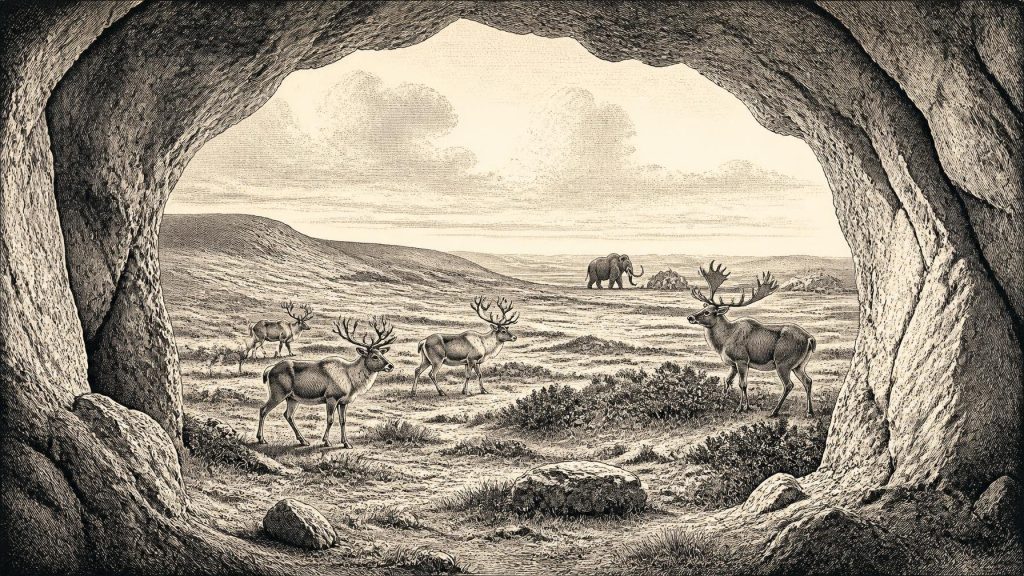
The most informative evidence comes from caves, especially in the limestone country of southern Ireland. Castlepook Cave, near Doneraile in north County Cork, is central to this story. Excavations undertaken in the late nineteenth and early twentieth centuries recovered a remarkable but difficult collection of animal remains. Subsequent research has identified or reported mammals including woolly mammoth, reindeer, giant deer (Megaloceros giganteus), brown bear, wolf, red fox, Arctic fox, spotted hyaena and lemmings. Such animals show that at least parts of Ireland supported a far richer Ice Age fauna than the island would possess after the glaciers and post-glacial seas reshaped its ecological connections.
The list should not be turned into a single illustrated scene or treated as proof that every species lived together at exactly the same moment. Castle deposits accumulated over long periods; bones may have been moved by water, scavengers, burrowing animals or people; and early excavations did not record deposits to modern standards. Cave carnivores themselves could carry prey into sheltered chambers. Spotted hyaena remains and heavily chewed bones are particularly important reminders that some caves were animal dens, not human homes. The strongest conclusion is that southern Irish caves preserve evidence for successive Pleistocene animal communities, including communities before the Last Glacial Maximum.
Modern redating has made that conclusion more secure while making older neat chronologies less secure. The Irish Quaternary Fauna Project showed the value of accelerator radiocarbon dating for museum collections. Later work using improved collagen pretreatment found that some earlier dates from Castlepook, Foley and Shandon caves were too young, pushing parts of the southern Irish fauna further back into Marine Isotope Stage 3. Researchers have consequently proposed that species such as giant deer and spotted hyaena may have disappeared locally before the Last Glacial Maximum, perhaps around 40,000 calibrated years ago. Around the modern label 31,936 BCE, then, mammal evidence is directly relevant, but it is usually dated in wide ranges and must be assessed specimen by specimen.
Was There a Human Presence?
No securely dated settlement, house, hearth, burial or stratified stone-tool assemblage is known from Ireland for this point in time. Nor is there accepted evidence for a permanent population. This absence matters. It means that historians cannot responsibly describe named communities, family life, hunting territories or a continuous colonisation of Ireland in 31,936 BCE.
There is, however, a reason for careful attention to Castlepook Cave. A reindeer bone from its historic collection has been reported as bearing a mark interpreted as stone-tool damage and as dating to about 33,000 years ago. If both the dating and anthropogenic interpretation are confirmed through full publication, contextual reassessment and comparison with natural damage, it could indicate a brief Upper Palaeolithic human visit or butchery episode close to this article’s chronological horizon. It would not by itself establish a settlement or prove that people lived in Ireland year-round. At present it is best regarded as an important research claim, not as a foundation for a detailed human history.
The contrast with the better-published evidence from Alice and Gwendoline Cave, County Clare, is instructive. There, cut marks on a brown-bear kneecap have been argued to show human activity around 12,810–12,590 calibrated years before present. Even that much later evidence is a single, exceptional proxy rather than a village site. It demonstrates the kind of direct, dated material needed to make a case for human presence, while underlining how sparse Ireland’s Palaeolithic record remains.
No Polities, but a Wider World
Political affairs, diplomacy and organised warfare cannot be recovered for Ireland at this date. There were no recorded kingdoms, tribal names, laws or monuments, and there is no evidence from which to reconstruct political boundaries. Likewise, there is no Irish evidence for religious buildings, formal burials, art, writing, schools or enduring ceremonial places around 31,936 BCE. Silence here is not evidence that Ice Age people elsewhere lacked culture. Upper Palaeolithic communities in parts of Europe made sophisticated tools, ornaments and art. It is simply not evidence for Ireland.
If people did occasionally reach the island, they would have belonged to wider mobile hunter-gatherer worlds shaped by seasonal weather, animal distributions and safe routes through a changing north-west European landscape. That is an inference from the broader European Upper Palaeolithic, not a fact demonstrated by an Irish camp. A possible butchery mark could imply the acquisition of meat or carcass processing; it cannot reveal whether a reindeer was hunted, scavenged or encountered after death, nor whether visitors travelled in a small party or returned repeatedly.
There is equally no evidence for farming, herding, crop cultivation, metalworking, pottery production, long-distance exchange networks or maritime trade in Ireland at this time. The relevant economy was ecological rather than agricultural: the movement and survival of large mammals and their predators in a cold, fluctuating environment. Caves may have offered temporary shelter to animals and, potentially, to people, but their principal historical value is as archives of bone, sediment and changing climate.
Evidence, Interpretation and Future Work
The story of Ireland around 31,936 BCE is therefore not one of an identifiable Irish society but of a place at the north-western edge of Ice Age Europe. Faunal remains demonstrate that animals repeatedly reached and occupied parts of the island before the full glacial maximum. Glacial reconstructions show that this living landscape was soon to be transformed by the growing British–Irish Ice Sheet. The combination helps explain both the possibility of fleeting human contact and the extraordinary scarcity of surviving archaeological traces.
Future work may change the balance of evidence. Re-excavation, refined radiocarbon methods, sedimentary ancient DNA, microscopic study of bone surfaces and improved ice-sheet modelling can test whether particular animals, deposits and possible tool marks belong together. Until then, the clearest account is also the most cautious: around this modernly numbered year, Ireland was an Ice Age landscape with demonstrable Pleistocene fauna, uncertain access routes and no securely established human settlement.
Primary Sources
- A reconsideration of the radiocarbon dating of the Marine Isotope Stage 3 fauna from southern Ireland
- The Irish Quaternary Fauna Project
- First evidence of a Late Upper Palaeolithic human presence in Ireland
- New insights on the fauna of Ireland's Younger Dryas and Early Holocene from Alice & Gwendoline Cave
- Growth and retreat of the last British–Irish Ice Sheet, 31 000 to 15 000 years ago: the BRITICE-CHRONO reconstruction
- Pattern and timing of retreat of the last British-Irish Ice Sheet
- Dimensions and chronology of the last ice sheet in Western Ireland
- Last Glacial Maximum cirque glaciation in Ireland and implications for reconstructions of the Irish Ice Sheet
- Character of advance and retreat of the southwest sector of the British-Irish Ice Sheet during the last glaciation
- Maximum extent and readvance dynamics of the Irish Sea Ice Stream and Irish Sea Glacier since the Last Glacial Maximum
- Using novel methods to track British and Irish Ice Sheet dynamics since the Late Pleistocene, along the west Porcupine Bank, NE Atlantic
- Stratigraphic and palaeo-geomorphological evidence for the glacial-deglacial history of the last British-Irish Ice Sheet in the north-western Irish Sea
- The colonization of Ireland: A human ecology perspective
- Anthropogenic changes to the Holocene nitrogen cycle in Ireland
- The IntCal20 Northern Hemisphere radiocarbon age calibration curve (0–55 cal kBP)
- The Mesolithic in Ireland: when was it?
- Ireland through geological time
- Geology of Ireland
- Archaeological excavations at Killuragh Cave, Co. Limerick: a persistent place in the landscape from the Early Mesolithic to the Late Bronze Age
- Occurrence of mammalia relicts at site Castlepook Cave
- Pleistocene vertebrates in the British Isles
- Early deglaciation of the British-Irish Ice Sheet on the Atlantic margin