Periglacial Shrub Tundra31937 BCE
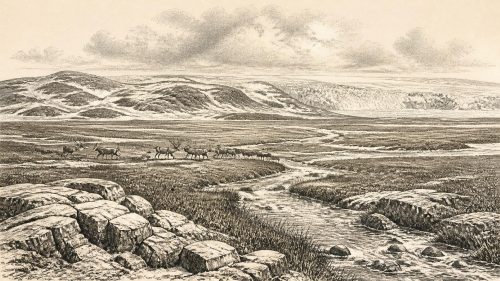
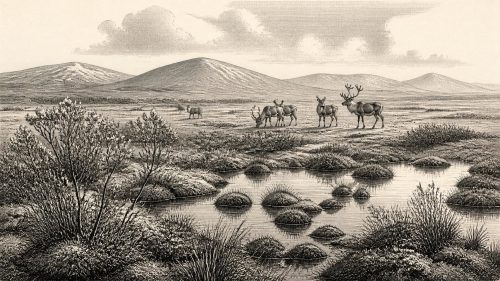
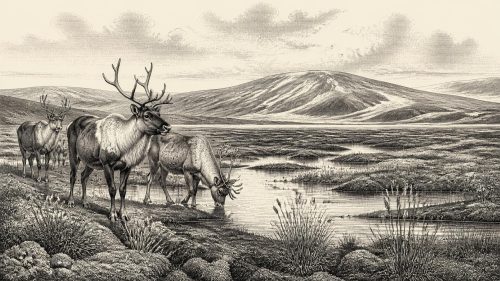
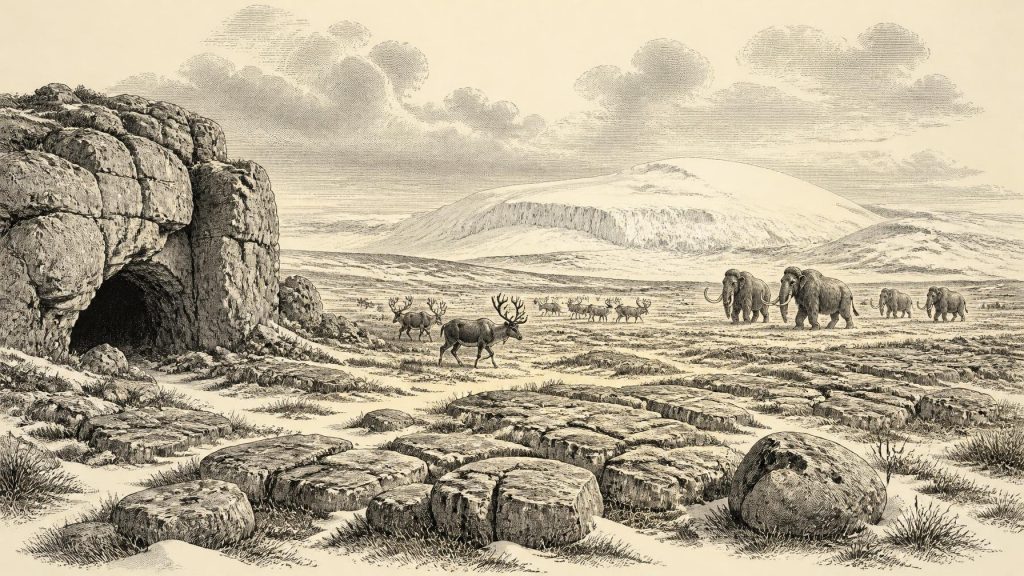
About 31,937 BCE, Ireland was a cold, open and environmentally unstable landscape in the later Last Glacial Period, approaching maximum glaciation. Lower sea levels altered coastlines and may have eased animal movement from Britain and Europe. Castlepook Cave, County Cork, preserves remains of reindeer, mammoth, giant deer, predators and other fauna, though deposits span different times. A reindeer bone reportedly bearing stone-tool butchery marks may indicate human passage around 33,000 years ago, but cannot prove permanent occupation. Later ice erosion and inundation destroyed evidence. No society, culture, trade or institutions can be inferred; sustained settlement is documented from the Mesolithic.
Dateline
A Date Beyond Annals
31,937 BCE cannot be treated as a year in the ordinary historical sense. No Irish written record, named ruler, settlement sequence or securely dated event can be assigned to a single calendar year so remote in time. Indeed, even the conversion between BCE dates and scientific chronologies needs care: archaeologists normally work with radiocarbon years before present (BP, where “present” is 1950) and calibrated calendar ranges, each with margins of uncertainty. The appropriate setting is therefore not a supposed episode in 31,937 BCE, but Ireland in the later part of the Last Glacial Period, approximately 34,000 calendar years ago.
This was within the Upper Palaeolithic in European archaeological terms, but Ireland’s evidence is exceptionally thin. Around this horizon, the island was approaching the severe cold phase that culminated in the Last Glacial Maximum, conventionally dated in Ireland and Britain to roughly 26,000–19,000 years ago. The record permits a cautious reconstruction of landscape, animals and possible human visits. It does not permit a narrative of an Irish people, polity or continuous settlement.
An Unstable Ice-Age Landscape
At about this date, Ireland was not yet necessarily the uniformly ice-covered country that it became during the later glacial maximum. Research on the British–Irish Ice Sheet indicates complex advances and retreats rather than one simple, island-wide freeze. Some reconstructions suggest that Ireland had remained largely ice-free until about 32,000 calibrated years BP, while other work identifies mountain ice caps and advancing glaciers in western and south-western Ireland during the colder stages around and after 32,000 BP. The precise extent of ice at any one place remains debated because the surviving landforms chiefly record later, more extensive glaciation.
That uncertainty matters. The Ireland of this broad period was not a green, wooded island recognisable from later prehistory. It contained cold, open environments shaped by frost, sparse vegetation, exposed rock, river systems and, locally, ice. Sea level was far lower than today because so much water was locked in global ice sheets. The coastlines of modern Ireland did not exist in their present form; broad areas of the continental shelf were dry land or shallower marine terrain. Connections towards Britain and continental Europe were consequently easier for animals than they would become after post-glacial sea-level rise, although the exact routes available at different moments are still being investigated.
For people or large mammals moving through this north-western edge of Europe, such landscapes offered both opportunities and hazards. Open ground could support grazing herds, but conditions were cold, highly seasonal and changeable. Caves in limestone districts were important not because they prove human habitation, but because they trapped and preserved bones that open-air landscapes, repeatedly altered by ice and erosion, often lost.
Castlepook and the Animal World
The most important Irish evidence relevant to this distant horizon comes from Castlepook Cave near Doneraile in north County Cork. Excavated principally in the early twentieth century by the naturalist Richard J. Ussher, its deposits yielded one of Ireland’s richest known collections of Pleistocene vertebrate remains. The material is held largely through the National Museum of Ireland collections and has been revisited by modern zooarchaeological research. Its importance lies not only in the variety of species, but also in its reminder that the Ice-Age island supported a far broader fauna than historic Ireland.
Recorded Castlepook animals include reindeer, woolly mammoth, giant deer, brown bear, wolf, Arctic fox, mountain hare, lemmings and spotted hyaena. Individual finds have different dates and cannot simply be treated as the remains of one simultaneously living community. Nor were all bones deposited in the same way: carnivores, scavenging, water movement, cave collapse and early excavation methods all affected the assemblage. Nevertheless, radiocarbon results from Castlepook and other Irish caves show that varied cold-period fauna occupied or reached Ireland between at least about 45,000 and 20,000 BP. A giant-deer bone from Castlepook, for example, produced a radiocarbon age of 32,060 ± 630 BP; this is a useful broad chronological marker, not a date for a particular year or season.
Reindeer are especially significant for imagining the living landscape. Their presence indicates cold, open habitats and suggests mobile herds capable of moving over wide territories. Mammoth and giant deer reinforce the picture of a substantial grazing fauna, while hyaena and wolf show that large predators and scavengers occupied the same ecological world. This was not an untouched wilderness in a romantic sense, but a functioning food web in which caves could serve as dens, refuges, traps for remains or places where bones accumulated through many separate episodes.
A Possible Human Trace
A reindeer femur fragment from Castlepook has been reported as bearing deep marks consistent with butchery by a stone tool and as dating to about 33,000 years ago. If the modification is accepted as human-made, it is directly relevant to the period around 31,937 BCE. It would indicate that a person used a sharp lithic edge to dismember or process a reindeer in Ireland during the Upper Palaeolithic, far earlier than the once-standard view that people first reached the island only after the final retreat of the ice.
The claim deserves both attention and restraint. The Castlepook bone derives from old excavations whose deposits were disturbed, incompletely recorded and sometimes re-sorted by natural processes. The reported date is a radiocarbon result expressed in years BP, rather than an exact calendar-year identification. One modified bone does not establish that Castlepook was a human camp, that a population lived permanently nearby, or that Ireland had continuous occupation. Nor does it securely identify the visitors with a particular named Upper Palaeolithic culture known from Britain or continental Europe.
It is best understood as evidence for possible human activity or passage, not proof of an Irish society in the later historical sense. Small hunting groups elsewhere in north-west Europe were highly mobile and could exploit seasonal animal movements. If people did reach the Cork region, they may have followed reindeer, processed a carcass encountered or acquired in the landscape, and left little beyond a single altered bone. Stone tools, hearths, shelters, burials, art and living surfaces of comparable age have not been securely recovered in Ireland.
Society, Belief and Exchange: What Cannot Be Claimed
There is no responsible evidence for political affairs, leaders, warfare, diplomacy, formal territories or institutions in Ireland at this point. Equally, there is no Irish evidence for religious buildings, graves, ritual practices, language, art or organised learning. The cave itself should not be called a shrine, a settlement or a hunting station merely because it contains striking animal remains. Such labels would turn archaeological possibility into fact.
Economy and trade must also be treated narrowly. A butchered reindeer bone, if humanly modified, supports the practical use of animal resources: meat, marrow, hide, sinew and bone may all have been valuable to hunter-gatherers. It does not demonstrate regular exchange networks or local manufacture. Any connection with Britain or continental Europe is an inference from geography, low sea levels, animal dispersal and the known mobility of Upper Palaeolithic communities beyond Ireland, rather than evidence of a documented Irish route or trading partnership.
Why the Evidence Is So Fragmentary
Ireland’s later glaciation helps explain the silence. Ice sheets and meltwater eroded, buried and rearranged older ground surfaces, while rising seas drowned former coastal plains where camps may once have stood. Archaeologists therefore depend heavily on caves, museum collections, radiocarbon dating, microscopic inspection of marks on bone, palaeontology, sediment analysis and reconstruction of former ice margins. Each technique produces evidence of a different kind and with different limits.
The contrast with the much later record is instructive. The securely dated butchered brown-bear patella from Alice and Gwendoline Cave in County Clare belongs to the terminal Pleistocene, calibrated to 12,810–12,590 cal BP, and is separated from Castlepook by roughly twenty millennia of poorly documented change. Sustained settlement is more securely visible only in the Mesolithic, from around 8000 BC, when hunter-gatherers left camps, tools and other traces across a warmer post-glacial Ireland.
A Cautious Place in Irish History
For 31,937 BCE, the most defensible history is environmental and evidential. Ireland was a cold, changing north-west European land, inhabited by an impressive Ice-Age fauna and moving towards the greater glaciation of the Last Glacial Maximum. Castlepook Cave in County Cork preserves a rare window onto that world. Its reindeer bone offers a potentially important sign that humans may have entered and exploited Ireland at about this remote horizon, but it cannot bear the weight of claims for permanent colonisation or a developed Irish culture.
The real significance of the period lies in that tension between possibility and proof. It reminds us that the human past of Ireland may extend far deeper than older textbooks allowed, while demanding that every claim remain proportionate to the fragile evidence from which it is made.
Primary Sources
- Maximum extent and dynamic behaviour of the last British–Irish Ice Sheet west of Ireland
- Last Glacial Maximum cirque glaciation in Ireland and implications for reconstructions of the Irish Ice Sheet
- Extent and deglacial chronology of the last British-Irish ice sheet; implications of exposure dating using cosmogenic isotopes
- Late Pleistocene chronostratigraphy and ice sheet limits, southern Ireland
- Timing and pace of ice-sheet withdrawal across the marine–terrestrial transition west of Ireland during the last glaciation
- Dimensions and chronology of the last ice sheet in Western Ireland
- Anthropogenic changes to the Holocene nitrogen cycle in Ireland
- The Irish Quaternary Fauna Project
- Castlepook Cave, Castlepook South, Cork: Excavations 2022
- Castlepook Cave
- Proceedings of the Royal Irish Academy: Castlepook Cave faunal report
- First evidence of a Late Upper Palaeolithic human presence in Ireland
- New insights on the fauna of Ireland's Younger Dryas and Early Holocene from Alice & Gwendoline Cave
- Could brown bears (Ursus arctos) have survived in Ireland during the Last Glacial Maximum?
- Ancient Hybridization and an Irish Origin for the Modern Polar Bear Matriline
- The Mesolithic in Ireland: when was it?
- Archaeology & Landscape
- Making Yourself at Home on an Island: The First 1000 Years (+?) of the Irish Mesolithic
- The Prehistory of Britain and Ireland
- The Antiquity of Man in Ireland
- H.A.R.P.: investigating Mesolithic landscapes of life and death at the western edge of Europe