Doneraile’s Mammoth Cave31914 BCE
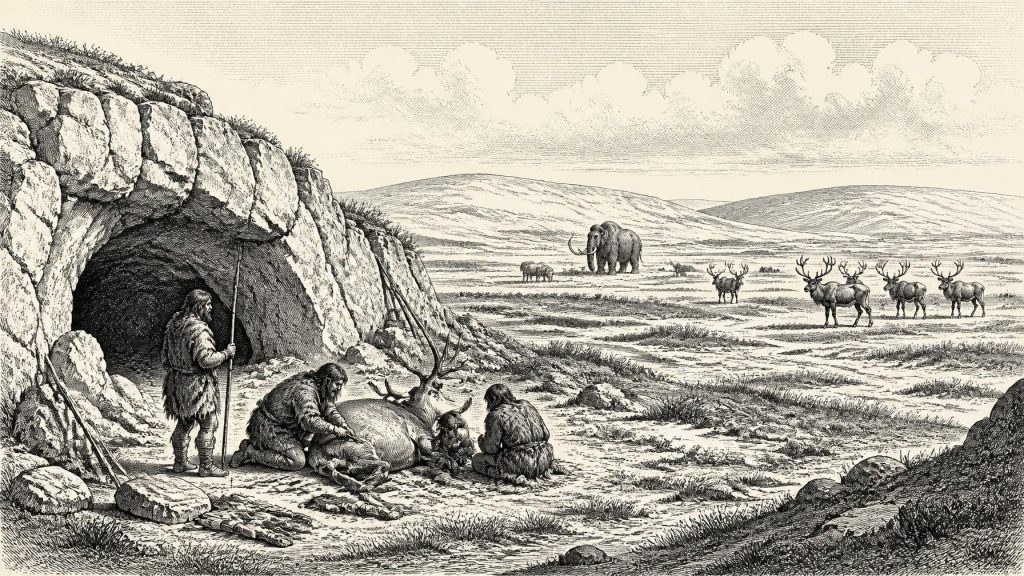
Around 31,914 BCE, Ireland lay within the climatically unstable Marine Isotope Stage 3, before the Last Glacial Maximum. Castlepook Cave near Doneraile preserves Ireland’s richest vertebrate evidence from this period: mammoth, reindeer, giant deer, bear, spotted hyaena, wolf, Arctic fox, hare and lemmings, indicating cold, open steppe-tundra habitats. Cave deposits were accumulated and disturbed by water, animals and excavation, limiting interpretation. Revised radiocarbon dating supports an older MIS 3 fauna. Cut-like marks on a reindeer femur plausibly indicate Upper Palaeolithic butchery, but cannot prove settlement, population continuity, culture or social organisation. Castlepook nevertheless demonstrates human visits within European ecological connections.
Dateline
The numbered year 31,914 BCE cannot be treated as a date at which a recorded Irish event occurred. No written source, annually resolved archaeological sequence or human calendar reaches remotely so far into Ireland’s past. It is best understood as a modern point within the Late Pleistocene, approximately 33,860 calendar years before AD 1950, in Marine Isotope Stage 3 (MIS 3), a climatically unstable interval of the last Ice Age. The responsible question is therefore not what happened in one exact year, but what evidence can illuminate Ireland broadly around this time.
The answer is striking but limited. Ireland was inhabited by Ice Age animals and had not yet entered the fullest phase of the Last Glacial Maximum, when the British–Irish Ice Sheet expanded across most of the island and surrounding shelf. The principal Irish archive for this earlier interval is Castlepook Cave, also known as Mammoth Cave or Doneraile Cave, near Doneraile in north County Cork. Its bones, sediments and difficult excavation history reveal an environment capable of supporting a remarkable cold-climate fauna. They also offer a tantalising, still incomplete case that people may have visited Ireland far earlier than the island’s traditionally accepted late-glacial human record.
Time Before Calendar Years
Modern BCE labels give a misleading impression of precision. Archaeologists date material from this period chiefly through radiocarbon measurement, then convert radiocarbon ages into calibrated ranges using internationally maintained calibration curves. Those ranges may span centuries or millennia; they do not identify an individual season, much less an exact year. Moreover, the relevant evidence is not a single layer sealed in a secure camp site. Castlepook’s cave deposits accumulated over a long time and were disturbed by water, animal activity and early excavation.
MIS 3 broadly spans about 57,000 to 29,000 years ago. Its climate was cold but punctuated by rapid shifts, rather than uniformly locked into the maximum conditions that came later. The date considered here lies near the end of that interval, before the Irish sector of the British–Irish Ice Sheet attained its last maximum extent. Research on ice-sheet chronology places major maximum expansion broadly after 30,000 years ago, with offshore evidence indicating far-reaching ice on western and southern approaches by roughly 27,000–25,000 calibrated years before present. That later advance destroyed, buried or reworked many earlier deposits, a major reason why Ireland’s Palaeolithic record is so sparse.
Thus 31,914 BCE was neither an era of familiar Irish coastlines nor a time from which a continuous ancestry of settlement can be assumed. Sea level was substantially lower globally, exposing broad continental shelves. Yet it is unwise to picture a simple, permanent land bridge from Ireland to Britain or continental Europe: ice margins, rivers, wetlands, changing sea basins and periodically submerged lowlands made access variable. Animals demonstrably reached the island; whether people did so, how often, and by which routes remain questions for evidence rather than assumptions.
A Cold, Open Landscape
The living landscape around this date would have differed profoundly from modern Ireland. There were no oak woods, enclosed fields, towns, farms or peatlands in their familiar later forms. The animal evidence points to open, cold environments with grassland, herb-rich steppe-tundra and patches of shrub or sparse woodland in more sheltered places. Conditions varied regionally with topography, proximity to ice and climatic fluctuation. It would be mistaken to reduce the whole island to a featureless snowfield: a habitat supporting grazing reindeer, mammoth and giant deer was ecologically diverse, even if treeless or thinly wooded over wide areas.
North Cork’s limestone plateau contained fissures and chambers that formed the Castlepook cave system. Caves were not necessarily human dwellings. They were traps, dens, shelters and sediment repositories. Water could wash bones into them; carnivores could carry prey inside; animals could die in or near entrances. Such processes are central to interpreting the evidence. A collection of bones proves animal presence, but it does not automatically demonstrate a hunting ground, a settlement, or a single moment of occupation.
Castlepook is exceptionally important because more than 2,000 bones have been recovered there and dated remains extend across a long middle-to-late Ice Age span. The Geological Survey Ireland identifies it as the island’s richest vertebrate site for the period leading up to the Last Glacial Maximum. Its value lies not in providing a neat prehistoric narrative, but in preserving a rare cross-section of a vanished Irish ecosystem.
Mammoths, Hyenas and Reindeer
The fauna attributed to Castlepook includes woolly mammoth, reindeer, giant deer or “Irish elk”, brown bear and spotted hyaena; other remains include wolf, Arctic fox, mountain hare and lemmings. “Irish elk” is a traditional name for Megaloceros giganteus, a widespread Eurasian giant deer rather than an animal confined to Ireland. Likewise, mammoth and hyaena connect the island to wider north-west European ecological networks. Their presence is direct evidence that suitable routes and habitats existed at particular times, not proof that every species lived together continuously or in the same exact locality.
Spotted hyaena is especially revealing. Castlepook is the only Irish site known to have produced it, and hyaenas may themselves explain part of the assemblage. A hyaena den accumulates bones through scavenging, hunting and chewing; it can also mix material from successive episodes. Carnivore teeth, weathering, sediment movement and later disturbance therefore have to be distinguished from marks made by people. The cave’s old collection is scientifically valuable precisely because modern osteological and radiocarbon methods can revisit individual specimens, but its original contexts cannot simply be recreated.
Earlier radiocarbon programmes placed several Castlepook animals within MIS 3, including a reindeer, brown bear, giant deer and lemmings. A 2020 reassessment using improved bone pretreatment found that some 1990s measurements had been too young by thousands of radiocarbon years. It strengthened the case for an older MIS 3 fauna, while also making simplistic date conversion hazardous. The sound conclusion is broad: southern Ireland supported substantial Pleistocene animal communities well before the Last Glacial Maximum, including around the timescale represented by this article.
The Reindeer Bone Question
The most consequential possible trace of people is a reindeer femur from Castlepook. Re-examination of the historic collection identified deep marks interpreted as consistent with chopping or butchery by a stone tool. Public reporting described the bone as about 33,000 years old and presented it as evidence for human activity in Ireland more than 20,000 years before the previously accepted late-glacial indication from a cut-marked bear bone at Alice and Gwendoline Cave in County Clare.
This is important evidence, but it must be described accurately. The bone does not supply a human skeleton, an excavated hearth, stone tools in undisturbed association, a built shelter, artwork, or a cemetery. Nor does it identify the people’s language, ancestry, name, political group or length of stay. Because Castlepook’s deposits have been disturbed and the evidence is so rare, the strongest formulation is that modified bone provides a plausible indication of Upper Palaeolithic human activity or butchery in Ireland during the Late Pleistocene. It does not yet establish a settled population at 31,914 BCE.
Recent fieldwork has properly focused on testing this proposition. Archaeologists have surveyed and excavated previously less-disturbed chambers, looking for stratified deposits, charcoal, lithics, further modified bone and environmental evidence. Such work matters more than repeating a dramatic “first settlement” claim. A securely dated stone tool or hearth associated with faunal remains would clarify whether people entered the cave, processed animals nearby, or merely left a fleeting trace in a wider landscape also used by carnivores.
Life, Society and Exchange
If the reindeer marks are human-made, they imply a small, mobile hunting and gathering party rather than an established village. Reindeer offered meat, marrow, fat, hide, sinew, antler and bone; a large animal could sustain several people and provide useful raw materials. That is an inference from Upper Palaeolithic subsistence elsewhere in north-west Europe, not something the Irish bone alone can demonstrate. We cannot responsibly specify camp size, gender roles, technologies, seasonal routine or hunting strategy for Castlepook.
There is likewise no evidence for political affairs, diplomacy, formal warfare, territorial kingdoms, religious institutions, trade networks or named leaders in Ireland at this date. It would be anachronistic to manufacture them. Human groups, if present, would have maintained social relations and knowledge essential to survival, but their organisation is archaeologically invisible in Ireland. We do not know whether a visit was part of a recurring route, a short hunting expedition, a refuge during environmental change or an isolated crossing.
Culture and learning can be discussed only at the broadest level. Upper Palaeolithic communities elsewhere in Europe possessed sophisticated stone-working traditions, practical ecological knowledge, clothing and social communication, and in some regions created ornaments, images and cave art. None of that can presently be assigned to Ireland around 31,914 BCE. The absence of Irish evidence is not proof that visitors had no culture; it is a limit on what the surviving record allows historians to claim.
An Island of Possibilities
The great historical development represented by this date is not a battle, accession or treaty, but the recognition that Ice Age Ireland was intermittently part of a wider European world of animals, shifting climates and possibly people. Castlepook’s Mammoth Cave preserves the strongest window onto that world. It shows that Ireland was not an empty, timeless stage awaiting the Mesolithic settlers of millennia later. Yet the evidence also demands restraint: the full ice advance would transform the island, and any small earlier human presence may have vanished without leaving a continuous settlement tradition.
For 31,914 BCE, then, the most defensible picture is of a cold, open Irish landscape where reindeer and other Pleistocene mammals ranged across habitats connected, at intervals, to neighbouring lands. In a limestone cave near modern Doneraile, bones accumulated through natural and animal processes, perhaps including one episode of human butchery. That modest but extraordinary possibility is enough to change the scale of Ireland’s deep past; it is not enough to invent the people’s story.
Primary Sources
- A reconsideration of the radiocarbon dating of the Marine Isotope Stage 3 fauna from southern Ireland
- The Irish Quaternary Fauna Project
- New insights on the fauna of Ireland’s Younger Dryas and Early Holocene from Alice & Gwendoline Cave
- Cork County Geological Site Report: Castlepook Cave
- Archaeology Research Excavation Grant 2022: Final Report
- 2022:564 – Castlepook Cave, Castlepook South, Cork
- The Exploration of Castlepook Cave, Co. Cork. With 3 Plates
- Occurrence of mammalia relicts at site Castlepook Cave
- Maximum extent and dynamic behaviour of the last British–Irish Ice Sheet west of Ireland
- Radiocarbon constraints on the age of the maximum advance of the British–Irish Ice Sheet in the Celtic Sea
- Pattern and timing of retreat of the last British–Irish Ice Sheet
- The timing and magnitude of the British–Irish Ice Sheet between Marine Isotope Stages 5d and 2
- Early deglaciation of the British-Irish Ice Sheet on the Atlantic shelf northwest of Ireland driven by glacioisostatic depression and high relative sea level
- Stratigraphic and palaeo-geomorphological evidence for the glacial-deglacial history of the last British-Irish Ice Sheet in the north-western Irish Sea
- Growth and retreat of the last British-Irish Ice Sheet, 31,000 to 15,000 years ago
- Pleistocene Vertebrates in the British Isles
- Quaternary Site Descriptions
- Areas of Scientific Interest in County Cork: Castlepook Caves
- Mammoth Cave
- Phylogeographic, ancient DNA, fossil and morphometric analyses reveal ancient and modern introductions of a large mammal: the complex case of red deer (Cervus elaphus) in Ireland