Membership is completely free, giving members unlimited access to all available resources, services, features, and benefits without any restrictions or fees.
Welcome back. Sign in to continue enjoying unlimited access to all available resources, services, features, and member benefits at no cost.
The Derryvree sediments received a conventional radiocarbon determination of 30,500 ± 1,170/1,030 radiocarbon years BP. “BP” means before AD 1950, not before the present day, and radiocarbon years are not the same as calendar years. When calibrated, the determination translates into a broad calendar-age interval, commonly placed at approximately 36,900–31,700 calibrated years BP. The range encompasses centuries upon centuries; its younger end lies close to the modern label used here. It is evidence for an interval of local conditions, not proof that a particular plant flowered or animal passed through Fermanagh in 30,669 BCE.
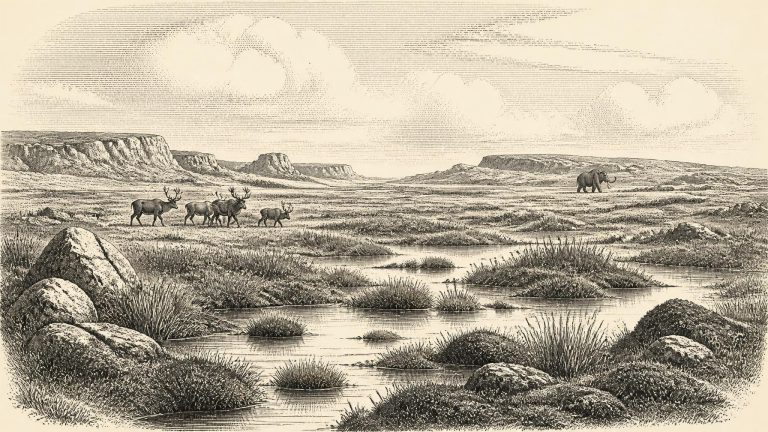
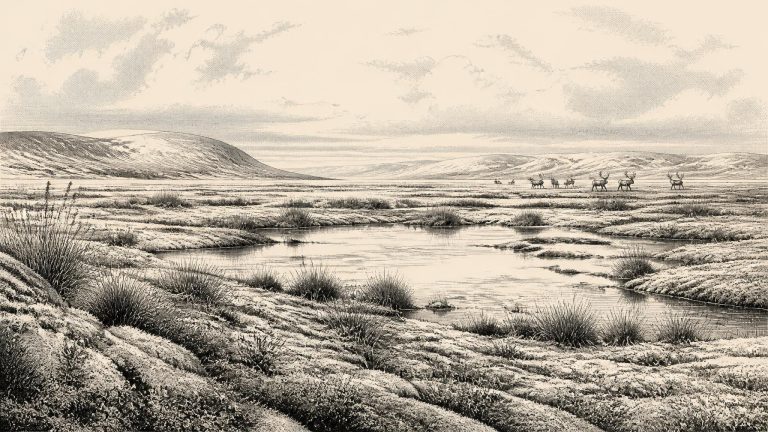
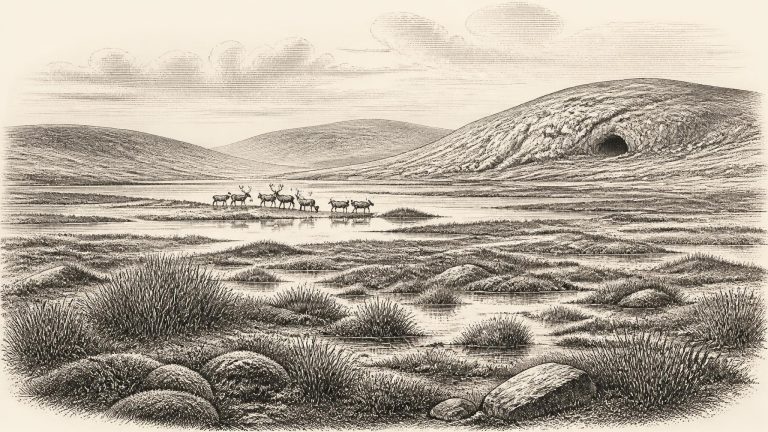
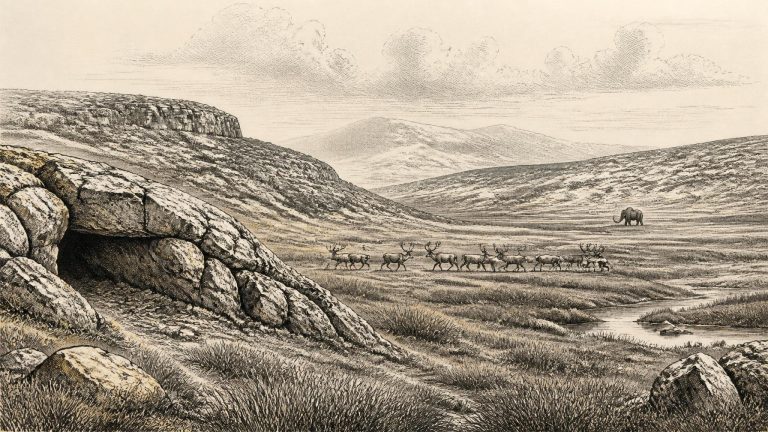
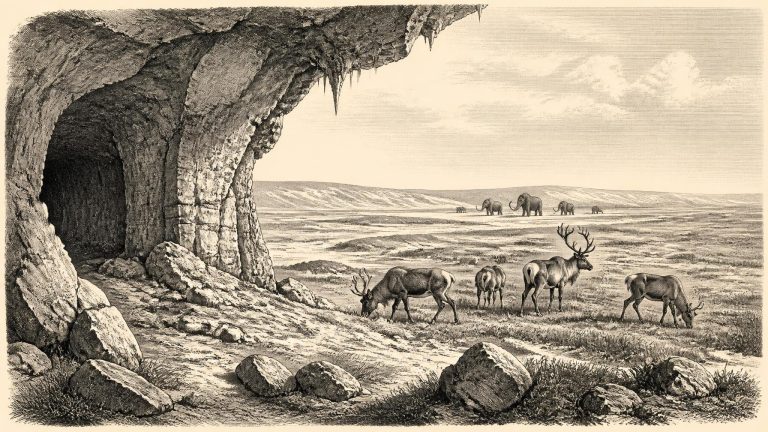
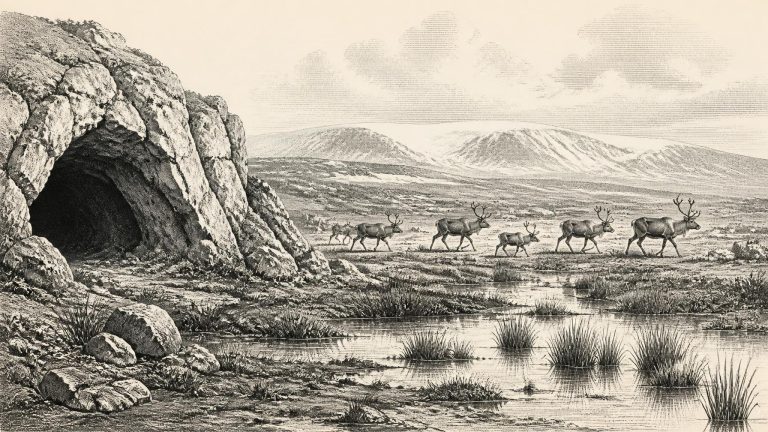
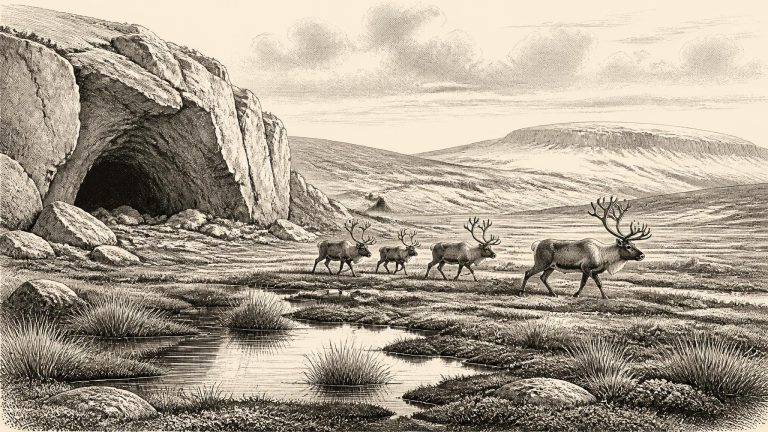
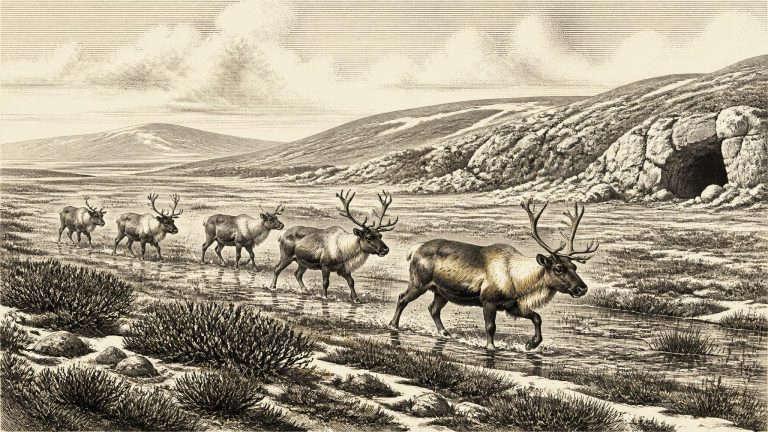
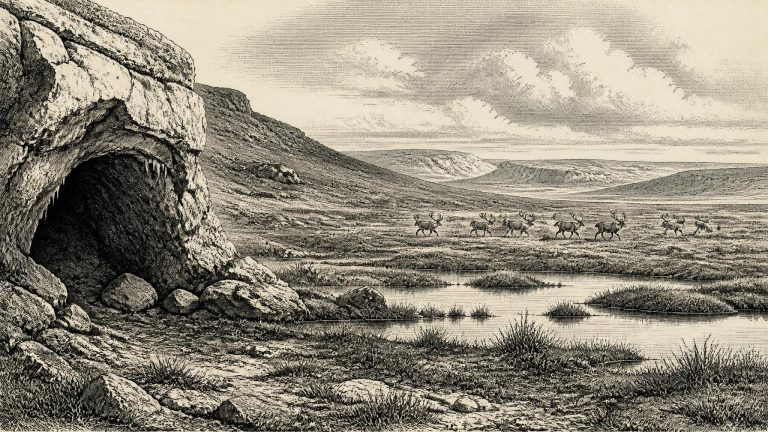
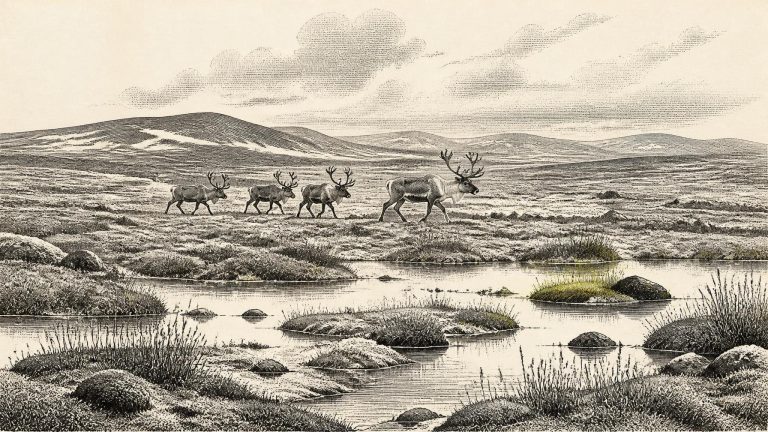
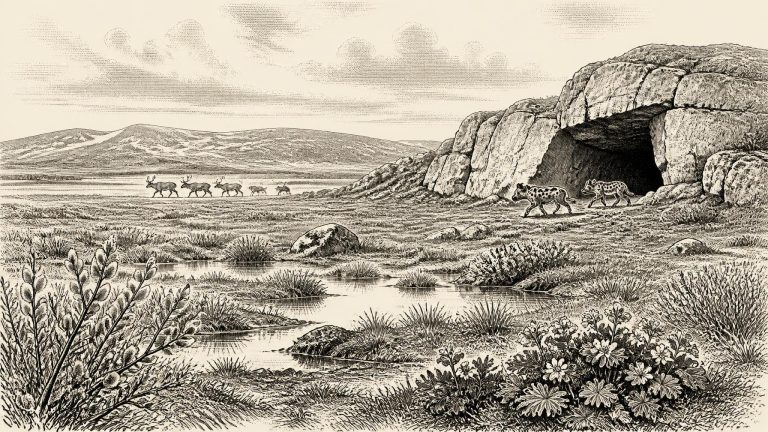
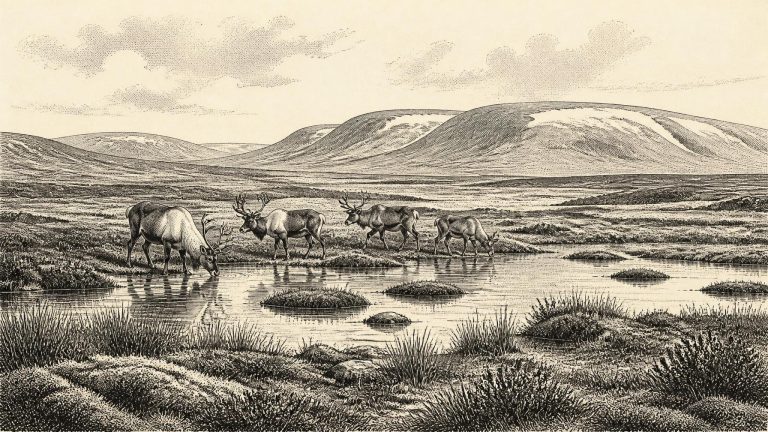
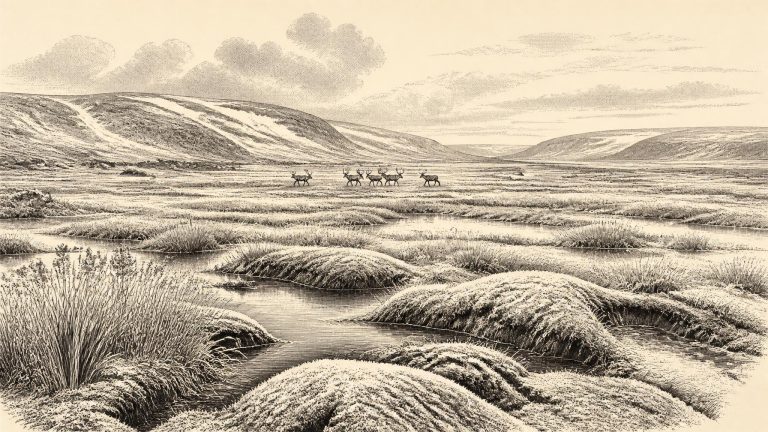
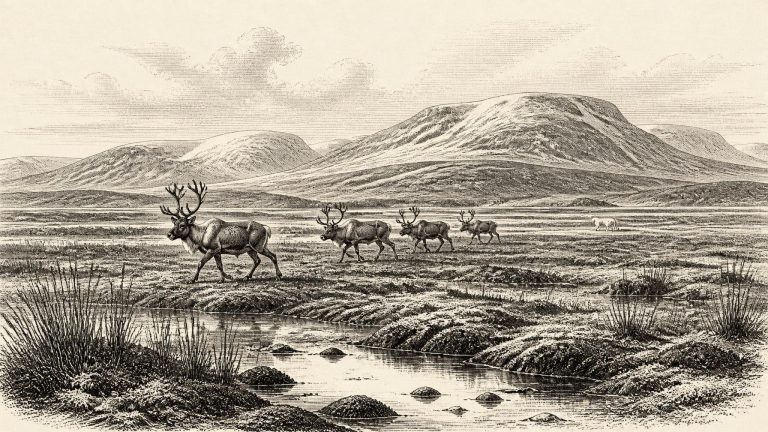
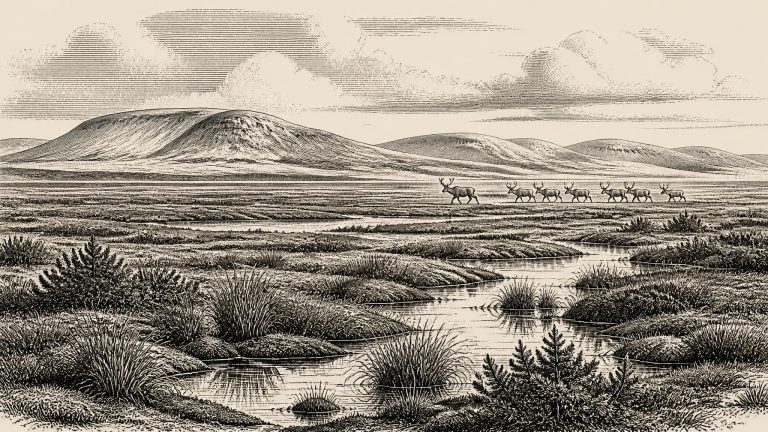
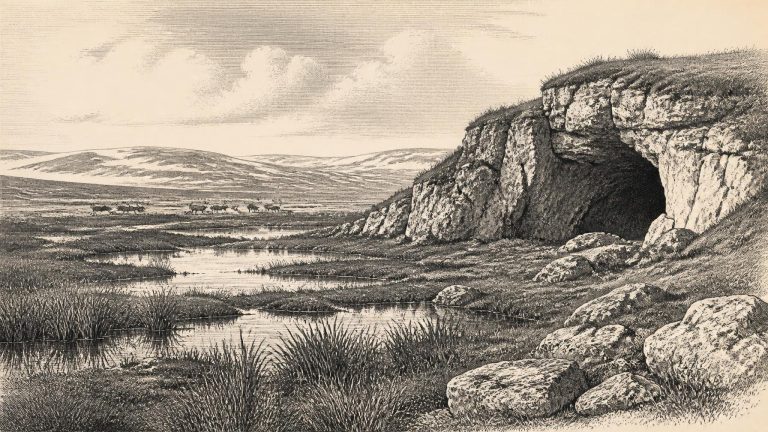
Derryvree is valuable because its organic silts were sealed between two tills: sediments left by advancing ice. Road works revealed a temporary environmental archive that would otherwise have been lost beneath later glacial deposits. Plant macrofossils, pollen, mosses and insect remains indicate open, treeless ground, with wet hollows, sedges, mossy vegetation and shallow freshwater. Bogbean and water-milfoil are among the plants that point to standing or slow-moving water. Juniper, dwarf willow, grasses and herbs belong to a low-growing vegetation cover rather than a wooded landscape.
Calendar years BCE are useful editorial tools, but radiocarbon laboratories report ages in years before present, where “present” conventionally means AD 1950. Those radiocarbon ages must then be calibrated against independently dated records of past atmospheric carbon. Around 30,000 radiocarbon years ago, calibration is especially important: radiocarbon and calendar time differ by several millennia, and ranges are broad. It is therefore better to say that deposits, animals or climatic episodes belong to intervals of the late Pleistocene than to assign them to 30,739 BCE as though a contemporary annal survived.
The label 30,894 BCE falls roughly 32,844 years before AD 1950, the conventional reference point for radiocarbon dating. That arithmetic is only a convenience. A radiocarbon age is not identical to a calendar age because atmospheric carbon levels have varied through time. Dates must therefore be calibrated against independently dated records, and around 30,000 radiocarbon years ago the resulting calendar ranges can extend across many centuries or millennia.
In archaeological convention, “before present” means before AD 1950. A modern BCE conversion can make an ancient age look misleadingly precise. The best evidence relevant to this point comes from deposits dated over centuries or millennia, not from a calendar. At Derryvree near Maguiresbridge, County Fermanagh, organic silts produced a conventional radiocarbon determination of 30,500 ± 1,170 radiocarbon years BP. Calibration gives a broader and differently shaped calendar range rather than one neat equivalent. Castlepook Cave, near Doneraile in north County Cork, has yielded animal bones spanning a long part of the Ice Age; revised dates show that some are substantially older than earlier measurements suggested. These records illuminate a changing Ireland around the thirty-first millennium BCE, but neither proves conditions everywhere on the island nor identifies one particular year.
Radiocarbon dates are not historical dates in the familiar sense. A laboratory measurement gives an age in radiocarbon years before present, conventionally before AD 1950. Because the amount of radioactive carbon in the atmosphere has altered through time, that measurement must be calibrated against independently dated natural records. At around 30,000 radiocarbon years ago, the resulting calendar range is necessarily broad. A determination from one sample may cover centuries or several millennia at high probability; it cannot identify a particular season, generation or numbered BCE year.
31,089 BCE is a modern label for a point in deep prehistory, not a year for which Ireland has a chronicle, named ruler, settlement record or recoverable political event. Modern calendar-year precision is not available. In the archaeological convention that counts backwards from AD 1950, it falls roughly 33,038 calendar years before present, but the evidence comes in radiocarbon ranges, disturbed cave deposits and long environmental sequences whose uncertainties are measured in centuries or millennia. The responsible subject is therefore Ireland during the later part of Marine Isotope Stage 3, before the fullest expansion of the Last Glacial Maximum ice sheet.
Modern calendar notation gives a deceptive appearance of precision. Radiocarbon determinations measure the remaining carbon isotope in once-living material; they must then be calibrated against changing atmospheric radiocarbon levels. Their results are ranges, and archaeological deposits can be mixed, redeposited or disturbed. A date such as 31,158 BCE is thus best used as a convenient point within a chronological window, not as the date of a hunt, migration or political event.
Ireland then stood within the Last Glacial Period, but not yet at the fullest extent of the last British–Irish Ice Sheet. The later maximum is generally reconstructed between about 27,000 and 24,000 years ago, although its growth, margins and timing varied greatly from one sector to another. Modelling and geological evidence indicate that ice masses were already developing across the Irish and British uplands by roughly 31,000 years ago, coalescing rapidly thereafter. For a point somewhat earlier than that, such as 31,201 BCE, the exact distribution of ice, open ground and coastal water around Ireland remains uncertain. It would be wrong to picture the whole island either as a uniform white ice cap or as an unbroken habitable plain.
31,219 BCE is a modern chronological label, not a year that anybody in Ireland could have named, recorded or remembered. No calendar, settlement sequence or event horizon can be resolved to that precision in the Late Pleistocene. In simple calendar arithmetic, it lies about 33,170 years before AD 1950, conventionally expressed as c. 33.2 thousand calibrated years BP. That conversion should not be mistaken for a radiocarbon measurement. At this depth of time, radiocarbon results require calibration and normally produce probability ranges rather than a single calendar year.
At about 33,000 calibrated years ago, Ireland stood before—not at—the fullest extent of the last glaciation. The term “Last Glacial Maximum” can be misleading if imagined as a single instant across every region. Ice sheets expanded and reached their greatest limits at different times. Current syntheses place substantial growth of the British–Irish Ice Sheet after roughly 35,000–32,000 years ago, while the Irish Sea sector expanded markedly from about 30,000 to 26,000 years ago; its furthest south-western advance came later, around 25,600 years ago. Thus 31,227 BCE belongs to an ice-building world whose outlines were changing over millennia, not to a settled, uniform age of ice.
Radiocarbon ages are not calendar dates by themselves. They measure the remaining carbon-14 in once-living material and must be calibrated against records of past atmospheric change. At more than 30,000 years ago, calibrated results commonly span centuries or longer. Even a securely dated bone tells us when an animal died within a probability range; it does not date every later movement, scratch or break affecting that bone. The numbered year is consequently best treated as a point within a much wider environmental interval.
Radiocarbon ages are not calendar dates straight from the ground. The amount of radioactive carbon surviving in an organic sample must be calibrated against independently dated environmental records, because atmospheric radiocarbon has varied through time. The further back one goes, the wider the probable calendar range may become. Moreover, a dated animal bone tells us when the animal lived and died, not necessarily the precise moment at which its bones were deposited, moved by water, gnawed by a carnivore or, if applicable, cut by a person.
No written language, political institution, named community or recoverable oral tradition can be placed in Ireland at this time. Nor can archaeologists identify a calendar day when a reindeer was killed, butchered or carried towards a cave. Radiocarbon dating measures the remaining radioactive carbon in once-living material and produces a probability range rather than a historical timestamp. Calibration is especially important beyond 30,000 years ago because atmospheric carbon levels varied markedly. A date on a bone establishes when the animal died within a range; it does not by itself date a mark on its surface to a precise instant.
At about 33.3 thousand cal BP, Ireland was still several millennia short of the Last Glacial Maximum, the coldest and most extensively glaciated part of the last glacial cycle. That later maximum is generally placed at roughly 26,500–19,000 cal BP, although ice-sheet advances and retreats varied around the island and its seas. MIS 3 itself was climatically unstable: severe cold phases alternated with comparatively milder interstadials. It would be misleading to picture all Ireland at this notional date as either an unbroken ice cap or a temperate green island. Conditions, ice margins, coastlines and habitats changed repeatedly over long timescales, while the exact configuration for this one calendar year cannot be recovered.
Radiocarbon years are not identical to calendar years, because atmospheric carbon-14 levels have varied through time. Calibration curves convert a laboratory measurement into one or more probability ranges, and uncertainty grows further back in time. The Derryvree result is especially valuable precisely because it is an age for organic matter in a recognisable sedimentary sequence, rather than an imagined date for a historical occurrence. Its broad calibrated range encompasses the modern label used here, but does not make 31,473 BCE uniquely demonstrable.
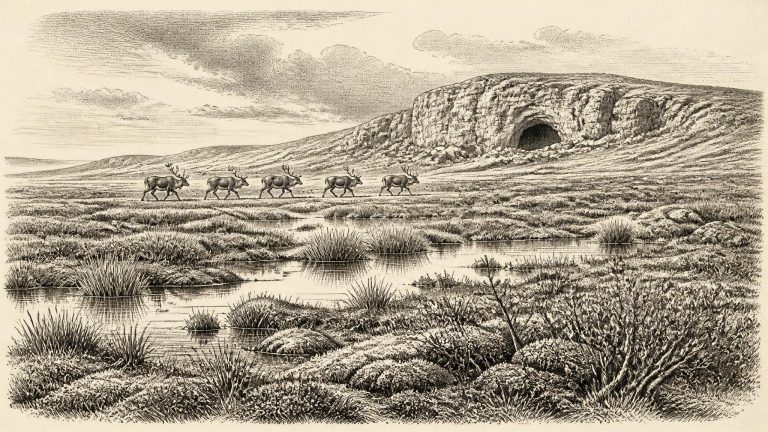
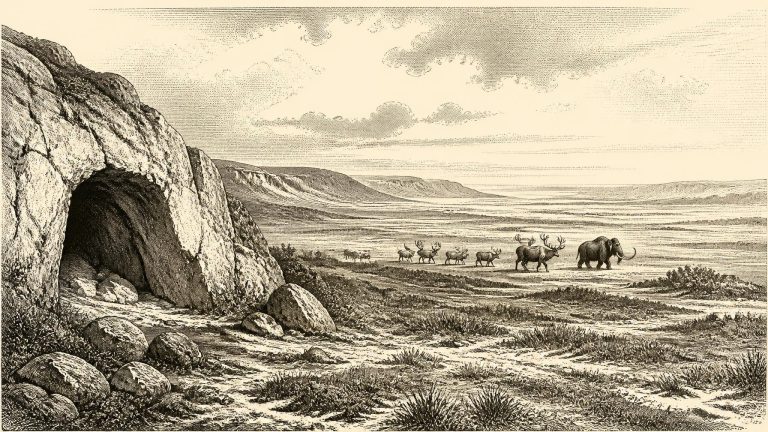
31,505 BCE is not a year that can be recovered from an Irish calendar, an annal or an excavation diary. It is a modern way of marking a point roughly 33,450 calibrated years before present (cal BP, where “present” is 1950). At this depth of time, modern calendar-year precision is unavailable. Radiocarbon results have statistical errors, calibration produces ranges rather than single moments, and deposits may represent repeated episodes rather than one season. The responsible question is therefore not “what happened in Ireland in 31,505 BCE?” but what evidence can illuminate conditions in and around Ireland during this part of the Middle Upper Palaeolithic and Marine Isotope Stage 3. The answer is fragmentary but important: buried wetland sediments, glacial layers, cave bones and a disputed-looking yet potentially consequential trace of animal processing.
The distinction between radiocarbon years and calibrated calendar ranges matters especially at this depth. Radiocarbon measurements are estimates with uncertainties; calibration translates them through a curve that itself becomes less precise further back in time. The older Irish literature often used broad phase names such as the Middle Midlandian or Derryvree Cold Phase. These are valuable regional frameworks, but they are not annual calendars. A determination from Derryvree near Maguiresbridge, County Fermanagh, of 30,500 ± 1,100 radiocarbon years BP has commonly been placed in a broadly late-MIS 3, cold but non-glacial interval. Calibrated ranges and correlations have changed as dating methods improve. The responsible conclusion is therefore approximate: around the later 30,000s cal BP, some Irish ground was ice-free and supported cold-adapted life; the precise extent of that ground at 31,564 BCE cannot be mapped with confidence.
The period belongs to the Midlandian, the Irish expression for the last major glacial stage. It preceded the fullest extent of the last British–Irish Ice Sheet, which came substantially later, broadly during the interval from about 26,500 to 19,000 years ago. That distinction matters. It would be wrong to picture the whole landmass at 31,588 BCE as permanently buried beneath the immense ice sheet of the Last Glacial Maximum. It would be equally wrong to imagine a stable, temperate island. The evidence indicates a North Atlantic landscape subject to large climatic shifts, regional contrasts and successive advances of ice.
The great ice-sheet maximum lay ahead, rather than being a single condition already fixed across the island. The British–Irish Ice Sheet grew rapidly during the later part of MIS 3 and reached its greatest overall area much later, around 26,000 years ago. Its margins did not advance everywhere at once. Accordingly, it is misleading to picture all Ireland in 31,605 BCE as buried beneath an unbroken ice cap, but equally misleading to imagine a mild green island. This was an unstable cold-world setting in which glaciers, periglacial ground and open habitats could all matter, varying by region and changing over generations beyond the resolution of the evidence.
Radiocarbon laboratories conventionally report ages in years “before present”, where “present” means 1950, not the current year. Such measurements are not direct calendar dates, because atmospheric carbon-14 has varied through time. The internationally used IntCal20 curve converts radiocarbon measurements into probability ranges in calendar years before 1950. At c. 30,000–40,000 years ago, those ranges may be broad and may contain more than one plausible interval. A single BCE label is consequently useful for ordering a long chronology, but it has a precision that the evidence itself does not possess.
The closest Irish evidence comes from local archives whose dates span centuries or millennia. At Derryvree, near Maguiresbridge in County Fermanagh, freshwater organic sediments lie between two layers of glacial till. The sequence records an interval when ice had withdrawn or was absent locally, before a later advance buried the deposits. A radiocarbon determination from Derryvree has been calibrated broadly to approximately 36,900–31,700 years before present. The notional date considered here sits within that wide range, but this does not make the deposit a record of conditions on one day, season or year. At Greenagho, also in Fermanagh, organic material beneath till has produced a calibrated range of roughly 37,200–35,700 years before present. Together, such deposits show that a simple picture of Ireland as continuously and uniformly ice-covered is untenable for this part of the last glacial period.
Radiocarbon determinations are reported in radiocarbon years and then calibrated against independently established curves to produce calendar-age ranges. Both the scientific measurement and the conversion have uncertainties. A calendar label such as 31,654 BCE is consequently much more precise-looking than the evidence permits. It should be treated as a point within a broad chronological neighbourhood, not as a moment at which conditions across the island can be reconstructed exactly.
Marine Isotope Stage 3, broadly spanning about 57,000 to 29,000 years ago, was not a single, uniformly frozen age. Across the North Atlantic it was marked by abrupt climatic oscillations: relatively milder interstadial episodes alternated with colder stadials. Temperature, precipitation, sea level, vegetation, river activity and the reach of glaciers all responded. Ireland’s record is too fragmentary to map those changes year by year, or even always century by century. It does show that the familiar image of an island continuously buried beneath a single immobile ice cap is wrong.
Radiocarbon and other scientific dates are estimates with ranges, not timestamps. At about 34,000 calibrated years ago, calibration itself is technically challenging: atmospheric radiocarbon varied over time, and the conversion from a radiocarbon measurement to calendar years depends on calibration curves and stated probability ranges. Older Irish cave collections bring a further problem. Many were excavated before present-day recording standards, so the original position of a bone within a deposit, and its relationship to other material, can be uncertain. A date on bone establishes when the animal died within a statistical range; it does not automatically date an apparent cut, a human visit, or a whole occupation.
Calendar precision is unavailable. An animal bone can be dated, within statistical limits, to the time when the animal died; it cannot by itself identify the season, the people who may have handled it, or an event in a numbered year. Calibration curves are essential because the concentration of atmospheric radiocarbon has changed through time, and the far past contains substantial uncertainty. Recent reassessment has also shown why older Irish cave dates require caution: improved pretreatment and ultrafiltration of bone collagen made several Castlepook results thousands of radiocarbon years older than earlier determinations. The date label used here is useful only as a navigational point within a broad, calibrated late-Pleistocene interval, not as a claim of exact chronology.
The distinction between radiocarbon years and calibrated calendar years matters especially at this depth of time. A radiocarbon result measures the remaining carbon-14 in organic material, but atmospheric carbon-14 levels have varied greatly. Researchers therefore calibrate results against internationally maintained curves such as IntCal20. At around 34,000 calendar years ago, calibration intervals can be broad, and revised laboratory pretreatment can substantially alter older results. A date written as 31,785 BCE should consequently be read as an approximate modern conversion, not as a date known to contemporaries or an exact timestamp for an archaeological layer.
Ireland was not yet necessarily the fully ice-covered land it became during the Last Glacial Maximum, conventionally placed later, broadly between about 26,500 and 19,000 years ago. The British–Irish Ice Sheet was growing and changing, however, while climate shifted abruptly between relatively milder interstadials and severe cold phases. It is misleading to picture a stable “Ice Age Ireland”. Conditions could differ greatly over centuries or millennia, and between exposed Atlantic coasts, uplands, river valleys and limestone lowlands.
Ireland stood well before the Last Glacial Maximum, when the British–Irish Ice Sheet expanded to cover most of the island. That later maximum is generally placed around 27,000 years ago in the British–Irish record, although its timing and extent varied from one ice-sheet sector to another. Around the nominal date used here, ice, water, vegetation and animal ranges were already changing on long and sometimes abrupt timescales. It is unsafe to picture a single fixed national landscape. Some places may have supported exposed ground and freshwater habitats during milder intervals; others lay nearer active or advancing ice; still others have left no surviving environmental record at all.
The apparent precision of 31,821 BCE must therefore not be mistaken for a precise archaeological moment. Radiocarbon determinations measure radiocarbon years before present, conventionally before 1950, and must be calibrated against changing atmospheric carbon levels to create calendar-age estimates. At great age the calibrated intervals can be wide, and old cave collections introduce further problems: bones may have been moved by animals, water, earlier excavation or later disturbance; material from different episodes can lie close together; and improved preparation techniques have revised some earlier Irish results substantially. The current IntCal20 calibration curve is especially important for the last glacial period, where revisions can alter calendar placement materially.