Doneraile’s Reindeer Cutmark31913 BCE
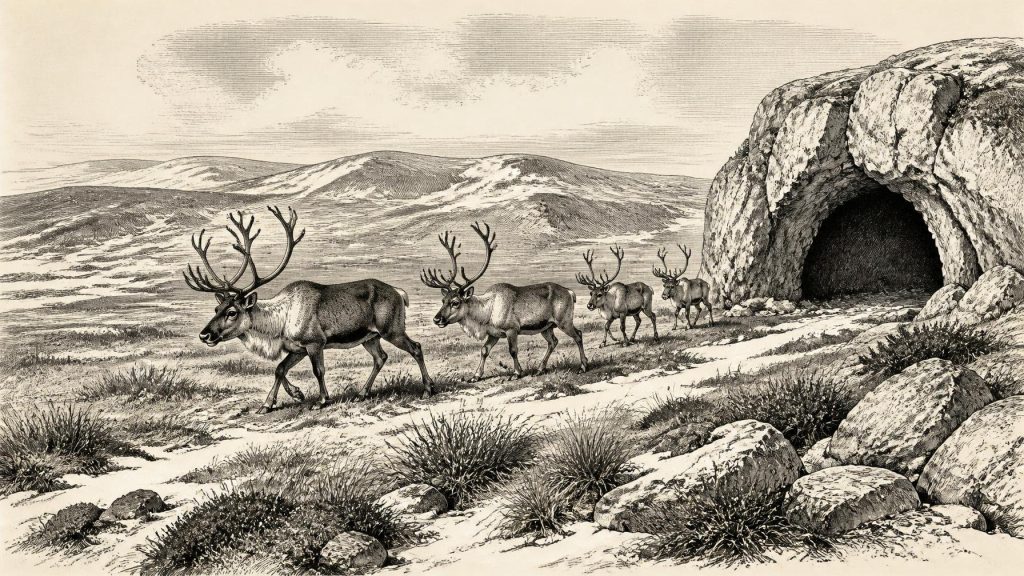
Labelled 31,913 BCE, this period cannot be treated as an observable calendar year, but lies within late Marine Isotope Stage 3, before the Last Glacial Maximum. Ireland was a cold, unstable mosaic of open vegetation, with advancing yet regionally variable ice. Castlepook Cave, County Cork, preserves crucial fossil evidence, including reindeer, mammoth, giant deer and predators, accumulated across different episodes. A reindeer femur reportedly bearing a stone-tool cut mark may indicate early human butchery, but remains unconfirmed and cannot prove settlement. Secure evidence places humans in Ireland only during the terminal Pleistocene. The era chiefly represents ecological change preceding glaciation.
Dateline
A date labelled 31,913 BCE offers a useful point from which to examine a very remote Irish past, but it must not be mistaken for a year that archaeology can observe. Nobody in Pleistocene Ireland used this calendar, and no excavation can assign an Irish camp, hunt or climatic episode to this particular twelve-month interval. At this depth of time, radiocarbon determinations carry substantial uncertainty and must be calibrated against changing atmospheric carbon levels; cave deposits may also mix remains accumulated at different moments. The responsible historical frame is therefore broader: this point falls within the later part of Marine Isotope Stage 3, a fluctuating cold phase before the Last Glacial Maximum.
What can be said is both limited and remarkable. Ireland was not yet the familiar green, wooded island of later prehistory. Its landscape was being reshaped by a severe Ice Age climate, and its best evidence comes not from houses or monuments but from animal bones, cave sediments, glacial landforms and the laboratories that date and reassess them. Around this broad period, north Cork’s Castlepook Cave, near Doneraile, preserves the island’s most important archive for the Pleistocene animal world before the great ice advance.
A Date Beyond Annual History
The numerical label 31,913 BCE is a modern conversion, not an exact prehistoric calendar date. For periods this old, scholars normally use calibrated years before present (cal BP, with “present” conventionally fixed at 1950) or broad geological stages. The calibration curve itself becomes less exact further back in time, while the survival of enough original collagen for radiocarbon dating is a separate challenge. Modern re-dating of Irish cave bones has shown why such caution matters: improved pretreatment has made several Castlepook dates thousands of radiocarbon years older than earlier results.
This does not make the evidence useless. It makes the questions more exacting. A directly dated bone can demonstrate that an animal was alive within a calibrated range. It cannot, by itself, date every bone lying nearby, establish a single intact living surface, or prove that people occupied the cave. The 31,913 BCE label should thus be read as an approximate window into a changing Late Pleistocene world, rather than a moment at which a known Irish event occurred.
Before the Ice Sheet’s Maximum
At this broad point in the chronology, the British–Irish Ice Sheet was growing but had not yet reached its fullest Last Glacial Maximum extent. Major reconstructions place the build-up of the ice sheet after roughly 35,000–32,000 years ago, with maximum conditions developing later, broadly between about 27,000 and 21,000 years ago. The timing was not uniform across Ireland: glaciers advanced, thickened and shifted differently in different sectors, while some mountain summits and margins experienced conditions distinct from the great ice streams.
That distinction is important for the south. Ireland should not be imagined as a single unchanging block of ice at 31,913 BCE. Its climate was cold, dry and unstable by modern standards, but the exact local extent of ice remains debated and has been reconstructed from landforms, offshore sediments and exposure dating. In the decades and millennia ahead, ice would transform drainage, scour valleys and redistribute vast quantities of sediment. Eskers, drumlins, glacial valleys and many other familiar elements of Ireland’s physical landscape belong to the longer legacy of these repeated advances and retreats, though they cannot be tied to this particular year.
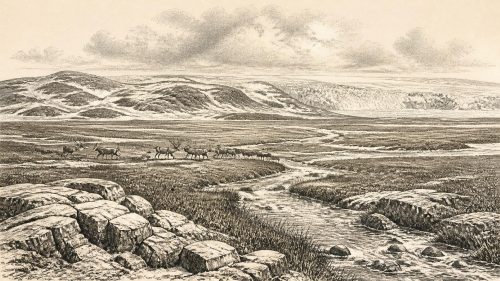
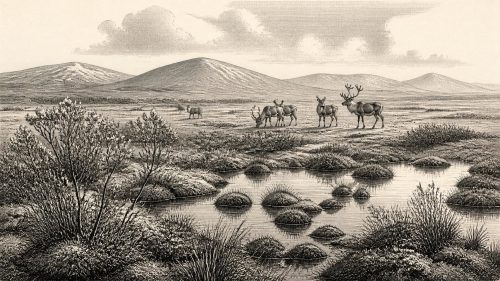
Vegetation appropriate to such a climate was sparse and open rather than forested. Grassland, herbs, sedges, dwarf shrubs and patches of tundra-like ground would have supported grazing animals where conditions permitted. It is better to call this a changing cold-stage mosaic than to picture one uniform “mammoth steppe” extending unchanged across the whole island. Pollen and fossil records are fragmentary, and local habitats would have varied with exposure, soil, snow cover, rivers and the approach of ice.
Castlepook’s Animal Archive
Castlepook Cave is central because its deposits have yielded an unusually rich range of Late Pleistocene remains. The early twentieth-century cave investigations recovered bones of reindeer, woolly mammoth, giant deer, brown bear, wolves, foxes, Arctic foxes, lemmings and spotted hyaena, among other animals. Such a list demonstrates that Ireland could support a far more cold-adapted and, at times, more formidable fauna than later historical Ireland. Yet it must not be treated as a census taken in one season. The cave accumulated material over a long span, and some specimens belong to separate climatic episodes.
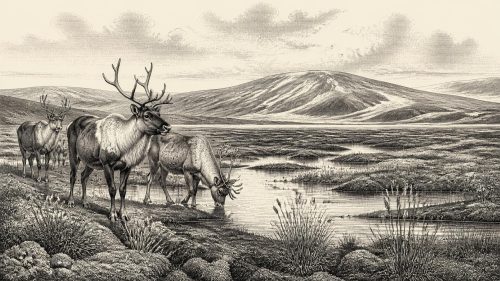
Recent work has materially altered the chronology. Re-dating indicates that some of Castlepook’s pre-Last Glacial Maximum animals are older than formerly believed, and research has suggested that giant deer and spotted hyaena may have disappeared locally around 40,000 calibrated years ago, well before the ice sheet’s maximum. For the broad era represented by 31,913 BCE, reindeer are especially relevant: they were animals of open, cold country and their remains occur at Castlepook. Mammoth, too, is securely part of the cave’s deeper Pleistocene record, although one should not claim that every species represented in the cave lived alongside every other species at this exact time.
The cave was not necessarily a place where people lived. Carnivores could drag carcass parts into underground shelters, scavenging could alter bones, water and sediment could move them, and the original excavators worked before modern methods of three-dimensional recording and fine-grained stratigraphic analysis. Castlepook is therefore a record of ecological processes as well as animal presence. New fieldwork seeks undisturbed deposits and applies techniques unavailable to the original investigators, including renewed dating and detailed study of bone surfaces and cave sediments.
The Reindeer Bone Question
The closest possible connection between this period and people is a reindeer femur fragment from Castlepook. County Cork heritage publications identify it as dating to about 31,000 BCE and describe a mark interpreted by zooarchaeologist Ruth Carden as having been made by a sharp stone tool during butchery. If that interpretation is confirmed through fully published specialist analysis and securely resolved chronology, it would be evidence that Upper Palaeolithic people reached Ireland much earlier than the previously accepted late-glacial human trace.
Its significance should not be overstated. The directly relevant bone was recovered from an old cave collection, not from a newly excavated, sealed hunting floor accompanied by tools, hearths and refitting debris. A cut-marked carcass bone, even if demonstrably human-modified, would show an act of butchery or carcass processing; it would not establish a permanent settlement, a population of any known size, or continuous occupation. Nor does it permit the naming of a people, language or cultural tradition on Irish soil. A brief visit by a small mobile group is a possible interpretation, not a demonstrated Irish society.
This cautious conclusion sits beside a firmer, much later result. At Alice and Gwendoline Cave in County Clare, a brown-bear kneecap bearing cut marks was independently dated to calibrated ranges of about 12,810–12,590 and 12,810–12,685 cal BP. That find is peer-reviewed evidence for a Late Upper Palaeolithic human presence after the worst glacial conditions had passed. It confirms that people did eventually reach Ireland in the terminal Pleistocene, but it cannot be projected backwards to prove occupation around 31,913 BCE.
No Kingdoms, No Settlements
There is no responsible basis for describing political affairs, diplomacy, warfare, rulers, tribes, law or territorial boundaries in Ireland at this date. There are no named people, inscriptions, graves, houses, weapons assemblages or monuments from which to reconstruct them. Likewise, there is no evidence for farming, herding, permanent villages, exchange networks, seafaring routes, formal religion, art or learning on the island in this period. These absences are not evidence that human groups elsewhere lacked culture; Upper Palaeolithic communities in other parts of Europe possessed sophisticated social worlds and material traditions. They simply cannot be imported into Ireland as facts.
If the Castlepook reindeer mark proves anthropogenic, it would make subsistence the only subject that can be approached directly: the removal of meat, tendon or hide from a large animal. Reindeer would have supplied valuable food and raw materials, and a travelling hunting party could have made practical use of a carcass. But even this remains an interpretation of one disputed or still-developing line of evidence. No Irish stone-tool assemblage of this age has been securely associated with it.
An Island in Ecological Transition
Regional change, rather than human history, is the chief story. During cold phases, lower sea levels altered the outlines of the surrounding seas and the geography of movement between Ireland, Britain and continental Europe. Whether particular routes were exposed, ice-blocked, marshy or navigable changed through time. The evidence does not justify a simple picture of a permanent land bridge that automatically delivered people and animals to Ireland. Colonisation depended on climate, available habitat, ice margins, sea crossings and chance, and these factors did not act in the same way for every species.
Castlepook’s bones show that large mammals and predators did reach Ireland before the Last Glacial Maximum. The subsequent expansion of ice and worsening environmental conditions likely eliminated or displaced many of them. Later recolonisation after deglaciation would produce a different, reduced fauna and eventually enable sustained human settlement. In that sense, 31,913 BCE belongs not to the beginning of continuous Irish history but to a much older ecological prelude: a cold and mobile world, known chiefly through fossil bone, approaching the disruptive power of the great ice sheet.
The most compelling lesson is methodological. Ireland’s deep past is continually revised as old museum collections are re-examined, measurements are recalibrated and caves are excavated with modern techniques. The reindeer bone near Doneraile may yet alter the story of the first human visits to the island. For now, it illuminates a possibility within a securely attested Ice Age landscape, not a year of recorded settlement or a lost prehistoric kingdom.
Primary Sources
- Prehistoric Details: Mell Flint Flake
- The Irish Quaternary Fauna Project
- A Reconsideration of the Radiocarbon Dating of the Marine Isotope Stage 3 Fauna from Southern Ireland
- New Insights on the Fauna of Ireland’s Younger Dryas and Early Holocene from Alice & Gwendoline Cave
- First Evidence of a Late Upper Palaeolithic Human Presence in Ireland
- Heritage Artefacts of County Cork
- The Archaeological Heritage of County Cork: An Overview
- Castlepook Cave, Castlepook South, Cork: 2022 Excavation Report
- Archaeology Research Excavation Grant 2022: Final Report
- The Exploration of Castlepook Cave, County Cork
- Occurrence of Mammalia Relicts at Site Castlepook Cave
- Figure 6: The Subdivision of the Quaternary Period in Ireland
- Extent and Timing of the Last Glacial Maximum in Britain and Ireland: A Review
- Growth and Retreat of the Last British–Irish Ice Sheet, 31,000 to 15,000 Years Ago: The BRITICE-CHRONO Reconstruction
- Last Glacial Maximum Cirque Glaciation in Ireland and Implications for Reconstructions of the Irish Ice Sheet
- Trimlines, Blockfields and the Vertical Extent of the Last Ice Sheet in Southern Ireland
- The Deglaciation of the Western Sector of the Irish Ice Sheet from the Inner Continental Shelf to its Terrestrial Margin
- Timing and Pace of Ice-Sheet Withdrawal Across the Marine–Terrestrial Transition West of Ireland During the Last Glaciation
- The IntCal20 Northern Hemisphere Radiocarbon Age Calibration Curve (0–55 cal kBP)
- Phylogeographic, Ancient DNA, Fossil and Morphometric Analyses Reveal Ancient and Modern Introductions of a Large Mammal: The Complex Case of Red Deer in Ireland
- Geology of Ireland
- Ireland Through Geological Time