Maguirebridge’s Buried Freshwater31848 BCE
Around 31,848 BCE, Ireland experienced the unstable cold conditions of Marine Isotope Stage 3, rather than a datable historical event. Landscapes varied between ice, periglacial ground, wetlands and exposed shelves, preceding the Last Glacial Maximum. At Derryvree, County Fermanagh, freshwater sediments enclosed by glacial tills preserve evidence of treeless tundra, mosses, sedges, pools and frost-affected terrain. Castlepook Cave, County Cork, contains a fauna including reindeer and Ice Age animals. A possibly tool-marked reindeer bone may indicate human presence, but no settlement, tools or occupation surface survives. The evidence documents environmental change and shifting animal communities, not prehistoric society or politics.
Dateline
The label 31,848 BCE is a modern chronological convenience, not a date that people in prehistoric Ireland could have recognised or recorded. It corresponds roughly to 33,800 calibrated years before 1950, but neither archaeology nor palaeoenvironmental science can resolve Irish events to a single calendar year at this depth of time. The responsible subject is therefore not an imagined annual episode but Ireland during the later part of Marine Isotope Stage 3: an unstable Ice Age interval preceding the Last Glacial Maximum.
No named inhabitants, rulers, communities or political territories can be identified. Indeed, there is no securely demonstrated settlement, hearth, house, burial, stone-tool assemblage or written evidence from Ireland that can be assigned to this particular point in time. What survives instead is a fragmentary archive of cave bones, buried sediments, pollen, insect remains, glacial landforms and dates with substantial margins of uncertainty. These traces illuminate a cold landscape repeatedly reshaped by climate; they do not permit a conventional national history.
A Date Within a Changing Ice Age
About 33,800 calibrated years ago, Ireland lay within the broad North Atlantic world affected by abrupt climatic shifts recorded especially clearly in Greenland ice cores. In that record, this approximate horizon falls close to the beginning of Greenland Interstadial 7, one of several comparatively milder interruptions within an overall cold glacial period. Such labels are valuable for comparison, but they must not be treated as a weather report for a given Irish valley or a single year. Climate signals took time to travel through different environments, while Irish terrestrial sequences are few and often difficult to date precisely.
The much more famous Last Glacial Maximum still lay ahead. Research on the British–Irish Ice Sheet indicates major expansion during the later part of the glacial cycle, with extensive ice reaching its maximum configuration principally around 27,000–23,000 calibrated years ago in different sectors. At the notional date considered here, therefore, Ireland should not simply be pictured as an island uniformly sealed beneath ice. Conditions varied sharply between regions and through time. Mountain glaciers, expanding ice masses, exposed ground, frozen soils, wetlands and seasonal meltwater channels could all have formed parts of the wider Irish environment.
Sea level was substantially lower than today because vast quantities of water were stored in global ice sheets. The outlines of the Irish Sea basin, Atlantic shelf and southern coast were consequently very different, with large areas of shelf exposed or transformed. Yet lower sea level does not by itself prove an easy land route into Ireland at this moment. The exact configuration of sea, ice, rivers and dry ground changed repeatedly, and evidence does not identify a particular crossing used by people or animals in 31,848 BCE.
The Derryvree Evidence
One of the most informative Irish records for the broader period lies at Derryvree near Maguiresbridge, County Fermanagh. Roadworks in 1969 cut through a drumlin and exposed freshwater silts and fine sands lying between two substantial sheets of glacial till. The deposit contained plant and animal remains and produced a radiocarbon determination of 30,500 radiocarbon years before present, with a large uncertainty range. It belongs broadly to the Middle Midlandian, or MIS 3, rather than offering a calendar-date snapshot.
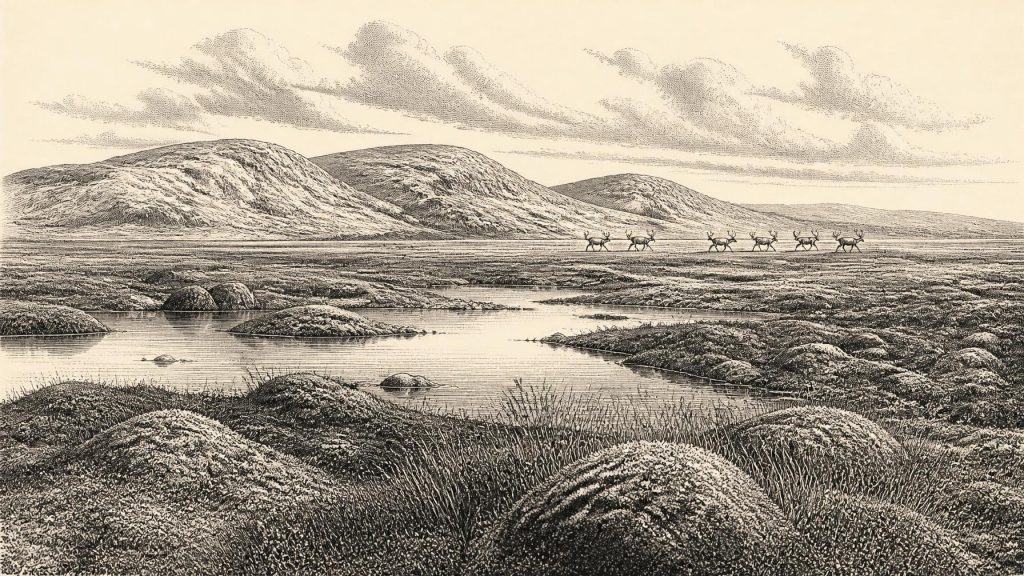
The Derryvree flora and fauna indicate open tundra vegetation and a periglacial regime. In practical terms, this was not a wooded Irish countryside of familiar oak, hazel, pasture and field. It was a cold, largely treeless setting with wet ground, shallow pools and vegetation able to withstand short growing seasons. Palaeoecological interpretation has compared the setting to muskeg: waterlogged ground rich in mosses and sedges, broken by open water and subject to frost. Insects, pollen and plant macrofossils are especially important because they register local habitats more directly than the later landscape forms left by ice.
Derryvree cannot be made to stand for every part of Ireland. It is a northern inland site, its sediments were subsequently overridden or bordered by ice, and its radiocarbon age has to be calibrated and interpreted alongside stratigraphy. Nevertheless, it demonstrates a crucial point: parts of Ireland preserved non-glacial freshwater environments during MIS 3, before later ice deposited the till that enclosed them. It is powerful evidence for environmental change, not evidence for a village, a hunting camp or a local population at Maguiresbridge.
Animals in the Cave Archive
Limestone caves in the south provide another, very different archive. Castlepook Cave near Doneraile in north County Cork has yielded one of Ireland’s richest collections of pre-Last Glacial Maximum vertebrate remains. Reassessment using improved radiocarbon methods has shown that several older cave chronologies were unreliable and that some animal remains are considerably older than formerly supposed. The result is not a simple, continuous sequence of animals walking through one cave chamber. Old excavations disturbed deposits, material moved within caves, and individual bones may have been brought in by carnivores, water or people.
Even with those cautions, the fauna establishes that Ireland was connected ecologically to the wider north-west European Ice Age world during portions of MIS 3. Reindeer are particularly relevant to the cold open habitats suggested by Derryvree. Other Castlepook material attests, at various times before the Last Glacial Maximum, to animals including brown bear, wolf, Arctic lemming, giant deer, woolly mammoth and spotted hyaena. These finds should not be converted into an annual list for 31,848 BCE. Some species may belong to substantially earlier episodes, and recent redating suggests that giant deer and spotted hyaena may have disappeared locally before about 40,000 calibrated years ago.
The cave record instead shows a shifting animal geography. Large herbivores required productive patches of grass, herbs, shrubs and wetland vegetation; predators and scavengers followed the opportunities they created. Caves themselves were not necessarily homes for every species represented within them. A hyaena den, carnivore scavenging place, natural trap, flood-affected cavity and humanly visited shelter can all leave bones, sometimes mixed together. Reading such deposits requires taphonomy: the study of what happened to remains from death to excavation.
The Human Question
The most intriguing evidence close to this broad timeframe is a reindeer femur from Castlepook Cave. The bone has been publicised as dating to roughly 33,000 years ago and as bearing a mark interpreted by its examiner as damage from a sharp stone tool during butchery. If both the dating and the anthropogenic interpretation withstand continuing scrutiny, it would suggest that Upper Palaeolithic people reached Ireland during a comparatively favourable phase before the Last Glacial Maximum.
That possibility matters greatly, but it must remain conditional. The femur derives from historic cave excavations rather than a modern excavation of an undisturbed occupation surface. No unquestionable stone tools, hearth, dwelling floor, human remains or repeated occupation deposits of the same age have yet been published from Ireland. A mark on bone must be distinguished from damage caused by carnivore teeth, sediment movement, trampling, excavation and later handling. The evidence could indicate a brief encounter between a small mobile hunting party and a reindeer; it cannot establish permanent settlement, continuous ancestry or a named ‘first Irish’ population.
There is consequently no basis for describing political affairs, diplomacy, warfare, law or social hierarchy in Ireland at this date. There were no states, kingships, churches, farms, ports, markets or monuments known from the evidence. Nor can religion, language, art, kinship systems or formal learning be recovered. Silence in these fields does not prove that visiting people lacked beliefs, stories, skills or social ties. It means that the surviving Irish record cannot responsibly describe them.
Life at the Margin
If people did enter Ireland during this phase, the most defensible comparison is with highly mobile Upper Palaeolithic hunter-gatherers elsewhere in north-west Europe. Their practical economy would have depended on knowledge of animal movements, weather, fuel, stone and shelter, rather than cultivation or livestock. Reindeer would have offered meat, hide, sinew, bone and antler, though none of these uses can be demonstrated from Castlepook beyond the disputed or provisional butchery inference. Exchange networks and sea crossings are conceivable in the wider European context, but no Irish artefact allows a trade route or place of origin to be reconstructed.
Settlement, in the durable archaeological sense, is absent. A short seasonal stop can leave almost nothing, especially in a terrain later eroded by glaciers, frost, rivers and rising seas. Conversely, the lack of evidence cannot be used to fill the gap with certainty. The most important historical development around 31,848 BCE was environmental, not political: Ireland was part of a fluctuating cold-world frontier, inhabited by changing animal communities and approaching a far more severe phase of ice-sheet growth. Derryvree’s buried freshwater sediments and Castlepook’s difficult bones are the traces from which that restrained history must be built.
Primary Sources
- Middle Midlandian Freshwater Series at Derryvree, Maguiresbridge, County Fermanagh, Northern Ireland
- A Reconsideration of the Radiocarbon Dating of the Marine Isotope Stage 3 Fauna from Southern Ireland
- The Irish Quaternary Fauna Project
- Palaeoecology
- The Subdivision of the Quaternary Period in Ireland
- Growth and Retreat of the Last British–Irish Ice Sheet, 31,000 to 15,000 Years Ago: the BRITICE-CHRONO Reconstruction
- Pattern and Timing of Retreat of the Last British-Irish Ice Sheet
- Late Pleistocene Chronostratigraphy and Ice Sheet Limits, Southern Ireland
- Early Deglaciation of the British-Irish Ice Sheet on the Atlantic Shelf Northwest of Ireland Driven by Glacioisostatic Depression and High Relative Sea Level
- New Data for the Last Glacial Maximum in Great Britain and Ireland
- Exposure-Age Constraints on the Extent, Timing and Rate of Retreat of the Last Irish Sea Ice Stream
- Phylogeographic, Ancient DNA, Fossil and Morphometric Analyses Reveal Ancient and Modern Introductions of a Large Mammal: the Complex Case of Red Deer (Cervus elaphus) in Ireland
- Palaeobiology of an Extinct Ice Age Mammal: Stable Isotope and Cementum Analysis of Giant Deer Teeth
- New Insights on the Fauna of Ireland's Younger Dryas and Early Holocene from Alice & Gwendoline Cave
- Archaeological Excavations at Killuragh Cave, Co. Limerick
- Radiocarbon Dating and Chronological Modelling: Radiocarbon Dating
- Scientific Dating of Pleistocene Sites: Introduction
- ORAU Calibration
- The Greenland Ice Core Chronology 2005, 15–42 ka. Part 1: Constructing the Time Scale
- Independent Tephrochronological Evidence for Rapid and Synchronous Oceanic and Atmospheric Temperature Rises Over the Greenland Stadial-Interstadial Transitions Between ca. 32 and 40 ka b2k
- Heritage Artefacts of County Cork 2021
- An Island World?