Doneraile’s Reindeer Landscape31847 BCE
Around 31,847 BCE, Ireland lay within the climatically unstable MIS 3 interval, not a precisely datable historical year. Cold, varied landscapes included periglacial tundra wetlands, documented at Derryvree, while later glaciation erased much evidence. Castlepook Cave, County Cork, preserves mixed remains of reindeer, mammoth, giant deer, hyaena, wolves, lemmings and other fauna, indicating periodically open, treeless habitats. A reindeer femur reportedly bears a stone-tool cut mark, suggesting possible human carcass processing around 31,000 BCE. However, no associated tools, hearths or settlement evidence confirm occupation. Changing sea levels, ice and lost coastal deposits obscure access routes. Perhaps transient human visits occurred.

Dateline
The label 31,847 BCE creates a useful point of orientation, but it must not be mistaken for a date available to the people, animals or landscapes of Ice Age Ireland. No calendar, written record or archaeological sequence can distinguish one year from the next at this depth of time. In modern archaeological terms, the date falls roughly 33,800 calendar years before AD 1950, within the Late Pleistocene and Marine Isotope Stage 3 (MIS 3), a long, unstable climatic interval conventionally spanning about 57,000 to 29,000 years ago. Evidence is dated in calibrated ranges, radiocarbon measurements and geological phases, often with uncertainties of centuries or more. The responsible history of Ireland at this point is therefore not a chronicle of events but an account of a changing environment, its sparse fossil archive, and the very limited possibility of human presence.
A Landscape Before the Ice Peak
Ireland was approaching, but had not yet reached, the maximum expansion of the last British–Irish Ice Sheet. That later maximum is now generally placed around 26,000 calendar years ago, with the greatest ice volume following several millennia later. Around the notional year considered here, cold conditions certainly prevailed, but neither temperature nor ice cover was uniform across the island. MIS 3 was punctuated by abrupt shifts between relatively milder interstadials and severe stadials. The island’s terrain was consequently altered by frost, seasonal thaw, wind, snow and moving water as well as by the fluctuating margins of ice.
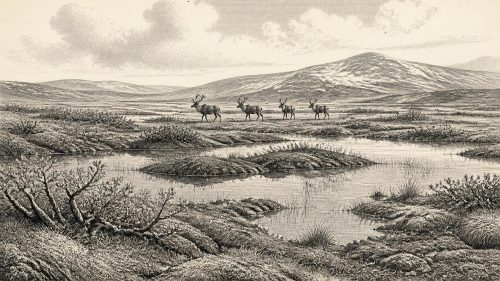
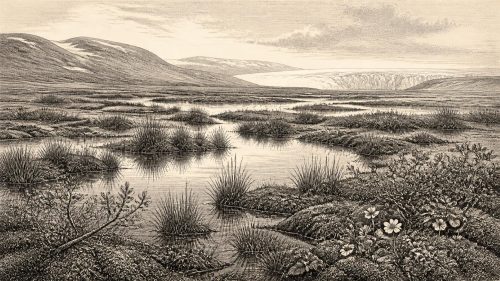
The best Irish evidence does not permit a map of conditions for 31,847 BCE itself. It does, however, show that some landscapes survived outside or between phases of glaciation. At Derryvree near Maguiresbridge in County Fermanagh, organic-rich freshwater silts and fine sands lay between two substantial tills. Their radiocarbon age, published as about 30,500 radiocarbon years BP, and their fossils indicate a cold, periglacial setting with open tundra vegetation. The deposit belongs broadly to the same middle part of the last glacial cycle, rather than to a particular calendar year. Its importance is that it preserves a rare interval when freshwater pools, marshy ground and tundra plants existed in inland Ireland before later ice overrode or buried the landscape.
Such evidence cautions against imagining the whole country as either continuously ice-covered or wholly hospitable. Conditions were regional and temporary. Exposed ground may have included grass, sedges, mosses, dwarf shrubs and scattered hardy herbs, with little or no woodland. Frozen ground and short growing seasons restricted plant cover, while wind could redistribute silt and snow. Valleys and lowlands offered different opportunities from uplands, coasts and ice margins. Today’s familiar rivers, soils, bogs and coastlines cannot simply be projected backwards: later glaciers scoured bedrock, shifted sediment, deepened basins and destroyed or concealed much of the older record.
The Cave Record of North Cork
The most evocative evidence for southern Ireland comes from Castlepook Cave, also known as Mammoth Cave or Doneraile Cave, in the Awbeg Valley below the Ballyhoura Hills in County Cork. Excavated principally in the late nineteenth and early twentieth centuries, its passages yielded a remarkable accumulation of animal remains. The original excavators recognised bones of reindeer, giant deer, mammoth, wolf, fox, brown bear, spotted hyaena, hare and lemmings. Later reassessment and radiocarbon dating have established that the cave contains material from more than one period. It is not a single sealed deposit or a snapshot of one Ice Age day.
That distinction matters. Some bones probably entered the cave through carnivore activity, natural deaths, water movement or the reworking of sediments; other material may have been disturbed by earlier excavation. A bone from the same passage is not automatically contemporary with every other bone. Modern studies have also shown that some earlier radiocarbon results from Irish caves required revision as laboratory pretreatment improved. Castlepook remains exceptionally important precisely because it is both rich and difficult: it records real Pleistocene animals in Ireland, yet demands careful separation of secure observations from attractive stories.
The fauna nevertheless illuminates an ecological world appropriate to broad MIS 3 conditions. Reindeer imply open, cold-country grazing habitats. Arctic and Norwegian lemmings, mountain hare and Arctic fox reinforce the picture of a treeless or sparsely vegetated environment. Wolf and spotted hyaena were major carnivores; hyaenas in particular could carry and accumulate bones in dens, complicating any claim that a cave was a human camp. Mammoth and giant deer demonstrate that Ireland periodically supported large herbivores, although fossil evidence does not prove that all listed species shared precisely the same locality or season. Their presence also shows that the island’s animal history was not that of the much later, comparatively species-poor Ireland.
A Reindeer Bone and a Large Question
This period has special significance because a reindeer femur from Castlepook has been reported as bearing a single mark interpreted by zoologist Ruth Carden as a cut made by a sharp stone tool during carcass processing. County Cork heritage material presents the bone as dating to about 31,000 BCE. If that interpretation and broad dating are sustained, it would indicate that people reached Ireland far earlier than the previously accepted Late Upper Palaeolithic evidence from Alice and Gwendoline Cave, County Clare. There, a brown-bear patella with cut marks has two independently obtained calibrated ranges of 12,810–12,590 and 12,810–12,685 cal BP.
The Cork bone is therefore directly relevant to a year around 31,847 BCE, but it must be described with restraint. Its reported date is approximate and does not establish activity in this exact numbered year. Nor does one modified bone prove a permanent settlement, a named archaeological culture, a continuous population or descent from those visitors to later Irish communities. No securely associated stone tool, hearth, dwelling surface, burial, human bone or extensive processing area of comparable age has yet been recovered from Ireland. The evidence supports, at most, a plausible episode of human interaction with a reindeer carcass during the wider MIS 3 period.
That possibility is still consequential. A sharp incision on fresh bone is consistent with cutting meat, separating joints or removing hide and sinew. If humans made it, the mark records practical knowledge and a stone edge rather than ceremony or monumental culture. Reindeer could provide food, fat, hides, tendon, antler and bone; a mobile hunting party elsewhere in north-west Europe would have understood those resources well. Yet it would be speculation to reconstruct their clothing, language, family structure, weapons, route into Ireland or length of stay from this isolated trace. The useful conclusion is modest: Ireland may have been visited and exploited intermittently, not demonstrably occupied as a settled homeland.
Mobility Without a Political Map
There can be no political history in the later sense for this date. There were no known kingdoms, chiefs, boundaries, treaties, diplomatic envoys or institutions in Ireland, and no evidence from which to infer them. Nor is there evidence for warfare between people. Conflict visible in the record is ecological: large herbivores negotiated cold, hunger and predation; wolves and hyaenas competed for carcasses; caves could be shelters, dens and traps for remains. To turn these relationships into a human political drama would be to invent what the archaeology does not contain.
The same limits apply to religion, art and learning. No ritual site, burial, rock art, musical instrument, ornament or symbolic object of this age has been securely identified in Ireland. The absence of such finds does not prove that visitors lacked beliefs, traditions or skilled knowledge; it shows only that none has survived in a recoverable Irish context. If people processed a reindeer, they would have possessed learned techniques of tracking, butchery and using stone, passed between individuals. Archaeology can responsibly recognise the likelihood of competence without assigning a particular identity or belief system to its bearers.
Crossings, Coasts and Lost Evidence
How animals, and perhaps people, reached Ireland remains a central problem. Lower global sea levels during the glacial cycle exposed large areas of the continental shelf and transformed the Irish Sea region. But lower sea level did not automatically create a broad, dry and enduring land bridge from Ireland to Britain or continental Europe. Ice, water depth, crustal movement and local topography all mattered. Research on later glacial and post-glacial sea levels finds no simple, long-lived route that can be assumed for every period. At 31,847 BCE, any connection or crossing route must remain a question for reconstruction, not a fact supplied by a modern map.
Much evidence may also be missing. Subsequent ice sheets eroded surfaces, while rising seas later submerged extensive former coastal plains and valleys. Acid soils destroy bone, and early cave excavations did not always record layers to modern standards. These processes help explain why Ireland’s earliest record is so much thinner than that of parts of Britain or continental Europe. They do not, however, allow absence to be filled with imaginary camps. New excavation at Castlepook has sought undisturbed Pleistocene deposits, while museum collections and old excavation notebooks continue to yield information through improved dating, microscopy and zooarchaeological analysis.
An Archive, Not an Anniversary
For Ireland around 31,847 BCE, the leading story is not of a people who can be named but of a land at an environmental threshold. Tundra wetlands in Fermanagh, bone-bearing limestone caves in Cork and the wider evidence for growing ice sheets indicate a cold, variable island landscape before the last glacial maximum transformed it. Reindeer are the most important animal in the human question because one Castlepook femur may preserve a tool mark. Mammoth, hyaena, giant deer and lemmings are equally important for showing the unexpectedly varied Ice Age fauna that reached Ireland during the broader period.
Modern calendar precision is unavailable here. The numbered year should be read as an invitation to examine a calibrated prehistoric horizon, not as an anniversary on which an event can be placed. What survives is fragmentary but compelling: sediments, bones, cave passages and a possible human cut mark. Together they describe an Ireland exposed to climatic instability, inhabited at intervals by cold-adapted animals, and perhaps touched by mobile hunters whose presence is still more a promising archaeological question than an established chapter of settlement history.
Primary Sources
- The IntCal20 Northern Hemisphere Radiocarbon Age Calibration Curve (0–55 cal kBP)
- IntCal Publications
- A Reconsideration of the Radiocarbon Dating of the Marine Isotope Stage 3 Fauna from Southern Ireland
- First Evidence of a Late Upper Palaeolithic Human Presence in Ireland
- Revisiting Alice and Gwendoline Cave, Co. Clare: New Light on the 1902 Excavations
- New Insights on the Fauna of Ireland's Younger Dryas and Early Holocene from Alice & Gwendoline Cave
- The Irish Quaternary Fauna Project
- Middle Midlandian Freshwater Series at Derryvree, Maguiresbridge, County Fermanagh, Northern Ireland
- Growth and Retreat of the Last British–Irish Ice Sheet, 31,000 to 15,000 Years Ago: the BRITICE-CHRONO Reconstruction
- Pattern and Timing of Retreat of the Last British-Irish Ice Sheet
- The Problem of a Late Quaternary Landbridge Between Britain and Ireland
- Deglaciation, Earth Crustal Behaviour and Sea-Level Changes in the Determination of Insularity: A Perspective from Ireland
- The Island of Ireland: Drowning the Myth of an Irish Land-Bridge?
- The Exploration of Castlepook Cave, County Cork, Being the Third Report from the Committee Appointed to Explore Irish Caves
- Occurrence of Mammalia Relicts at Site Castlepook Cave
- 2022:564 – Castlepook Cave, Castlepook South, Cork
- Heritage Artefacts of County Cork 2021
- Areas of Scientific Interest in County Cork: Castlepook Caves
- Mammoth Cave, Irish Caves Database
- Pleistocene Vertebrates in the British Isles
- Advances in Irish Quaternary Studies
- Mammals, National Museum of Ireland