Castlepook’s Incised Femur31694 BCE
The nominal date 31,694 BCE cannot describe an event, but denotes a broadly dated MIS 3 interval of climatic instability. Ireland was a changing glacial frontier, with shifting ice, water and open terrain. Derryvree sediments record cold, treeless freshwater tundra between glacial advances; Crag Cave indicates episodic milder conditions. Castlepook Cave preserves diverse Ice Age fauna, though bones accumulated over time and are not contemporaneous. An incised reindeer femur may indicate stone-tool butchery and Ireland’s earliest human presence, but lacks secure contextual evidence. The article concludes that mobile hunter-gatherers may have visited, without proof of settlement, continuity or social details.
Dateline
A Date Outside Calendar History
“31,694 BCE” is a useful modern filing point, not a date at which an event can be assigned to Ireland. No written record, named individual, settlement sequence or archaeological layer can resolve a particular Irish year so far back. In scientific terms the point falls at roughly 33,600 calibrated years before present (cal BP, where “present” is AD 1950), within Marine Isotope Stage 3, a long and climatically unstable portion of the last glacial cycle. At this depth of time, radiocarbon dates come with substantial ranges and are periodically revised as laboratory methods and calibration curves improve. Modern IntCal20 calibration extends to 55,000 cal BP, but it does not turn a bone, pollen sample or silt bed into a diary entry.
The most responsible account of Ireland at this point is therefore regional and evidential. It concerns a cold, changing north-western edge of Europe; the plants, animals, water and ice that left durable traces; and one exceptional north Cork bone which may preserve evidence of people. It cannot responsibly supply a king, tribe, battle, diplomatic encounter, religion or a permanent community. Those categories belong to much later historical societies, not to the sparse and disturbed evidence available for Ice Age Ireland.
An Uneven Glacial Island
Ireland was not yet at the climatic climax usually called the Last Glacial Maximum. The maximum spread of the British–Irish Ice Sheet was asynchronous from region to region, with its greatest overall extent around 26,000 years ago; research on the western and southern Irish sectors places major ice expansion after the period considered here. This does not mean a mild or uniformly ice-free island. It means that ice margins, frozen ground, exposed terrain, drainage and coastal geography were changing at different rates in different places. The familiar modern outline of Ireland was not an adequate guide to the available land or routes of movement.
Crag Cave in County Kerry offers an important independent indication of this instability. Calcite formations in a shallow cave can grow only when liquid water percolates through soil and rock, conditions incompatible with permanent deep freezing at the site. Uranium-thorium dates show episodic speleothem growth in south-west Ireland through much of the last glacial period, with particularly active deposition in the later part of MIS 3. That is evidence for intervals of amelioration, not for a warm Ireland or for a stable climate. The same study identifies swings of at least 10°C between colder and milder phases.
For people and animals, such variation mattered more than any notional annual date. A short-lived improvement could alter snow cover, plant growth, freshwater availability and the practical permeability of a landscape. A return to severe cold could reverse those advantages. Ireland was a western frontier within a wider European world of shifting ice, sea and open ground.
Derryvree’s Wet Tundra
The clearest Irish environmental archive close to this horizon lies at Derryvree near Maguiresbridge, County Fermanagh. Road works exposed freshwater silts and fine sands caught between two tills: sediment left by an earlier glacial episode lay beneath them, while later ice-related deposits sealed them above. This order of layers is firm evidence for a non-glacial freshwater interval between episodes of glaciation. It is not evidence that every district in Ireland was simultaneously open, nor that the later drumlin landscape had already taken its modern form.
The organic material from Derryvree produced a conventional radiocarbon result of about 30,500 ± 1,170 radiocarbon years BP. Published calibrated discussion places the deposit broadly around 36,900–31,700 cal BP. The modern calendar label 31,694 BCE lies within that broad span, but cannot be located more precisely inside it. Derryvree consequently illuminates the kind of landscape that could exist around this point, not the weather or biological activity of an exact year.
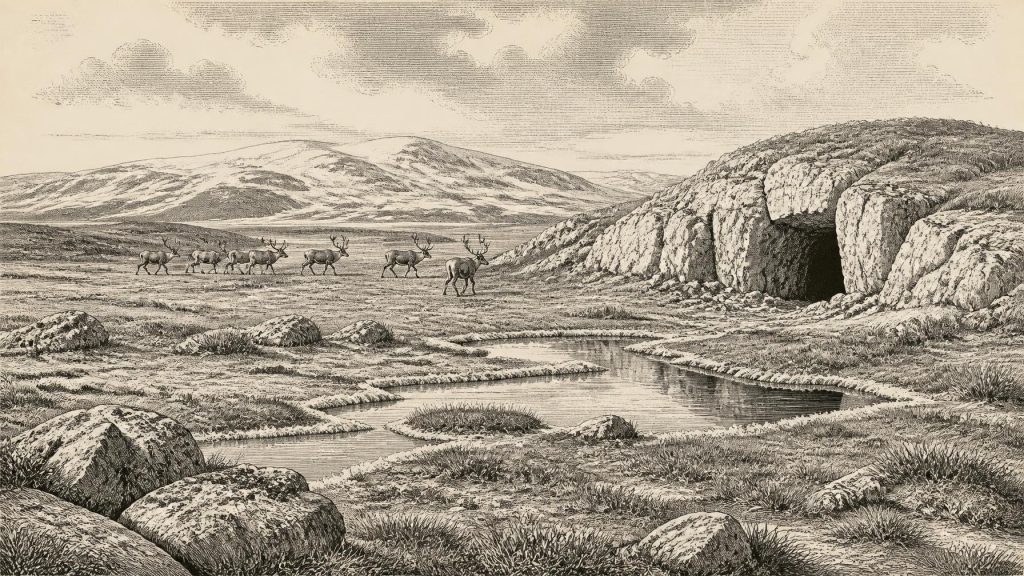
Pollen, plant macrofossils, mosses and insects from the deposits indicate a cold, largely treeless setting. Sedges, grasses, herbs, dwarf shrubs, mossy wet ground and open water formed a periglacial mosaic sometimes compared with muskeg: saturated ground punctuated by shallow pools and subject to frost. This was neither a barren sheet of snow nor the later wooded island of oak, elm, hazel and ash. Short growing seasons constrained vegetation, yet freshwater margins could support a varied, productive local ecology. Nearby Greenagho provides a further Fermanagh inter-till record, reinforcing the conclusion that parts of the region experienced cold but biologically active intervals before later ice advance.
The Animals of Castlepook
Nearly 300 kilometres south-west of Derryvree, Castlepook Cave near Doneraile in County Cork preserves Ireland’s richest known assemblage of vertebrate remains from the period leading towards the Last Glacial Maximum. Its narrow limestone passages and chambers accumulated bones over a long interval rather than during one event. The cave’s fossil record includes woolly mammoth, reindeer, giant deer, brown bear, wolf, Arctic fox, mountain hare, lemmings and spotted hyaena. Such a list is evidence that these animals reached Ireland at different points in the Ice Age; it must not be read as a single, perfectly contemporary herd-and-predator scene.
Recent redating has made that caution especially necessary. Improved treatment and accelerator radiocarbon methods showed that several bones from Castlepook were significantly older than earlier determinations suggested. The revised work indicates that some animals, including giant deer and spotted hyaena, may have disappeared locally before roughly 40,000 cal BP. Castlepook remains indispensable, but it is a cave archive assembled through carnivore activity, natural deaths, transport, sediment movement and early excavation, rather than an intact open-air habitat sampled in a single season.
Even with those limits, the fauna conveys the scale of the Irish environment. Reindeer point to open, cold terrain and seasonal mobility; hares, foxes and lemmings to northern or alpine-style conditions; mammoth and giant deer to a landscape with enough forage and accessible ground for large herbivores. Spotted hyaenas and wolves indicate carnivores capable of scavenging, hunting and carrying remains into shelter. A cave may thus represent a den, trap, refuge or bone-collecting place, not simply the spot where an animal died. The animal evidence supports an ecologically connected Irish landscape, but not a simple reconstruction of population sizes or migration routes.
The Reindeer Bone Question
One Castlepook specimen matters particularly for the human story: a fragment of reindeer femur carrying a deep incision interpreted by zooarchaeologist Ruth Carden as a mark made with a sharp stone tool during butchery. County Cork heritage material identifies the object as a Palaeolithic reindeer femur from Castlepook, conventionally presented as c. 31,000 BC. If the modification is anthropogenic, it is potentially the earliest known sign of people in Ireland by a very large margin.
Its importance must be matched by restraint. The specimen comes from an old cave collection, not a modern excavation of an undisturbed hearth, floor or hunting stand. No securely associated stone-tool assemblage, dwelling, fire-place, human burial or repeated occupation surface of comparable age has been recovered. A radiocarbon result dates the animal’s death, rather than automatically dating a cut, identifying the place of butchery, or measuring how long people remained nearby. The cave’s carnivores may have transported discarded or scavenged portions of carcasses into the galleries. Current Castlepook research has explicitly sought intact deposits and direct evidence such as lithics, charcoal and further modified bone because the question is not yet settled by a single marked specimen.
The strongest conclusion is therefore modest but momentous: people may have reached Ireland during MIS 3 and may have processed reindeer in the wider Castlepook landscape. The femur does not demonstrate an enduring settlement, a distinct Irish population or continuous occupation before the ensuing expansion of ice. Nor can it tell us whether visitors came once, seasonally, or over generations.
Life Beyond the Evidence
If people were present, they would have belonged to mobile Upper Palaeolithic hunter-gatherer worlds known elsewhere in north-west Europe. Reindeer could provide meat, fat, hide, sinew, antler and bone; stone tools would have been crucial to cutting and working animal materials. Yet those statements are comparative interpretation, not direct observations of a Castlepook camp. No food store, shelter, grave, art panel, ornament, hearth or tool-making floor securely dated to this Irish horizon permits a fuller reconstruction of everyday life.
Accordingly, there is no evidence for political authority, territorial states, formal diplomacy, warfare or trade in Ireland at 31,694 BCE. There is likewise no direct evidence for religious practice or institutional learning. People, if present, certainly possessed knowledge: of animal movement, weather, materials and survival in dangerous terrain. But archaeology cannot identify their language, beliefs, kinship system or ceremonies from the present record. Absence of evidence is not proof that these things did not exist; it is a boundary on what can be claimed about Ireland.
The principal development represented by this nominal year is environmental possibility. Derryvree shows that cold-stage Ireland included freshwater wetlands and tundra vegetation between glacial advances. Crag Cave records episodic conditions mild enough for liquid water to circulate underground. Castlepook proves that substantial Ice Age mammals entered the island’s wider region, while its incised reindeer femur holds out the serious, unresolved prospect of human butchery. In place of a conventional annual chronicle, 31,694 BCE offers a rare view of Ireland as an unstable Pleistocene frontier: living, changing and only partially knowable.
Primary Sources
- A Reconsideration of the Radiocarbon Dating of the Marine Isotope Stage 3 Fauna from Southern Ireland
- The Irish Quaternary Fauna Project
- Castlepook Cave: Cork County Geological Site Report
- Heritage Artefacts of County Cork 2021
- Archaeology Research Excavation Grant 2022
- Castlepook Cave, Co. Cork, 2022
- Episodic Speleothem Deposition Tracks the Terrestrial Impact of Millennial-Scale Last Glacial Climate Variability in SW Ireland
- Spatio-Temporal Dynamics of Speleothem Growth and Glaciation in the British Isles
- Late Pleistocene Chronostratigraphy and Ice Sheet Limits, Southern Ireland
- Growth and Retreat of the Last British–Irish Ice Sheet, 31,000 to 15,000 Years Ago: the BRITICE-CHRONO Reconstruction
- Extent and Deglacial Chronology of the Last British–Irish Ice Sheet: Implications of Exposure Dating Using Cosmogenic Isotopes
- Exposure-Age Constraints on the Extent, Timing and Rate of Retreat of the Last Irish Sea Ice Stream
- Maximum Extent and Dynamic Behaviour of the Last British–Irish Ice Sheet West of Ireland
- Stratigraphic and Palaeo-Geomorphological Evidence for the Glacial-Deglacial History of the Last British–Irish Ice Sheet in the North-Western Irish Sea
- Timing and Pace of Ice-Sheet Withdrawal Across the Marine–Terrestrial Transition West of Ireland During the Last Glaciation
- The Timing and Magnitude of the British–Irish Ice Sheet Between Marine Isotope Stages 5d and 2
- Early Midlandian–Middle Midlandian, Pleistocene, Northern Ireland
- Irish Quaternary Association Field Guide 16
- Middle Midlandian Interstadial Deposits at Greenagho, Near Belcoo, County Fermanagh, Northern Ireland
- The IntCal20 Northern Hemisphere Radiocarbon Age Calibration Curve (0–55 cal kBP)
- IntCal History
- New Insights on the Fauna of Ireland's Younger Dryas and Early Holocene from Alice & Gwendoline Cave
- Irish Cave Exploration