

Castlepook’s Reindeer Landscape31259 BCE
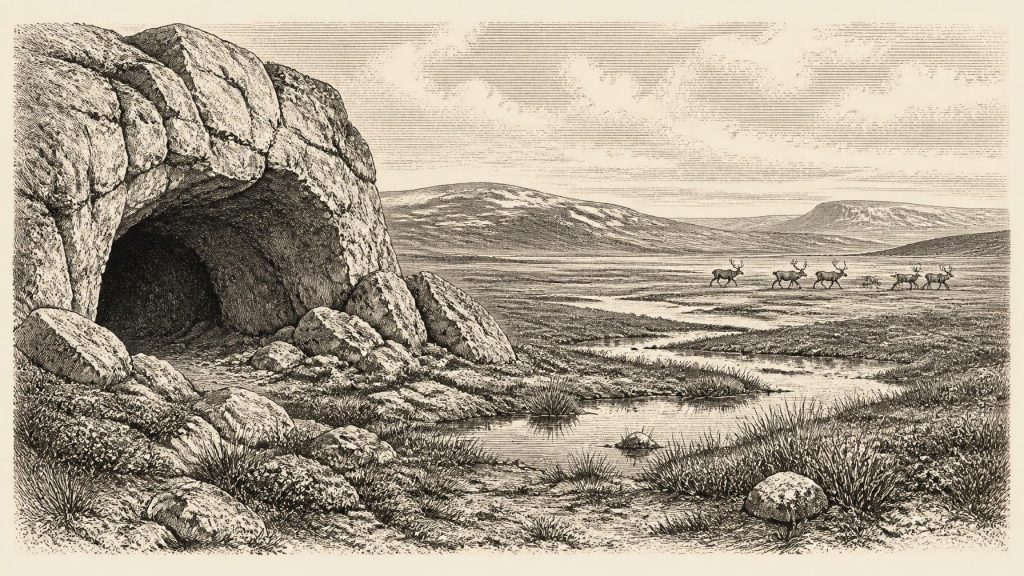
31,259 BCE is a modern chronological reference within Marine Isotope Stage 3, not a recorded Irish year. Ireland then experienced fluctuating cold conditions as ice sheets expanded, while some lowland refuges supported open tundra and steppe. Castlepook Cave, County Cork, preserves a fauna including reindeer, mammoth, giant deer, wolves, Arctic foxes, lemmings and spotted hyaenas, demonstrating cold-stage ecosystems. Derryvree, County Fermanagh, records sedges, herbs, mosses, insects and wetland tundra beneath glacial deposits. A cut-marked reindeer femur may indicate brief human activity, but lacks secure context. No evidence establishes settlement, social organisation, routes, or population; the period remains an ecological frontier.
Dateline
31,259 BCE is a modern chronological label, not a year for which Ireland preserves a recorded event. No calendar, named individual, settlement sequence or political history can be assigned to this point with year-by-year precision. In archaeological terms, it lies roughly 33,200 years before the conventional radiocarbon reference date of AD 1950, during the later part of Marine Isotope Stage 3 (MIS 3), a long, climatically variable phase of the last Ice Age. The responsible way to approach Ireland at this depth of time is through dated animal remains, cave deposits, fossil plants and insects, sediments, and the large-scale record of growing ice sheets.
The evidence does not describe an Irish nation, tribe or community. It does, however, show that parts of the island could support a striking cold-stage ecosystem before the Last Glacial Maximum. The richest archive is Castlepook Cave, also known as Mammoth Cave, near Doneraile in north County Cork. Its bones, together with the environmental deposits at Derryvree near Maguiresbridge in County Fermanagh, make it possible to sketch a cautious picture of an open, cold, treeless Ireland inhabited by large herbivores and formidable carnivores, and perhaps visited briefly by people.
Time Without a Calendar
Modern BCE notation can give a deceptive impression of precision. Radiocarbon ages have uncertainties; their conversion into calendar ages requires calibration against independently dated records; and a bone or layer usually represents an interval, rather than a single event. The year 31,259 BCE should therefore be read as a point placed within broad ranges, not as a date on which anything identifiable happened in Ireland.
MIS 3 is conventionally placed at roughly 57,000 to 29,000 years ago. It was neither uniformly frozen nor steadily warming. Rapid North Atlantic climatic shifts altered temperatures, sea ice, rainfall, vegetation and the extent of glaciers over periods far longer than a human lifetime but short in geological terms. Around the time represented by this article, the Irish Ice Sheet was building towards its much greater Last Glacial Maximum extent. Research on Irish glacial landforms indicates an early phase of Scottish ice incursion into north-east Ireland at about 35,000 years ago, while the island-wide maximum came much later, broadly between 23,000 and 18,000 years ago.
This distinction matters. Ireland was not simply an unbroken white ice cap at 31,259 BCE. Conditions differed by region and changed through time. Some uplands and northern sectors may already have been affected by expanding ice, while lowland and southern refuges could at times sustain tundra and steppe-like habitats. The later advance of ice was also destructive: glaciers scoured ground surfaces, reworked sediments and removed or buried many traces that might otherwise record early human activity.
Castlepook’s Cold-Stage Fauna
Castlepook Cave is central because it has yielded Ireland’s most substantial collection of vertebrate remains from the middle and later stages of the last cold period. Excavations in the early twentieth century recovered a very large bone assemblage, though the methods and recording standards of the time leave major limitations. More recent re-dating has demonstrated that some older radiocarbon determinations underestimated the age of the fauna by thousands of years. The cave’s surviving record spans a long period rather than one neatly dated occupation episode.
The animals represented include reindeer, woolly mammoth, giant deer, brown bear, wolf, Arctic fox, mountain hare, collared lemming, Norwegian lemming and spotted hyaena. Not every species necessarily lived together at one moment, nor does every recovered bone belong to the vicinity of 31,259 BCE. Yet the assemblage securely establishes that Ireland, in suitable MIS 3 phases, was connected to wider north-west European ecological worlds very unlike the modern island.
Reindeer are especially informative. Their presence indicates cold-adapted grazing landscapes, probably with extensive herbaceous vegetation and seasonal movement across broad territories. Lemmings, Arctic foxes and mountain hares reinforce the evidence for harsh conditions and open ground. Mammoths and giant deer imply sufficient plant resources and range for very large herbivores. Spotted hyaenas, known in Ireland chiefly from Castlepook, point to a food web containing active predators and scavengers as well as carrion-rich cave accumulations. A cave, therefore, was not merely a shelter: it could be a den, a place where animals died naturally, a trap-like feature, or a site into which bones were dragged and disturbed.
The National Museum of Ireland identifies Castlepook as the country’s most important site for mammal remains from the last cold stage. Its fauna is evidence, not scenery. It demonstrates animal presence and broad habitat possibilities; it cannot by itself tell us the exact appearance of every valley, the size of herds, or whether a particular species was resident year-round. Nevertheless, it overturns any simple image of Ice Age Ireland as biologically empty before the final retreat of the glaciers.
Derryvree’s Open Tundra
A second vital source lies far to the north. In 1969, road works at Derryvree, near Maguiresbridge in County Fermanagh, exposed freshwater silts and fine sands sealed between glacial tills in a drumlin. The deposit yielded a conventional radiocarbon determination of 30,500 +1,170/−1,030 BP, alongside plant and animal evidence interpreted as belonging to a full-glacial, periglacial environment. Because the measurement carries a substantial uncertainty and is expressed in radiocarbon rather than calibrated calendar years, it cannot be made to describe one exact BCE year. It is nevertheless directly relevant to the broader cold phase in which 31,259 BCE falls.
Derryvree preserved pollen, seeds, mosses and insect remains from a rare Irish inter-till landscape. The evidence points to open tundra vegetation: sedges and cold-tolerant herbs around wet ground, with sparse dry-land cover rather than closed forest. Finds including mountain avens, dwarf willow, bogbean, water-milfoil and distinctive mosses indicate a mosaic of shallow water, wet margins and exposed mineral ground. Such communities did not make the climate mild. They show, rather, that liquid water, short growing seasons and local vegetation could persist amid severe cold and frost action.
This environmental record is more secure than any attempt to populate the landscape with a particular human society. It suggests a patchwork of windswept ground, low plants, pools and sedge-rich wetland, not the later wooded Ireland familiar from historical imagery. In such terrain, animal movements would have followed forage, shelter, season and snow conditions. Rivers, lake margins and limestone caves concentrated resources and may also have concentrated the archaeological material that has survived.
The Reindeer Femur Question
The strongest possible human connection to this period is a reindeer femur from Castlepook. Public accounts have described the bone as about 33,000 years old and a deep linear mark upon it as consistent with cutting or chopping by a sharp stone tool while tissue was still fresh. If that interpretation is confirmed, it would be remarkable evidence that one or more people processed a reindeer in Ireland during MIS 3, vastly earlier than the long-established evidence for post-glacial settlement.
Its importance requires restraint. The dated bone establishes the age of the animal’s death, not automatically the age, maker or precise setting of the mark. A zooarchaeological judgement is needed to distinguish a tool mark from carnivore damage, breakage, sediment abrasion, trampling or excavation damage. Moreover, the femur comes from an old cave collection, not from an undisturbed excavation surface accompanied by a stone-tool assemblage, hearth, dwelling, butchered refuse scatter or human remains of matching date.
The most responsible conclusion is therefore conditional. The marked femur may record a brief Upper Palaeolithic visit and carcass processing; it does not yet prove a permanent Irish population, a camp at Castlepook, regular hunting territory, a migration route, language, ancestry or descendants. Fresh work at the cave has sought intact, stratified faunal deposits precisely because secure context is needed to test the older collection’s tantalising evidence.
People Beyond the Evidence
Across Europe, Homo sapiens communities of the Upper Palaeolithic made sophisticated stone tools, hunted and scavenged animals, used hides and plant materials, maintained social contacts across considerable distances, and in some regions created ornaments, figurative art and cave paintings. Those facts provide context, but they cannot simply be transferred to Ireland. No securely dated Irish hearth, lithic assemblage, burial, ornament, artwork or built shelter has been demonstrated for this particular phase.
Accordingly, political affairs, diplomacy and warfare are unknowable here. There is no evidence for chiefs, territories, alliances, raids or institutions in Ireland around this point. Nor can religion or learning be described beyond the general possibility that any visitors belonged to wider human communities with cultural knowledge and social traditions. To claim more would replace Irish evidence with a borrowed continental narrative.
Even the question of access must remain measured. Sea level was lower during the Ice Age, and scholarship places Ireland’s permanent island separation considerably later, around 20,600–18,100 calibrated years BP. This means that movement from Britain or the adjacent shelf world may not always have required the sea crossings familiar today. But no Irish find identifies a route, season, group size or direction of travel for MIS 3 visitors.
A Landscape Before Settlement
The economic history of 31,259 BCE is therefore principally ecological. Reindeer and other herbivores converted sparse vegetation into mobile concentrations of meat, hide, bone and antler; carnivores and scavengers followed them; caves preserved fragments of these relationships. If people reached Ireland, a reindeer carcass could have offered an important resource, but the evidence cannot say whether it was hunted, scavenged or encountered after another predator’s action. There is no evidence for farming, herding, metalworking, pottery, long-distance trade or settled villages.
What survives is a frontier landscape, not a society in the historical sense: a changing edge of north-west Europe where ice, water, grassland and tundra shaped the opportunities available to animals and perhaps to small groups of people. Castlepook and Derryvree matter because they preserve that opportunity in different forms—one through bones in a limestone cave, the other through a wetland deposit buried beneath later ice. Together they make 31,259 BCE meaningful without pretending that it was ever a recoverable Irish calendar year.
Primary Sources
- A Reconsideration of the Radiocarbon Dating of the Marine Isotope Stage 3 Fauna from Southern Ireland
- The Irish Quaternary Fauna Project
- A Middle Midlandian Freshwater Series at Derryvree, Maguiresbridge, County Fermanagh, Northern Ireland
- Castlepook Cave
- Spotted Hyena Skull
- First Evidence of a Late Upper Palaeolithic Human Presence in Ireland
- New Insights on the Fauna of Ireland’s Younger Dryas and Early Holocene from Alice and Gwendoline Cave, County Clare
- Response of the Irish Ice Sheet to Abrupt Climate Change During the Last Deglaciation
- Variations in Esker Morphology and Internal Architecture Record Time-Transgressive Changes in Subglacial Hydrology
- Subglacial Bedform Geomorphology of the Irish Ice Sheet Reveals Major Configuration Changes During Growth and Decay
- Dimensions and Chronology of the Last Ice Sheet in Western Ireland
- Trimlines, Blockfields and the Vertical Extent of the Last Ice Sheet in Southern Ireland
- Pattern and Timing of Retreat of the Last British-Irish Ice Sheet
- Early Deglaciation of the British-Irish Ice Sheet on the Atlantic Continental Shelf
- Last Glacial Maximum Cirque Glaciation in Ireland and Implications for Reconstructions of the Irish Ice Sheet
- Castlepook Cave, Co. Cork, 2022
- Our Ancient Landscapes: Hunter-Gatherers in Ireland
- Archaeological Heritage of County Cork
- Ireland’s Palaeolithic Archaeology – Fleeting Footprints in a Frozen Land
- Prehistoric Ireland