Castlepook’s Last Open Country30177 BCE
Around 30,177 BCE, Ireland lay in the later Marine Isotope Stage 3, a cold, largely treeless landscape approaching the Last Glacial Maximum. Cave deposits at Castlepook in north Cork preserve evidence of reindeer, mammoth, giant deer and predators, demonstrating habitable open country despite climatic instability. Scientific dates provide ranges, not exact calendar years, and disturbed deposits require caution. A marked reindeer femur may record stone-tool butchery about 33,000 years ago, suggesting possible human visits. No settlement, tools, hearths or society are securely known. Advancing ice later erased much evidence, making Castlepook a vital but incomplete archive of Ice Age Ireland.

Dateline
The label 30,177 BCE gives a useful place in a modern chronological sequence, but it must not be mistaken for a year in which an Irish event can be dated. No written record, calendar, named community or annual archaeological horizon exists for Ireland at this depth of time. By simple conversion to the archaeological convention of years before present, where “present” is AD 1950, it lies about 32,126 years before present. That arithmetic is not a precise age for a site or object. At this antiquity, evidence is dated through scientific measurements with substantial uncertainties and, for radiocarbon, calibrated probability ranges rather than exact calendar years.
The responsible subject is therefore Ireland in the later part of Marine Isotope Stage 3, during the Last Ice Age, rather than an invented incident in a single year. The island was part of a changing north-west European environment: colder than today, open in many places, and subject to major climatic oscillation. Its most important evidence comes not from settlements, but from caves, animal bones, sediments and the later imprint of advancing ice. North Cork, especially the cave system at Castlepook near Doneraile, offers the most evocative, though still difficult, window on this world.
Dating a Deep Past
Radiocarbon results do not read directly as calendar dates. Atmospheric radiocarbon levels changed through time, so a measured radiocarbon age has to be calibrated against independently dated environmental records. IntCal20, the current international Northern Hemisphere calibration framework, extends to 55,000 calibrated years before present, but the older part of its curve is necessarily built from several kinds of evidence, including floating tree-ring sequences, lake and marine records, corals and speleothems. Consequently, a date around 32,000 calibrated years ago may still have a range of possible calendar ages measured in centuries.
That limitation is especially important in Ireland, where many key Pleistocene finds were recovered in nineteenth- and early twentieth-century excavations. Excavators often worked before modern stratigraphic standards, and cave deposits could be disturbed by water, animals, collapse and later digging. Recent re-dating has shown that several older Irish radiocarbon determinations were too young because laboratory pretreatment methods were less effective at removing contaminants. A bone’s date establishes when the animal died, not automatically when it entered a cave, when a mark was made upon it, or when people visited the locality.
The Landscape Before Maximum Ice
About 32,000 years ago, Ireland had not yet reached the later maximum extent of the last British–Irish Ice Sheet, generally placed around 27,000 to 21,000 years ago, although ice-sheet growth was already becoming a defining regional process. The precise pattern was not uniform. Ice centres, margins and flow paths changed through time, and the evidence does not justify imagining either a wholly ice-free island or a single unbroken ice cover for every moment of the preceding millennia. The surviving animal and cave records demonstrate that at least some Irish landscapes supported terrestrial life during Marine Isotope Stage 3.
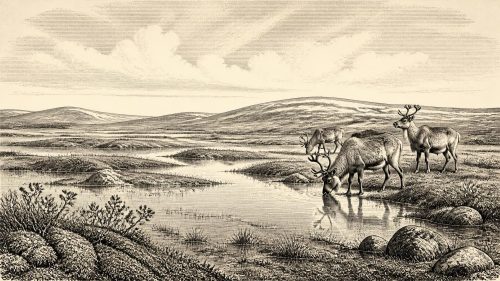
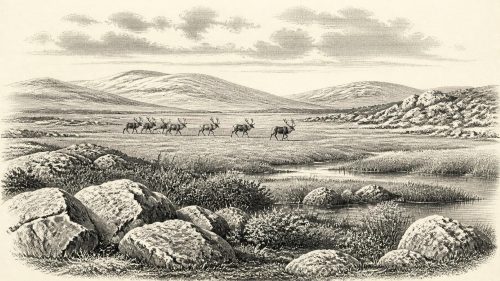
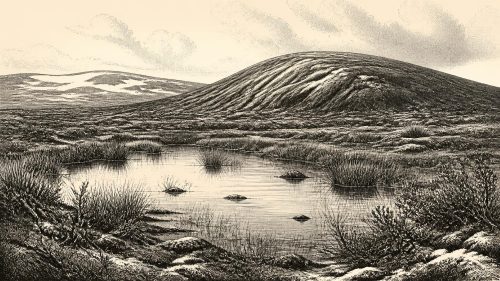
This was not the familiar wooded island of later prehistory. The best-supported broad picture is a cold, largely treeless mosaic of grassland, herb-rich steppe-tundra, bare ground, wet hollows and sheltered valleys. Seasonal snow, frozen ground and powerful winds would have shaped both vegetation and movement. Small stands of shrub or local sheltered vegetation may have occurred during milder episodes, but there is no basis for projecting later forests backwards into this period. Wetlands and cave entrances were significant parts of the landscape, while coastlines lay far from their modern positions because global sea level was lower.
Lower sea level enlarged parts of the continental shelf, but it does not prove that Ireland was joined to Britain by a simple, continuous land bridge at this particular date. The Irish Sea basin retained deep channels, while the extent of sea ice, exposed shelf and glacial barriers varied. Ireland was nevertheless ecologically connected to the wider western European zone over long timescales: animals had reached it, and any human movement would have depended on a changing combination of coast, ice, sea crossings and accessible terrain rather than a guaranteed dry route.
Animals of Castlepook Country
Castlepook Cave, also called Mammoth Cave in older accounts, is Ireland’s richest known archive for pre-Last Glacial Maximum vertebrate remains. Its deposits and museum collections have produced bones of reindeer, woolly mammoth, giant deer, brown bear, wolf, fox, Arctic fox, mountain hare, lemmings and spotted hyaena. Not every species need have lived together at precisely the same time, and a cave assemblage is not a census of a single landscape. Yet the combination makes clear that southern Ireland could support a distinctive cold-stage fauna across parts of Marine Isotope Stage 3.
Reindeer were particularly well suited to open, seasonal country. Their presence indicates forageable ground, not an empty polar desert. Mammoth and giant deer belong to the same larger picture of extensive grass- and herb-dominated habitats, while lemmings and Arctic fox point to cold conditions. Wolves and hyaenas reveal a food web with large carnivores as well as herbivores. Caves may have served as dens, traps, refuges or repositories into which bones were dragged, washed or fell; the hyaena evidence is a warning that carnivores, rather than people, explain much of the assemblage.
Direct dates add necessary caution. Reassessment of Castlepook, Shandon and Foley cave material has moved some animal occurrences substantially further back than earlier results suggested. A red-deer bone from a Waterford cave has a calibrated range of roughly 32,930–31,280 cal BP, which brackets the chronological neighbourhood of 30,177 BCE in modern notation. Such dates do not allow a claim that a particular red deer was alive in that nominal year, but they provide sounder evidence for a habitable Irish terrestrial environment at about this time than any historical narrative could.
A Possible Human Trace
The most consequential, and most limited, human evidence is a reindeer femur from Castlepook. It bears a deep linear modification that zooarchaeologist Ruth Carden has interpreted as a fresh-bone cut or chop made with a stone tool during carcass processing. Public accounts have described the bone as about 33,000 years old, making it potentially far earlier than Ireland’s previously accepted terminal Pleistocene human evidence. If the interpretation is confirmed, it would show that people reached Ireland during the later stages of Marine Isotope Stage 3.
It does not, however, identify a village, a hunting camp or a settled population. No securely associated hearth, stone-tool assemblage, dwelling floor, human bone or repeated occupation surface has yet been demonstrated for Castlepook at this age. The modified bone cannot tell us whether its maker killed the reindeer, scavenged it, stayed for hours or days, travelled alone or with companions, or returned season after season. Nor can it securely assign the visitor to a named archaeological culture. The appropriate conclusion is stronger than dismissal but weaker than certainty: it is a potentially important proxy for very early human activity, awaiting fuller contextual confirmation from renewed work at the cave.
Life Without a Recorded Society
There is no evidence for political affairs, diplomacy, territorial states, chiefs or organised warfare in Ireland around this point. Likewise, there is no identifiable religion, monument tradition, art style or formal learning that can be responsibly attributed to the island. Silence here is not evidence that Ice Age people elsewhere lacked social lives, beliefs, skill or stories; it means Ireland has not preserved material that permits those subjects to be described locally.
If people did enter the island, the practical demands would have been formidable. They would have needed detailed knowledge of animal behaviour, weather, fuel, shelter, stone and routes through difficult country. Cutting a carcass, if the Castlepook mark is indeed anthropogenic, implies practical anatomical knowledge and access to a sharp stone edge. But even that modest inference must not be inflated into claims of mammoth-hunting, long-distance trade, permanent houses or clan territories. There is no evidence for exchange networks or economic production in the later prehistoric sense. Subsistence, if humans were present, would have been mobile and immediate: acquiring food and materials in an unstable cold-stage landscape.
The cave itself should not be romanticised as a home. Its animal remains accumulated through several natural and biological processes, and its present archive was heavily shaped by early excavation. Its real importance lies in the survival of evidence almost nowhere else preserved on the island. The bones held in the National Museum of Ireland collections, together with surviving deposits and new fieldwork, make Castlepook a research site rather than a finished story.
An Island on the Edge of Change
For Ireland, the central development around 30,177 BCE was environmental rather than political. Open cold-country habitats still permitted large mammals to range through parts of the island, and perhaps permitted intermittent human visits. Yet the direction of long-term change was towards the expansion and eventual dominance of the last ice sheet. Later glacial erosion removed or buried enormous areas of earlier ground surface, helping to explain why evidence is so scant and why cave deposits matter disproportionately.
This is an Ireland known in fragments: a reindeer bone, a mammoth remain, a carnivore tooth, a redeposited sediment, a calibrated range. Together they reject two misleading extremes. The island was neither a timeless wilderness awaiting the first settlers of the Holocene nor a documented Ice Age homeland with recoverable annual history. It was a demanding, dynamic landscape in which animals certainly lived and humans may have briefly acted. The task of scholarship is to retain both the fascination of that possibility and the discipline imposed by the evidence.
Primary Sources
- A reconsideration of the radiocarbon dating of the Marine Isotope Stage 3 fauna from southern Ireland
- The Irish quaternary fauna project
- A reappraisal of the Irish red deer (Cervus elaphus) population based on mitochondrial DNA analysis
- Castlepook Cave, County Cork: County Geological Site Report
- Archaeological Heritage of County Cork
- Heritage Artefacts of County Cork
- Archaeology Research Excavation Grant 2022: Final Report
- Growth and retreat of the last British–Irish Ice Sheet, 31,000 to 15,000 years ago: the BRITICE-CHRONO reconstruction
- Radiocarbon constraints on the age of the maximum advance of the British–Irish Ice Sheet in the Celtic Sea
- New data for the Last Glacial Maximum in Great Britain and Ireland
- Dimensions and chronology of the last ice sheet in Western Ireland
- Timing and pace of ice-sheet withdrawal across the marine–terrestrial transition west of Ireland during the last glaciation
- Deglaciation chronology of the Donegal Ice Centre, north-west Ireland
- Trimlines, blockfields and the vertical extent of the last ice sheet in southern Ireland
- New insights on the fauna of Ireland's Younger Dryas and Early Holocene from Alice & Gwendoline Cave
- Occurrence of mammalia relicts at site Castlepook Cave
- The IntCal20 Northern Hemisphere Radiocarbon Age Calibration Curve (0–55 cal kBP)
- IntCal History
- North GRIP Ice Core Last Glacial d15N and Temperature Reconstruction
- Data – Centre for Ice and Climate
- The extinction pattern of the giant deer Megaloceros giganteus in Europe
- The exploration of Castlepook Cave, County Cork