
Hyaenahall’s Mammoth Horizon30121 BCE
About 30,121 BCE, Ireland lay in a cold, unstable Late Ice Age landscape as the British–Irish Ice Sheet expanded. Open tundra-like habitats, altered coastlines and routes supported cold-adapted fauna, while glaciation later destroyed or buried much evidence. Castlepook Cave in County Cork preserves Ireland’s vertebrate archive for this period, though its mixed deposits span many millennia and were excavated. Bones of mammoth, reindeer, giant deer, hyaena, wolves and Arctic mammals demonstrate animal access. A possibly tool-marked reindeer bone may indicate human activity around 33,000 years ago, but cannot establish settlement, society or sustained occupation. The period remains an environmental history.
Dateline
Modern calendar-year precision is not available for Ireland in 30,121 BCE. No community on the island recorded a date, and archaeology cannot isolate an event, ruler, journey or settlement to this particular year. The number is useful only as a point on a modern timeline: it falls roughly 32,100 calibrated years before present, within the later part of Marine Isotope Stage 3, a fluctuating interval of the Last Ice Age. The responsible history of Ireland at this point is therefore a history of climate, animals, caves and uncertain traces rather than of named peoples or political events.
An Island Entering Deep Cold
At about 32,000 calibrated years ago, Ireland was approaching the great expansion of the British–Irish Ice Sheet. This was not yet a single, simple moment when every part of the island lay under ice. Recent reconstructions model substantial ice build-up over Ireland and Britain from about 31,000 years ago, with mountain ice caps and glaciers expanding and merging at different rates. Northern and upland districts were especially vulnerable to early glaciation; south-western Ireland may still have contained ice-free or seasonally accessible ground for part of this broader interval. The exact outline of ice at any one place remains model-dependent, and it should not be converted into a confident map for 30,121 BCE.
The wider climatic setting was cold, dry and unstable by modern Irish standards. Open vegetation, rather than woodland, characterised the landscapes capable of supporting large grazing animals. Wind, frost action, seasonal thaw and sparse plant cover shaped slopes and river valleys. Sea level was lower than today because vast quantities of water were stored in continental ice sheets, changing coastlines and the configuration of the Irish Sea. Yet lowered seas did not automatically make Ireland a straightforward extension of Britain or continental Europe. The channels, ice margins, weather and shifting shorelines made movement difficult, and the routes available to animals or people varied through time.
These physical changes are the chief ‘public affairs’ of this prehistoric horizon. There were no demonstrable Irish polities, boundaries, diplomatic alliances or wars. Glacial growth altered habitable terrain, freshwater, forage and access routes more profoundly than any human institution that can presently be identified. It also removed or buried much evidence that might once have existed. Later ice movement, erosion, redeposition and post-glacial sea-level change mean that an absence of campsites is not proof that no person ever entered Ireland; it does, however, prevent claims of a settled population.
Castlepook’s Uneven Archive
The most important Irish evidence relevant to this long interval comes from Castlepook Cave, also known as Mammoth Cave, near Doneraile in north County Cork. The limestone cave system includes passages later labelled Hyaenahall, Elephant Hall and the Gallery of Aged Carnivores. Excavations between 1904 and 1918 recovered a remarkably rich bone assemblage. Geological Survey Ireland describes it as Ireland’s principal vertebrate archive for the period leading up to the Last Glacial Maximum: more than 2,000 bones have been recovered, with direct radiocarbon determinations on individual specimens spanning approximately 45,700 to 19,950 radiocarbon years BP.
That great span is a warning as well as a resource. Castlepook is not a neatly sealed occupation floor made in a single season. Animal remains accumulated through many episodes, probably involving carnivore activity, natural deaths, water movement and disturbance of sediments. Early excavation methods also left incomplete contextual records. A bone recovered from one gallery need not be contemporary with another bone nearby, and the animal’s date is not automatically the date of any mark on its surface. Modern re-dating has shown why such caution matters: improved preparation methods have altered the apparent age of some Irish cave specimens substantially.
Nevertheless, the cave establishes an important fact. Ireland supported a far more varied cold-stage mammal community than its later historical fauna suggests. The Castlepook record includes woolly mammoth, reindeer, giant deer, brown bear, wolf, Arctic fox, mountain hare, collared lemming, Norwegian lemming and spotted hyaena. Not every species belongs to precisely the same phase, but together they show repeated access by animals adapted to open, cold environments. Spotted hyaena is particularly significant. Its presence makes a cave full of bones less likely to be a human larder by default: large carnivores could drag prey and scavenged carcasses into sheltered passages, break bones and rearrange deposits.
Mammoths, Reindeer and Predators
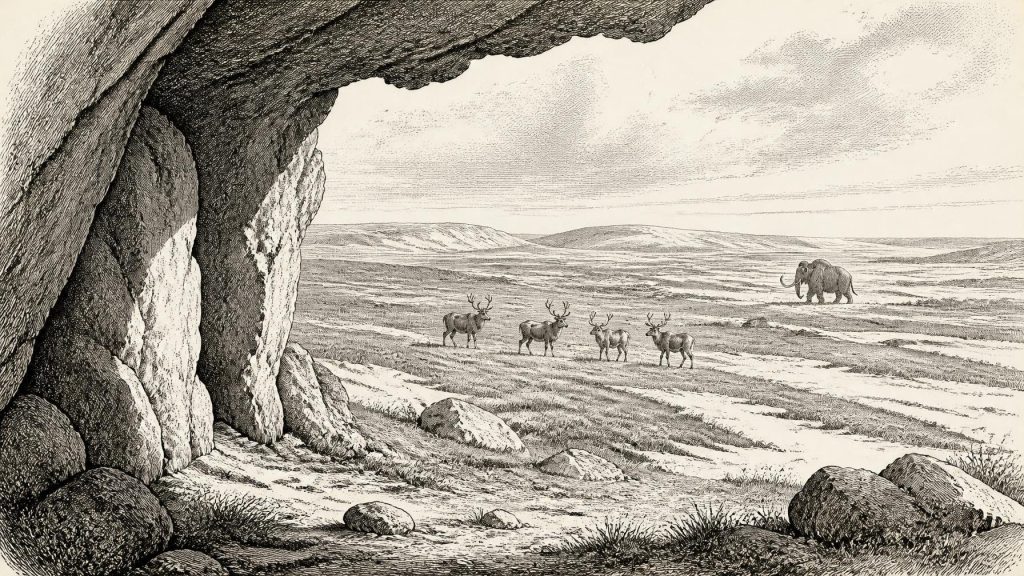
For the broad period around 30,121 BCE, the animal evidence permits a guarded reconstruction of food webs, not an exact scene. Reindeer and giant deer indicate grazing or browsing opportunities in open country; lemmings and Arctic fox point towards cold conditions and tundra-like habitats; wolves and hyaenas show that herbivores faced formidable predators and scavengers. Mammoth remains are the most arresting reminder that Ireland was not always an island of small modern mammals. A mammoth bone from Castlepook produced an early radiocarbon determination of 33,500 ± 1,200 BP, while later dating programmes placed other elements of the fauna across a wide Ice Age chronology.
It would be mistaken to picture a stable herd of mammoths, reindeer and giant deer all gathered outside the cave in the year 30,121 BCE. The evidence instead records a long-lived, changing faunal presence in southern Ireland before and during the approach to glacial maximum. Animals may have reached the island in different climatic windows, and some species may have been seasonal or short-lived visitors. The cave’s location in the Blackwater–Awbeg region was one local refuge or trap within a much larger landscape, not a census of the whole island.
Daily life can therefore be described securely for animals but not for people. Large herbivores depended on patches of usable vegetation and water; carnivores exploited prey, carrion and caves; small mammals occupied niches made possible by cold, open ground. The alternation of snow, freeze-thaw conditions and short growing seasons would have limited plant productivity. No evidence from this date permits claims for houses, clothing, cooking hearths, boats, families or a permanent Irish hunting territory. Such details are familiar from better-preserved Upper Palaeolithic sites elsewhere in Europe, but analogy must not be allowed to replace Irish evidence.
The Human Question
A reindeer femur from Castlepook has made this period especially important. Public accounts of the specimen describe a deep linear mark interpreted by palaeozoologist Ruth Carden as having been made with a sharp stone tool, and report an age of roughly 33,000 years ago. If that interpretation is sustained by continuing analysis, it would be evidence that a person handled and perhaps butchered a reindeer in Ireland during the Upper Palaeolithic, tens of millennia before the island’s securely documented post-glacial settlement.
Its implication must remain narrow. One modified bone would not demonstrate a village, a population, regular migration, a named cultural tradition or permanent occupation. It would not even reveal where the animal was killed, whether people entered the cave, or how long they remained in Ireland. Carnivore damage, sediment movement, old excavation practices and the limits of direct dating all demand close study. The most defensible conclusion is that Castlepook offers a tantalising possible sign of a brief human encounter with an animal in a challenging Ice Age landscape.
This is distinct from the better-supported terminal Pleistocene evidence at Alice and Gwendoline Cave, County Clare, where a butchered brown-bear bone dates to about 12,800–12,600 calibrated BP. That later find concerns a very different climatic and geographical Ireland. Nor should either cave be used to project familiar later identities backwards. There were no Gaels, Irish kingdoms, Christian institutions or written traditions in 30,121 BCE. The language, kinship systems and cultural affiliations of any people who may have made a short visit are unknown.
Silence on Society and Belief
No Irish evidence from this horizon identifies religious practice, art, burial, formal learning, exchange systems or diplomacy. A cave may have been a carnivore den, a natural bone trap, a place occasionally entered by animals, or conceivably a place briefly visited by people; it cannot be called a shrine merely because it is ancient and subterranean. Likewise, there is no securely associated stone-tool assemblage from Castlepook that could establish a technological tradition or economic network.
Trade is therefore not visible. The movement of animals across changing sea channels and lowland shelves is not the same thing as human commerce. If people reached Ireland during this broader interval, they would have required knowledge, equipment and social connections sufficient to move through a severe north-west European environment. That is an inference from the practical demands of travel, not direct evidence for Irish seafaring or exchange. The archaeological record supports possibility, not a detailed social narrative.
What This Year Can Mean
Thirty thousand years before the familiar story of prehistoric Ireland, the island’s past is best approached as an environmental threshold. Ice was building, coastlines were altered, and cold-adapted animals occupied at least some Irish landscapes. Castlepook Cave preserves the clearest witness: a complex, time-mixed archive of mammoths, reindeer, giant deer, predators and small Arctic mammals, with a provocative but still limited possible trace of human action.
The year 30,121 BCE should thus not be given an invented episode. Its historical value lies in showing how much Ireland’s deep past depends on careful distinctions: between a radiocarbon age and a calendar year; between an animal bone and an occupation deposit; between a possible cut mark and demonstrated settlement; and between the vivid life of an Ice Age landscape and the much thinner evidence for people within it. Future excavation, sediment analysis, ancient DNA and improved dating may sharpen the picture. For now, Hyaenahall’s bones speak most clearly of a cold, mobile world at the edge of expanding ice.
Primary Sources
- Castlepook Cave, County Geological Site Report
- The Irish Quaternary Fauna Project
- A Reconsideration of the Radiocarbon Dating of the Marine Isotope Stage 3 Fauna from Southern Ireland
- Growth and Retreat of the Last British–Irish Ice Sheet, 31,000 to 15,000 Years Ago: The BRITICE-CHRONO Reconstruction
- The Colonization of Ireland: A Human Ecology Perspective
- First Evidence of a Late Upper Palaeolithic Human Presence in Ireland
- New Insights on the Fauna of Ireland's Younger Dryas and Early Holocene from Alice & Gwendoline Cave
- The IntCal20 Northern Hemisphere Radiocarbon Age Calibration Curve (0–55 cal kBP)
- Radiocarbon Calibration
- Archaeological Heritage of County Cork
- Heritage Artefacts of County Cork
- Ulster Archaeological Society Newsletter, Autumn 2023
- Pleistocene Vertebrates in the British Isles
- Proceedings: Postglacial Colonization Conference
- The Last Glacial Maximum British–Irish Ice Sheet: A Reconstruction Using Digital Terrain Mapping
- The Deglaciation of the Western Sector of the Irish Ice Sheet from the Inner Continental Shelf to its Terrestrial Margin
- The Last Eurasian Ice Sheets – A Chronological Database and Time-Slice Reconstruction, DATED-1
- Maximum Extent and Dynamic Behaviour of the Last British–Irish Ice Sheet West of Ireland
- Ancient Hybridization and an Irish Origin for the Modern Polar Bear Matriline
- The Exploration of Castlepook Cave, County Cork