Awbeg Before the Ice31172 BCE
31,172 BCE cannot denote a specific Irish event, but falls within unstable Marine Isotope Stage 3, before the Last Glacial Maximum. Northern Ireland’s Derryvree sediments indicate cold, open tundra wetlands with sedges, mosses, aquatic plants and cold-adapted insects, although conditions varied regionally. Southern caves contain MIS 3 remains of reindeer, mammoth, giant deer and predators, showing intermittent habitats for fauna. A cut-marked Castlepook reindeer bone suggests occasional Upper Palaeolithic visitors, not proven settlement. Sea levels may have altered connections with Britain, but routes remain uncertain. Expanding ice later destroyed evidence, leaving fragmentary environmental records rather than detailed secure human history.
Dateline
The label 31,172 BCE is useful for arranging a modern chronology, but it cannot identify an event in Ireland on that particular year. There were no written calendars, dated settlements or named communities from which such precision could be recovered. In archaeological terms, the nominal year falls roughly 33,120 years before AD 1950, the conventional “present” of radiocarbon science, within the Late Pleistocene and Marine Isotope Stage 3 (MIS 3). That was a long, climatically unstable part of the last Ice Age, not a moment that can be isolated in an Irish historical narrative. The responsible account is therefore one of calibrated ranges, deposits and probabilities.
Ireland at this time was approaching, rather than already securely within, the Last Glacial Maximum. The maximum extent of the British–Irish Ice Sheet came much later, principally around 26,500–19,000 calibrated years BP, although the expansion of ice was neither uniform nor simultaneous in every region. Reconstructions of the ice sheet show important uncertainty in its earliest growth. A date equivalent to 31,172 BCE must not be used to claim confidently that the whole island was either ice-free or covered by a single continuous ice mass. Conditions and ice margins changed over centuries and millennia, while later glaciers erased much earlier evidence.
Cold Ground Between the Tills
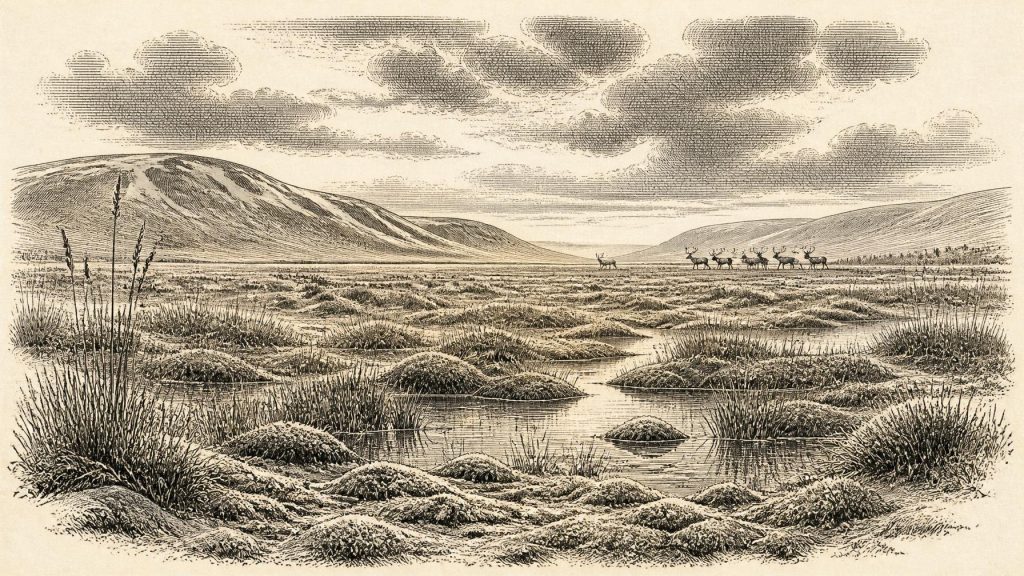
The closest Irish environmental evidence comes from the north. At Derryvree, near Maguiresbridge in County Fermanagh, road works exposed freshwater silts and fine sands sealed between two layers of glacial till. The organic deposit produced a radiocarbon determination of 30,500 +1,170/−1,030 radiocarbon years BP. Its calibrated equivalent is broad, commonly expressed as approximately 36,900–31,700 cal BP. That span encompasses the notional date considered here, but it is vital not to mistake a long-lived deposit for an annual record. Derryvree demonstrates that part of northern Ireland supported a cold freshwater environment during later MIS 3; it does not describe what happened in 31,172 BCE itself.
Its plant and insect remains provide a rare local view. Pollen was largely herbaceous, while macrofossils included sedges, mosses and aquatic plants. Cold-adapted beetles added to the picture. Together, these traces indicate open tundra or muskeg-like ground, shallow pools and wet margins affected by severe seasonal freezing. The landscape was not the wooded island familiar from later prehistory. A few tree-pollen grains cannot prove nearby forest, since wind can carry pollen over long distances. The stronger inference is sparse vegetation, short growing seasons and exposed terrain broken by wet hollows rather than continuous woodland.
A Changing Irish Landscape
Such evidence reveals an Ireland of contrast. Water could persist in protected basins despite a periglacial climate, allowing mosses, sedges and small aquatic plants to survive. Elsewhere, frost action, wind and thin soils would have limited cover. Rivers, slopes and coastlines also differed from those of today: much water was locked in northern ice sheets, sea level was lower, and land now beneath the Irish Sea formed part of a wider, changing physical world. Whether particular dry-land routes connected Ireland, Britain and continental Europe at this precise time remains uncertain. Low sea level made wider connections possible in some reconstructions, but ice, water depth and changing topography prevent a simple assertion of a reliable land bridge.
The northern Fermanagh record should not simply be projected across every county. Ireland’s Atlantic setting, varied relief and the developing ice sheet produced regional variation. Southern caves preserve one kind of evidence, northern inter-till sediments another. The most defensible general conclusion is that at least some Irish landscapes were capable of supporting cold-adapted plants and animals during MIS 3, before renewed glaciation buried or destroyed many of the deposits that might otherwise have told a fuller story.
Animals in the Southern Caves
Southern Irish caves, especially Castlepook Cave near Doneraile in County Cork, are central to this reconstruction. Modern re-dating has shown that some cave faunas once thought younger belong substantially earlier, in MIS 3. Reindeer, woolly mammoth, giant deer, brown bear, Arctic fox, hare, wolf and spotted hyaena are among the animals represented in the wider Irish Pleistocene record. Not every species need have occupied the same place at the same time, and cave assemblages are not ordinary census lists. Carnivores can drag prey remains into caves; water, collapse, excavation methods and nineteenth- and early twentieth-century collecting can mix material from different deposits.
Nevertheless, the fauna establishes a powerful ecological point. Ireland was not necessarily an empty, featureless ice desert before the Last Glacial Maximum. It intermittently supported sizeable herbivores and predators within a cold, open environment. Reindeer are particularly appropriate indicators of such conditions, though their presence does not establish a modern Arctic climate in every respect. Mammoth and giant deer remains demonstrate that the island could at times be part of a broader north-west European network of animal movement. The later local disappearance of some species, including giant deer and spotted hyaena, may have preceded the full glacial maximum, but exact causes remain unsettled.
The Human Question
Human history at this date is much less secure than environmental history. A reindeer femur from Castlepook Cave has been reported as dating to about 33,000 years ago and bearing a deep mark interpreted as a possible stone-tool cut made while the bone was fresh. If that interpretation is confirmed, it would indicate that people handled or butchered reindeer in Ireland during the later Upper Palaeolithic, far earlier than the long-established Mesolithic settlement record. It would not, however, prove a permanent population, a village, a named culture or occupation in the exact nominal year.
The distinction is essential. The femur came from an old cave collection, not from a newly excavated, intact living surface with hearths, stone tools and a tightly controlled sequence of dates. Natural damage, carnivore activity and the complex movement of cave deposits must always be considered when interpreting modified bone. The evidence is intriguing and historically important, but singular. Ireland presently lacks a securely excavated, contemporary settlement from around 33,000 years ago. The safest conclusion is that short visits by mobile hunter-gatherers are possible and perhaps indicated, whereas continuous habitation remains unproven.
Life Without Recorded Polities
Nothing supports claims about kingship, tribes, diplomacy, formal warfare or territorial states in Ireland at this point. There are no names, monuments, burials or settlements from which social ranks or political boundaries could responsibly be reconstructed. If people entered the island, they would have belonged to small, highly mobile Upper Palaeolithic hunting and gathering groups whose wider European counterparts depended on knowledge of animal movement, seasonal resources, shelter and routes. This is an analogy drawn from surrounding regions, not direct proof of an Irish camp or social system.
For the same reason, religion, language, art and learning cannot be described specifically for Ireland in 31,172 BCE. The absence of evidence is not evidence that people lacked beliefs, skills or traditions; it is a limit imposed by survival. Organic shelters, clothing, wooden implements and spoken knowledge are exceptionally unlikely to endure for more than thirty millennia, especially where later ice repeatedly scoured the ground. A sharp incision on bone, if human-made, shows practical action rather than a recoverable body of ritual or symbolism.
Economy, Movement and Risk
There was no agricultural economy, trade system or built settlement demonstrable in Ireland at this time. Farming lay many millennia in the future. Any human visitors would have obtained food from wild resources, with reindeer and other large mammals potentially important where available. But the Castlepook femur cannot tell us whether people killed the animal, scavenged it, removed a small portion of meat, or processed a carcass first taken by predators. Nor can it establish regular exchange with Britain or continental Europe. It does show why caves, river corridors and animal routes matter: they were points at which sparse traces could accumulate and, exceptionally, survive.
The major development was environmental, not political: Ireland was moving towards a period in which expanding ice would transform or obliterate much of its earlier landscape. The tundra wetland at Derryvree and the cave bones of Cork are survivors from before that transformation. They show an island periodically open to cold-adapted life, perhaps occasionally to human movement, but vulnerable to abrupt climatic deterioration. Around 31,172 BCE, Ireland’s history is best understood not as a chapter of recorded peoples and events, but as the fragile prelude to glaciation preserved in moss spores, freshwater silts and scattered animal bones.
Primary Sources
- A Reconsideration of the Radiocarbon Dating of the Marine Isotope Stage 3 Fauna from Southern Ireland
- The Irish Quaternary Fauna Project
- The Red Deer, Cervus elaphus, in Ireland: Genetic and Osteometric Evidence for the Post-Glacial Recolonisation of Ireland
- Growth and Retreat of the Last British–Irish Ice Sheet, 31,000 to 15,000 Years Ago: The BRITICE-CHRONO Reconstruction
- Growth and Retreat of the Last British–Irish Ice Sheet, 31,000 to 15,000 Years Ago: The BRITICE-CHRONO Reconstruction
- Last Glacial Maximum Cirque Glaciation in Ireland and Implications for Reconstructions of the Irish Ice Sheet
- Late Pleistocene Chronostratigraphy and Ice Sheet Limits, Southern Ireland
- Dimensions and Chronology of the Last Ice Sheet in Western Ireland
- Stratigraphic and Palaeo-Geomorphological Evidence for the Glacial-Deglacial History of the Last British-Irish Ice Sheet in the North-Western Irish Sea
- Maximum Extent and Readvance Dynamics of the Irish Sea Ice Stream and Irish Sea Glacier Since the Last Glacial Maximum
- The Problem of a Late Quaternary Landbridge Between Britain and Ireland
- Deglaciation, Earth Crustal Behaviour and Sea-Level Changes in the Determination of Insularity: A Perspective from Ireland
- The Island of Ireland: Drowning the Myth of an Irish Land-Bridge?
- Ireland: Submerged Prehistoric Sites and Landscapes
- The Colonization of Ireland: A Human Ecology Perspective
- First Evidence of a Late Upper Palaeolithic Human Presence in Ireland
- Palaeoecology: IQUA Field Guide 16
- Early Midlandian–Middle Midlandian, Pleistocene, Northern Ireland
- The IntCal20 Northern Hemisphere Radiocarbon Age Calibration Curve (0–55 cal kBP)
- Consistently Dated Atlantic Sediment Cores Over the Last 40 Thousand Years