Castlepook’s Provisional Encounter31020 BCE
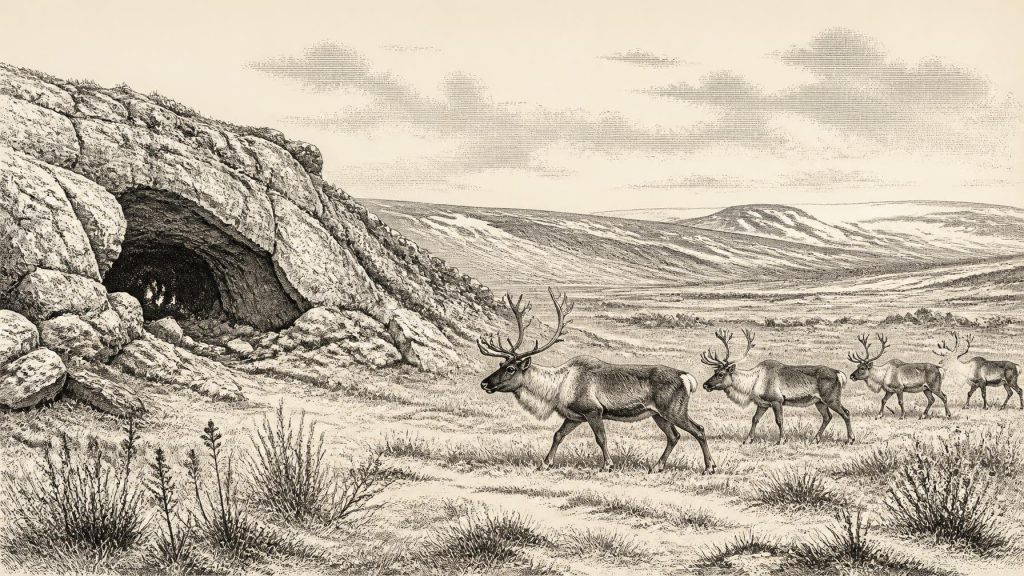
Around 31,020 BCE, a projected rather than recorded date, Ireland lay within the cold, fluctuating landscapes of Marine Isotope Stage 3, before the Last Glacial Maximum. Expanding ice, exposed tundra-like habitats and lower sea levels created a variable environment supporting reindeer and large mammals, particularly in the south. Castlepook Cave, County Cork, preserves bones of reindeer, mammoth, giant deer and hyaena, though accumulated deposits cannot form a single scene. A cut-like mark on a reindeer femur may indicate Ireland’s earliest human animal processing, but lacks associated tools, hearths or settlement evidence. It suggests possible Upper Palaeolithic visits, not permanent settlement.
Dateline
Modern calendar-year precision is not available for Ireland at 31,020 BCE. The date is a backward projection of the modern calendar, not a date recorded by people then alive. In archaeological terms it falls roughly around 33,000 calendar years before present (cal BP, where “present” is AD 1950), in Marine Isotope Stage 3 of the Late Pleistocene. Radiocarbon ages at this depth of time must be calibrated and expressed as ranges; moreover, cave deposits and animal remains usually represent episodes spread across centuries or millennia, not a single year. The responsible subject is therefore Ireland in the decades around this nominal date, not an invented event on it.
A Landscape Before the Maximum
This was an Ice Age Ireland, but not yet the fullest extent of the last British–Irish Ice Sheet. The major local and global glacial maximum lay later, broadly between about 26,500 and 19,000 years ago. Reconstructions indicate rapid and regionally uneven ice-sheet growth during the preceding millennia. At roughly 33,000 cal BP, Ireland’s precise ice cover cannot be drawn with confidence for any one moment: evidence is stronger for later maximum limits and retreat than for the exact onset of ice expansion in every district.
That uncertainty matters. It is misleading to imagine either a uniformly ice-covered island or a wholly open one. The available evidence supports a changing mosaic: expanding ice centres and glaciers in some regions, cold exposed ground elsewhere, and habitats that could briefly support large mammals in at least parts of southern Ireland. Subsequent glaciation repeatedly eroded, buried and rearranged older landscapes. Much of the evidence for this period consequently survives not as settlements on open ground, but in caves, buried sediments, offshore cores, landforms and curated bone collections.
Castlepook Cave’s Uneasy Evidence
The key Irish place for this approximate date is Castlepook Cave, near Doneraile in north County Cork. Excavated principally in the early twentieth century, the cave produced a remarkable collection of Late Pleistocene bones, including reindeer, woolly mammoth, giant deer and spotted hyaena. Later work by the Irish Quaternary Fauna Project and subsequent re-dating demonstrated both the importance and the difficulty of the archive: old excavations recorded contexts less precisely than modern investigations require, and improved pretreatment of bone samples has shifted some dates substantially older.
A reindeer femur from Castlepook has been presented by County Cork heritage researchers as dating to about 31,000 BCE and bearing a deep mark interpreted by palaeozoologist Ruth Carden as the result of cutting with a sharp stone tool. If that interpretation is correct, the mark is potentially Ireland’s earliest evidence for a person processing an animal. It would be an extraordinary trace of an Upper Palaeolithic encounter: someone had access to a reindeer carcass and a sharp-edged implement in or near Ireland during a severe cold-stage interval.
The limits of that claim are as important as its promise. The bone itself dates the animal’s life, not the exact instant of cutting; a single surface modification cannot establish whether people killed the reindeer, scavenged it, removed meat elsewhere, or merely handled part of an already dead animal. Castlepook has not yielded a securely associated hearth, stone-tool assemblage, dwelling floor, human burial or stratified camp of this age. Nor does the cave prove permanent settlement. Carnivores could drag bones underground, water and frost could disturb deposits, and nineteenth- and early twentieth-century excavation removed much contextual information. “Possible human activity” is therefore more accurate than “an Irish population”.
Cold-Stage Fauna and Environment
Even without a demonstrable settlement, the animals from Castlepook illuminate a real Irish environment. Reindeer indicate open, cold country capable of sustaining grazing herds. Mammoth, giant deer and spotted hyaena belong to a wider north-west European Pleistocene fauna, although the mere presence of their bones in one cave does not prove that all species lived together at exactly 31,020 BCE. The refined chronology suggests that giant deer and spotted hyaena may have disappeared locally before the Last Glacial Maximum, around 40,000 cal BP. That is a useful warning against turning a cave fauna accumulated over long periods into a single picturesque scene.
The most defensible reconstruction is of a treeless or sparsely wooded cold landscape with grass, herbs and low shrubs in suitable exposed areas, interrupted by rock, wet ground, snow patches and advancing ice. Conditions would have varied sharply with altitude, aspect and climate fluctuations. Limestone caves around the Blackwater valley could provide sheltered dens for carnivores and traps for archaeological information, but they were not necessarily human homes. A cave bone assemblage records animal movement, predation, scavenging and geological processes as much as it records people.
There is no evidence from Ireland at this date for farming, livestock, pottery, metalworking, monumental construction or woodland clearance. Nor can we reconstruct fields, villages or a settled seasonal round. If visitors did reach the island, they were almost certainly mobile hunter-gatherers operating within the wider Upper Palaeolithic world of north-west Europe, where animal carcasses, hides, marrow and bone were valuable resources. That is an inference from the broader period, however, rather than a directly excavated Irish toolkit.
People, Movement and the Sea
The apparent Castlepook cut mark raises the possibility of movement into Ireland during a phase when sea levels were lower than today and the geography of the Irish Sea differed profoundly. It does not demonstrate a simple dry-land route from Britain, still less a continuous land bridge to continental Europe. Ice, meltwater, coastlines and sea passages changed over time, while later submergence has removed or concealed many potential coastal sites. Any human arrival may have involved a short visit across a shifting maritime or glacial landscape rather than colonisation.
There is no evidence for named peoples, political authority, diplomacy or territorial frontiers in Ireland at this time. A solitary possible butchery trace cannot reveal language, kinship rules, leadership or relations between groups. Equally, there is no direct evidence for organised human conflict. The violent processes visible in the cave record are chiefly ecological: predators, scavengers, carcass transport and natural breakage. Calling hyaena activity “conflict” would confuse animal behaviour with human history.
Trade is also beyond the evidence. No securely dated Irish exchange goods, quarry sites or imported Upper Palaeolithic artefacts are known from around 33,000 cal BP. Stone tools would have been essential if the Castlepook incision was human-made, but no tool associated with the femur has been recovered. It is reasonable to say that a sharp lithic edge was used only conditionally—if the mark diagnosis is accepted—not to claim an established Irish flint-working industry or trading network.
Culture Without a Settlement Record
Religion, art and learning leave no identifiable Irish evidence for this nominal year. There are no cave paintings, engravings, ornaments, burials or ritual deposits securely attributable to an Upper Palaeolithic community in Ireland. This absence should not be mistaken for proof that visitors lacked beliefs, stories, technical knowledge or social traditions; mobile people everywhere possessed them. It means simply that the Irish record does not permit those traditions to be described responsibly.
The strongest cultural lesson is methodological. Ireland’s deep prehistory is being revised not by spectacular monuments but by re-examining museum collections, applying improved radiocarbon methods, identifying animal species more securely and testing bone surfaces microscopically. Castlepook’s reindeer femur is important precisely because it is so slight: one mark, on one old specimen, challenges a long-held assumption that Ireland had no Palaeolithic human story at all. Yet it also demonstrates why claims must remain proportionate to evidence.
An Island at the Edge
At around 31,020 BCE, Ireland lay at the north-western edge of the Upper Palaeolithic world and on the threshold of increasingly extensive glaciation. The island was not politically empty in the modern sense, nor was it a future nation awaiting settlement; those concepts do not apply. It was a changing Pleistocene landscape in which large mammals sometimes found viable ranges and in which people may have appeared fleetingly. The later ice advance would scour and bury much of what they could have left behind.
For that reason, the annual entry for this date is necessarily a record of uncertainty as well as discovery. Castlepook offers a plausible, potentially transformative sign of human handling of reindeer around this broad interval. It does not yet give Ireland a dated camp, a community or a continuous population. The most historically sound conclusion is modest but significant: around this point in deep time, southern Ireland formed part of a cold, dynamic ecological zone visited by Pleistocene animals, and perhaps—briefly—by people.
Primary Sources
- A Reconsideration of the Radiocarbon Dating of the Marine Isotope Stage 3 Fauna from Southern Ireland
- The Irish Quaternary Fauna Project
- The Exploration of Castlepook Cave, County Cork, Being the Third Report from the Committee Appointed to Explore Irish Caves
- Heritage Artefacts of County Cork
- Prehistoric Details: Mell Flint Flake
- Phylogeographic, Ancient DNA, Fossil and Morphometric Analyses Reveal Ancient and Modern Introductions of a Large Mammal: The Complex Case of Red Deer in Ireland
- Deglaciation Chronology of the Donegal Ice Centre, North-West Ireland
- Timing and Pace of Ice-Sheet Withdrawal Across the Marine–Terrestrial Transition West of Ireland During the Last Glaciation
- The Deglaciation of the Western Sector of the Irish Ice Sheet from the Inner Continental Shelf to its Terrestrial Margin
- Last Glacial Maximum Cirque Glaciation in Ireland and Implications for Reconstructions of the Irish Ice Sheet
- Trimlines, Blockfields and the Vertical Extent of the Last Ice Sheet in Southern Ireland
- Extent and Deglacial Chronology of the Last British–Irish Ice Sheet: Implications of Exposure Dating Using Cosmogenic Isotopes
- Late Pleistocene Chronostratigraphy and Ice Sheet Limits, Southern Ireland
- Dimensions and Chronology of the Last Ice Sheet in Western Ireland
- Early Deglaciation of the British-Irish Ice Sheet on the Atlantic Shelf Northwest of Ireland Driven by Glacioisostatic Depression and High Relative Sea Level
- Growth and Retreat of the Last British–Irish Ice Sheet, 31,000 to 15,000 Years Ago: the BRITICE-CHRONO Reconstruction
- The IntCal20 Northern Hemisphere Radiocarbon Age Calibration Curve (0–55 cal kBP)
- A 60,000 Year Greenland Stratigraphic Ice Core Chronology
- Early Deglaciation of the British-Irish Ice Sheet on the Atlantic Shelf Northwest of Ireland Driven by Glacioisostatic Depression and High Relative Sea Level
- Growth and Retreat of the Last British–Irish Ice Sheet, 31,000 to 15,000 Years Ago: the BRITICE-CHRONO Reconstruction
- NOAA/WDS Paleoclimatology: North GRIP Greenland Ice Core Chronology 2005, 60,000 Year, 20 Year Resolution