Hyena Hall’s Shifting Ground31019 BCE
Thirty-one thousand and nineteen BCE is a modern label for a poorly dated phase of Marine Isotope Stage 3, before Ireland’s last major glaciation. Lower sea levels and fluctuating ice margins created changing, locally varied landscapes. Castlepook Cave in County Cork preserves fauna including hyena, reindeer, mammoth, giant deer, wolves and lemmings, indicating cold open habitats, although its deposits accumulated over time. Derryvree, County Fermanagh, records an ice-free freshwater wetland between glacial episodes. A cut-marked reindeer bone from Castlepook may indicate human butchery, but cannot prove settlement. Evidence supports a diverse pre-glacial ecology, while political and economic history remains unknowable.
Dateline
A Date Without an Annual Record
31,019 BCE is a modern chronological label, not a year that can be recovered from an Irish annal, settlement sequence or datable human lifetime. In the archaeological convention of counting backwards from AD 1950, it lies roughly 32,970 years before present. At such depth, radiocarbon ages must be calibrated, and even calibrated results commonly span centuries or millennia. The responsible subject is therefore Ireland during the later part of Marine Isotope Stage 3 (MIS 3), rather than an invented event on a particular day or in a particular year. The evidence consists chiefly of cave fauna, buried sediments, pollen and plant remains, glacial landforms, and the changing reliability of the dates assigned to them.
MIS 3, broadly about 57,000–29,000 calibrated years ago, was not a uniform “Ice Age” climate. It included sharp oscillations between colder stadials and relatively milder interstadials. Ireland’s position on Europe’s north-western edge made its environments especially sensitive to these shifts, to sea-level changes and to the growth of the British–Irish Ice Sheet. By the global Last Glacial Maximum, after about 26,500 calibrated years ago, ice would extend widely across Ireland; but 31,019 BCE precedes that maximum. It belongs to a difficult transitional world whose local landscapes must be reconstructed site by site.
An Island Not Yet Familiar
It would be misleading to picture the modern island, coastlines and counties simply transported into the distant past. Sea level was substantially lower during the last glacial cycle, exposing broad shelves now under the Atlantic and Irish Sea. Ireland’s connection to Britain and the continent altered repeatedly as ice, sea level and coastlines changed. The fossil record demonstrates that terrestrial mammals did reach Ireland in this period, but it cannot identify the exact route, season or frequency of every crossing. Nor does it establish that all parts of the landmass were simultaneously open, habitable or connected.
At the scale of this nominal date, the best conclusion is that parts of Ireland supported animal communities before the final, expansive ice-sheet phase. Yet ice margins were dynamic and regional conditions differed. Evidence from later ice-sheet advance and retreat confirms that the last British–Irish Ice Sheet was not a simple, static cap: its growth and collapse involved major marine and terrestrial sectors, fast-flowing ice streams and shifting margins. That later history helps explain why older landscapes and archaeological traces are rare, disturbed or buried beneath till.
Castlepook’s Faunal World
The most evocative evidence for Ireland around the broader 33,000-year horizon comes from Castlepook Cave, also called Mammoth Cave, near Doneraile in north County Cork. Excavated principally in the early twentieth century, its limestone passages yielded Ireland’s richest known assemblage of pre-Last Glacial Maximum vertebrate remains. The cave’s historical gallery name, Hyena Hall, preserves an important fact: spotted hyena was among the animals represented there. The National Museum of Ireland identifies a Castlepook skull as Crocuta crocuta; the site also produced remains attributed to reindeer, mammoth, giant deer, bear, wolf, foxes and lemmings.
Those finds establish an Ice-Age fauna, not a neatly contemporaneous herd standing together on a single Cork plain. Cave assemblages are accumulations. Carnivores drag in prey and carrion; animals die naturally; water shifts bones; sediments are reworked; and early excavators often recorded locations less precisely than modern field methods demand. Recent redating has moreover shown that several older Irish cave radiocarbon determinations were too young, probably because improved pretreatment can remove later contamination from bone collagen. Castlepook remains indispensable, but it must be read as a time-averaged archive rather than a frozen scene.
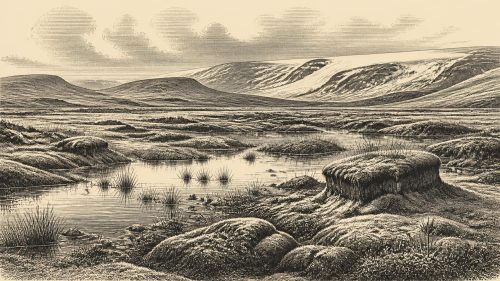
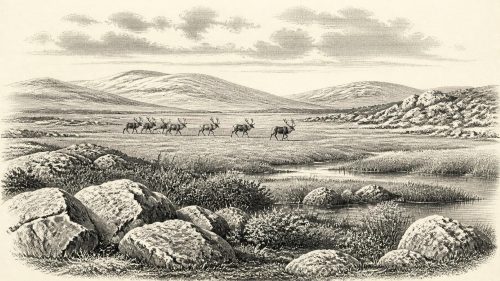
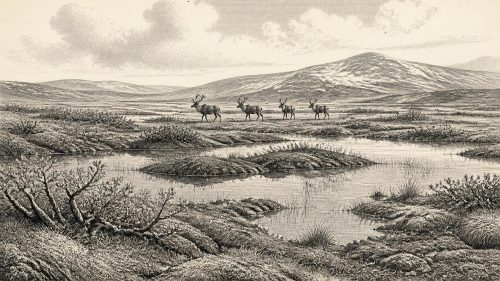
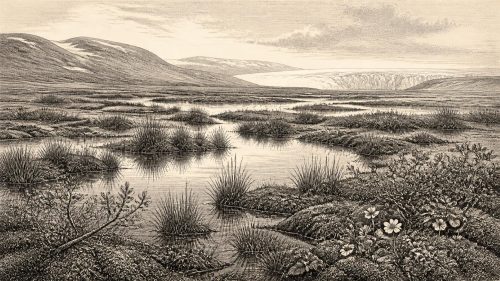
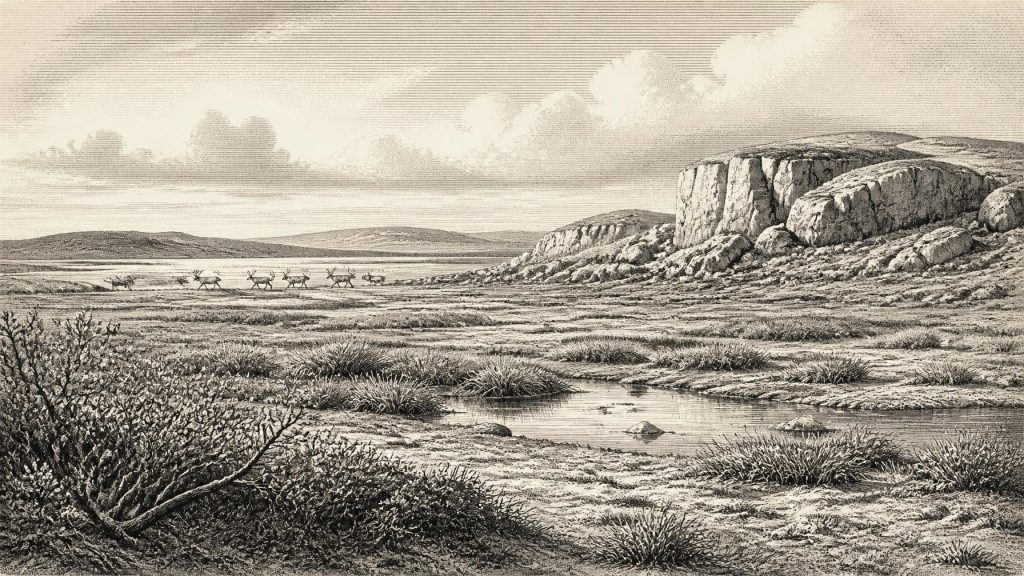
Nevertheless, the fauna allows a restrained reconstruction. Reindeer, lemmings and Arctic fox point towards cold, open habitats; mammoth and giant deer imply enough vegetation, at least seasonally, to sustain large herbivores; wolves and hyenas reveal predators and scavengers within a substantial food web. This was not the densely wooded Ireland of later millennia. It was likely a treeless or very sparsely wooded mosaic of grassland, herb-rich tundra, damp hollows and exposed ground, varying with climate, drainage and altitude. The precise abundance of each species is unknown, and absence from a cave collection is not proof that an animal was absent from Ireland.
Wet Ground Beneath Fermanagh
A contrasting record lies at Derryvree, near Maguiresbridge in County Fermanagh. Roadworks exposed freshwater silts and fine sands containing organic material between two layers of till, sediment deposited by glacier ice. This sequence provides a powerful relative chronology: ice advanced or deposited till; an ice-free freshwater environment existed at the site; then later ice again covered or affected the locality. The organic bed, known by its radiocarbon sample number BIRM-166, produced a conventional age of 30,500 ± 1,100 radiocarbon years BP. Calibration gives a broad calendar-age interval, commonly cited at roughly 36,900–31,700 calibrated years BP.
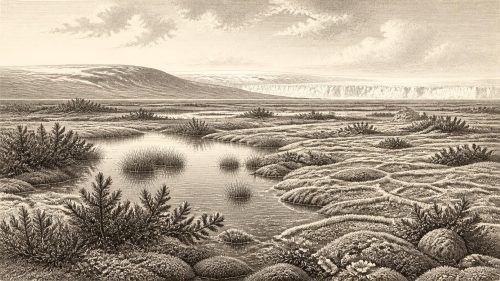
That range overlaps the modern label 31,019 BCE, but it does not date a single annual landscape. Nor can it demonstrate that the entire island was ice-free at once. Its value is more exacting and more important: it shows that an inland Fermanagh locality preserved a freshwater, periglacial environment between glacial episodes. Plant remains including sedges, mosses, dwarf willow, mountain avens, bogbean and aquatic taxa have been interpreted as evidence of cold, open wetland vegetation, with pools or slow water amid waterlogged ground. Such deposits preserve ecological conditions, not a human community.
A Possible Human Trace
One Castlepook object gives this period exceptional importance for Irish prehistory: a reindeer femur reported to bear a deep linear mark made while the bone was fresh. The mark has been interpreted as the result of a sharp stone tool used in butchery. County Cork heritage material presents it as a possible indication that Stone Age hunters processed reindeer in Ireland some 31,000 years ago. If secure, it would place human activity on the island far earlier than the terminal-Pleistocene evidence from County Clare that is presently better contextualised.
It should not, however, be converted into a story of an established Palaeolithic population in 31,019 BCE. The bone’s radiocarbon age dates the animal’s death, not necessarily the precise moment at which its surface was modified. Identifying a cut mark requires careful distinction from carnivore damage, abrasion, breakage and excavation damage. Crucially, no securely associated stone-tool assemblage, hearth, dwelling surface, human burial or repeated butchered deposit of comparable age has been recovered at Castlepook. The evidence may indicate a brief human encounter with a carcass; it does not demonstrate a permanent settlement, population continuity, language group or migration history.
Society Beyond Recovery
Consequently, political affairs, diplomacy and organised warfare cannot responsibly be described for Ireland at this date. There were no recorded polities, leaders, territories or treaties, and no material evidence from Ireland that supports assigning such institutions to a human group here. Nor is there evidence for farming, livestock keeping, pottery, metalworking, monuments, formal trade networks or permanent villages. If people visited, their social organisation would have been that of mobile Upper Palaeolithic hunter-gatherers known elsewhere in Europe; but applying that general comparison to Ireland remains interpretation, not direct proof.
The same boundary applies to religion, art and learning. No cave art, ritual structure, burial, ornament, inscribed object or musical instrument of this age has been found in Ireland. It is reasonable to say that the people of Upper Palaeolithic Europe possessed rich cultural lives, but it is not responsible to attribute any particular belief, ceremony or artistic tradition to a possible Irish visitor on the strength of one modified bone. Silence in the record may partly reflect later glaciation, erosion and the limited survival of open-air sites; it is still silence, not positive evidence.
Economy as Ecology
There is no demonstrable Irish economy in the usual historical sense. What can be discussed is the ecological basis on which a hypothetical visit would have depended. Large herbivores offered meat, marrow, hides, sinew and bone, while smaller mammals and birds broadened the available resource base. The visibility of reindeer and mammoth remains does not mean either animal was reliably available in every season. Herd movements, snow cover, severe cold, predator competition and shifting ice margins would have made travel and subsistence precarious.
“Trade” is likewise unsupported. Lower sea levels may have reduced water barriers at various times, but a physically broader landscape is not evidence of exchange between Irish groups, or between Ireland and Britain. The cave fauna does show biogeographical connection: animals reached the Irish landmass from wider north-west European populations during favourable phases. That is a statement about dispersal, not commerce.
What This Date Means
The most important development around 31,019 BCE is therefore neither a named event nor the beginning of an Irish historical tradition. It is the survival of fragmentary evidence for a pre-maximum Ice-Age Ireland: cold, exposed, ecologically varied and periodically accessible to large mammals. Fermanagh’s buried wetland and Cork’s cave fauna illuminate different elements of that world. Together they show that Ireland was not merely an empty blank before later ice, even though its human history at this date remains unproven beyond a compelling but contested clue.
Modern calendar precision gives this article a useful filing point; it must not give a false impression of certainty. The calibrated ranges, stratigraphic relationships and re-examined bones are the history. They reveal a changing land on the eve of far more extensive glaciation, and they set clear limits on what can honestly be claimed about the earliest possible people in Ireland.
Primary Sources
- A Reconsideration of the Radiocarbon Dating of the Marine Isotope Stage 3 Fauna from Southern Ireland
- The Irish Quaternary Fauna Project
- Castlepook Cave: Cork County Geological Site Report
- Heritage Artefacts of County Cork
- Spotted Hyena Skull
- The Exploration of Castlepook Cave, Co. Cork. With 3 Plates.
- Stuart, AJ (2001): Occurrence of Mammalia Relicts at Site Castlepook Cave
- Pleistocene Vertebrates in the British Isles
- New Insights on the Fauna of Ireland's Younger Dryas and Early Holocene from Alice & Gwendoline Cave
- Growth and Retreat of the Last British–Irish Ice Sheet, 31,000 to 15,000 Years Ago: the BRITICE-CHRONO Reconstruction
- Growth and Retreat of the Last British–Irish Ice Sheet, 31,000 to 15,000 Years Ago: the BRITICE-CHRONO Reconstruction
- Dimensions and Chronology of the Last Ice Sheet in Western Ireland
- Trimlines, Blockfields and the Vertical Extent of the Last Ice Sheet in Southern Ireland
- Early Deglaciation of the British-Irish Ice Sheet on the Atlantic Shelf Northwest of Ireland Driven by Glacioisostatic Depression and High Relative Sea Level
- Maximum Extent and Dynamic Behaviour of the Last British–Irish Ice Sheet West of Ireland
- Radiocarbon Constraints on the Age of the Maximum Advance of the British–Irish Ice Sheet in the Celtic Sea
- The IntCal20 Northern Hemisphere Radiocarbon Age Calibration Curve (0–55 cal kBP)
- IntCal
- Irish Quaternary Association: Outreach and Education Resources
- Irish Quaternary Association Publications