Derryvree’s Mossy Fen30918 BCE
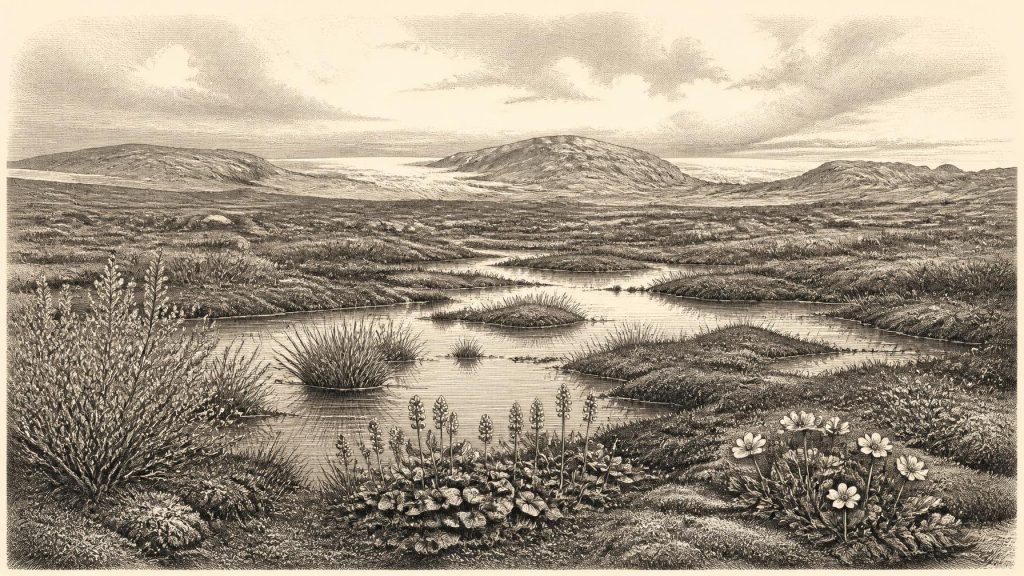
Labelled 30,918 BCE retrospectively, this period belongs to MIS 3 and cannot support year-specific Irish history. Derryvree, County Fermanagh, preserves freshwater silts between glacial tills, radiocarbon dated broadly to 36,900–31,700 calibrated years before present. Its fossils indicate ice-free, treeless tundra with wetlands, mosses, sedges and hardy plants during a fluctuating cold climate. Castlepook Cave, County Cork, records MIS 3 fauna including reindeer, giant deer, mammoth and predators, but accumulated over long periods. A marked reindeer femur may indicate stone-tool butchery, although it remains uncertain. Together, these archives show a dynamic, wildlife-rich landscape, not evidence for settled human communities or institutions.
Dateline
The label 30,918 BCE is a modern point on a retrospective timeline, not a year that can be recovered from Ireland’s Ice Age record. No calendar, ruler, settlement sequence or dated event permits year-by-year history at this depth of time. In the conventional archaeological system that counts back from AD 1950, it lies roughly 32,867 calendar years before present. The responsible approach is therefore to place it within a much broader archaeological and environmental interval: the Late Pleistocene, during Marine Isotope Stage 3 (MIS 3), when climates around the North Atlantic changed sharply and repeatedly.
The strongest Irish evidence relevant to this notional year comes not from an excavated camp but from sediments, fossils and cave bones. These sources can show that particular landscapes existed, that plants and animals occupied them, and that ice advanced or retreated. They cannot identify an Irish community in 30,918 BCE, still less its leaders, beliefs or political affairs. This is a history of a changing land and its living inhabitants, with only a tentative possibility of human contact.
A Date Within a Range
The key local archive is at Derryvree, near Maguiresbridge in County Fermanagh. Road works in 1969 cut through a drumlin and exposed organic freshwater silts and fine sands enclosed between two substantial layers of till, the unsorted material deposited by glacier ice. The sequence is unusually informative. A lower till records an earlier glacial occupation; above it came an interval in which water, sediment, plants and small animals accumulated in an ice-free basin; an upper till shows that glacier ice later returned and sealed the deposits.
Organic material from this freshwater series produced the radiocarbon determination Birm-166: 30,500 radiocarbon years before present, with an uncertainty of +1,170/−1,030 years. A radiocarbon result is not itself a calendar date, since atmospheric carbon-14 levels have varied over time. Published calibration of this old determination has expressed the deposit broadly as about 36,900–31,700 calibrated years before present. The modern label 30,918 BCE falls within that wide span. It does not date a particular season at Derryvree, nor prove that every fossil in the deposit lived simultaneously. What it securely indicates is an ice-free, biologically active Fermanagh environment during part of this cold-stage interval.
This distinction matters because the evidence is exceptionally vulnerable to over-reading. The Derryvree bed tells a relative story of glacier ice, freshwater conditions and renewed glaciation. It does not provide an annual climate diary. Nor can one site in south Fermanagh stand for every district of the landmass that would become Ireland. Yet its preservation beneath a drumlin makes it one of the most valuable windows into an Irish landscape otherwise heavily reworked by later ice.
Water, Mosses and Open Ground
Derryvree was not the wooded island familiar from later prehistory. Its pollen, plant macrofossils and small-fauna evidence point instead to open tundra vegetation and a periglacial regime: severe cold, frequent freezing and thawing, and ground likely affected by seasonal frost. The old descriptive term muskeg is useful if treated carefully. It evokes a wet, moss-rich mosaic of shallow water, saturated sediment, sedges, herbs and low-growing plants rather than an uninterrupted blanket of snow or a later peat bog.
Among the surviving botanical clues are bogbean, dwarf willow, mountain avens, lesser clubmoss and aquatic water-milfoil, together with mosses and pollen dominated by herbaceous plants. These remains demonstrate that a cold landscape could nonetheless contain freshwater pools and short but productive growing seasons. Plant communities occupied different niches: water plants in pools and channels, mosses and sedges in wet ground, and hardy tundra herbs or low shrubs on better-drained patches. A few pollen grains of trees are not evidence for nearby forest; they may have travelled far or been reworked from older sediments. The defensible picture is treeless or almost treeless open country.
Such terrain would have changed rapidly over small distances. Meltwater, frost cracking, shallow ponds, exposed mineral ground and snow patches could coexist, while the growing season imposed strict limits on plant growth. For animals, the most valuable places may have been wetland margins and the richer summer vegetation around them. For any people who entered the region, water, fuel, shelter and prey would have been unevenly distributed and strongly seasonal. That last point is an ecological inference, not evidence for a documented human occupation at Derryvree.
An Island Approaching Reorganisation
At this time Ireland was within the long last glacial cycle but had not yet reached the later Last Glacial Maximum, when ice expanded much more extensively across the island and adjoining shelf. Research on the British–Irish Ice Sheet increasingly portrays the earlier cold stage as dynamic rather than simple: ice masses could grow, retreat and readvance, while different sectors responded differently to climate and topography. The Derryvree sequence gives this larger picture a tangible Irish form. It records an interval without local glacier cover, bracketed by episodes of ice deposition.
Coastlines were also unlike those of the present. Global sea level was lower than today, but the precise pattern of exposed shelf, sea, sea ice, glaciers and possible crossings cannot be reconstructed for one numbered year. Later ice erosion and marine inundation have removed many potential land surfaces. Consequently, the absence of settlements or stone artefacts is not proof that people never reached Ireland during MIS 3; it is also a consequence of a difficult archaeological record. Equally, missing evidence cannot be filled with confident stories of migration routes or permanent communities.
Castlepook’s Animal Archive
County Cork provides a different kind of evidence. Castlepook Cave, near Doneraile, has produced Ireland’s most important pre-Last Glacial Maximum animal assemblage. Its deposits and older excavations yielded bones of reindeer, giant deer, woolly mammoth, brown bear, wolf, Arctic fox, lemmings and spotted hyaena. Revised accelerator radiocarbon dating has shown that several specimens are considerably older than earlier results suggested, placing part of the fauna firmly within MIS 3. The cave confirms that Ireland was repeatedly accessible to, and capable of supporting, a rich cold-stage fauna between roughly 45,000 and 20,000 radiocarbon years ago.
That does not mean all of these animals shared one landscape at one time. Cave deposits can accumulate through carnivore activity, natural deaths, water movement and disturbance over many millennia. Castlepook was in part a carnivore den, not a neatly sealed hunting camp. Its fauna is therefore best read as a long archive of changing ecological opportunities rather than a single photograph of Ice Age Cork. Reindeer and other grazers indicate open habitats; predators demonstrate a food web in which carcasses could be contested, scavenged and transported into caves. Mammoth or hyaena remains are evidence of animals in Ireland, not evidence that a mammoth hunt occurred there.
The Reindeer Femur Question
One Castlepook reindeer femur gives this era special importance for Irish human history. The bone bears a deep linear mark interpreted by the palaeozoologist Ruth Carden as damage made by a sharp stone implement during butchery. County Cork heritage interpretation has presented it as a Palaeolithic object of about 31,000 BC. If that diagnosis is confirmed through further contextual and microscopic work, it would be striking evidence that a person processed a reindeer in Ireland far earlier than the well-established terminal Pleistocene traces of human activity.
For 30,918 BCE, however, caution is essential. The bone’s radiocarbon age dates the death of the animal, not necessarily the instant when the mark was made. Its reported age must be calibrated rather than treated as an exact BCE equivalent. Nor does one modified bone establish where the carcass was killed, whether butchery occurred in the cave, how many people were involved, or whether they lived on the island. No securely associated hearth, lithic assemblage, dwelling floor, human remains or repeated occupation deposit of comparable age has yet been recovered. The strongest formulation is that Castlepook preserves a significant proposed trace of human action, not proof of a settled Irish population in this particular year.
No Polities, but a Living Landscape
There is no evidence here for political institutions, diplomacy, warfare, trade networks, formal religion, art or learning in Ireland. There are no named groups and no recoverable social hierarchy. If mobile Upper Palaeolithic hunters did occasionally reach the island, comparison with better documented north-west European contexts suggests small, flexible groups exploiting seasonal resources. That is a plausible model, not an Irish fact established by a camp or burial.
The principal development around this broad horizon was environmental. Derryvree records fresh water and resilient tundra vegetation between glacial advances; Castlepook documents a wider world of herbivores and formidable carnivores in the south. Together they show that Ice Age Ireland was neither a timeless wilderness nor a uniformly ice-covered void. It was a fragmented, cold and changing landscape. Its fragile sediments and bones define both what can be said about 30,918 BCE and the firm limits beyond which responsible history must not go.
Primary Sources
- A Middle Midlandian Freshwater Series at Derryvree, Maguiresbridge, County Fermanagh, Northern Ireland
- A Reconsideration of the Radiocarbon Dating of the Marine Isotope Stage 3 Fauna from Southern Ireland
- The Irish Quaternary Fauna Project
- New Insights on the Fauna of Ireland’s Younger Dryas and Early Holocene from Alice & Gwendoline Cave
- The Timing and Magnitude of the British–Irish Ice Sheet Between Marine Isotope Stages 5d and 2
- Oscillating Retreat of the Last British-Irish Ice Sheet on the Continental Shelf Offshore Galway Bay, Western Ireland
- Palaeoecology
- Figure 6.— The Subdivision of the Quaternary Period in Ireland
- Quaternary Site Descriptions
- Heritage Artefacts of County Cork
- Archaeological Heritage of County Cork
- 2022:564 – Castlepook Cave, Castlepook South, Cork
- Menyanthes trifoliata
- Dryas octopetala
- Salix herbacea
- Myriophyllum alterniflorum
- Selaginella selaginoides
- Deposits of the Last Glaciation
- Archaeology Research Excavation Grant 2022: Final Report
- The IntCal20 Northern Hemisphere Radiocarbon Age Calibration Curve (0–55 cal kBP)