Castlepook’s Marked Hindleg30917 BCE
At 30,917 BCE, Ireland was a climatically unstable Late Pleistocene landscape, not a date capable of precise annual history. During the Midlandian cold stage, open tundra, wetlands and seasonal meltwater existed alongside advancing ice. Derryvree sediments in Fermanagh preserve evidence of treeless freshwater habitats, although their dating cannot identify this specific year. Castlepook Cave in Cork yielded a reindeer femur, about 33,000 years old, bearing a possible stone-tool cut mark: Ireland’s earliest proposed human evidence. Yet no associated tools, hearths or settlements survive. Faunal and geological remains demonstrate ecological activity and changing routes, while human presence remains brief, uncertain, debated.

Dateline
30,917 BCE is not a date at which Ireland can be described year by year. No written record, annual chronology or securely dated event survives from this part of the Late Pleistocene. The label is best treated as a modern point within a much broader archaeological and environmental timespan. It falls roughly 32,866 years before AD 1950, the conventional ‘present’ used in scientific dating, but that arithmetic is not the same as a precise archaeological date. Radiocarbon ages must be calibrated, and beyond about 14,000 years ago calibration is built from several kinds of natural archive rather than an annual tree-ring sequence. The responsible picture is therefore of Ireland during the later part of Marine Isotope Stage 3, a climatically unstable interval before the fullest expansion of the last British–Irish Ice Sheet.
The evidence closest in spirit to this date comes from a small number of cave-bone assemblages, buried wetland sediments and glacial landforms. They document environments and animal movements over centuries or millennia. They do not permit the assignment of a named occurrence to 30,917 BCE, nor do they reveal a continuous human population. Indeed, the apparently simple question of whether people were in Ireland at this time remains dependent on exceptionally slight and debated evidence.
A Cold Country Before Maximum Ice
Ireland was not yet the familiar green island of later millennia. It lay within the Midlandian cold stage, the Irish expression of the last glacial cycle. Climate swung sharply between colder and relatively milder phases, while expanding ice masses, altered sea levels and changing vegetation repeatedly transformed routes across north-west Europe. The Last Glacial Maximum is generally placed later, broadly after 26,500 calibrated years before present, although the British–Irish Ice Sheet did not reach its greatest extent everywhere at one moment. Large-scale reconstructions show advances and retreats between roughly 31,000 and 15,000 years ago, with different sectors behaving differently.
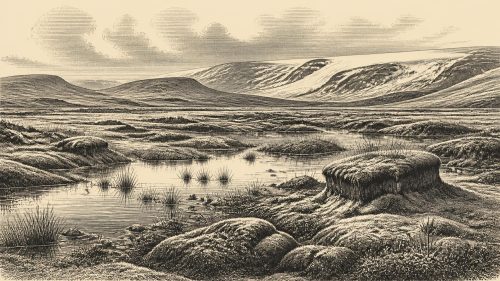
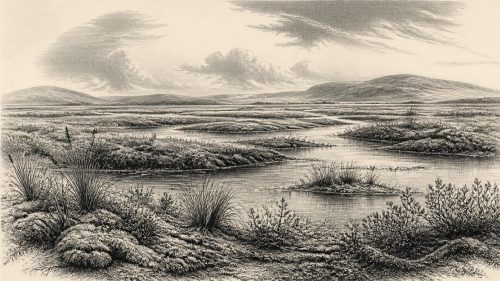
For the particular horizon represented by 30,917 BCE, it is safer to speak of a cold, open and changeable Irish landscape than of an island wholly entombed beneath ice. Geological sequences in County Fermanagh preserve organic sediments trapped between tills: deposits made when water and vegetation existed in places later overridden or enclosed by glacial activity. At Derryvree, near Maguiresbridge, fossil mosses, sedges, aquatic plants and insects point to cold freshwater wetlands and a treeless tundra or muskeg mosaic. These deposits have been associated with a later Middle Midlandian cold phase, with an old radiocarbon determination of about 30,500 BP; its uncertainty and the subsequent development of dating methods mean that it cannot be made to coincide with one numbered BCE year.
Nevertheless, Derryvree offers an essential corrective to any image of unbroken ice. Low hollows could hold pools, sedge beds and organic mud during ice-free or marginal intervals. Open ground supported plants able to cope with short growing seasons, frozen subsoil and strong winds. Dwarf shrubs, grasses, sedges, herbs and mosses supplied a thin but meaningful ecological base. In summer, meltwater and shallow wetlands would have broken up the stony terrain; in winter, snow, frost and exposed ground dominated. Such evidence describes habitat, not a settled landscape.
The Castlepook Question
The most arresting object relevant to this distant period is a reindeer femur fragment from Castlepook Cave, also called Mammoth Cave, near Doneraile in north County Cork. Castlepook is Ireland’s richest known cave locality for Pleistocene vertebrate remains. Its collections include evidence for animals associated with cold open country and cave use, among them reindeer, woolly mammoth, brown bear, fox, hare, lemmings and spotted hyaena. Crucially, however, cave assemblages are not snapshots. Carnivores, water, gravity, scavenging and nineteenth- and early twentieth-century excavation all affected how bones entered the cave, where they were found and what contextual information survived.
The femur has been publicised as approximately 33,000 years old and bears a deep linear modification interpreted by zoologist Ruth Carden as a cut or chopping mark made with a sharp stone implement while the bone was fresh. If that interpretation is upheld, it is Ireland’s earliest currently proposed evidence of human activity: a brief Upper Palaeolithic encounter involving the processing of a reindeer carcass. County Cork heritage material has reasonably presented the find as broadly around 31,000 BCE. That broad public label explains its relevance here, but it must not be converted into a claim that the mark was made in 30,917 BCE specifically.
The limits are as important as the possibility. There is no securely associated hearth, stone-tool assemblage, dwelling surface, burial, artwork or human bone of this age from Ireland. A modified animal bone, even if genuinely cut by people, cannot establish a village, a permanent population, a named culture, a migration route or descent from later Irish communities. It does not tell us whether hunters killed the animal, found carrion, visited for hours, travelled seasonally or returned. Nor can it settle whether other bones in the cave represent the same episode. This is evidence for a possible human action, not proof of an Irish society in the ordinary historical sense.
Animals, Food and Movement
The animal evidence does establish something substantial: Ireland could support a much richer Ice Age fauna than the modern island. Reindeer are especially suggestive of open grazing landscapes and may have moved over broad seasonal ranges. Mammoth remains point to the existence, at least in suitable phases, of extensive plant resources for very large herbivores. Giant deer, bears, foxes, hares, lemmings and hyaenas belong to a varied northern fauna whose composition changed with climate and access. Hyaena remains also warn against easy conclusions: a cave may have been a carnivore den or a place where bones accumulated naturally, rather than a human camp.
If people did reach Ireland, their economy would have been entirely mobile and opportunistic. The only defensible inference from the marked femur is possible meat and marrow processing. Reindeer could provide food, hide, sinew, bone and antler, but none of those wider uses is demonstrated at Castlepook. There is no basis for estimating population, defining territories or reconstructing a seasonal round. Equally, there is no evidence for farming, pottery, metalworking, built monuments, stored grain or domestic animals. The familiar categories of later prehistory simply do not apply.
Sea level was substantially lower during the glacial period than it is today, exposing areas now beneath the Irish Sea and Atlantic shelf. Ireland’s connections to Britain and the European mainland changed as sea level and ice margins changed. This makes animal and possible human movement more plausible than it would be across the modern sea, but it does not mean that a simple, dry ‘land bridge’ stood open continuously. Routes could have involved coastal plains, river valleys, ice margins, changing channels and hazardous terrain. The geographical setting enabled episodes of dispersal; it does not demonstrate regular travel or exchange.
No Kingdoms, No Diplomacy
There is no evidence from this period for political institutions, leaders, warfare, diplomacy, law or collective identities recognisable as nations or tribes. Nor is there evidence for religion in the archaeological sense: no burial rite, shrine, image, engraved symbol or ceremonial deposit can be assigned to Ireland around this point. Silence on these subjects is not an omission to be filled with imaginative narrative. It is a real property of the surviving record.
That silence also applies to language, learning and culture. Any visitors, if the Castlepook modification is anthropogenic, would have carried knowledge of cold-country travel, animal behaviour, carcass processing and stone technology. Yet no stone tool has been recovered in direct association with the bone, so even the technological tradition cannot responsibly be named. Their speech, kinship, beliefs, clothing and social organisation are unknown. Comparisons with Upper Palaeolithic groups elsewhere in Europe may suggest possibilities, but they are interpretation, not Irish evidence.
Landscape as the Main Archive
The strongest history for this date is environmental. Sediments at Derryvree, faunal remains from Castlepook and reconstructions of the growing British–Irish Ice Sheet reveal a landscape repeatedly remade by cold. Wetland plants and insects record local conditions; mammal bones show that larger animals reached and lived in parts of Ireland; tills, erratics and glacially scoured rock demonstrate later ice expansion. Each archive has a different timescale and its own problems of preservation. Together they show neither a blank nor a settled homeland, but a sparsely evidenced northern landscape in transition.
By the time later ice expansion reached its maximum, many such habitats had been buried, eroded or drastically altered. That destruction helps explain why the record for 30,917 BCE is so thin. Ireland’s deep past survives as scattered traces rather than a continuous story: a wetland sealed between glacial deposits, a cave bone curated from old excavation, a fossil insect or a landform dated long after its formation. The marked hindleg at Castlepook is important not because it answers every question, but because it makes the question of early human presence unavoidable. For this year, as for much of Ice Age Ireland, the most honest conclusion is both compelling and limited: there was a cold, ecologically active country here, and perhaps a fleeting human encounter within it.
Primary Sources
- Castlepook Cave: Cork County Geological Site Report
- Heritage Artefacts of County Cork
- Early Midlandian–Middle Midlandian, Pleistocene, Northern Ireland
- Aghnadarragh: Earth Science Conservation Review Site Summary
- The Irish Quaternary Fauna Project
- New Insights on the Fauna of Ireland’s Younger Dryas and Early Holocene from Alice & Gwendoline Cave
- The IntCal20 Northern Hemisphere Radiocarbon Age Calibration Curve (0–55 cal kBP)
- Growth and Retreat of the Last British–Irish Ice Sheet, 31,000 to 15,000 Years Ago: the BRITICE-CHRONO Reconstruction
- Growth and Retreat of the Last British–Irish Ice Sheet, 31,000 to 15,000 Years Ago: the BRITICE-CHRONO Reconstruction
- New Data for the Last Glacial Maximum in Great Britain and Ireland
- Extent and Timing of the Last Glacial Maximum (LGM) in Britain and Ireland: a Review
- Late Pleistocene Chronostratigraphy and Ice Sheet Limits, Southern Ireland
- Trimlines, Blockfields and the Vertical Extent of the Last Ice Sheet in Southern Ireland
- Oscillating Retreat of the Last British-Irish Ice Sheet on the Continental Shelf Offshore Galway Bay, Western Ireland
- Timing and Pace of Ice-Sheet Withdrawal Across the Marine–Terrestrial Transition West of Ireland During the Last Glaciation
- Dimensions and Chronology of the Last Ice Sheet in Western Ireland
- The Island of Ireland: Drowning the Myth of an Irish Land-Bridge?
- Mammoth and Musk Ox ESR-Dated to the Early Midlandian at Aghnadarragh, County Antrim, Northern Ireland, and the Age of the Fermanagh Stadial
- Irish Quaternary Association: Outreach and Education Resources
- What Was on the Menu in Prehistoric Ireland?