Maguirebridge’s Tundra Basin30859 BCE
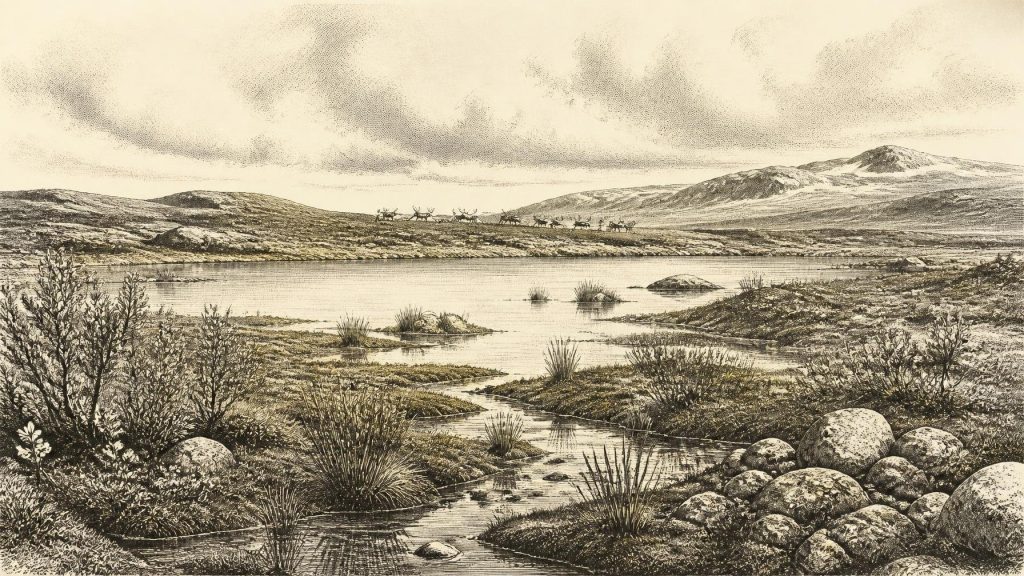
30,859 BCE is not a recoverable Irish date but a notional point within unstable MIS 3. Derryvree, County Fermanagh, preserves freshwater sediments between tills, indicating an ice-free, periglacial tundra wetland with treeless vegetation, seasonal thaw and productive shallow water. Castlepook Cave, County Cork, contains a time-mixed fauna including mammoth, giant deer, reindeer, bear, wolf, hyaena and lemmings, demonstrating cold, open habitats. A possibly stone-cut reindeer femur may indicate mobile Upper Palaeolithic hunters, but cannot prove settlement. Later ice expansion destroyed or obscured much evidence. The period therefore reveals a changing ecosystem, while human presence, society and continuity remain deeply unresolved.
Dateline
The label 30,859 BCE is a modern chronological convenience, not a date at which an Irish event can be recovered. No calendar, writing, named community or archaeological horizon can be assigned to that particular year. In simple arithmetic it falls about 32,800 years before the radiocarbon reference year of AD 1950, but that is not itself a scientific age determination. For this remote period, responsible history works with ranges: radiocarbon measurements, calibrated probability intervals, sediment sequences and changing climatic phases. The relevant setting is the later part of Marine Isotope Stage 3 (MIS 3), an unstable stretch of the last Ice Age before the fullest expansion of the Last Glacial Maximum.
Ireland at this time was neither the familiar green, wooded island of later prehistory nor necessarily one uniform expanse of glacier. Conditions and ice margins altered repeatedly over long spans. The evidence is fragmentary and local, but it establishes something important: at points during this cold age, parts of Ireland supported tundra and wetland ecosystems, and large mammals crossed or occupied landscapes now profoundly reshaped by ice, sea-level change and later erosion.
A Date Range, Not a Recorded Year
The closest Irish environmental archive is at Derryvree, near Maguiresbridge in County Fermanagh. Road works in 1969 exposed freshwater silts and fine sands sealed between two glacial tills within a drumlin. This sequence is valuable precisely because it survived between deposits laid down by ice. A radiocarbon measurement from the organic material gave 30,500 ± 1,170/1,030 radiocarbon years BP. Such a result cannot be converted honestly into one BCE year: radiocarbon ages must be calibrated, the uncertainty is substantial, and the sediment accumulated over time rather than in a moment.
Nevertheless, Derryvree provides a defensible window onto Ireland broadly near this notional date. The deposit belongs to the Middle Midlandian, Ireland’s local term for part of the last cold stage, and indicates an ice-free interval before later glaciation. It is evidence for a particular Fermanagh basin, not proof that every region of the island had identical weather, vegetation or ice cover. Its significance lies in showing that a cold but living landscape existed where later ice left drumlins and till.
Fresh Water Beneath Later Ice
The Derryvree fossils describe a severe periglacial environment: ground subject to intense cold and freezing processes, but not continuously buried beneath glacier ice. Plant macrofossils, mosses, insect evidence and sparse pollen point to open, treeless vegetation. Sedges and wet-ground plants occupied the margins of freshwater, while species such as bogbean, mountain-avens, dwarf willow and clubmoss have been used to reconstruct a mosaic of shallow water, damp mossy ground and exposed mineral soil. The sparse pollen record does not support a forested Fermanagh; a few grains of tree pollen are more plausibly distant inputs or reworked material than signs of local woodland.
This was not a simple polar desert. The freshwater sediments demonstrate standing or slow-moving water, seasonal thaw and enough biological productivity to preserve organic remains. Yet it was a difficult landscape. Short growing seasons, strong winds, frozen ground and marked seasonal contrasts are consistent with the flora and with wider evidence for abrupt North Atlantic climatic fluctuations during MIS 3. “Tundra” is therefore useful as a broad description, provided it does not conjure a single unchanging habitat. Around a shallow basin, wet sedge- and moss-rich ground could lie close to stony, sparsely vegetated terrain.
There is no basis for describing the basin as a settlement. No hearth, stone-tool assemblage, structure, burial or food debris of this age was recovered at Derryvree. Its record is environmental: it tells us what could live there, not that people did.
Castlepook’s Animal World
County Cork provides the strongest complementary evidence. Castlepook Cave, also known as Mammoth Cave, near Doneraile, has yielded Ireland’s richest known assemblage of Late Pleistocene vertebrates. More than 2,000 bones have been recovered from its passages and chambers, including remains attributed to woolly mammoth, giant deer, reindeer, brown bear, wolf, mountain hare, Arctic fox, lemmings and spotted hyaena. The cave did not preserve a single day’s fauna. Its deposits accumulated and were disturbed over long periods; individual bones have different histories, and older excavations did not meet modern standards of stratigraphic recording.
Even with those limits, the assemblage demonstrates that Ireland could support, or was accessible to, a strikingly continental-looking fauna during phases of MIS 3. Reindeer and lemmings are strong indicators of open, cold-adapted environments. Mammoth and giant deer imply extensive feeding grounds rather than dense woodland. Spotted hyaena, represented at Castlepook by bones, teeth and a skull, was a powerful scavenger and predator capable of moving carcass parts into caves. The presence of carnivores is an important warning against assuming that every bone was carried or modified by people.
Recent reassessment of Irish cave radiocarbon dates has also changed the chronology. Improved pretreatment of bone collagen showed that some earlier determinations were too young. Work on the Castlepook fauna places important parts of the assemblage securely in MIS 3, while suggesting that giant deer and spotted hyaena may have disappeared locally before the Last Glacial Maximum, around 40,000 calibrated years BP. The precise coexistence of every recorded species should not be assumed: the cave is an archive of repeated episodes, not a frozen ecosystem.
The Reindeer Femur Question
One Castlepook specimen makes this period especially significant for human history. A reindeer femur from the old collection has been presented by zooarchaeologist Ruth Carden and County Cork heritage publications as carrying a deep mark made by a sharp stone tool during the processing of fresh bone. The object has been associated publicly with about 31,000 BC, placing it broadly near the timescale represented by 30,859 BCE. If that interpretation is upheld, it would be evidence that people handled a reindeer carcass in Ireland during the Upper Palaeolithic, far earlier than the long-established record of post-glacial settlement.
The finding must remain proportionate to its evidence. The bone is not a house, camp floor, burial, hearth or lithic workshop. No stone tool responsible for the mark has been found with it, and no securely associated cluster of butchered bones demonstrates repeated use of the cave by people. A radiocarbon determination dates the animal’s death within a range; it does not automatically date the incision, identify its maker, establish where the animal was killed or prove that the cave was the place of butchery. Indeed, carnivores may have carried discarded carcass parts into Castlepook.
The most that can responsibly be said is also the most interesting: Ireland may have been visited by one or more highly mobile Upper Palaeolithic hunters during this broad period. If they were present, they could have used a sharp stone edge to obtain meat, hide, sinew or marrow from a large animal. They may have arrived from Britain or farther across north-west Europe during a phase when lower sea levels changed the geography of the Irish Sea basin. But no route, group size, language, cultural identity, season or duration of stay is known. A single modified bone cannot establish continuous occupation or ancestry linking any visitors to later inhabitants.
Society Without a Social Record
Political affairs, diplomacy, formal conflict and institutions are beyond the evidence. There were no states, kingdoms, towns, written agreements or monuments in Ireland from which such subjects could be reconstructed. Nor is there evidence for farming, herding, metalworking, markets or a permanent trade network. The economic possibilities visible in the record are ecological: grazing animals, predators, freshwater, plant materials and stone suitable for cutting tools. Any human economy, if humans were present, was a hunter-gatherer one conducted on a small and mobile scale.
Likewise, there is no direct evidence for ritual, religious practice, art, teaching or language in Ireland at this date. It would be reasonable, by comparison with Upper Palaeolithic communities elsewhere in Europe, to expect shared knowledge of animal behaviour, seasonal travel and stone-working. But comparison is interpretation, not Irish proof. There is no Irish cave art, portable art, grave, structured deposit or ritual site securely dated to this time.
An Island in Transition
The wider regional story is one of impending transformation. Later in the last glacial cycle, the British–Irish Ice Sheet expanded dramatically, reaching its maximum extent in different sectors roughly between 28,000 and 20,000 calibrated years BP. Ice and meltwater eroded, buried and rearranged older terrain. That later glaciation helps explain why early evidence is so scarce: camps, shorelines and light structures are especially vulnerable to destruction, while many former coastal landscapes now lie beneath the sea. It does not, however, justify inventing lost settlements where none have been found.
Thus the history of Ireland around 30,859 BCE is not a story of named people or dated deeds. It is a carefully bounded reconstruction from a Fermanagh freshwater basin, a Cork cave and a handful of scientifically dated animal remains. Derryvree shows tundra wetland existing between episodes of glaciation. Castlepook shows that reindeer, mammoths, giant deer and carnivores moved through an open Ice Age world. The marked reindeer femur raises the possibility of a human encounter with that world. Together they reveal a living, changeable Ireland at the edge of the great ice, while leaving its human history tantalisingly unresolved.
Primary Sources
- A Middle Midlandian Freshwater Series at Derryvree, Maguiresbridge, County Fermanagh, Northern Ireland
- Palaeoecology: South Fermanagh, Northern Ireland
- The Subdivision of the Quaternary Period in Ireland
- A Reconsideration of the Radiocarbon Dating of the Marine Isotope Stage 3 Fauna from Southern Ireland
- The Irish Quaternary Fauna Project
- Castlepook Cave, County Geological Site Report
- Spotted Hyena Skull
- Archaeological Heritage of County Cork
- Heritage Artefacts of County Cork
- First Evidence of a Late Upper Palaeolithic Human Presence in Ireland
- First Evidence of a Late Upper Palaeolithic Human Presence in Ireland
- New Insights on the Fauna of Ireland's Younger Dryas and Early Holocene from Alice & Gwendoline Cave
- The Colonization of Ireland: A Human Ecology Perspective
- Ireland Through Geological Time
- Quaternary Geology and Geomorphology Data
- Geological Mapping Projects
- Ireland's Palaeolithic Archaeology – Fleeting Footprints in a Frozen Land
- The Mesolithic in Ireland: When Was It?
- The Last Glacial Maximum
- Restricted Cirque Glaciers in the Wicklow Mountains, Ireland, During the Nahanagan Stadial (Greenland Stadial-1/Younger Dryas)
- Introduction to the Late Quaternary and Holocene of Northern Ireland
- IQUA Field Guides