Doneraile’s Faunal Window30844 BCE
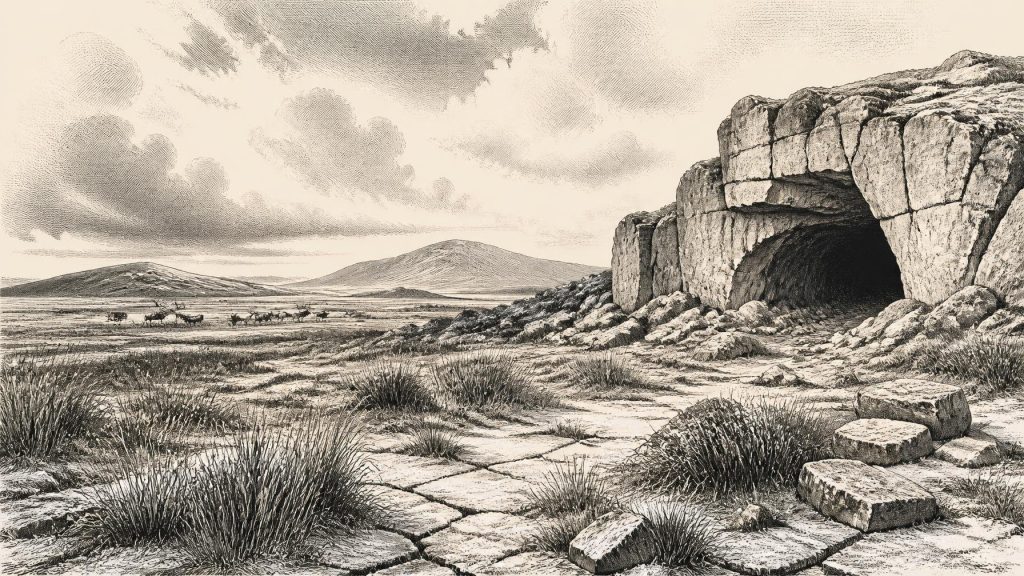
Thirty thousand years before Irish societies, Ireland formed part of a cold Pleistocene landscape during Marine Isotope Stage 3, before the Last Glacial Maximum. Open tundra or steppe supported reindeer, mammoth, giant deer, bears, wolves, hyaenas and other fauna, documented at Castlepook Cave near Doneraile. Cave deposits and radiocarbon dates demonstrate animal presence, although disturbed collections limit precision. A reindeer bone, possibly bearing a stone-tool cut mark, suggests a human incursion around 31,000 BCE, but cannot prove settlement or continuity. No tools, hearths or structures survive. Thus evidence records environmental change and transient hunters, not a dated event or society.
Dateline
30,844 BCE is not a year for which Ireland has a historical record. It is a modern calendar label, approximately 32,793 years before AD 1950, the conventional reference point for “before present” in archaeological science. Neither an event nor a person can responsibly be assigned to that precise year. The evidence is instead measured in radiocarbon determinations, calibrated ranges, cave deposits and long climatic phases whose uncertainty commonly runs to centuries or millennia. What can be examined is Ireland in the later part of Marine Isotope Stage 3, before the full Last Glacial Maximum, through a small but exceptionally important body of environmental and faunal evidence.
At this date Ireland was part of the Pleistocene world: colder, generally more open and much less familiar than the wooded island of later prehistory. It was not yet securely established as a permanently inhabited country. The strongest Irish evidence comes from animal bones, especially those recovered from Castlepook Cave, near Doneraile in north County Cork, rather than from settlements, monuments or written testimony. The cave’s evidence provides a window, not a complete picture, onto a changing Ice Age landscape.
Before the Great Ice Expansion
The numbered date falls well before the peak of the Last Glacial Maximum. Reconstructions of the British–Irish Ice Sheet place its maximum extent considerably later, broadly during the period around 26,000–19,000 years ago, although the timing, thickness and local limits of ice remain subjects of active research. Ireland was therefore not simply an island buried beneath a single unchanging sheet of ice in 30,844 BCE. Conditions varied across regions and through time: ice advanced and retreated, while exposed lowlands, uplands and coastal plains could support cold-adapted plants and animals during less severe intervals.
This was nevertheless a highly unstable North Atlantic climate. Greenland ice cores record abrupt switches between colder stadials and relatively milder interstadials throughout the last glacial period. Those records are vital for setting Ireland in a wider frame, but they do not supply an Irish weather report for one calendar year. Nor should their chronology be used to turn a broad environmental phase into a dated Irish episode. The responsible conclusion is that people, animals and vegetation in Ireland, if present, faced a climate capable of changing markedly within a few human generations.
An Open, Cold Country
There were no Neolithic forests, farm fields or peat bogs of the familiar modern kind. In a cold-stage setting, much of the land available beyond glaciers would have supported tundra or mammoth-steppe-like vegetation: grasses, sedges, herbs, dwarf shrubs and scattered hardy woody plants where local conditions allowed. Such ground could look spare, but it was not lifeless. Seasonal growth supported grazing animals and, in turn, carnivores and scavengers. Rivers carrying meltwater, frost-shattered slopes, exposed limestone and shifting sediments made the terrain difficult, while lower sea levels altered coastlines and the geography of crossings between Ireland, Britain and continental Europe.
The details cannot be mapped confidently for every Irish county in 30,844 BCE. Much of the direct plant evidence comes from other glacial intervals or from deposits whose dating has broad limits. Yet the animal record and regional glacial research make clear that Ireland formed part of a wider north-west European cold-stage ecosystem. The landscape was a mosaic, not an empty white expanse: the availability of forage, shelter and passable routes changed with season, elevation and climate.
Castlepook Cave and Its Animals
Castlepook Cave—historically also called Mammoth Cave—is the key locality. Excavations and collecting there, especially in the late nineteenth and early twentieth centuries, produced an unusually rich assemblage of Pleistocene bones. Later work by the Irish Quaternary Fauna Project used accelerator radiocarbon dating to investigate the age range of material from Irish caves. It found that a varied mammal fauna reached Ireland between at least about 45,000 and 20,000 radiocarbon years ago, though old cave collections and disturbed deposits mean that bones found together need not be of the same date or have arrived by the same process.
Castlepook’s recorded fauna includes reindeer, woolly mammoth, giant deer, brown bear, wolf, fox, hare, lemmings and spotted hyaena. This is important evidence for environment, but it must be read carefully. A cave bone is not necessarily evidence that the animal lived or died inside the cave: hyaenas and other carnivores could drag prey and carrion into dens; water, collapse and later excavation could mix material; and a specimen may represent a short visit rather than a resident population. Even so, the assemblage demonstrates that north Cork lay within, or was repeatedly reached by, a broad Ice Age faunal zone.
A reindeer metatarsal from Castlepook produced a radiocarbon age of 33,630 ± 790 BP in the 1997 project. This is a radiocarbon result, not a precise calendar date, and calibration at this depth is necessarily broad. It does, however, place reindeer in the Irish record well before the Last Glacial Maximum. The modern calendar point 30,844 BCE should not be presented as the animal’s exact death date, but it lies in the same general pre-maximum Ice Age world to which Castlepook bears witness.
The Reindeer Bone and Human Presence
The most arresting possibility is human activity. A reindeer femur from Castlepook, held in the National Museum of Ireland’s natural-history collections, has been publicised as dating to about 31,000 BCE and as carrying a deep mark identified by zooarchaeologist Ruth Carden as having been made by a sharp stone tool during butchery. County Cork heritage material accordingly presents it as evidence that Stone Age hunters may have processed reindeer in the Doneraile area. If this interpretation is upheld, it would be Ireland’s earliest currently claimed indication of human activity, dramatically earlier than the well-established post-glacial archaeological record.
Its importance demands restraint. The femur is a single bone from an old cave assemblage, not an excavated occupation floor sealed beneath dated sediments. No stone-tool assemblage securely associated with it has yet been recovered in Ireland, nor is there a hearth, dwelling, burial, food store or concentration of butchered bones of the same age. The bone’s date measures when the animal died, not necessarily the exact moment, location or circumstances in which its surface was marked. A cut mark can support a carefully limited inference—human handling of a carcass—but cannot establish a village, a named culture, continuous occupation or a population descended from later Irish communities.
The most plausible interpretation is therefore of a brief Upper Palaeolithic incursion, if the mark is anthropogenic: mobile hunter-gatherers may have reached Ireland during a favourable phase, exploited a large animal, and left little else that survives. Hunting reindeer would have offered meat, fat, hide, sinew, antler and bone, resources familiar to Upper Palaeolithic groups elsewhere in Europe. But none of those wider European practices can be assumed as a detailed description of activity at Castlepook. Ireland has not yielded the tools needed to identify the hunters’ technological tradition or the evidence needed to reconstruct their camp life.
Society Without a Recorded Society
For this reason, conventional categories of political history do not apply. There is no evidence for rulers, territories, diplomacy, warfare, law or formal institutions in Ireland at this date. There is likewise no Irish evidence for farming, herding, metallurgy, trade networks, permanent houses, ritual monuments, formal burial grounds or writing. Absence of evidence is not proof that no people ever entered the island; it is a reminder of how slight and uneven survival is in a glacial landscape repeatedly reshaped by ice, water and erosion.
If people did visit, their social world was probably organised on a small, mobile scale rather than around states or settlements. Their movements would have depended on animal migrations, seasonal resources, knowledge of routes and the practical risks posed by cold, predators and changing ground. Contacts with groups in Britain or on the European mainland are possible in geographical terms, particularly when sea levels were lower, but no Irish artefact or genetic evidence currently demonstrates a route, an exchange partnership or a diplomatic connection. These remain possibilities, not facts.
What This Date Can Mean
Thirty millennia before the first securely documented farming communities, and long before the later Irish languages, kingdoms and monuments, Ireland’s history is principally environmental. Castlepook Cave shows that Ice Age animals crossed or occupied this western edge of Europe; its reindeer femur raises the serious possibility that human hunters did so as well. The lesson of 30,844 BCE is not that Ireland possessed a hidden prehistoric civilisation. It is that the island was part of a mobile, cold-adapted world in which fauna, climate and perhaps small groups of people could reach places later transformed by ice and sea.
Future excavation of intact cave deposits, improved dating and microscopic re-examination of bone surfaces may refine the picture. For now, the evidence supports a precise distinction: there was a Pleistocene Irish landscape rich enough for reindeer, mammoth, hyaena and other animals; there may have been a fleeting human encounter within it; but modern calendar-year precision, permanent settlement and a year-specific event remain beyond what the archaeology can demonstrate.
Primary Sources
- The Irish Quaternary Fauna Project
- Heritage Artefacts of County Cork
- Archaeology Research Excavation Grant 2022: Final Report
- The Mesolithic in Ireland: When Was It?
- Figure 6.—The Subdivision of the Quaternary Period in Ireland
- New Insights on the Fauna of Ireland’s Younger Dryas and Early Holocene from Alice & Gwendoline Cave
- First Archaeological Evidence of Humans in Palaeolithic Ireland
- Dimensions and Chronology of the Last Ice Sheet in Western Ireland
- Extent and Deglacial Chronology of the Last British–Irish Ice Sheet: Implications of Exposure Dating Using Cosmogenic Isotopes
- Trimlines, Blockfields and the Vertical Extent of the Last Ice Sheet in Southern Ireland
- Last Glacial Maximum Cirque Glaciation in Ireland and Implications for Reconstructions of the Irish Ice Sheet
- Late Pleistocene Chronostratigraphy and Ice Sheet Limits, Southern Ireland
- Growth and Retreat of the Last British–Irish Ice Sheet, 31,000 to 15,000 Years Ago: the BRITICE-CHRONO Reconstruction
- The Timing and Magnitude of the British–Irish Ice Sheet Between Marine Isotope Stages 5d and 2
- The Evolution of the Terrestrial-Terminating Irish Sea Glacier During the Last Glaciation
- Stratigraphic and Palaeo-Geomorphological Evidence for the Glacial-Deglacial History of the Last British-Irish Ice Sheet in the North-Western Irish Sea
- A Stratigraphic Framework for Abrupt Climatic Changes During the Last Glacial Period Based on Three Synchronized Greenland Ice-Core Records
- IntCal20: The Northern Hemisphere Radiocarbon Age Calibration Curve (0–55 cal kBP)
- Marine20—The Marine Radiocarbon Age Calibration Curve (0–55,000 cal BP)
- Timing, Pace and Controls on Ice Sheet Retreat: an Introduction to the BRITICE-CHRONO Transect Reconstructions of the British-Irish Ice Sheet