
Cork Caves, Fermanagh Wetlands30837 BCE
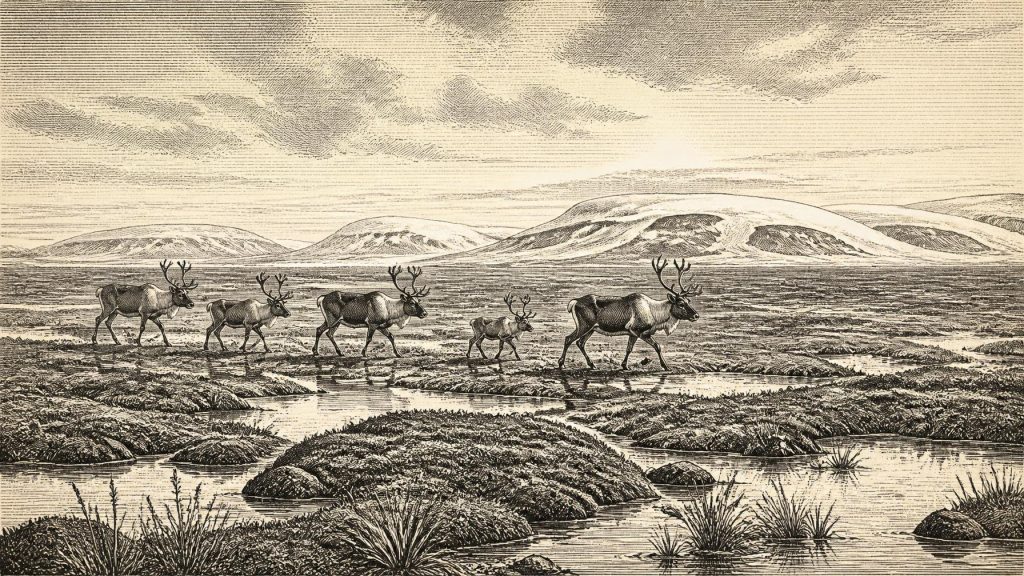
Around 30,837 BCE, Ireland lay within the climatically unstable MIS 3 phase of the Late Pleistocene, not a recoverable calendar year. Inter-till deposits at Derryvree and other Fermanagh sites record temporary ice-free freshwater wetlands, with sedges, mosses, insects and sparse treeless vegetation, between glacial advances. Castlepook Cave in Cork preserves a time-mixed Ice Age faunal assemblage, including mammoth, reindeer, giant deer, bear and hyaena, demonstrating viable habitats. A possibly stone-tool-marked reindeer femur may indicate brief human activity, but cannot prove settlement or continuous occupation. Evidence supports a shifting mosaic of ice, wetlands, open ground and animal corridors, rather than uniformity.
Dateline
The label “30,837 BCE” is useful for arranging a modern chronology, but it does not identify an event that happened in a recoverable Irish calendar year. No written calendar, settlement record or annually resolved archaeological sequence exists for Ireland at this depth of time. In archaeological convention, it is roughly 32,787 years before AD 1950, but even that conversion should not imply precision. The responsible account is built from calibrated ranges, stratigraphy and environmental proxies: buried muds, plant remains, insects, animal bones, cave deposits and the traces left by advancing and retreating ice.
A Date Within a Long Cold Stage
This point falls in the Late Pleistocene, during Marine Isotope Stage 3 (MIS 3), a lengthy and climatically unstable portion of the last Ice Age. Across the North Atlantic world, relatively milder interstadials alternated abruptly with colder stadials. Ireland was not uniformly entombed beneath an ice sheet throughout the whole period, nor was it a stable, welcoming landscape. Conditions changed substantially between regions and through time. The later Last Glacial Maximum, when the Irish Ice Sheet expanded to far greater extent, still lay ahead.
The most relevant Irish environmental sequence comes from Derryvree, near Maguiresbridge in County Fermanagh. There, a road cutting exposed organic freshwater sediments and fine sands enclosed between two tills. Till is sediment deposited directly by ice, so the order of layers is crucial: an earlier glacier deposited the lower till; afterwards, water, plants and organic mud accumulated locally; then a later advance laid down the upper till. This is firm evidence for a change from glacial occupation to an ice-free freshwater setting and back again. It is not evidence for a single year’s weather, much less an historical incident.
A radiocarbon determination from Derryvree’s organic bed was 30,500 radiocarbon years before present, with a large uncertainty. When calibrated, the deposit has been placed broadly between about 36,900 and 31,700 calendar years before present. The nominal year 30,837 BCE sits within that wide range. It cannot be used to say that a particular sedge, insect or pool existed in that exact year; rather, Derryvree illuminates the sort of Irish environment that could occur during this phase. Calibration matters because radiocarbon years are not identical to calendar years, particularly so far back in time.
Wet Ground Between Glaciers
The Derryvree deposits point to a treeless, cold and open landscape, but not to lifelessness. Freshwater mosses, sedges and other wet-ground plants grew around shallow water and saturated ground. Pollen, plant macrofossils and insect remains together indicate a periglacial environment: one heavily shaped by frost, seasonal freezing, sparse vegetation and short growing seasons, but without local glacier cover while the organic sediments accumulated. The word “wetland” should not conjure a modern Irish bog fringed by woodland. This was a raw, exposed landscape of mud, pools, sedge-rich margins and open ground.
Comparable inter-till deposits at Hollymount, also near Maguiresbridge, and at Greenagho near Belcoo show why Fermanagh matters so much to this period. They preserve fragments of environmental history beneath later glacial deposits. The sites do not necessarily represent one continuous, island-wide habitat or exactly contemporary episodes. Together, however, they demonstrate that northern Ireland experienced repeated changes in ice cover and climate during the Midlandian, the Irish name commonly used for the last glacial stage. Their survival is exceptional: later ice frequently eroded, mixed or buried earlier landscapes.
At the scale of the whole island, certainty diminishes. Derryvree proves local conditions in one northern basin during a dated interval; it should not be stretched into a detailed map of every Irish valley, coast or upland at 30,837 BCE. Ice-sheet reconstructions indicate that the British–Irish Ice Sheet was growing and changing during the period before its later maximum, while regional records preserve different parts of that complex history. Ireland should therefore be imagined as a shifting mosaic of ice, ice margins, open ground, freshwater basins and animal corridors, not as a single uniform tundra plain.
Castlepook’s Animal Archive
In the south, Castlepook Cave near Doneraile, County Cork, provides a different kind of evidence. Its narrow passages and chambers, including places historically called Hyaena Hall and Elephant Hall, yielded more than two thousand bones during excavations in the early twentieth century. Reassessment and redating have shown that its faunal archive spans a long stretch of the Ice Age rather than one neatly sealed occupation horizon. This distinction is essential. Castlepook is a major record of animals present in Ireland before the Last Glacial Maximum, but its entire collection cannot be treated as a snapshot of one community living together on one day.
The cave has produced remains of woolly mammoth, reindeer, giant deer, brown bear and spotted hyaena, as well as later cold-adapted animals such as Arctic fox, wolf and lemmings. Some bones have returned dates in the MIS 3 range. Their presence establishes that parts of Ireland could support, at different times, sizeable grazing animals and formidable predators. It also corrects any image of an empty island awaiting post-glacial colonisation. Yet animal presence is not the same as a settled human landscape, and species lists must not be converted automatically into a precise reconstruction for 30,837 BCE.
Spotted hyaenas are especially important for interpretation. A hyaena den can bring bones from kills or scavenged carcasses into a cave, break and disperse them, and mix material from different moments. Water movement, older excavation methods and disturbance within the cave add further complications. Castlepook’s bones are therefore evidence with a history: they record animals, carnivore behaviour, sediment movement and collecting practices as well as ancient environments. The cave’s scientific value lies partly in this challenge, because it requires each specimen’s location, species identification, dating and modification to be assessed separately.
The Reindeer Femur Question
A reindeer femur from Castlepook has been presented as the most provocative possible human trace from Ireland around this broad period. The bone, held in the National Museum of Ireland’s Natural History collections, has a deep linear mark interpreted by zooarchaeologist Ruth Carden as damage made by a sharp stone tool during butchery. County Cork heritage material associates it with about 31,000 BCE, close to the modern date used for this article. If that interpretation is upheld, the mark would indicate that a person handled and processed a reindeer carcass in Ireland during the Upper Palaeolithic.
That would be a consequential finding, but its limits are just as important as its promise. The femur is a single bone from an old cave assemblage, not a newly excavated and securely stratified camp floor. No stone tool, hearth, dwelling, human burial, butcher’s area or substantial group of securely associated food remains of comparable age has yet been recovered at Castlepook. A radiocarbon date on an animal bone dates the animal’s death, not necessarily the instant when a surface mark was made. Nor can one mark demonstrate whether people killed the reindeer, encountered a carcass, stayed briefly, travelled in a larger party or ever returned.
Accordingly, the strongest formulation is cautious: Castlepook offers a potentially very early indication of human activity in Ireland, not proof of a permanent population. It is far earlier than the securely dated Late Upper Palaeolithic butchered bear bone from Alice and Gwendoline Cave, County Clare, dated to approximately 12,800–12,600 calibrated years before present. The gap between a possible MIS 3 encounter and later evidence warns against turning either discovery into a story of continuous occupation.
No Polities, No Proven Trade
There were no known Irish kingdoms, chiefs, borders, diplomacy or political institutions to describe at this date. Archaeology has not identified a settlement, cemetery or material assemblage from which social hierarchy could responsibly be inferred. If people did reach Ireland, they may have been highly mobile foragers operating across a wider north-west European world, potentially following animal movements and exploiting seasonal resources. That is a plausible interpretation of the ecological setting, not a demonstrated itinerary or social history.
For the same reason, there is no evidence here for trade, farming, craft specialisation, monuments, ritual practice, art, formal learning or a named cultural tradition on the island. Reindeer, mammoth and hyaena remains tell us about fauna and habitats; they do not reveal a market, a religion or a language. The absence of such evidence is not proof that no thought, custom or social relationship existed among any visitors. It is a boundary set by the surviving record.
A Landscape Before Settlement
The central development around 30,837 BCE was environmental instability. In Fermanagh, freshwater life briefly flourished between phases of glaciation. In Cork, caves accumulated bones from a changing Ice Age fauna, perhaps in part through the activity of carnivores. The possible cut-marked reindeer femur raises the prospect that people entered this world, perhaps fleetingly, but does not yet supply the durable archaeological footprint of settlement.
Modern Ireland’s wooded fields, towns, coasts and political divisions belong to an unimaginably later world. Around this point in the Ice Age, the best evidence is not an annal of human affairs but a record written in silt, moss, bone and till. Its restraint is its strength: Ireland was environmentally diverse enough to sustain freshwater ecosystems and large mammals during parts of MIS 3, while the question of human presence remains one of the most important—and most carefully qualified—questions in Irish prehistory.
Primary Sources
- A Middle Midlandian Fresh-Water Series at Derryvree, Maguiresbridge, County Fermanagh, Northern Ireland
- Early Midlandian–Middle Midlandian, Pleistocene, Northern Ireland
- Figure 6.— The Subdivision of the Quaternary Period in Ireland
- Middle Midlandian Interstadial Deposits at Greenagho, Near Belcoo, County Fermanagh, Northern Ireland
- An Inter-Till Freshwater Deposit at Hollymount, Maguiresbridge, Co. Fermanagh
- Freshwater Organic Deposits and Stratified Sediments Between Early and Late Midlandian (Devensian) Till Sheets, at Aghnadarragh, County Antrim, Northern Ireland
- A Reconsideration of the Radiocarbon Dating of the Marine Isotope Stage 3 Fauna from Southern Ireland
- The Irish Quaternary Fauna Project
- Castlepook Cave
- Heritage Artefacts of County Cork
- 32564: Castlepook Cave, Castlepook, Doneraile, Cork
- Spotted Hyena Skull
- The IntCal20 Northern Hemisphere Radiocarbon Age Calibration Curve (0–55 cal kBP)
- IntCal
- ORAU: Radiocarbon Dating
- Episodic Speleothem Deposition Tracks the Terrestrial Impact of Millennial-Scale Climate Variability During MIS 3
- Fast and Slow Components of Interstadial Warming in the North Atlantic During the Last Glacial
- Growth and Retreat of the Last British–Irish Ice Sheet, 31,000 to 15,000 Years Ago: the BRITICE-CHRONO Reconstruction
- Dimensions and Chronology of the Last Ice Sheet in Western Ireland
- The Deglaciation of the Western Sector of the Irish Ice Sheet from the Inner Continental Shelf to its Terrestrial Margin
- Trimlines, Blockfields and the Vertical Extent of the Last Ice Sheet in Southern Ireland
- First Evidence of a Late Upper Palaeolithic Human Presence in Ireland
- New Insights on the Fauna of Ireland’s Younger Dryas and Early Holocene from Alice & Gwendoline Cave
- Ireland: Submerged Prehistoric Sites and Landscapes
- Mammals: National Museum of Ireland – Natural History Collections