Crag Cave and Castlepook30830 BCE
Around 30,830 BCE, Ireland lay within the climatically unstable Late Pleistocene MIS 3, not a precisely dated historical year. At Derryvree, County Fermanagh, freshwater sediments between glacial tills record a severe tundra-like environment of sedges, mosses and seasonal wetlands. Crag Cave speleothems indicate intermittent milder, wetter episodes. Castlepook Cave, Cork, preserved cold-stage fauna, including mammoth, reindeer, giant deer, bears, wolves and hyaenas, although its disturbed deposits cannot date species together. A marked reindeer femur may indicate Upper Palaeolithic butchery, but provides no secure evidence of settlement. Subsequent glaciation later buried or erased much of this fragmentary ecological record across Ireland.
Dateline
Modern calendar-year precision is not available for Ireland in 30,830 BCE. This is a convenient modern label for a point roughly 32,780 years before AD 1950, within the Late Pleistocene and Marine Isotope Stage 3 (MIS 3), a climatically unstable part of the last Ice Age. It cannot identify an event that occurred in one Irish year, a ruler, a community or even a particular season. The responsible history is instead one of broad, calibrated ranges, sediment layers, animal remains and cave deposits. These sources reveal a cold and changing Irish landscape, but they do not provide an annual chronicle.
A Date Within a Long Cold Stage
At this depth of time, the distinction between radiocarbon years and calendar years is essential. Radiocarbon dates measure the remaining carbon-14 in once-living material; because atmospheric carbon-14 has varied, laboratory results must be calibrated against independently dated records. IntCal20, the current Northern Hemisphere calibration curve, extends to 55,000 calibrated years before present, but uncertainty becomes substantial in this remote period. A date such as 30,830 BCE should therefore be treated as a modern filing label, not as an ancient date known to its inhabitants.
The most useful Irish environmental record close to this horizon comes from Derryvree, near Maguiresbridge in County Fermanagh. Roadworks in 1969 cut through a drumlin and exposed fine freshwater sands, silts and organic material trapped between two deposits of till: the unsorted debris left by glacier ice. The sequence provides a powerful relative chronology. An earlier glacial episode had affected the locality; a subsequent interval allowed water, sediment and living things to accumulate; later ice or ice-related deposition covered and preserved the older wetland.
Organic material from the Derryvree freshwater series produced the radiocarbon determination BIRM-166, conventionally reported as 30,500 radiocarbon years before present, with a large error range of +1,170 and −1,030 years. Calibration places the deposit broadly within later MIS 3, often expressed as approximately 36,900–31,700 calibrated years before present. The nominal year addressed here falls inside that broad span. It does not date a particular pool, plant, animal or human action at Derryvree. Nevertheless, it is a rare Irish window into conditions that could plausibly illuminate this phase of the Ice Age.
Wet Ground Beneath a Future Drumlin
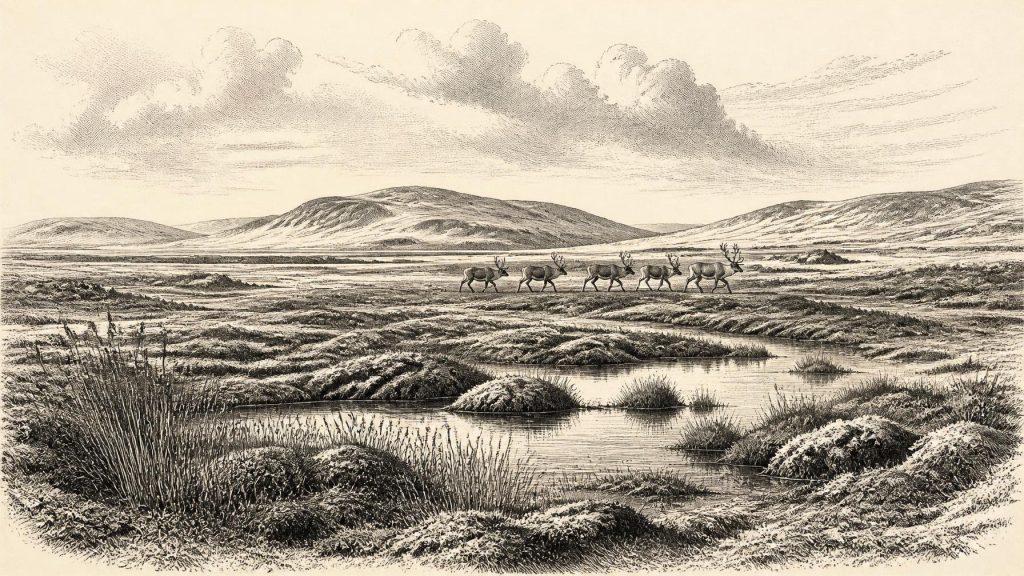
The Derryvree assemblage points to a severe periglacial environment rather than the wooded island familiar today. Plant pollen was sparse and poorly preserved, but plant macrofossils, mosses and aquatic evidence showed that fresh water and wet ground persisted locally. Sedges, grasses and hardy herbs could use the short growing season; mosses and water plants occupied shallow pools, marshy margins and slow-moving water. The flora includes species associated with open northern or Arctic-alpine environments. Trees did not form a forest around the site. Occasional tree pollen need not indicate local woodland, since pollen can travel considerable distances or be redeposited.
This was not a dead landscape. The freshwater deposit records a patchwork in which water, wet soils and sheltered hollows could sustain more life than exposed ridges or frost-shattered ground. Yet its richness should not be romanticised into a green refuge. Winters were likely long and harsh, vegetation low and discontinuous, and the growing season brief. Seasonal freezing, snow cover, strong winds and bare mineral ground would have shaped every plant and animal able to survive there.
The Derryvree record also demonstrates change rather than climatic uniformity. A freshwater wetland could form between glacial incursions, then be overridden or buried as conditions altered. At Crag Cave in County Kerry, uranium-thorium dating of speleothems independently shows episodic calcite growth during MIS 3. Dripstone can grow only when liquid water moves through cave systems, so these episodes support the wider conclusion that the long cold stage included milder and wetter interludes. That does not mean that every part of Ireland was mild at once, or that Derryvree was ice-free throughout MIS 3. It means that Ireland’s climate and ice cover were dynamic on timescales far longer than a human year.
Animals of the Southern Caves
For the island’s animal world, Castlepook Cave near Doneraile in north County Cork is the leading source. Known historically as Mammoth Cave, it yielded Ireland’s richest assemblage of cold-stage vertebrate remains. The broader collection includes woolly mammoth, reindeer, giant deer, brown bear, wolf, foxes, Arctic fox, lemmings and spotted hyaena. Such animals place parts of Ireland within a wider north-west European cold-climate zone, linked ecologically to Britain and the continental shelf beyond the modern coast.
There are important limits to this evidence. Castlepook was excavated in the early twentieth century, long before present-day approaches to stratigraphic recording, recovery and dating. Cave assemblages are not simple lists of animals standing together outside one entrance. Carnivores may drag prey or carrion into a den; scavengers, water movement, collapse and later excavation can mix bones of different ages. Modern re-dating has shown that some older Irish faunal chronologies require revision, especially where earlier radiocarbon methods did not use the improved pretreatment now expected for ancient bone.
Even so, the fauna establishes an important point: sizeable mammals reached and survived in parts of Ireland during MIS 3. Reindeer and horse-like open-country grazing systems elsewhere in north-west Europe were accompanied by predators and scavengers, while mammoth and giant deer demonstrate the potential scale of herbivore life. The Irish record remains too sparse to reconstruct a complete food web for 30,830 BCE, and it cannot show that every Castlepook species lived at the cave simultaneously. The cave instead offers a time-averaged glimpse of repeated animal movement through a fluctuating cold landscape.
The Reindeer Femur Question
Castlepook has also become central to the question of whether people reached Ireland far earlier than the well-established post-glacial settlement record. A reindeer femur from the cave has been presented as bearing a deep mark made by a sharp stone tool during butchery. County Cork’s heritage publication assigns the bone broadly to about 31,000 BC and attributes the assessment to palaeozoologist Ruth Carden. If the mark is securely a stone-tool cut made when the bone was fresh, it would be striking evidence that one or more Upper Palaeolithic people handled a reindeer in Ireland during the late Ice Age.
The claim must remain carefully bounded. A marked bone is not a settlement. No securely associated hearth, stone-tool assemblage, dwelling floor, burial, food store or repeated butchered-bone concentration of comparable age has been recovered in Ireland. The bone’s date measures the age of the animal, not an exact instant when a mark was made; the cave’s complicated excavation and depositional history makes context especially important. Nor can the bone reveal whether a small party hunted the animal, scavenged it, processed it elsewhere, visited briefly or returned repeatedly.
Accordingly, the evidence permits a possibility of fleeting human activity, not a confident population history. The wider European Upper Palaeolithic shows that Homo sapiens had sophisticated hunting technologies, social networks, art and diverse cultural traditions. None of those features can responsibly be transferred automatically to Ireland. Ireland has not produced securely dated evidence for houses, camps, tools, art, graves, clothing, language or named groups at this time.
No States, No Trade Record
Political affairs, diplomacy and organised warfare leave no identifiable trace in Ireland around this date. There were no recorded polities, rulers, territories or institutions, and no evidence supports projecting later Irish identities into the Pleistocene. Likewise, there is no Irish evidence for agriculture, livestock management, permanent villages, mining, metalworking or market exchange. If people were present, their economy would have depended on immediate access to wild resources, mobility and practical knowledge of seasonally changing terrain; this is an inference from the possible human trace and the wider hunter-gatherer world, not a documented Irish social system.
Lower global sea levels made the surrounding geography unlike the modern map. More continental shelf was exposed around Ireland and Britain, and routes for animals and perhaps people changed as ice margins, rivers, coastlines and seasonal conditions shifted. Yet no secure crossing route can be drawn for this exact horizon. A land connection, exposed coastal plains, sea ice and short water passages are matters for regional reconstruction, not proof that a specific group travelled to or from Ireland in 30,830 BCE.
Religion, ritual, learning and art are similarly beyond the reach of the surviving Irish evidence. Caves can acquire powerful meanings in later societies, but animal bones in Castlepook do not demonstrate ceremony. Derryvree’s sedges and mosses reveal ecology, not belief. The absence of evidence is not evidence that Ice Age people lacked culture; it is a reminder that Ireland has not preserved, or has not yet identified, material that can answer these questions for this interval.
An Environmental History
The greatest development appropriate to this date is therefore environmental. Ireland was approaching the fuller expansion of the British–Irish Ice Sheet, whose maximum belongs chiefly to the later period around 27,000–21,000 years ago. Around the nominal date, conditions varied sharply by region: a freshwater tundra-like setting is documented at Derryvree, while southern caves preserve evidence for large mammals and carnivores. Renewed glaciation would later erase, displace and bury much of this earlier world.
For Ireland in 30,830 BCE, the clearest history is not of kings or monuments but of water collecting between ice advances, tundra vegetation taking hold on exposed ground, animals moving through open country, and a possible but unconfirmed human encounter with a reindeer. The archaeological record is thin, uneven and often disturbed. Its restraint is part of its value: it allows a genuine, if fragmentary, picture of an island landscape long before written history.
Primary Sources
- A Middle Midlandian Freshwater Series at Derryvree, Maguiresbridge, County Fermanagh, Northern Ireland
- Palaeoecology: Field Guide No. 16
- The Irish Quaternary Fauna Project
- A Reconsideration of the Radiocarbon Dating of the Marine Isotope Stage 3 Fauna from Southern Ireland
- Castlepook Cave, County Geological Site Report
- Heritage Artefacts of County Cork
- New Insights on the Fauna of Ireland’s Younger Dryas and Early Holocene from Alice & Gwendoline Cave
- Extent and Timing of the Last Glacial Maximum in Britain and Ireland: A Review
- BRITICE Glacial Map, Version 2: A Map and GIS Database of Glacial Landforms of the Last British–Irish Ice Sheet
- Trimlines, Blockfields and the Vertical Extent of the Last Ice Sheet in Southern Ireland
- Dimensions and Chronology of the Last Ice Sheet in Western Ireland
- Episodic Speleothem Deposition Tracks the Terrestrial Impact of Millennial-Scale Last Glacial Climate Variability in SW Ireland
- Spatio-Temporal Dynamics of Speleothem Growth and Glaciation in the British Isles
- The IntCal20 Northern Hemisphere Radiocarbon Age Calibration Curve (0–55 cal kBP)
- IntCal Publications
- IntCal History
- Scientific Dating of Pleistocene Sites: Scientific Dating Methods
- The Geological Heritage of County Leitrim
- The Colonization of Ireland: A Human Ecology Perspective
- The Geological Heritage of County Cavan, Part 1