BIRM-166 Beneath Fermanagh30831 BCE
30,831 BCE cannot be reconstructed as a single Irish historical year, but falls within a broad Late Pleistocene MIS 3 interval. Derryvree, County Fermanagh, preserves freshwater organic deposits between glacial tills, dated broadly to 36,900–31,700 calibrated years BP, revealing cold, treeless wetlands with tundra vegetation during a local ice-free phase. Castlepook Cave, County Cork, contains diverse cold-stage fauna, although its deposits accumulated over long periods and were disturbed. An incised reindeer femur may indicate human butchery around 33,000 years ago, but not settlement. Ireland’s environments varied regionally as ice expanded towards the Last Glacial Maximum with no recoverable social history.
Dateline
30,831 BCE is not a recoverable year in Irish history. It is a modern calendar label, approximately 32,781 years before the archaeological convention of “present” in AD 1950. No Irish written record, calendar, named person, settlement sequence or political event can be placed in that single year. The evidence instead consists of deposits and animal bones dated in broad ranges. The most responsible frame is therefore Ireland during the later part of the Late Pleistocene, within Marine Isotope Stage 3 (MIS 3): a long, cold and climatically unstable interval before the fullest expansion of the last British–Irish Ice Sheet.
A Date Within a Range
The closest exceptionally informative Irish record is Derryvree, near Maguiresbridge in County Fermanagh. Road works there in 1969 exposed fine sands, freshwater silts and organic layers enclosed between two tills: unsorted debris laid down directly by glacier ice. This stratigraphy provides secure relative evidence. Ice had covered the locality; a period then followed in which water, vegetation and organic sediment accumulated; later ice advanced again and sealed the deposit beneath a second till. It is an environmental archive, not an archaeological settlement layer.
The key sample, BIRM-166, produced a conventional radiocarbon age of 30,500 radiocarbon years before present, with a substantial uncertainty of +1,170 and −1,030 years. Radiocarbon years cannot simply be converted into calendar years because atmospheric carbon-14 levels have varied through time. Modern calibration places the relevant Derryvree material broadly within about 36,900–31,700 calibrated years BP, approximately 34,950–29,750 BCE. The nominal date 30,831 BCE falls within that wide interval, but cannot be tied to a particular season, pool, plant, animal or human action. Calendar-year precision is unavailable.
That limitation is not a failure of archaeology. It is the essential finding. A single buried wetland can show that part of Fermanagh was not under overriding ice during an interval of the last glacial cycle; it cannot provide a weather report for every part of the landmass now called Ireland. Nor can it establish that all plants and animals identified in the deposit lived there simultaneously. The island’s older record is sparse partly because repeated glaciations eroded surfaces, disturbed sediments and buried what survived under newer deposits.
Fresh Water in a Cold Land
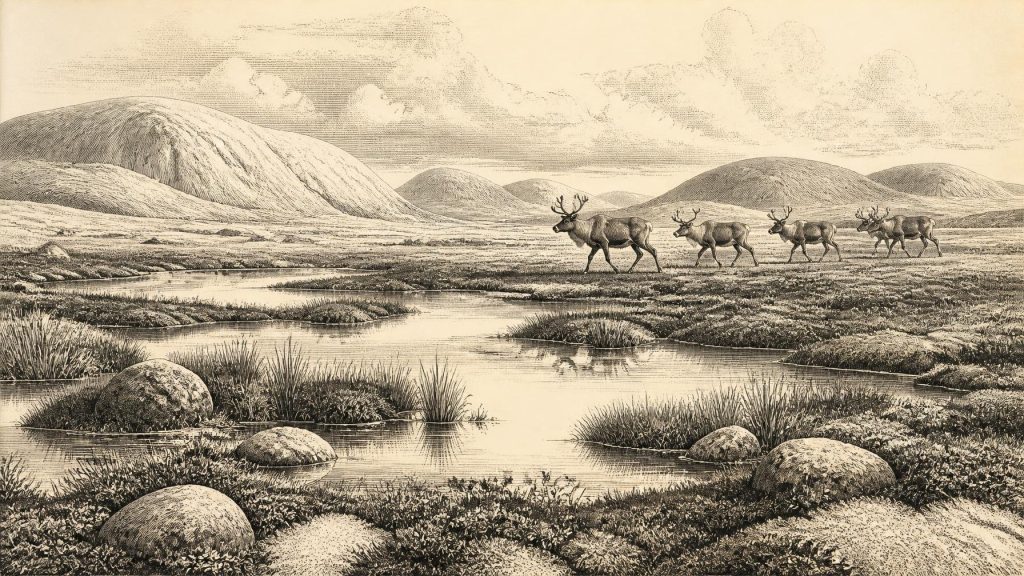
Derryvree nevertheless gives a rare, vivid glimpse of an Irish Ice Age environment. Fossil plant remains, pollen and insects indicate a treeless, cold and wet landscape rather than forest or permanent polar desert. Freshwater mosses and sedges grew around slow water. Aquatic plants, including water-milfoil and bogbean, show that pools or sheltered channels existed. Other remains point to open ground with low herbs and dwarf shrubs. Mountain-avens, rosy saxifrage, arctic willow and alpine clubmoss belong to a flora adapted to cold conditions and short growing seasons.
“Tundra” is a useful shorthand, provided it does not imply featureless snow. The evidence supports a patchwork of shallow water, saturated mossy ground, sedge margins, exposed mineral soil and sparse vegetation. Seasonal thaw would have allowed water to move and plants to grow; winter freezing and periglacial processes would have affected the ground. Such places could be biologically productive at particular times of year, yet harsh, exposed and highly variable. The Derryvree deposit records an ice-free or less intensely glaciated local interval, not an easy or stable climate.
Regional comparison reinforces the need for caution. Inter-till and organic deposits at Hollymount and Greenagho, also in Fermanagh, show that northern Ireland preserves other traces of cold, non-glacial conditions during the Midlandian. Their dates and sequences are not precise duplicates of Derryvree’s. Together they demonstrate changing local environments over long spans, rather than a single island-wide phase with fixed boundaries. The familiar drumlin landscapes of Fermanagh are themselves products of the longer history of glacial movement, erosion and deposition that repeatedly altered such habitats.
Castlepook’s Animal Archive
In County Cork, Castlepook Cave near Doneraile offers a different kind of evidence. Also known as Mammoth Cave, it is Ireland’s richest known archive of vertebrate remains from the period leading towards the Last Glacial Maximum. Its deposits have yielded woolly mammoth, reindeer, giant deer, brown bear, wolf, Arctic fox, mountain hare, lemmings and spotted hyaena. This fauna demonstrates that Ireland was connected ecologically to north-western Europe during parts of the Late Pleistocene and could support, or at least be reached by, a varied cold-stage animal community.
The cave must not be treated as a neatly dated census. Bones accumulated across a long period, and many were recovered during excavations undertaken principally between 1904 and 1913, before modern standards of stratigraphic recording, sediment analysis and laboratory pretreatment. Water movement, carnivore activity and older excavation methods may all have disturbed associations. Later radiocarbon programmes have shown that some previous dates for southern Irish cave fauna were too young, making the history more securely ancient but also more complex. A mammoth bone, a hyaena bone and a reindeer bone do not establish that those animals stood together outside the cave in the same year.
Still, Castlepook changes the scale on which Ireland’s Late Pleistocene must be imagined. Reindeer imply open country and seasonal mobility; hyaenas could have transported carcass parts to caves; mammoths and giant deer belong to wider European faunal networks that reached the region before later ice expansion. These animals did not require an Irish political territory, trade system or permanent village. Their presence instead reflects shifting routes across a landscape whose shorelines, sea levels and ice margins differed greatly from those of today.
The Reindeer Femur Question
One Castlepook object carries particular archaeological importance: a reindeer femur bearing a deep linear modification interpreted by zooarchaeologist Ruth Carden as a mark made on fresh bone by a sharp stone tool. The bone has been reported as about 33,000 years old. If that interpretation is confirmed, it would provide evidence that people processed an animal in Ireland during MIS 3, far earlier than the formerly accepted post-glacial human record.
It is important, however, to state exactly what this evidence can and cannot show. The marked bone is a serious lead for Upper Palaeolithic human activity, not secure proof of an enduring settlement at Castlepook or elsewhere in Ireland. No associated hearth, lithic assemblage, house floor, burial, structured refuse deposit or repeated occupation surface of comparable age has been demonstrated. The cave’s complex formation history also means that the date of the bone does not automatically date the incision with calendar-year precision. The strongest conclusion is modest: people may have visited southern Ireland and butchered reindeer during this broad interval.
People Without a Recoverable Society
If hunters did reach Ireland around this horizon, their movements were likely occasional, mobile and tied to practical opportunities: animal herds, sheltered ground, fresh water, fuel and routes across exposed or changing terrain. That is an inference from the marked bone, Late Palaeolithic lifeways elsewhere in north-west Europe and the animal record; it is not direct evidence for a named Irish group. There is no basis for describing clans, chiefs, territorial boundaries, law, diplomacy or warfare in 30,831 BCE. “Ireland” is used here for convenience, not as a prehistoric state or community recognised by its inhabitants.
Nor is there evidence for agriculture, livestock, cereal cultivation, pottery, metalworking, long-distance exchange networks or permanent built settlements. Any people present would have relied on knowledge carried in memory and practice rather than on writing: how to find game, make and maintain cutting tools, read weather and terrain, process food, and preserve social relationships within small mobile groups. Such capacities are plausible for hunter-gatherers of the period, but no excavated Irish assemblage of this age allows them to be reconstructed in detail.
Silence on Belief and Conflict
Religion, art and formal learning are almost wholly beyond the Irish evidence at this date. There is no securely dated Irish cave art, portable art, ceremonial structure, burial or ritual deposit attributable to the Derryvree–Castlepook horizon. It would be unsafe to project the famous painted caves or carved objects of continental Europe directly onto Ireland. People, if present, certainly possessed social lives and knowledge, but archaeology cannot responsibly specify their language, stories, rituals or identities.
The same restraint applies to conflict and diplomacy. Predation and competition undoubtedly shaped animal life, while humans elsewhere sometimes hunted large game and negotiated access to seasonal resources. Yet no Irish evidence identifies a battle, alliance, raiding party or diplomatic encounter. The principal forces visible in the record are environmental: advancing and retreating ice, changing watercourses, cold-adapted vegetation, moving animals and the repeated destruction or burial of older landscapes.
Approaching Greater Ice
At this broad point in time, the British–Irish Ice Sheet was entering an important phase of growth and reorganisation, though neither its exact extent nor the timing of every advance is settled equally well for all regions. Reconstructions indicate substantial upland ice in Ireland by around 31,000 years ago, while evidence from Fermanagh and cave faunas in the south shows why a simple picture of the entire island being continuously buried by ice is untenable. Different sectors experienced different conditions, and ice advance was not a single instantaneous event.
The eventual Last Glacial Maximum lay ahead, with major British–Irish ice-sheet expansion and maximum extents reached later, broadly around 28,000–20,000 calibrated years BP depending on sector and definition. For the people and animals potentially moving through Ireland around the nominal year 30,831 BCE, the decisive history was therefore not a royal succession or a recorded war, but a narrowing ecological world. Wetland refuges, open feeding grounds and accessible passages could appear, disappear and be transformed over generations.
What survives from this time is fragile but consequential: a Fermanagh freshwater sequence sealed between tills; animal remains in a Cork limestone cave; improved radiocarbon measurements; and an incised reindeer bone whose interpretation remains important but provisional. Together they show an Ireland that was neither timeless wilderness nor empty page. It was a changing Late Pleistocene landscape, intermittently habitable for specialised plants and animals and perhaps briefly entered by people, yet far beyond the precision of an annual chronicle.
Primary Sources
- Early Midlandian–Middle Midlandian, Pleistocene, Northern Ireland
- A reconsideration of the radiocarbon dating of the Marine Isotope Stage 3 fauna from southern Ireland
- The Irish Quaternary Fauna Project
- Castlepook Cave: County Geological Site Report
- Heritage Artefacts of County Cork
- Archaeology Research Excavation Grant 2022: Castlepook Cave
- Growth and retreat of the last British–Irish Ice Sheet, 31,000 to 15,000 years ago: the BRITICE-CHRONO reconstruction
- Growth and retreat of the last British–Irish Ice Sheet, 31,000 to 15,000 years ago: the BRITICE-CHRONO reconstruction
- The timing and magnitude of the British–Irish Ice Sheet between Marine Isotope Stages 5d and 2
- Radiocarbon constraints on the history of the western Irish ice sheet prior to the Last Glacial Maximum
- Stratigraphic and palaeo-geomorphological evidence for the glacial-deglacial history of the last British-Irish Ice Sheet in the north-western Irish Sea
- The IntCal20 Northern Hemisphere Radiocarbon Age Calibration Curve (0–55 cal kBP)
- IntCal History
- Figure 6.—The subdivision of the Quaternary Period in Ireland
- Freshwater organic deposits and stratified sediments between Early and Late Midlandian (Devensian) till sheets, at Aghnadarragh, County Antrim, Northern Ireland
- New insights on the fauna of Ireland’s Younger Dryas and Early Holocene from Alice & Gwendoline Cave
- Investigating seasonal mobility in Irish giant deer Megaloceros giganteus through strontium isotope analysis
- The Exploration of Castlepook Cave, Co. Cork
- A Middle Midlandian freshwater series at Derryvree, Maguiresbridge, County Fermanagh, Northern Ireland
- Radiocarbon Dating and the Irish Cave Faunas