Doneraile’s Cutmarked Reindeer30800 BCE
Around 30,800 BCE, Ireland was in the Late Pleistocene, before the Last Glacial Maximum, not a date associated with recoverable events or settled society. Derryvree, County Fermanagh, preserves evidence of treeless tundra wetland, with freshwater plants, insects and seasonal periglacial conditions. Castlepook Cave, County Cork, produced bones of mammoth, reindeer, giant deer and other cold-adapted fauna, although these accumulated over extended periods. A roughly 33,000-year-old reindeer femur may bear stone-tool cut marks, suggesting brief human carcass processing. However, it cannot prove permanent occupation. Later glaciation damaged earlier archives, leaving environmental evidence stronger than social history and human presence unresolved overall.
Dateline
30,800 BCE is not a recoverable Irish year. No people then living in or visiting Ireland used a calendar that can be matched to a modern date, and no written record, settlement sequence or securely dated occupation layer identifies a particular event at this point. The label is a modern chronological convenience, approximately 32,750 calendar years before AD 1950. At this depth of time, even excellent scientific dates normally carry uncertainties of centuries or millennia. The responsible subject is therefore Ireland in the later part of the Late Pleistocene, within Marine Isotope Stage 3, rather than an invented episode on a single day or in a single season.
A Cold Island Before Maximum Glaciation
Ireland was approaching, but had not yet reached, the fullest expansion of the last British–Irish Ice Sheet. The principal Last Glacial Maximum in the Irish sector is generally placed later, broadly about 27,000–23,000 calibrated years before present. At its height, ice covered Ireland and extended across much of its continental shelf. That later event matters greatly for 30,800 BCE: it rearranged landscapes, eroded or buried older deposits, and helps explain why the human and environmental record for this earlier period is so fragmentary.
It would nevertheless be wrong to picture all of Ireland at 30,800 BCE as uniformly entombed beneath an ice sheet. Buried deposits at Derryvree near Maguiresbridge, County Fermanagh, demonstrate that a freshwater environment existed there before a subsequent glacial advance. The celebrated Birm-166 radiocarbon determination from organic silts and fine sands was 30,500 radiocarbon years BP, with a large stated uncertainty of +1,170/−1,030 years. Modern calibration makes clear why this cannot be equated mechanically with either 30,500 BCE or a single calendar year: it belongs broadly in the middle 30,000s calibrated years BP. It illuminates the kind of cold-stage environment that preceded renewed ice cover, not a moment-by-moment national weather report.
Derryvree’s Treeless Wetland
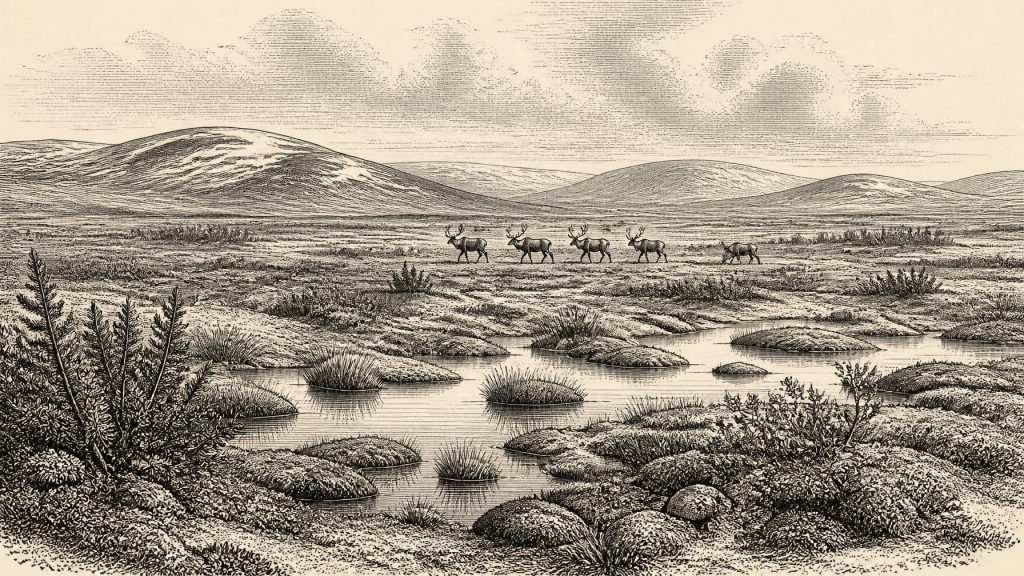
The Derryvree sequence is among the most informative Irish records for this broad interval because its organic layer lay between two tills, deposits left by glaciers. Its pollen, plant remains, insects and mosses point to an open, treeless tundra or muskeg landscape under periglacial conditions. Grasses and sedges grew alongside herbs, juniper and dwarf-shrub vegetation; mosses and shallow open water were important elements of the habitat. Fossils including bogbean and alternate water-milfoil show that this was not simply a sterile expanse of snow or bare gravel. There were pools, wet ground and plant-rich margins, though within a climate marked by hard winters and pronounced seasonality.
This evidence supports a cautious environmental reconstruction. Parts of northern Ireland could sustain freshwater vegetation and invertebrate life during a cold interval. It does not prove that the same plants covered every upland, valley or coast at precisely 30,800 BCE. Nor does it establish a familiar modern landscape. Forests were absent from the Derryvree setting, soils were vulnerable to frost disturbance, and seasonal change would have governed water, forage and animal movement far more decisively than it does in Ireland today.
Animals at Castlepook Cave
County Cork provides the other major window. Castlepook Cave near Doneraile, also known as Mammoth Cave, yielded a remarkable assemblage of Pleistocene animal bones from nineteenth- and early twentieth-century digging, supplemented by later work. The fauna includes woolly mammoth, reindeer, giant deer, brown bear, wolf, foxes, mountain or Arctic hare, stoat, collared lemming, Norwegian lemming and spotted hyaena. Taken together, these finds show that cold-adapted animals reached Ireland during phases of the last glacial cycle and that the island was ecologically connected, at least intermittently, to wider north-west European faunal worlds.
Yet Castlepook must be read as a cave archive, not as a photograph of one afternoon. Bones accumulated over long periods; caves can serve as carnivore dens, shelters, traps and channels for water and sediment. Earlier excavators did not record contexts to modern standards. Modern radiocarbon reassessment has also shown that some legacy dates from southern Irish caves require revision. Individual dates from Castlepook span a substantial range, while the fauna itself may combine remains deposited at different times. Mammoth, hyaena and reindeer can therefore establish that these species occurred in the broader Pleistocene landscape, but cannot automatically be assembled into one simultaneous herd moving across the Cork countryside in 30,800 BCE.
The Reindeer Femur Question
The most consequential possible human trace relevant to this era is a reindeer femur from Castlepook. It has been publicly reported as roughly 33,000 years old and as carrying a deep surface mark interpreted by zooarchaeologist Ruth Carden as damage made by a stone implement during carcass processing. If that interpretation is upheld, it would be evidence that people handled a reindeer in Ireland during the Upper Palaeolithic, tens of millennia before the island’s well-established post-glacial settlement record. In the vicinity of 30,800 BCE, it is therefore the closest available clue to a human presence.
But the caveat is fundamental. A radiocarbon date measures the death of the animal, not necessarily the instant at which any mark was made. The specimen was not recovered from a recently excavated, intact living floor with associated tools, hearth, dwelling, human remains and refitting bones. No securely dated Palaeolithic settlement, lithic workshop or cemetery is known in Ireland for this period. The National Museum of Ireland consequently continues to stress the absence of clear Palaeolithic evidence for humans in Ireland. The femur is best described as potentially transformative evidence of a brief human visit or butchery episode, rather than proof of a resident community.
Society Cannot Be Reconstructed
There is no responsible basis for naming a people, language, kin group, leader or territory in Ireland at this date. There were no documented polities, borders, councils, diplomatic missions or wars. Nor is there evidence for religious buildings, burial rites, images, music, teaching, exchange networks or a distinctive Irish artistic tradition. These are not missing chapters waiting to be filled with familiar later labels such as Gaelic, Celtic or tribal; they are questions for which the surviving evidence provides no answer.
If the Castlepook mark was made by people, it implies only a narrow activity: the use of a sharp stone tool on an animal carcass. Such a task could have supplied meat, marrow, hide, sinew or bone, but the division of labour, size of the visiting party and duration of its stay are unknown. It does not demonstrate a camp, let alone a permanent economy. The most that can be said is that a mobile hunter-gatherer party, if present, would have faced a country where animal movement, shelter, fuel, fresh water and rapidly changing weather were practical matters of survival.
Routes, Coasts and Uncertain Connections
Sea level during the Ice Age was lower than today, and the Irish landmass, shorelines and adjacent shelves were different. That broad fact makes the geographical setting unlike modern Ireland, but it should not be converted into an unproven claim that people simply walked from Britain or continental Europe to Doneraile. Glaciers, cold seas, changing channels and exposed lowlands created shifting barriers as well as possible routes. The available Irish evidence does not identify a crossing point, vessel, trackway or continuous land bridge at the relevant time.
Nor can trade be demonstrated. Reindeer, mammoth and predators testify to faunal dispersal, not commerce; a possible cut-marked femur indicates possible carcass processing, not an exchange system. In this deep period, environmental evidence is stronger than social history. The relationship between Ireland and neighbouring regions must be framed as ecological and geographical possibility, not as a known network of travellers or traders.
What the Evidence Really Shows
For around 30,800 BCE, the strongest conclusion is both modest and important. Ireland contained, at least in some intervals and regions before the later glacial maximum, open cold-climate habitats capable of supporting freshwater plants, insects and a varied large-mammal fauna. Derryvree preserves one northern wetland landscape; Castlepook preserves a southern cave record of Ice Age animals. A reindeer femur may record a fleeting human action, but the claim remains far smaller than a history of settlement.
Subsequent ice did more than alter the terrain: it narrowed the archive from which later generations can reconstruct it. That is why a layer of silt under a drumlin and a marked bone in a Cork cave carry such weight. They do not provide a king, a battle or a named community for 30,800 BCE. They provide something more appropriate to the evidence: a cold, changing island, living wetlands at the edge of advancing glaciation, and the unresolved possibility that people briefly entered that world.
Primary Sources
- A Middle Midlandian Freshwater Series at Derryvree, Maguiresbridge, County Fermanagh, Northern Ireland
- Irish Pleistocene Biostratigraphy
- The Irish Quaternary Fauna Project
- A Reconsideration of the Radiocarbon Dating of the Marine Isotope Stage 3 Fauna from Southern Ireland
- Prehistoric Details
- The IntCal20 Northern Hemisphere Radiocarbon Age Calibration Curve (0–55 cal kBP)
- IntCal Publications
- New Data for the Last Glacial Maximum in Great Britain and Ireland
- Pattern and Timing of Retreat of the Last British-Irish Ice Sheet
- Ireland: Submerged Prehistoric Sites and Landscapes
- Timing and Pace of Ice-Sheet Withdrawal Across the Marine–Terrestrial Transition West of Ireland During the Last Glaciation
- Trimlines, Blockfields and the Vertical Extent of the Last Ice Sheet in Southern Ireland
- A Critical Review and Re-Investigation of the Pleistocene Deposits
- Exploring Controls of the Early and Stepped Deglaciation on the Western Margin of the British-Irish Ice Sheet
- Pleistocene Vertebrates in the British Isles
- First Evidence of a Late Upper Palaeolithic Human Presence in Ireland
- Revisiting Alice and Gwendoline Cave, Co. Clare: New Light on the 1902 Excavations
- New Insights on the Fauna of Ireland's Younger Dryas and Early Holocene from Alice & Gwendoline Cave
- Looking for the Irish Palaeolithic: New Research Projects on Old Animal Bones and Cave Sediments
- Ireland's Palaeolithic Archaeology – Fleeting Footprints in a Frozen Land
- Reindeer Bone Found in Cork Cave Shows Human Activity in Ireland 33,000 Years Ago
- What Was on the Menu in Prehistoric Ireland?
- The Antiquity of Man in Ireland
- Mammoth Cave, County Cork