
Castlepook’s Deep Galleries30799 BCE
Around 30,799 BCE, Ireland lay in the climatically unstable Middle Midlandian, approaching major glaciation but not uniformly ice-covered. Derryvree sediments in County Fermanagh preserve evidence of a cold, treeless, tundra-like freshwater environment, although their dating cannot define conditions in that precise year. Castlepook Cave, County Cork, contains a complex, long-lived assemblage of Ice-Age fauna, including mammoth, giant deer, reindeer and hyaena, shaped by carnivore activity and water. A cut-marked reindeer femur may indicate brief human presence, but proves neither settlement nor hunting. No political, social or cultural history is recoverable; evidence instead reveals dynamic ecosystems and substantial uncertainty about chronology.
Dateline
Modern calendar-year precision is not available for Ireland around 30,799 BCE. The number is a useful point on a modern timeline, not a year that can be matched to an excavated season, a named generation or an event in the Irish past. Expressed in the archaeological convention of years before AD 1950, it falls roughly 32,750 years ago, within the later part of Marine Isotope Stage 3 (MIS 3), a climatically unstable interval of the Late Pleistocene. Evidence from Ireland is sparse, unevenly dated and often disturbed by ice, water and nineteenth- or early twentieth-century excavation. What can responsibly be written is therefore an environmental and archaeological overview, using calibrated ranges where possible and keeping firm evidence separate from interpretation.
An Unstable Ice-Age Ireland
Ireland at this broad horizon was not the familiar green, wooded island of later millennia. It lay within the Midlandian, the Irish name for the last major glacial cycle, equivalent to the Devensian in Britain and the Weichselian in northern Europe. MIS 3 was not a single uniform freeze. Greenland ice-core records and north-west European sequences show repeated, sometimes abrupt shifts between colder stadials and comparatively milder interstadials. Irish evidence is too fragmentary to assign weather to 30,799 BCE itself, but it strongly indicates a cold, treeless and highly seasonal world in the millennia around it.
The key caution is geographical. Ice cover expanded and contracted regionally; the state of one valley, cave or drumlin cannot stand for the whole island. Recent reconstruction of the British–Irish Ice Sheet suggests substantial ice growth across the wider archipelago during the period from about 31,000 years ago, with the fullest and most extensive late-glacial ice conditions developing later. At the date considered here, Ireland was moving towards that major glaciation, but it should not simply be imagined as either wholly ice-covered or wholly ice-free. Patches of exposed ground, coastal or lowland refuges, ice margins, meltwater corridors and local ice masses may all have existed at different times and places.
Derryvree’s Buried Freshwater Record
The best direct Irish environmental guide to this broad interval comes from Derryvree, near Maguiresbridge in County Fermanagh. Road works in 1969 cut through a drumlin and exposed freshwater silts and fine sands sealed between two thick tills: deposits left by glacier ice. The sequence establishes an important order of events. Ice had occupied the locality; an interval without overriding ice then allowed freshwater sediment and organic material to accumulate; later ice or ice-derived sediment buried the deposit. It is not an annual diary, but it is a rare surviving fragment of an otherwise repeatedly erased landscape.
A radiocarbon determination from the Derryvree organic series was reported as 30,500 radiocarbon years BP, with a substantial uncertainty. A radiocarbon age is not identical to a calendar age: calibration produces a broad, non-linear range in the mid- to late-30,000s calibrated years BP, depending on the method and probability range used. Derryvree therefore cannot be claimed as a wetland seen in 30,799 BCE. It is instead a closely relevant record of the Middle Midlandian environment in the longer climatic setting of that date.
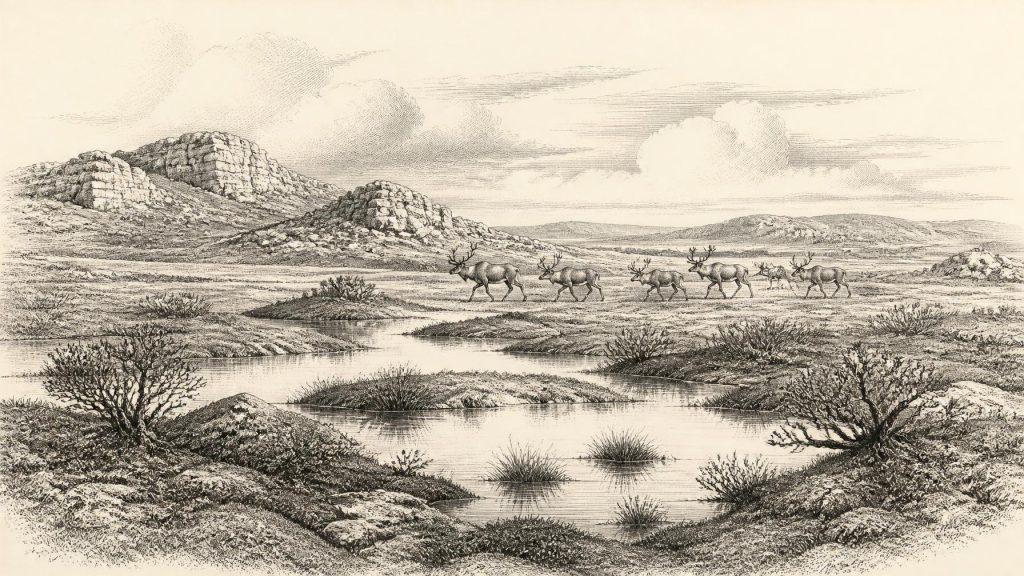
Its fossils are unusually informative. Pollen, plant macrofossils, mosses and insect evidence point to open, treeless vegetation and a periglacial climate. Grasses and sedges occurred with hardy herbs, while aquatic and wetland plants show that shallow fresh water persisted locally. Moss assemblages and such plants as dwarf willow, mountain avens and bogbean have been used to reconstruct a tundra-like muskeg: wet, peaty, moss-rich ground broken by pools and sedge communities. This does not mean every part of Fermanagh was a continuous bog. It means that a sheltered freshwater basin and its margins sustained cold-adapted life amid a generally open landscape.
The absence of woodland is as revealing as the presence of tundra plants. There is no evidence for the oak, hazel and mixed forest that would later dominate much of post-glacial Ireland. Fuel, cover and animal habitat would consequently have been organised around low vegetation, exposed mineral ground, wet hollows and perhaps scattered scrub rather than mature woods. Frost action, snow cover, strong winds and short growing seasons would have shaped daily conditions for any animal or person moving through such terrain. The Derryvree silts record these ecological constraints directly; the exact appearance of the wider countryside remains an interpretation.
Castlepook and the Animal World
In north County Cork, Castlepook Cave near Doneraile preserves Ireland’s richest known assemblage of pre-Last Glacial Maximum vertebrate remains. The cave’s deep limestone galleries yielded more than 2,000 bones in excavations undertaken chiefly between 1904 and 1918. Improved radiocarbon work has shown that specimens formerly treated as broadly similar in age can in fact span a long period, roughly 45,700 to 19,950 radiocarbon years BP. The cave was a repository repeatedly affected by carnivores, water movement and changing conditions, not a neatly sealed snapshot of one season.
Nonetheless, its fauna demonstrates that Ireland supported animals now absent from the island. Finds include woolly mammoth, giant deer, reindeer, brown bear, wolf, Arctic fox, mountain hare, collared lemming and Norwegian lemming, as well as spotted hyaena. Not every species need have occupied the same patch of ground at the same time, and some bones could have been carried or reworked within the cave. Yet the combined evidence fits a cold, open mosaic capable of supporting large grazing or browsing mammals, smaller Arctic-adapted mammals and formidable predators and scavengers. Ireland’s Ice-Age ecology was markedly richer in large terrestrial mammals than the later island fauna.
Spotted hyaena is particularly important because it helps explain the character of the cave assemblage. Hyaenas can transport carcass parts, gnaw bones and use dens over repeated periods. Castlepook’s deposits should therefore not be read as the menu of a single human hunting party or as a census of local animals. Mammoth or giant-deer bone proves the former presence of those animals more securely than it explains how they entered a specific gallery. The same principle applies to reindeer: the animals were part of the broader Irish Pleistocene fauna, but their seasonal movements, herd size and precise range in 30,799 BCE cannot be recovered.
A Reindeer Bone and a Human Question
The closest possible human connection to this date is also the most debated and limited. A reindeer femur from Castlepook has been identified as bearing a deep incision interpreted as a cut mark made by a sharp stone edge during butchery. County Cork heritage interpretation has associated the specimen with about 31,000 BC, and the claim has rightly renewed interest in an Irish Upper Palaeolithic presence. If the mark is anthropogenic and contemporary with the death of the animal, it would be evidence that a person handled and processed reindeer in Ireland far earlier than the long-recognised Late Upper Palaeolithic evidence from Alice and Gwendoline Cave, County Clare.
But the limits matter. Castlepook has not produced a securely associated hearth, living surface, stone-tool collection, dwelling, burial or human skeleton of this age. The old cave deposits were excavated before modern recording standards, and the bone comes from a complex setting rather than a sealed butchery floor. A single marked bone does not establish that people lived permanently in Ireland, that they hunted the reindeer rather than scavenged it, or that a group crossed the sea or ice by any particular route. Nor can it establish a language, ancestry, kin group or connection with later Irish populations.
It is reasonable to describe a brief Upper Palaeolithic visit as a possibility, not a demonstrated settlement. Elsewhere in western Europe, Homo sapiens communities of comparable antiquity used stone technology, hunted and scavenged large animals, made clothing and maintained social networks across considerable distances. Those facts provide context, but they must not be turned into unearned detail for Ireland. No Irish evidence from this period yet supports claims for local cave art, ornaments, ritual, formal burial, houses, territorial boundaries or a continuing community.
No Politics, but Real Constraints
For this reason, political affairs, diplomacy and organised conflict cannot be reconstructed for Ireland around 30,799 BCE. There were no states, written agreements, rulers or named peoples in the evidence. Conflict among animals was undoubtedly part of the ecosystem, and any human visitors would have faced risks from cold, difficult terrain and large carnivores, but archaeology cannot identify a battle, alliance or political territory. Similarly, religion and learning leave no recoverable Irish trace at this horizon. It would be misleading to supply imagined shamans, cult places or seasonal ceremonies simply because such practices are known or inferred elsewhere in Upper Palaeolithic Europe.
Economy and exchange are also beyond direct demonstration. If the Castlepook incision is a genuine tool mark, it indicates only the practical use of a sharp implement on fresh bone: an act of carcass processing with nutritional and material value. Reindeer could supply meat, fat, hide, sinew and bone; those are biological possibilities, not an inventory of resources demonstrably taken in Cork. There is no evidence for farming, herding, metalworking, pottery, long-distance trade or a settled production economy. Nor is there evidence that Ireland was then an island in the modern sense or, conversely, that a continuous land route was available. Lower sea levels altered coasts and exposed seabed, but changing ice, sea level and topography make any route for people or animals uncertain.
What This Date Can Mean
The most important development around this point is therefore environmental rather than political: Ireland was part of a changing Ice-Age world in which cold-adapted plants and animals occupied at least some ice-free or seasonally accessible landscapes before the later maximum expansion of the British–Irish Ice Sheet. Derryvree gives a locally preserved freshwater tundra environment; Castlepook gives a long and complicated faunal archive from the south. Together they overturn any image of a biologically empty Ireland, while also showing how much has been lost beneath later ice and sea.
At 30,799 BCE, Ireland has no year-specific historical narrative. It has buried silts, pollen grains, mosses, bones, cave passages and contested marks on a reindeer femur. These are modest remains, but they are valuable precisely because they impose discipline. They reveal a severe, open and ecologically dynamic landscape, and they leave open the possibility of a fleeting human encounter. They do not yet reveal an Irish society. Future excavation of undisturbed cave deposits, renewed analysis of museum collections and improved dating may refine the picture; for now, the responsible history is one of evidence, uncertainty and an Ice-Age island region on the threshold of deeper glaciation.
Primary Sources
- A Middle Midlandian Freshwater Series at Derryvree, Maguiresbridge, County Fermanagh, Northern Ireland
- Irish Pleistocene Biostratigraphy
- Palaeoecology
- Figure 6.— The Subdivision of the Quaternary Period in Ireland
- Quaternary Deposits and Glacial Stratigraphy in Ireland
- The Irish Quaternary Fauna Project
- A Reconsideration of the Radiocarbon Dating of the Marine Isotope Stage 3 Fauna from Southern Ireland
- Castlepook Cave: Cork County Geological Site Report
- On the Cave of Castlepook, Near Doneraile, Co. Cork
- Pleistocene Vertebrates in the British Isles
- Occurrence of Mammalia Relicts at Site Castlepook Cave
- Heritage Artefacts of County Cork
- Archaeology Research Excavation Grant 2022: Castlepook Cave Final Report
- 2022:564 — Castlepook Cave, Castlepook South, Cork
- New Insights on the Fauna of Ireland's Younger Dryas and Early Holocene from Alice & Gwendoline Cave
- The Mesolithic in Ireland: When Was It?
- Growth and Retreat of the Last British–Irish Ice Sheet, 31,000 to 15,000 Years Ago: the BRITICE-CHRONO Reconstruction
- Pattern and Timing of Retreat of the Last British-Irish Ice Sheet
- The Island of Ireland: Drowning the Myth of an Irish Land-Bridge?
- The Timing and Magnitude of the British–Irish Ice Sheet Between Marine Isotope Stages 5d and 2
- Late Pleistocene Chronostratigraphy and Ice Sheet Limits, Southern Ireland
- Conserving Quaternary Geoheritage in Northern Ireland