Derryvree’s Sealed Sedgebed30797 BCE
The date 30,797 BCE cannot support a year-specific Irish history, but falls within Marine Isotope Stage 3, before the Last Glacial Maximum. At Derryvree, County Fermanagh, organic freshwater sediments between glacial tills preserve mosses, sedges and insects from a cold, locally ice-free wetland interval. Other northern deposits confirm fluctuating non-glacial conditions. Castlepook Cave, County Cork, contains diverse cold-adapted fauna, demonstrating links with wider Europe under changing sea and ice conditions. A possibly tool-marked reindeer bone may indicate fleeting human activity, but proves neither settlement nor society. Evidence reveals a dynamic ecological frontier, later largely erased by ice in subsequent millennia.
Dateline
30,797 BCE is not a recoverable year in Irish history. It is a modern calendar label for a point roughly 32,746 years before AD 1950, the reference date conventionally used in radiocarbon chronology. No written record, annual deposit, named individual or securely dated human episode permits a year-by-year account. The responsible approach is to place the date within a broader Late Pleistocene interval: Marine Isotope Stage 3 (MIS 3), during the last glacial cycle and before the Last Glacial Maximum. For Ireland, the strongest evidence comes from deposits and fossils dated in ranges, not from events datable to a particular calendar year.
A Range Rather Than an Anniversary
Radiocarbon measurements are not calendar dates. They measure residual carbon-14 and require calibration against an internationally maintained curve, which accounts for past changes in atmospheric carbon-14. At more than 30,000 years ago, both laboratory uncertainty and the shape of the calibration curve mean that results commonly translate into broad probability ranges. IntCal20 extends the Northern Hemisphere calibration framework to 55,000 calibrated years before present, but it does not make annual precision possible at Derryvree or anywhere else in Ireland at this depth of time.
The numbered date falls within the broad calibrated span commonly associated with the Derryvree freshwater deposits near Maguiresbridge, County Fermanagh: approximately 36,900–31,700 calibrated years BP in published discussion of its conventional radiocarbon determination. That overlap makes Derryvree a valuable window on the kind of environment that existed in one part of Ireland around this remote horizon. It does not demonstrate that the sediments formed in 30,797 BCE itself, nor that all regions of the present island shared the same conditions. The landscape was changing through time, and the record is local.
Fresh Water Between the Tills
Derryvree was exposed during roadworks in 1969, when a cut through a drumlin revealed organic-rich freshwater silts and fine sands between two distinct sheets of glacial till. Till is the unsorted debris left by glacier ice. The sequence therefore records a powerful environmental story: ice had deposited the lower till; a period without local ice then allowed a freshwater basin to collect sediments, plants and insects; later ice or glacial activity covered the deposit beneath an upper till. Much of Ireland’s older Pleistocene evidence was eroded, disturbed or buried by subsequent glaciations. The survival of this inter-till deposit is consequently exceptional.
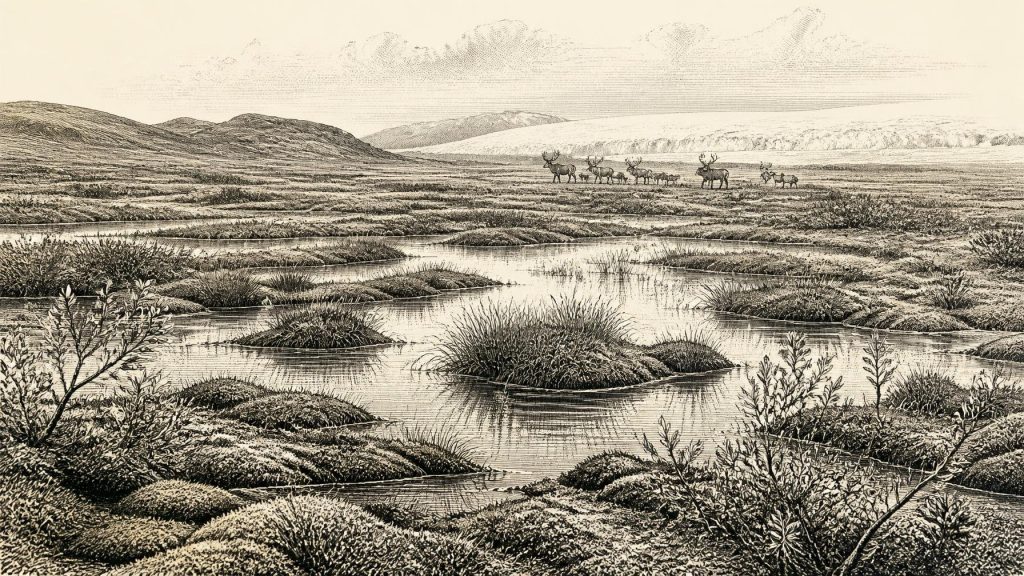
The organic layers contain freshwater mosses and sedges, together with plant and insect evidence of cold, open conditions. The setting has often been described as treeless tundra or muskeg: wet ground, shallow pools and sedge-rich margins in a landscape without closed woodland. Such terms are useful shorthand, but they should not conjure an unchanging, uniform wilderness. A freshwater hollow can preserve a distinctive ecological pocket. Its record confirms biologically active ground in Fermanagh during an ice-free interval, not a single climate map for all Ireland.
Other northern Irish deposits, including Hollymount near Maguiresbridge and Greenagho near Belcoo, also indicate that cold, non-glacial intervals occurred amid the wider Midlandian glacial sequence. Their chronology is not simple enough to be compressed into a neat island-wide timetable. Together, however, they undermine any image of Ireland as continuously entombed beneath ice throughout the whole Late Pleistocene. Ice margins, water, exposed ground and periglacial conditions shifted repeatedly over long timescales.
Castlepook’s Animal Landscape
In the south, Castlepook Cave near Doneraile in County Cork provides a different kind of archive. The cave has yielded Ireland’s richest known assemblage of Late Pleistocene vertebrate remains. Its historically excavated deposits are complicated: bones came from several passages, sands and stalagmite floors, and much was recovered before modern excavation methods established exact three-dimensional contexts. The cave should therefore not be treated as a single simultaneous scene. Nonetheless, radiocarbon work and recent research show that its fauna belongs broadly to a long MIS 3 history before the Last Glacial Maximum.
The assemblage includes reindeer, woolly mammoth, giant deer, brown bear, wolf, Arctic fox, mountain hare, collared and Norwegian lemmings, and spotted hyaena. This is compelling evidence that cold-adapted and open-country animals reached Ireland at different points in this period. Reindeer and mammoth suggest extensive grazing habitats; lemmings and Arctic fox point towards severe northern conditions; hyaenas indicate a predator and scavenger capable of using caves. Yet an animal list is not a photograph of one day. Species may have entered the cave, died, been dragged in, or been deposited in separate episodes over many millennia.
The fauna does, however, make clear that Ireland was ecologically connected to the wider north-west European world more often than its modern island geography might imply. Lower global sea levels and changing ice and sea margins altered routes between Ireland, Britain and continental Europe. Recent sedimentary ancient-DNA research from Castlepook supports this wider faunal connectivity, identifying genetic links between Irish cave animals and European populations. It remains unwise to translate this into a simple, permanent dry land bridge or a fixed migration route. Local relative sea level, ice loading and marine corridors were complex and changing.
The Human Question
The most consequential possible human evidence relevant to this era is a reindeer bone from Castlepook reported as about 33,000 years old and bearing a deep linear modification interpreted as a stone-tool mark made during fresh-bone processing. If that interpretation is confirmed through full publication and continuing analysis, it would show that people handled a reindeer carcass in Ireland far earlier than the long-established terminal-Pleistocene evidence from County Clare. It would be an important indication of an Upper Palaeolithic visit or encounter.
Its limits matter as much as its promise. The date establishes the age of the animal bone, not the duration, size or identity of any human presence. A marked bone is not a dwelling, hearth, stone-tool assemblage, burial, shoreline camp or settled territory. No securely associated settlement surface has been identified at Castlepook for this time. Nor can the find establish whether visitors hunted the animal, encountered a carcass, travelled regularly through the region, or left descendants. Ireland around 30,797 BCE may have been visited intermittently; permanent occupation cannot responsibly be inferred.
No Kingdoms, No Recorded Conflict
There is no evidence for political communities, chiefs, states, diplomacy, territorial boundaries or organised warfare in Ireland at this date. These are not merely missing details; the archaeological record does not yet demonstrate a resident human population from which such institutions could be reconstructed. Likewise, no language, personal name, kinship system or social hierarchy can be assigned to Ireland. The word “Ireland” here describes the landmass that would later form the island, not a country, people or cultural identity in the modern sense.
Conflict is visible only in the ecological sense: predators, scavengers and herbivores occupied demanding environments shaped by cold, seasonal food availability and changing ice. Hyaena activity in caves and carnivore-modified bone may reveal competition over carcasses, but they do not tell us anything about human warfare. The possible Castlepook butchery trace is far too slight to turn the animal landscape into a human hunting territory.
Daily Life, Belief and Learning
There is no direct evidence for everyday human life in Ireland in 30,797 BCE. If people reached the island, they would have belonged chronologically to the wider Upper Palaeolithic world of Homo sapiens in north-west Europe, where mobile groups used stone technology, clothing, fire and social networks. But these are regional comparisons, not discoveries from Ireland. No Irish tool-kit, shelter, ornament, figurative image, cave art or human burial can securely be attributed to this horizon.
The same restraint applies to religion and culture. Caves acquired symbolic roles in many later societies, but animal bones at Castlepook do not prove ritual, ceremony or sacred use. Nor is there material evidence for storytelling, formal teaching, music or exchange networks on the island. A possible act of carcass processing is economic in the narrowest sense—meat, marrow, hide, sinew or bone may have been useful—but it cannot demonstrate trade, planned seasonal procurement or a stable local subsistence system.
An Uneven Island
The most important development around this date was environmental rather than political: parts of Ireland supported life during a fluctuating cold stage before later ice expansion transformed much of the terrain and removed much of its evidence. Derryvree preserves the wetland side of that world—fresh water, mosses, sedges and cold-climate insects beneath later glacial deposits. Castlepook preserves its faunal side—large herbivores, small cold-adapted mammals and carnivores within a cave archive. Neither site is a complete national survey, yet together they show a land that was neither empty in ecological terms nor reliably knowable in human terms.
For 30,797 BCE, then, the soundest historical conclusion is deliberately modest. Ireland was part of a dynamic Late Pleistocene frontier, with local ice-free habitats and intermittent connections to wider European faunas. Its surviving evidence reveals wetlands and animals, perhaps a fleeting human intervention, but no established society. The sealed sedgebed at Derryvree and the bones at Castlepook are valuable precisely because they preserve fragments of a world later ice almost entirely erased.
Primary Sources
- A Middle Midlandian Freshwater Series at Derryvree, Maguiresbridge, County Fermanagh, Northern Ireland
- Early Midlandian–Middle Midlandian, Pleistocene, Northern Ireland
- Palaeoecology: Irish Quaternary Association Field Guide
- The Subdivision of the Quaternary Period in Ireland
- Middle Midlandian Interstadial Deposits at Greenagho, Near Belcoo, County Fermanagh, Northern Ireland
- A Reconsideration of the Radiocarbon Dating of the Marine Isotope Stage 3 Fauna from Southern Ireland
- Castlepook Cave, County Cork: Geological Heritage Audit Site Report
- The Irish Quaternary Fauna Project
- Occurrence of Mammalia Relicts at Site Castlepook Cave
- Pleistocene Vertebrates in the British Isles
- Sedimentary Ancient DNA Reveals Late Pleistocene Faunal Connectivity Between Ireland and Eurasia
- New Insights on the Fauna of Ireland's Younger Dryas and Early Holocene from Alice & Gwendoline Cave
- Growth and Retreat of the Last British–Irish Ice Sheet, 31,000 to 15,000 Years Ago: the BRITICE-CHRONO Reconstruction
- BRITICE Glacial Map, Version 2: a Map and GIS Database of Glacial Landforms of the Last British–Irish Ice Sheet
- The Timing and Magnitude of the British–Irish Ice Sheet Between Marine Isotope Stages 5d and 2
- Pattern and Timing of Retreat of the Last British-Irish Ice Sheet
- New Data for the Last Glacial Maximum in Great Britain and Ireland
- Relative Sea-Level Changes and Crustal Movements in Britain and Ireland Since the Last Glacial Maximum
- The IntCal20 Northern Hemisphere Radiocarbon Age Calibration Curve (0–55 cal kBP)
- IntCal Publications
- IntCal History
- Heritage Artefacts of County Cork
- Ireland's Palaeolithic Archaeology: Fleeting Footprints in a Frozen Land