BIRM-166 Radiocarbon Determination30796 BCE
At 30,796 BCE, Ireland has no event record; the date is a modern label within the Late Pleistocene. Derryvree, County Fermanagh, provides the nearest evidence: organic wetland sediments between tills, radiocarbon dated BIRM-166, show a locally ice-free interval roughly 36,900–31,700 calibrated years BP. Its treeless tundra vegetation indicates cold, seasonal conditions. Castlepook Cave, County Cork, preserves diverse MIS 3 fauna, including mammoth, reindeer, giant deer and predators, although deposits are disturbed and accumulated over time. A marked reindeer femur may suggest human carcass processing, but cannot prove settlement. Ireland faced expanding ice, without evidence of permanent communities, agriculture or institutions.
Dateline
“30,796 BCE” is a modern chronological label, not a year for which Ireland possesses an event record. No calendar, ruler, settlement horizon or excavated activity can be fixed to that particular twelve-month span. In radiocarbon terms it falls roughly 32,745 years before the conventional reference year of AD 1950, within the Late Pleistocene, broadly Marine Isotope Stage 3 (MIS 3). The responsible history of Ireland at this depth of time is therefore one of ranges, sediments, bones and landforms rather than annals. The most illuminating evidence is not a village or a grave, but a buried wetland at Derryvree near Maguiresbridge, County Fermanagh, together with cave fauna in County Cork and the larger record of a growing British–Irish Ice Sheet.
Dating a Changing Landscape
The nearest relevant Irish date comes from Derryvree, where roadworks exposed a drumlin containing a remarkable sequence: glacial till, then organic freshwater sediments and fine sands, then a later till. Till is debris laid down by glacier ice. The plant-bearing layer between the two tills records a period in which the locality was not under ice, before glaciers returned and sealed the deposits beneath a second sheet of glacial sediment. Organic material from the sequence produced the radiocarbon determination BIRM-166, conventionally dated to 30,500 radiocarbon years BP, with a substantial statistical uncertainty. Calibration converts radiocarbon years into estimated calendar years, but cannot turn the result into an anniversary. Published discussion places the Derryvree deposits broadly within about 36,900–31,700 calibrated years BP. The modern label 30,796 BCE lies within that wide interval, not at a demonstrable beginning, end or episode within it.
This distinction matters because climate and ice cover did not behave uniformly across the island. Derryvree is a local archive, not a weather report for all Ireland. It demonstrates that part of Fermanagh was ice-free long enough for freshwater and wetland sediments to accumulate. It does not prove that every coast, valley and upland was ice-free at the same time. Conversely, evidence for glaciers in northern and mountainous districts does not mean that all lower ground was continuously entombed beneath ice. Ireland’s late Ice Age was regionally varied and repeatedly changing.
The Derryvree Wetland
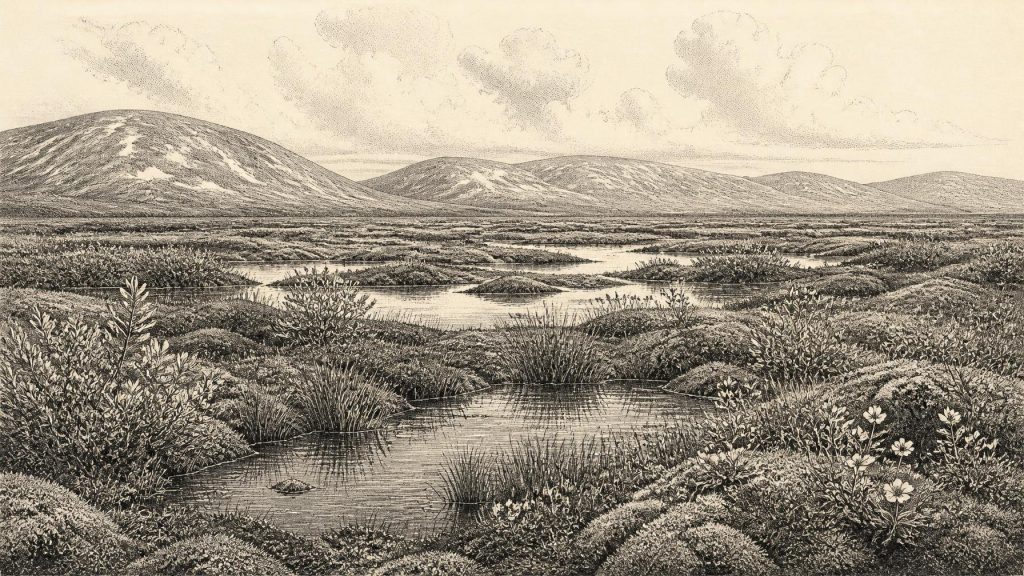
The fossils in the Derryvree organic beds point to a treeless, cold landscape. Mosses, sedges and wetland plants, including bogbean and water-milfoil, survived around shallow freshwater. Mountain-avens, dwarf willow, clubmoss and other cold-tolerant plants indicate open ground rather than woodland. The word muskeg, used by Quaternary researchers for this kind of waterlogged, mossy and sedge-rich terrain, offers a useful visual comparison: a low, wet, peaty landscape broken by pools and slow water, set within open tundra or tundra-steppe.
That is direct environmental evidence, but it has limits. Plant remains establish that particular species grew or were deposited near the basin; they do not yield a map of the whole island. Nor can they provide an annual temperature, a precise snow depth or an exact season. Still, the assemblage firmly rejects familiar images of an ancient Ireland clothed in oak forest. Around this broad period, woodland was absent from the Derryvree record. The landscape was exposed, short-growing and strongly seasonal, shaped by frost, snowmelt, shallow water and wind.
The region was also on the threshold of major glacial change. Modern reconstructions of the British–Irish Ice Sheet show ice building across Ireland and Britain after about 31,000 years ago, with a complex mixture of northern ice masses, mountain glaciers and expanding marine margins. At approximately 30,796 BCE, the full later ice-sheet maximum still lay ahead, but the environmental future of the Derryvree wetland was already written in its stratigraphy: renewed ice would cover and preserve its organic layer. The wetland was a temporary ecological opening, not the beginning of a stable climate.
Animals at the Ice Edge
County Cork offers another window on this wider world. Castlepook Cave, near Doneraile in the Awbeg valley, has yielded Ireland’s most important pre-maximum-glaciation animal assemblage. Its finds include woolly mammoth, reindeer, giant deer, brown bear, wolf, fox, Arctic and Norwegian lemmings, mountain hare and spotted hyaena. These remains were accumulated over a long period and in several cave passages. They must not be imagined as one simultaneous herd, one season or one frozen tableau. Yet their combined presence shows that parts of Ireland could support, or at least be reached by, a diverse cold-stage fauna during MIS 3.
The implications are considerable. Reindeer and lemmings fit an open, cold environment; mammoth and giant deer point to productive grazing landscapes at least during suitable intervals; predators and scavengers show that the food web was more complex than a simple vision of barren ice. Spotted hyaenas are especially important because caves can be dens as well as traps or shelters. Hyaenas and other carnivores may drag in bones, gnaw them, scatter them and mix remains of different ages. Water movement, collapses, frost and early excavation methods added further disturbance. Castlepook is consequently a vital palaeontological archive, but not an excavated settlement with a straightforward human story.
Recent redating has strengthened the case that significant elements of southern Ireland’s cave fauna belong to MIS 3, while also exposing the difficulties of older radiocarbon results. Improved pretreatment of bone collagen can make a specimen thousands of years older than a previous measurement suggested. That is not a failure of archaeology; it is precisely why museum collections, dating techniques and conclusions must be revisited. The safest conclusion is that animal movement into Ireland occurred during favourable episodes before the most extensive later glaciation. The precise routes remain uncertain. Lower global sea levels altered shorelines, but changing coastlines, ice in the Irish Sea region and the absence of a simple mapped land bridge prevent confident reconstruction of a particular crossing.
A Single Bone and Human Possibility
Castlepook also holds the most provocative possible evidence for people in Ireland at roughly this depth of time: a reindeer femur from an old collection, publicly dated to around 31,000 BCE and bearing a deep linear mark interpreted by zooarchaeologist Ruth Carden as a stone-tool cut or chop made during carcass processing. If that interpretation is confirmed, it would indicate that one or more people handled a reindeer in Ireland during the Upper Palaeolithic, vastly earlier than the better-established terminal Pleistocene evidence from Alice and Gwendoline Cave in County Clare.
But the qualifications are central, not incidental. The Castlepook femur is a bone from a historically excavated and disturbed cave archive, not a securely recorded occupation floor. Its date concerns the animal’s death within a scientific range; it does not independently date the making of the mark. No associated stone tool, hearth, shelter, burial, human bone, food-waste concentration or repeatedly occupied campsite of comparable age has been published from the cave. Carnivore activity is a genuine complication. The direct evidence is therefore a reindeer bone and a proposed human modification. A short visit by mobile hunters is a reasonable hypothesis, but permanent settlement, population size, language, kinship, identity and route of arrival cannot be recovered from this object.
There is likewise no evidence for political institutions, warfare, diplomacy, trade networks, farming, formal religion, artistic traditions or systems of learning in Ireland at this date. Such absences should not be mistaken for claims about the inner lives of any people who may have passed through. They reflect the sparse survival of evidence and the fact that later glaciation eroded, buried or rearranged much of the earlier landscape. Ireland may once have held surface camps whose traces were destroyed; that possibility cannot substitute for excavated proof.
Life Without a Settlement Record
If people did enter Ireland during this interval, their likely material circumstances can only be inferred from Upper Palaeolithic comparisons elsewhere in north-west Europe. A small mobile group capable of using stone cutting edges could have taken meat, hides, sinew, marrow and bone from large animals. Such possibilities are compatible with the reindeer femur hypothesis, but Castlepook does not reveal whether an animal was hunted, scavenged, butchered outdoors or carried to the cave by a carnivore. It is safer to speak of subsistence opportunity than of a local economy. There is no evidence for cultivation, domestic animals, permanent housing, exchange centres or seaborne commerce.
The most substantial historical development relevant to 30,796 BCE was environmental rather than political: an Ireland of open cold-country vegetation, wetlands and mobile animals, increasingly vulnerable to expanding ice. Derryvree preserves an interval when freshwater life persisted in Fermanagh between glacial advances. Castlepook preserves the remains of animals that occupied a shifting southern landscape over many millennia. Together they reveal an Ireland that was neither timelessly frozen nor securely settled: a changing northern edge of the European world, where ecological windows opened and closed long before the later return of people left a fuller archaeological record.
Primary Sources
- A Reconsideration of the Radiocarbon Dating of the Marine Isotope Stage 3 Fauna from Southern Ireland
- The Irish Quaternary Fauna Project
- Growth and Retreat of the Last British–Irish Ice Sheet, 31,000 to 15,000 Years Ago: the BRITICE-CHRONO Reconstruction
- BRITICE-CHRONO Maps and GIS Data of the Last British-Irish Ice Sheet 31 to 15 ka, Including Model Reconstruction, Geochronometric Age Spreadsheet, Palaeotopographies and Coastline Positions
- The Timing and Magnitude of the British–Irish Ice Sheet Between Marine Isotope Stages 5d and 2: Implications for Glacio-Isostatic Adjustment, High Relative Sea Levels and ‘Giant Erratic’ Emplacement
- Sedimentology and Chronology of the Advance and Retreat of the Last British-Irish Ice Sheet on the Continental Shelf West of Ireland
- Oscillating Retreat of the Last British-Irish Ice Sheet on the Continental Shelf Offshore Galway Bay, Western Ireland
- Trimlines, Blockfields and the Vertical Extent of the Last Ice Sheet in Southern Ireland
- BRITICE Glacial Map, Version 2: a Map and GIS Database of Glacial Landforms of the Last British–Irish Ice Sheet
- Figure 6.— The Subdivision of the Quaternary Period in Ireland
- New Insights on the Fauna of Ireland's Younger Dryas and Early Holocene from Alice & Gwendoline Cave
- First Evidence of a Late Upper Palaeolithic Human Presence in Ireland
- First Evidence of a Late Upper Palaeolithic Human Presence in Ireland
- The Mesolithic in Ireland: When Was It?
- Heritage Artefacts of County Cork 2021
- 2022:564 – Castlepook Cave, Castlepook South, Cork
- The Geological Heritage of Clare
- Cenozoic: Tertiary and Quaternary
- The Role of the Irish Ice Sheet
- The Colonization of Ireland: A Human Ecology Perspective