Castlepook’s Unmarked Landscape30795 BCE
Around 33,000 calibrated years ago, Ireland experienced fluctuating Late Pleistocene conditions before the Last Glacial Maximum. Lower sea levels altered its geography, while cold, open landscapes supported varied fauna. Castlepook Cave, County Cork, Ireland’s richest vertebrate-fossil site of this period, yielded mammoth, giant deer, reindeer, brown bear and spotted hyaena remains. Its deposits were accumulated and disturbed through several processes, and early excavation limited contextual certainty; revised dating has also altered chronologies. A marked reindeer femur may indicate Upper Palaeolithic butchery, but does not prove settlement or continuous occupation. No evidence supports claims about contemporary society, economy, politics or culture.
Dateline
30,795 BCE is not a date that can be matched to a recorded Irish event. It is a modern calendar label imposed on a very remote part of the Late Pleistocene. If treated simply as an arithmetic conversion, it lies about 32,744 years before the radiocarbon convention’s “present” of 1950; but that is not the same as possessing evidence precise to a single year. At this depth in time, archaeology works with calibrated ranges, laboratory uncertainties, changing calibration curves and deposits that may have been disturbed long after bones or sediments entered them. The responsible question is therefore not what happened in Ireland in one particular year, but what the surviving evidence can say about Ireland in the broad interval around 33,000 calibrated years ago.
An Ice-Age Interval, Not the Ice Maximum
This was Marine Isotope Stage 3, an unstable phase of the last glacial cycle. It preceded the Last Glacial Maximum, conventionally placed at roughly 26,500–19,000 years ago, when the Irish Ice Sheet formed part of the much larger British–Irish Ice Sheet. Around 30,795 BCE, Ireland should not be imagined as uniformly entombed beneath the later maximum ice cover. Rather, conditions fluctuated sharply between colder and relatively milder intervals, while local glaciers, snowfields, frost action, vegetation and animal ranges responded to those changes on differing timescales. The climate was cold by modern standards, but it was not a single, unchanging ‘Ice Age weather forecast’.
Nor did modern Ireland’s familiar coast provide the geographical frame. Sea level was lower than today and the exposed continental shelves altered the size and shape of the landmass, the position of coasts and the distances involved in travel. Yet the evidence does not permit a confident map for one year, nor does it settle exactly how accessible every part of Ireland was at every moment. What is clear is that Ireland lay on Europe’s north-western edge, where climate and sea routes made occupation, animal dispersal and survival unusually precarious.
Castlepook Cave and Its Fauna
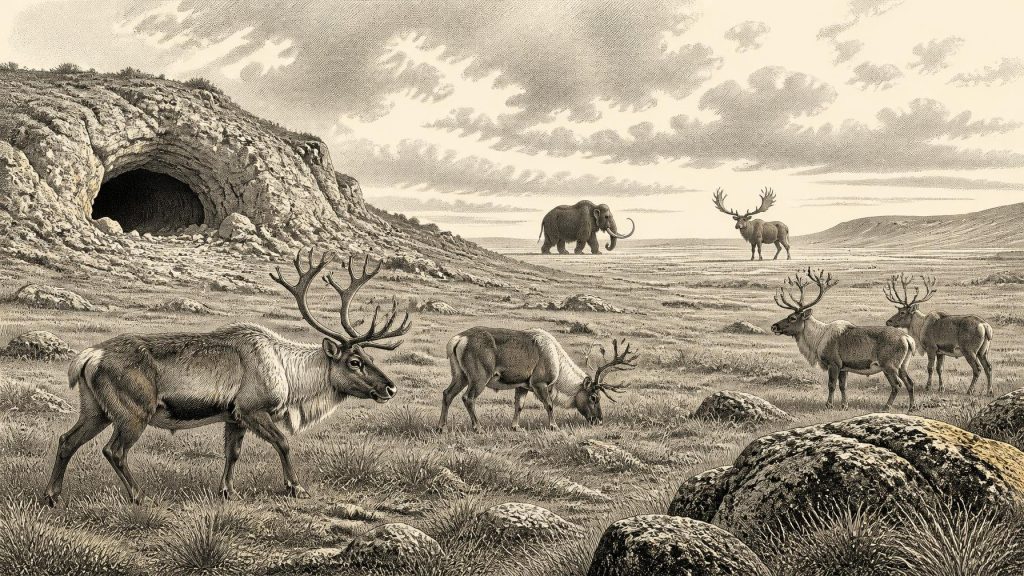
The strongest Irish evidence for this broad period comes not from settlements but from caves, above all Castlepook Cave near Doneraile, County Cork, also known as Mammoth Cave. Excavated principally between 1904 and 1918, it produced a remarkable assemblage of Pleistocene animal remains. Geological Survey Ireland describes it as the country’s richest vertebrate-fossil site for the period leading towards the Last Glacial Maximum. Its recorded fauna includes woolly mammoth, giant deer, reindeer, brown bear and spotted hyaena; later material includes wolves, Arctic foxes and lemmings. These remains establish that parts of Ireland could support, or at least receive, a far richer cold-stage mammal community than the island has known in historic times.
Those animals should not be turned into a painted panorama of every Irish valley. Castlepook is a local cave archive, not a census of the island. A mammoth bone proves that a mammoth, or material from one, reached the cave system; it does not demonstrate herds continuously roaming every district. Equally, reindeer, giant deer and brown bear remains show real ecological possibilities, but their dates and distributions were not identical. The cave accumulated bones over a long period, and different chambers may have received material by different processes. A hyaena den, a natural trap, carnivore scavenging, animals dying nearby and water movement can all help create an assemblage that is scientifically invaluable but behaviourally complicated.
That complication matters especially at Castlepook. The early excavators removed very large quantities of bone, with much contextual information lost by modern standards. Later researchers noted extensive water re-sorting, making simple vertical sequences unreliable. Recent reassessment using improved pretreatment and radiocarbon methods found that several older determinations from southern Irish caves were too young: re-dated Castlepook specimens became approximately 5,000 to 12,000 radiocarbon years older. Consequently, older published dates are not a secure basis for assigning individual animals to an exact calendar moment. The cave speaks powerfully about a pre-maximum Ice-Age fauna, but softly about any one episode within it.
Open Country at Ireland’s Edge
The animal record nevertheless supports a cautious environmental reconstruction. Reindeer, mammoth and giant deer are consistent with extensive open or broken country: a mosaic of grassland, herb-rich steppe-tundra, low shrubs, bare ground and wet hollows rather than dense woodland. Plant evidence from Irish sequences shows that late-glacial environments could include cold-adapted herbs, mosses, sedges and dwarf shrubs, although the particular plant communities around 30,795 BCE cannot be recovered in equal detail for every region. The most defensible picture is of a seasonally severe, wind-exposed landscape in which shelter, forage and unfrozen water were unevenly distributed.
Large herbivores made that landscape productive for predators and scavengers as well as people, if people were present. Spotted hyaena is particularly striking. Its bones and signs of carnivore activity at Castlepook show that the cave was part of an animal landscape with competition for carcasses and shelter. Brown bears and wolves add further evidence of a functioning terrestrial food web. But one should resist assuming an intact copy of the famous Eurasian ‘mammoth steppe’. Ireland was an Atlantic fringe with a selective and changing fauna. The absence of a species from the small Irish record may be meaningful, or may merely reflect preservation, sampling and the survival of old collections.
A Possible Human Trace
The most provocative evidence directly relevant to this era is a reindeer femur from Castlepook that has been interpreted as bearing a deep mark made by a stone tool during butchery. County Cork’s heritage publication identifies the specimen as a reindeer leg bone from Castlepook, now in the National Museum of Ireland’s Natural History collections, and presents the mark as opening the possibility of Palaeolithic hunters in Ireland. Public accounts have associated the bone with an age of about 33,000 years. If the modification is indeed anthropogenic and contemporary with the bone, it would show that a person processed a reindeer in Ireland during the Upper Palaeolithic—many millennia before the well-established post-glacial record.
That possibility is important, but its limits are equally important. The bone is not a settlement. There is no securely associated hearth, stone-tool assemblage, dwelling, burial, human skeleton, repeated occupation surface or dated pile of butchered refuse from this time in Ireland. The old cave context has also been disturbed, and a radiocarbon age for an animal bone does not automatically date the instant at which a surface mark was made. The proper conclusion is therefore modest: Castlepook offers a potentially very early indication of human action, not proof of a resident Irish population, a named group or a continuous colonisation.
Society Beyond the Evidence
If a small party did reach Ireland around this broad period, it may have been mobile and highly knowledgeable about animal movements, weather and the use of stone, hide and bone. Such possibilities are consistent with Upper Palaeolithic lifeways elsewhere in north-west Europe. They are not, however, demonstrated for Ireland. A single marked bone cannot tell us whether travellers arrived to hunt, scavenged a carcass, sought a cave refuge, crossed seasonally, or came only once. It cannot reveal their language, kinship system, identity, route, numbers, age or gender.
For the same reason, political affairs, diplomacy and organised warfare are beyond the Irish record at this date. There is no evidence for chiefs, territories, alliances, borders or formal conflict. There is no securely Irish evidence for ritual sites, burials, cave art, portable art, music, calendrical knowledge or teaching. Absence of evidence does not prove that people lacked beliefs, stories, skills or social rules; it means that the surviving Irish material cannot responsibly describe them. The cultural history of this moment is principally a history of what later geological processes and early collecting practices have failed to preserve.
No Economy of Exchange Yet Visible
Likewise, there is no basis for identifying an Irish economy, trade network or permanent settlement pattern in 30,795 BCE. Hunting and carcass processing are plausible only if the Castlepook mark is accepted as human-made, while gathering plant foods, making clothing, transporting stone and sharing food are reasonable general possibilities for Palaeolithic people but not directly evidenced on the island. There are no demonstrated Irish houses, storage pits, workshops, harbours or exchanged objects of this age. The earliest securely documented chapters of settlement belong much later, after enormous climatic and geographical transformations.
The most important development around this point, then, was environmental rather than political: Ireland remained a volatile northern landscape before the last great ice expansion. Castlepook preserves fragments of its animal life—reindeer, giant deer, mammoth, bear and hyaena—and perhaps one tantalising sign of human intervention. Its lesson is not that a fully populated prehistoric Ireland has been discovered. It is that the island’s deep past was more ecologically varied, and its human possibilities more open, than older histories allowed. Future excavations, redating and microscopic analysis may refine that picture; for now, uncertainty is part of the evidence.
Primary Sources
- Castlepook Cave, County Geological Site Report
- A Reconsideration of the Radiocarbon Dating of the Marine Isotope Stage 3 Fauna from Southern Ireland
- The Irish Quaternary Fauna Project
- Ancient DNA Reveals That Irish Red Deer Are Genetically Distinct from Their Scottish, English and Norwegian Counterparts
- First Evidence of a Late Upper Palaeolithic Human Presence in Ireland
- The Archaeology of Caves in Ireland
- New Insights on the Fauna of Ireland’s Younger Dryas and Early Holocene from Alice & Gwendoline Cave
- Trimlines, Blockfields and the Vertical Extent of the Last Ice Sheet in Southern Ireland
- Dimensions and Chronology of the Last Ice Sheet in Western Ireland
- Oscillating Retreat of the Last British-Irish Ice Sheet on the Continental Shelf Offshore Galway Bay, Western Ireland
- Maximum Extent and Dynamic Behaviour of the Last British–Irish Ice Sheet West of Ireland
- Figure 6.—The Subdivision of the Quaternary Period in Ireland
- Field Guides
- Publications
- Outreach and Education Resources
- Heritage Artefacts of County Cork
- Mammoth Cave
- A North-Western Habitat: the Paleoethology and Colonisation of a European Peninsula
- Archaeological Excavations at Killuragh Cave, Co. Limerick
- First Evidence of a Late Upper Palaeolithic Human Presence in Ireland