Derryvree’s Willow and Moss30786 BCE
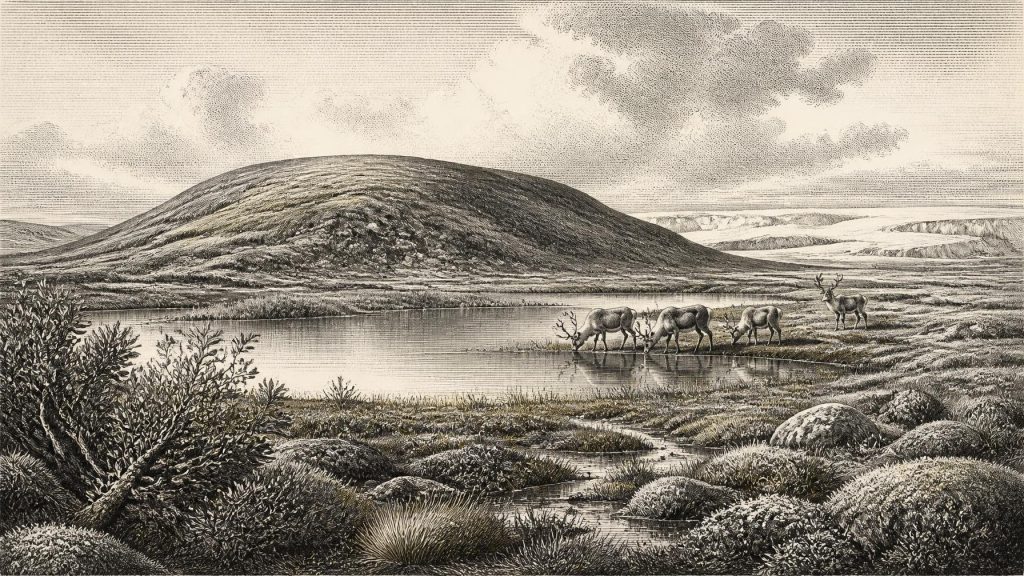
Around 30,786 BCE, Ireland has no recoverable annual history, only environmental and archaeological evidence expressed in broad ranges. At Derryvree, County Fermanagh, freshwater sediments between glacial tills indicate an ice-free MIS 3 interval, supporting treeless wetlands with mosses, sedges, dwarf willow and arctic-alpine plants. Castlepook Cave, County Cork, preserves fauna including mammoth, reindeer, giant deer, predators and smaller mammals, demonstrating wider European late-Pleistocene ecological connections. A marked reindeer femur may indicate brief human carcass processing, but cannot establish settlement. Subsequent ice-sheet expansion destroyed or buried much evidence, leaving a fragmentary record of changing cold landscapes, animals and possible visitors there.
Dateline
“30,786 BCE” is a modern chronological label, not a recoverable year in Irish prehistory. No written record, calendar, named individual or datable historical event exists for Ireland at this depth in time. In radiocarbon terms the label falls about 32,736 years before AD 1950, within the Late Pleistocene and Marine Isotope Stage 3 (MIS 3). The responsible evidence is therefore measured in broad calibrated ranges, rather than in years or seasons. Ireland can be illuminated around this point by buried sediments, pollen and plant remains, cave fauna, glacial landforms and a small number of contested clues to human activity. It cannot support a conventional annual history.
A Freshwater Record Beneath the Drumlins
The closest important Irish environmental archive is at Derryvree, near Maguiresbridge in County Fermanagh. Road cutting through a drumlin exposed a remarkable sequence: organic freshwater muds and silts lay between two tills, the unsorted sediments deposited by separate episodes of glacier ice. The order of the layers is more secure than any finely resolved date. Ice had covered the locality; thereafter a pool, wetland or sluggish freshwater basin accumulated sediment and plant material; then a later ice advance buried the deposit beneath fresh glacial debris. Derryvree is thus a rare survival from an Ireland whose earlier landscapes were repeatedly scoured, rearranged or sealed by ice.
Organic matter from this sequence produced the radiocarbon determination BIRM-166, conventionally reported as about 30,500 radiocarbon years before present, with a large uncertainty. Radiocarbon years are not calendar years: the concentration of atmospheric carbon-14 has varied through time, so measurements need calibration against independently dated records. Modern calibration curves extend this far back, but they yield probability distributions and wide ranges, not dates fit for a diary. Published discussion places Derryvree broadly in the later part of MIS 3, approximately 36,900–31,700 calibrated years before present. The notional year considered here falls within that span, but it cannot be assigned to a particular layer, plant or episode at the site.
This distinction matters. Derryvree demonstrates that its part of Fermanagh was ice-free long enough for freshwater sediments and organic material to form during an earlier cold-stage interval. It does not prove that every part of Ireland was simultaneously ice-free, nor that the island had a uniform climate. The British–Irish Ice Sheet was dynamic and its pre-Last Glacial Maximum history remains unevenly understood. Local ice, permafrost, meltwater and exposed ground could have produced sharply different conditions across relatively short distances.
Treeless Wetlands and Open Ground
The Derryvree plant evidence points to a cold, open environment rather than a wooded Irish landscape. Mosses, sedges, bogbean or buckbean (Menyanthes trifoliata), water-milfoil, dwarf willow, mountain-avens and other northern or arctic-alpine taxa indicate wet ground beside shallow freshwater, surrounded by treeless tundra or muskeg-like vegetation. Such plants do not produce a picturesque, uniform “ice-age Ireland”; they describe particular ecological niches represented in one sedimentary basin. Yet together they show that living vegetation persisted in at least some ice-free ground, despite a severe climate and the proximity of advancing or retreating ice.
In practical terms, this was a landscape of short growing seasons, exposed soils and shifting watercourses. Low herbs, grasses, dwarf shrubs and mossy wetland would have been more important than trees. Wind, frost action and seasonal thaw would have shaped the ground. Open country also supported grazing animals, although evidence from animal bones must be treated separately from the Fermanagh flora: a cave deposit in Cork and a wetland deposit in Fermanagh are not a single excavated ecosystem. They are complementary, geographically distant windows onto the broader Irish late-Pleistocene world.
Castlepook’s Animal World
At Castlepook Cave near Doneraile, County Cork, antiquarian excavations recovered one of Ireland’s most important Pleistocene faunal collections. Subsequent reassessment has identified remains attributed to mammoth, reindeer, giant deer, brown bear, wolf, Arctic fox, hare, rodents and spotted hyaena. Direct dating and renewed analysis indicate that some of the cave’s fauna belongs to MIS 3, while also showing that old collections and disturbed cave deposits demand caution. A cave is not simply a census of animals roaming outside its entrance: bones may have been carried in by carnivores, accumulated in different episodes, moved by water or excavation, and mixed across long spans of time.
Even with those limits, Castlepook makes one conclusion unavoidable: Ireland was not biologically empty throughout the late Pleistocene. Large herbivores and predators reached parts of the island during intervals before the Last Glacial Maximum. Reindeer are especially consistent with open, cold environments, while hyaena and mammoth remains point to ecological connections with the wider mammoth-steppe and tundra landscapes of north-west Europe. The precise combinations of animals present at any one time, however, remain less certain than popular reconstructions often suggest. Some species may have disappeared locally well before the ice sheet reached its maximum extent.
The Reindeer Femur Question
The most arresting possible human evidence is a reindeer femur from the Castlepook collection. It has been reported as roughly 33,000 years old and bears a deep mark interpreted by zooarchaeologist Ruth Carden as consistent with cutting or chopping by a stone tool during carcass processing. If that interpretation is confirmed, it would indicate a very early Upper Palaeolithic human encounter with a reindeer in Ireland, vastly earlier than the island’s well-attested post-glacial occupation. It is a significant possibility, but not a licence to describe a settled Irish hunting community in 30,786 BCE.
The evidential limits are clear. The femur is a single specimen from a historic cave collection, rather than an undisturbed living floor excavated with associated tools and hearths. Its date establishes when the animal lived and died, not necessarily the precise moment at which a surface mark was made. It cannot reveal where the animal was killed, how many people handled it, whether people entered the cave, or whether they returned. No securely associated stone-tool assemblage, dwelling, burial, art, food refuse or repeated occupation layer has demonstrated a resident population in Ireland at this date. The prudent description is possible brief human visitation or carcass processing, not proven settlement.
Movement into Ireland was geographically conceivable but archaeologically unproven. Sea levels were lower than today and the outlines of coasts, estuaries and offshore plains differed greatly from modern maps. Ice and cold-water barriers also changed through time. Whether people or animals travelled over exposed land, crossed narrow water, followed coastal routes, or used some combination of these possibilities cannot be settled from the Irish evidence presently available. A proposed route is an interpretation; the marked bone, if anthropogenic, is the physical clue from which it begins.
No Polities, No Proven Ritual Landscape
There is no evidence for political affairs, diplomacy, named groups, territorial boundaries or organised conflict in Ireland around this date. Nor is there evidence for agriculture, permanent villages, long-distance trade networks, metalworking, formal religious monuments, burial rites or a local artistic tradition. Such absences should not be mistaken for proof that people were incapable of social life, belief or learning; Upper Palaeolithic peoples elsewhere in Europe possessed complex technologies and cultural practices. They mean only that Ireland has not yielded material evidence from which those subjects can responsibly be reconstructed for this period.
If a small group did enter the island, its economy would have depended on immediate knowledge of animals, weather, stone, fire, shelter and routes through an unstable cold landscape. That is an inference from the possible reindeer-processing evidence and the wider European Upper Palaeolithic context, not a directly documented Irish way of life. There is no securely dated Irish hearth from which to describe meals, no toolkit from which to reconstruct manufacturing, and no human remains from which to discuss ancestry, language or kinship. The archaeological silence is itself historically important.
Approaching the Ice Sheet Maximum
What later happened to this world helps explain why its record is so fragmentary. The Last Glacial Maximum came after the interval represented by Derryvree. Ice expanded across much of Ireland, reshaping valleys and lowlands, depositing tills and drumlins, and eroding or burying earlier soils and sediments. The later British–Irish Ice Sheet was not a static blanket: reconstructions show asynchronous advances and retreats between regions. Nonetheless, its expansion removed much of the fragile evidence that might once have recorded plants, animals and transient human movement around 30,786 BCE.
Ireland around this notional year was therefore neither a historical nation nor an empty white void. It was a changing northern landscape in which freshwater wetlands could form between glacial episodes, arctic-alpine plants could grow, and large mammals could move through open country. One marked reindeer bone raises the possibility that people also reached this frontier. The evidence is compelling precisely because it is slight: sediment, moss, animal bone and an uncertain cut mark preserve a deep past that must be described in ranges, probabilities and careful distinctions between what survives and what can only be imagined.
Primary Sources
- A Middle Midlandian Freshwater Series at Derryvree, Maguiresbridge, County Fermanagh, Northern Ireland
- Figure 6.— The Subdivision of the Quaternary Period in Ireland
- The timing and magnitude of the British–Irish Ice Sheet between Marine Isotope Stages 5d and 2: implications for glacio-isostatic adjustment, high relative sea levels and ‘giant erratic’ emplacement
- Growth and retreat of the last British–Irish Ice Sheet, 31 000 to 15 000 years ago: the BRITICE-CHRONO reconstruction
- Timing, pace and controls on ice sheet retreat: an introduction to the BRITICE-CHRONO transect reconstructions of the British-Irish Ice Sheet
- Trimlines, blockfields and the vertical extent of the last ice sheet in southern Ireland
- A reconsideration of the radiocarbon dating of the Marine Isotope Stage 3 fauna from southern Ireland
- The Irish Quaternary Fauna Project
- Pleistocene vertebrates in the British Isles
- Occurrence of mammalia relicts at site Castlepook Cave
- Archaeology Research Excavation Grant 2022
- Archaeology Research Excavation Grant Report 2023
- 32564: Castlepook Cave, Co. Cork
- The colonization of Ireland: A human ecology perspective
- Studies on the Early Settlement of Scotland and Ireland
- The Antiquity of Man in Ireland
- New insights on the fauna of Ireland's Younger Dryas and Early Holocene from Alice & Gwendoline Cave
- Phylogeographic, ancient DNA, fossil and morphometric analyses reveal ancient and modern introductions of a large mammal: the complex case of red deer (Cervus elaphus) in Ireland
- Preliminary assessment of the archive of faunal remains from excavated Irish cave sites
- The IntCal20 Northern Hemisphere Radiocarbon Age Calibration Curve (0–55 cal kBP)
- IntCal Publications
- New data for the Last Glacial Maximum in Great Britain and Ireland