Mammoth Cave’s Marked Femur30777 BCE
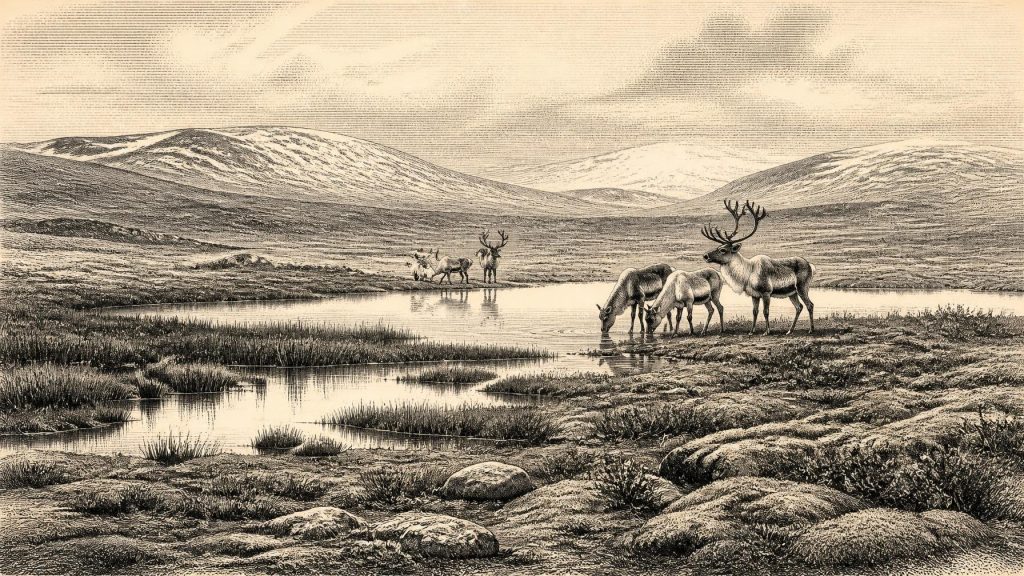
Around 30,777 BCE, Ireland cannot be reconstructed as a single dated moment, but evidence indicates a volatile later Pleistocene environment. At Derryvree, Fermanagh, freshwater sediments between tills record locally ice-free, treeless tundra wetlands, with mosses, sedges, aquatic plants and insects, during a cold interval preceding maximum ice-sheet expansion. Lower sea levels and shifting ice altered coasts and access, while later glaciation destroyed much evidence. Castlepook Cave preserves cold-stage fauna including mammoth, reindeer, giant deer, hyena and bear. A marked reindeer femur may indicate early human butchery, but disturbed context supports only possible episodic human visits, not permanent settlement or society.
Dateline
The label “30,777 BCE” is a modern calendrical convenience, not a date that prehistoric evidence can resolve. It corresponds roughly to 32,726 years before the conventional radiocarbon baseline of AD 1950, within the later Pleistocene and Marine Isotope Stage 3. No Irish deposit, animal bone or human action can responsibly be assigned to that individual year. The closest evidence consists of dated ranges, sediments and disturbed cave collections. Taken together, they suggest an Ireland of severe seasonal cold, open vegetation, freshwater pockets and large mammals, shortly before the most extensive phase of the last Irish ice sheet.
This was not a country of named peoples, kingdoms or recorded events. There were no states, diplomatic contacts, laws, writing or surviving monuments from which political history can be written. The historical task is instead to distinguish what the material record demonstrates from what it merely makes possible. Around this nominal date, the principal story is environmental change and the uncertain possibility of brief human visits to a landscape later heavily altered by ice.
A Date Within a Range
The best Irish environmental sequence relevant to this period was found at Derryvree, near Maguiresbridge in County Fermanagh. Road works in 1969 cut through a drumlin and exposed organic freshwater silts and fine sands lying between two separate sheets of till, the unsorted material deposited by glacier ice. The order of layers is direct evidence: ice had occupied the site; an interval followed in which freshwater and wet ground developed; later glacial action sealed the deposit beneath another till.
Organic material from the Derryvree bed returned a conventional radiocarbon age of 30,500 with an uncertainty of +1,170/−1,030 radiocarbon years before present. Calibration does not turn this into a single year. Published treatments place the deposit broadly at about 36,900–31,700 calibrated years before present, a span that includes the approximate chronological position represented by 30,777 BCE. The silts accumulated over time, and their date is a probability range for a deposit, not a timestamp for a particular day, season, animal or human activity.
Older schemes termed this interval the Derryvree Cold Phase within the Irish Midlandian, the local name for the last glacial cycle. Such labels remain useful shorthand, but they should not imply a uniform climate across the island or a perfectly synchronised phase. The later Pleistocene was volatile. Ice margins, snowfall, permafrost, sea level and vegetation changed over centuries and millennia, while the evidence surviving in any one place is necessarily local.
Fermanagh’s Treeless Wetland
Derryvree nevertheless provides an unusually vivid glimpse of an Irish cold-stage habitat. Pollen, plant macrofossils and insect remains indicate open tundra-like vegetation and a periglacial regime: ground affected by frost, largely without trees, but not devoid of life. Mosses, sedges, grasses and hardy herbs grew around shallow freshwater. Finds reported from the deposit include bogbean, alternate water-milfoil, mountain-avens, dwarf willow and lesser clubmoss. Their combination shows that local pools and saturated ground persisted despite a harsh climate.
The word “tundra” should not conjure a featureless snowfield. The evidence instead supports a varied low-growing landscape: wet hollows, sedgy margins, mossy ground, exposed mineral soils and open water. Summer thaw and plant growth would have contrasted sharply with long cold seasons. Insect evidence helps to support the interpretation of a chilly, open setting, while aquatic plants independently show that at least some water remained unfrozen for part of the year. This was an ecological mosaic, not a single uniform plain.
It would be unsafe, however, to transplant every species and condition at Derryvree to all of Ireland in 30,777 BCE. The record comes from one Fermanagh basin. It is strong evidence for the local environment during the broad interval represented by the deposit; it is an informed analogue, rather than a nationwide weather report for the numbered year.
Ice, Coast and Changing Ground
The island’s geography was also unlike that of modern Ireland. Global sea level was substantially lower during the last glacial cycle, exposing more of the continental shelf, but coastlines and routes changed with both sea level and ice. It is therefore misleading either to picture a familiar island surrounded by today’s sea or to assume a simple, permanent land bridge to Britain and continental Europe. Passages could have been altered by exposed shelf, marine water, river systems, local ice and dangerous seasonal conditions.
There is broad agreement that the British–Irish Ice Sheet later expanded dramatically. At its Last Glacial Maximum, conventionally placed around 27,000–23,000 calibrated years before present for the Irish sector and shelf, ice covered Ireland and extended towards the Atlantic shelf edge. The period represented by Derryvree predates that maximum, demonstrating at least local ice-free conditions in Fermanagh between glacial episodes. Precisely how much of Ireland was ice-covered at the nominal date remains debated, because pre-maximum deposits are sparse and later ice repeatedly eroded or buried earlier landscapes.
This destructive power explains much of the archive’s silence. Advancing ice scoured soils, shifted boulders, reworked sediments and removed many possible campsites. Low-lying coastal landscapes that may once have been accessible are now submerged or transformed. Absence of a settlement therefore cannot prove that no person ever entered Ireland; equally, the loss of evidence cannot be used to invent a resident population.
Castlepook and the Animal World
County Cork’s Castlepook Cave, also called Mammoth Cave, offers a second, very different window onto the period. Its collections include remains of woolly mammoth, giant deer, reindeer, brown bear and spotted hyena, with Arctic fox, wolf and lemmings also represented in the wider cold-stage fauna. Direct dates from some Castlepook material fall broadly in the middle and later part of Marine Isotope Stage 3. The cave is consequently one of Ireland’s most important archives for the animals that reached the island before the last glacial maximum.
Yet a cave bone collection is not a census of creatures living together at one moment. Castlepook was excavated mainly in the early twentieth century, and water movement, carnivore activity and antiquarian methods disturbed or obscured much original context. A hyena den can accumulate carcass material; floods and later digging can move it again. Mammoth or reindeer bones establish that those animals occurred in Ireland during parts of the relevant cold-stage world, but they do not establish an annual herd count, a settled hunting territory or a complete food web for 30,777 BCE.
The presence of large grazers and browsers is nevertheless significant. Reindeer, mammoth and giant deer imply that open habitats could support substantial herbivores at favourable times. Predators and scavengers, including spotted hyena, point to a landscape in which carcasses and prey were contested resources. Life was mobile and seasonal. Its rhythms were set more by migration, forage, weather and safe shelter than by the fields, roads and villages that would define later Irish history.
The Marked Reindeer Bone
Castlepook also bears on the difficult question of people. A fragment of reindeer femur from the cave has been reported as approximately 33,000 years old and as carrying deep marks consistent with stone-tool butchery. If that interpretation is confirmed, it is potentially the earliest evidence of human activity in Ireland: not proof of a town or long-lived colony, but evidence that one or more people processed a reindeer carcass.
The qualification matters. The bone provides no securely associated hearth, stone-tool assemblage, dwelling floor, burial or stratified occupation surface. Its antiquarian recovery and disturbed cave context restrict what can be claimed. A radiocarbon date on the animal dates its death, not necessarily the exact moment of cutting; a cut-like mark requires careful comparison with damage caused by carnivores, trampling, excavation and natural breakage. The responsible conclusion is that Castlepook preserves an important, still limited candidate for Upper Palaeolithic butchery close to this broad period.
There is thus no basis for describing a named Irish hunter-gatherer society, its language, kinship system, beliefs, art or ritual in this year. Upper Palaeolithic groups elsewhere in Europe made sophisticated stone tools, travelled widely and used shelters, clothing and symbolic media. Those wider comparisons show what was possible for humans of the time; they are not evidence that those practices occurred at Castlepook. Ireland’s evidence currently supports, at most, episodic human presence rather than a demonstrated permanent population.
No Politics, but a Precarious Economy
Political affairs and diplomacy leave no trace here because there is no evidence for polities. Conflict is equally undocumented: predators competed with one another, and people may have hunted or scavenged, but no Irish evidence identifies organised warfare. Religion and learning cannot be recovered. There are no known shrines, graves, artworks or inscribed objects of this age in Ireland from which to infer ceremony, cosmology or formal teaching.
Economy, in the narrower ecological sense, can be discussed. Wild plants, freshwater and migratory or wandering animals formed the available resource base. Had people been present, survival would have depended on flexible movement, knowledge of animal behaviour, stone-working and shelter in an exposed cold environment. But even this is a conditional inference, not a description of an established Irish community. Farming, domestic animals, metallurgy, long-distance commodity trade and permanent settlement lay many millennia in the future.
For Ireland around 30,777 BCE, then, the most important development was neither a ruler nor a battle but a changing Ice Age landscape. Derryvree records a locally ice-free freshwater tundra within a long glacial cycle; Castlepook records an extraordinary assemblage of cold-stage mammals and a provocative possible trace of human butchery. Together they replace older visions of an empty, featureless frozen island with a more careful picture: biologically active, environmentally unstable, and only fleetingly illuminated by the evidence that survived.
Primary Sources
- A Middle Midlandian Freshwater Series at Derryvree, Maguiresbridge, County Fermanagh, Northern Ireland
- The Irish Quaternary Fauna Project
- New Insights on the Fauna of Ireland's Younger Dryas and Early Holocene from Alice & Gwendoline Cave
- New Data for the Last Glacial Maximum in Great Britain and Ireland
- Pattern and Timing of Retreat of the Last British-Irish Ice Sheet
- The Deglaciation of the Western Sector of the Irish Ice Sheet from the Inner Continental Shelf to its Terrestrial Margin
- The Timing and Magnitude of the British–Irish Ice Sheet Between Marine Isotope Stages 5d and 2
- Exploring Controls on the Stability of the Last British-Irish Ice Sheet
- Dimensions and Chronology of the Last Ice Sheet in Western Ireland
- Ireland: Submerged Prehistoric Sites and Landscapes
- Anthropogenic Changes to the Holocene Nitrogen Cycle in Ireland
- Figure 6: The Subdivision of the Quaternary Period in Ireland
- Castlepook Cave, County Geological Site Report
- Prehistoric Details: Stone Age Collections
- Spotted Hyena Skull, Castlepook Cave
- Castlepook Cave Excavation, 2022
- Archaeological Heritage of County Cork
- First Evidence of a Late Upper Palaeolithic Human Presence in Ireland
- Menyanthes trifoliata: Fossil Record in Fermanagh
- Dryas octopetala: Fossil Record in Fermanagh
- Selaginella selaginoides: Fossil Record in Fermanagh
- Saxifraga rosacea: Fossil Record in Fermanagh
- A Critical Review and Re-investigation of the Pleistocene Deposits Between Cranfield Point and Kilkeel, Northern Ireland
- A Palaeo-glaciological Reconstruction of the British-Irish Ice Sheet