
Elephant Hall’s Open Steppe30778 BCE
30,778 BCE is a modern label within unstable Marine Isotope Stage 3, not a date for a recorded Irish event. Derryvree, County Fermanagh, preserves freshwater sediments between tills, indicating an ice-free, treeless, tundra-like wetland, although it cannot represent all Ireland. Castlepook Cave, County Cork, contains remains of mammoth, reindeer, giant deer, predators and cold-stage fauna, accumulated across episodes. A marked reindeer femur may indicate Palaeolithic butchery, yet requires confirmation and proves neither settlement nor continuity. Evidence supports changing environments and possible mobile visitors, not society, economy or politics. Later glaciation has left a fragmentary archive of sediment, bone and ice.
Dateline
30,778 BCE is a modern chronological label, not a year that can be observed in the Irish archaeological record. It falls approximately 32,728 calibrated years before AD 1950 (cal BP), within the Late Pleistocene and Marine Isotope Stage 3, a long, climatically unstable part of the last Ice Age. No Irish calendar, written source, settlement sequence or annually resolved environmental archive permits a claim about an event in this exact year. The responsible history is therefore a reconstruction of conditions across broad, calibrated ranges, based on sediments, fossils, cave deposits and the changing evidence of ice.
Around this point in deep time, Ireland was neither the familiar green island nor a single unbroken wilderness of ice. Its landscapes altered repeatedly as climate fluctuated, ice expanded or withdrew locally, rivers and meltwater reworked ground, and cold-adapted plants and animals occupied whatever terrain was available. The evidence is thin and often disturbed by later glaciation, but it is enough to show that parts of Ireland formed a changing north-west European cold-stage environment.
A Date Beyond Calendar Precision
Archaeological dates of this antiquity must be handled with particular care. Radiocarbon results are not calendar years: they measure residual carbon-14 and must be calibrated against records of past atmospheric variation. The resulting dates are probability ranges, often broad at thirty millennia ago. A BCE label is useful for organising a year-by-year series, but it should not suggest that a particular Irish community experienced a recorded “year 30,778 BCE”.
The closest Irish environmental sequence of relevance lies at Derryvree near Maguiresbridge, County Fermanagh. Road works in 1969 exposed a freshwater layer of silts and fine sands enclosed between two distinct tills, the unsorted deposits left by glacier ice. Organic material from that layer returned a conventional radiocarbon age of 30,500 +1,170/−1,030 BP. Subsequent discussion has expressed its approximate calibrated span as c. 36,900–31,700 cal BP. Thus 30,778 BCE falls within the broad interval illuminated by the Derryvree evidence, but cannot be assigned to a particular season, pool, plant bed or animal death there.
The sequence does, however, establish an important order of events: ice had affected the locality; an ice-free freshwater and wet-ground environment later developed; and renewed glacial deposition eventually sealed it. This is valuable evidence for regional environmental change, not proof that the whole island was ice-free at once. The timing and extent of Irish ice during MIS 3 remain debated because later glaciers eroded, buried and redistributed much of the earlier record.
Derryvree’s Treeless Wetland
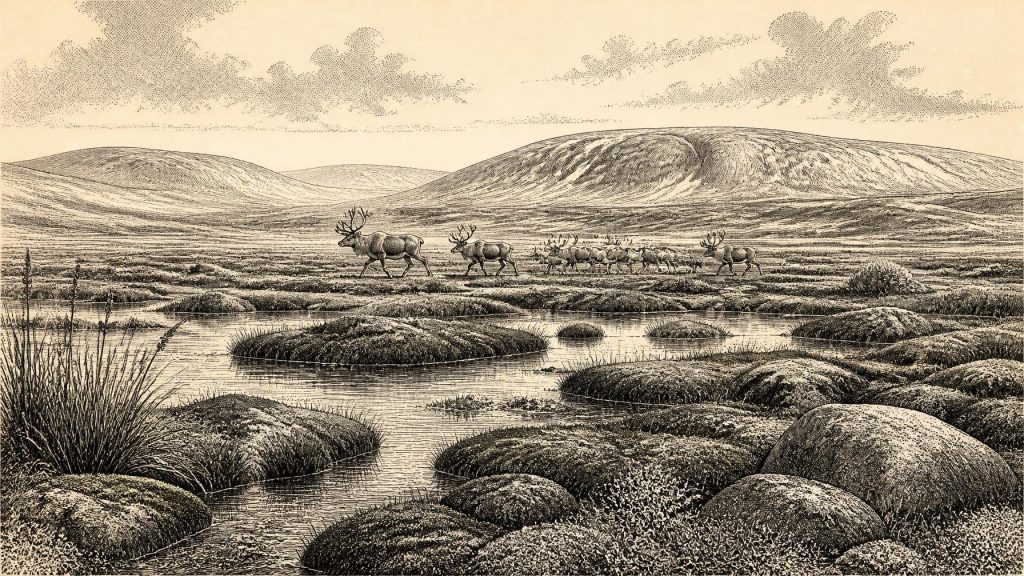
Fossil evidence from Derryvree indicates a severe periglacial setting. Pollen was poorly preserved, but the surviving assemblage was dominated by herbaceous plants. Macrofossils included mosses, while sedges, grasses and other hardy tundra-associated plants are represented in the wider interpretation of the deposit. The image is not of woodland, fields or permanent pasture, but of sparse, open vegetation around freshwater: a landscape shaped by cold, wind, frost and short growing seasons.
That environment should not be simplified into a uniform “mammoth steppe”. Even a treeless Irish landscape contained local variation. Wet hollows, shallow pools, exposed gravel, river margins, snowbeds, sheltered slopes and better-drained ground offered markedly different conditions. A moss-rich freshwater basin in Fermanagh says most clearly what existed in and beside that basin. It supports the wider interpretation of open, cold country, while cautioning against treating the whole island as one identical habitat.
Derryvree also matters because its organic layer survived between glacial deposits. Such survival is unusual. Ice sheets are destructive historians: they scour bedrock, transport sediment and erase earlier land surfaces. The scarcity of sites is therefore not evidence that nothing happened in Ireland. It is a warning that the surviving archive is selective. What has endured is a small and difficult body of evidence from which large claims must not be made.
Animals in a Changing Landscape
County Cork’s Castlepook Cave, also called Mammoth Cave or Doneraile Cave, provides the most striking Irish animal archive for the broader pre-Last Glacial Maximum world. Its old collections include reindeer, woolly mammoth, giant deer, brown bear, wolf, Arctic fox, lemmings and spotted hyaena. Together, those animals demonstrate that Ireland was at times connected ecologically to the colder faunal worlds of Britain and continental north-west Europe. Reindeer and lemmings point towards cold, open habitats; hyaenas and wolves remind us that large carcasses and caves belonged to predators and scavengers as well as to herbivores.
Yet Castlepook must not be turned into a single moment frozen in time. Its bones accumulated through many episodes and through several processes: animals died, predators dragged remains into shelter, water moved material, sediments shifted, and antiquarian excavators recovered bones without the recording methods expected today. Older radiocarbon programmes were pioneering, but later work has shown that some dates obtained before modern ultrafiltration of bone collagen are unreliable. The faunal list is important evidence; exact dates for individual specimens require continuing reassessment.
The cave’s named chambers, including Elephant Hall, evoke a dramatic Ice Age scene, but they do not prove that mammoths stood together with every other recorded species in a single landscape or season. More securely, Castlepook shows that southern Ireland repeatedly supported a richer large-mammal fauna than survives today. It also shows why cave taphonomy matters. A bone in a cave may record hunting, carnivore activity, natural death or later transport; interpretation depends on marks, context and dating rather than spectacle.
The Reindeer Femur Question
A single Castlepook reindeer femur has made this period especially significant. Ruth Carden identified a deep mark on the bone as consistent with cutting by a sharp stone tool during carcass processing. County Cork heritage publications have presented the specimen as evidence of human activity around 30,000 BCE. If that interpretation and its chronology are confirmed by fully published specialist work, it would be potentially the earliest evidence that people handled an animal in Ireland, far earlier than the long-established record of post-glacial hunter-gatherer settlement.
Its potential importance should not obscure its limitations. A modified bone is not a habitation site. No securely associated hearth, stone-tool assemblage, occupation floor, dwelling, burial, human skeleton, ornament or artwork of comparable antiquity has been demonstrated at Castlepook. Nor can one cut or chop-like mark establish whether people killed the reindeer, encountered an already dead animal, removed meat, hide or sinew, or processed the carcass elsewhere before the bone entered the cave. It cannot reveal their number, identity, language, route or length of stay.
The most careful conclusion is therefore modest. Around the broad timeframe represented by 30,778 BCE, Ireland may have been visited by highly mobile Upper Palaeolithic people capable of using stone cutting edges and exploiting large animals. But that remains an interpretation contingent on the human origin and secure dating of the mark. It is not evidence for permanent population, continuous occupation or a settled Irish society.
Society, Power and Belief: What Cannot Be Known
There is no basis at this date for Irish kings, tribes, territories, diplomacy, formal warfare or political institutions. Likewise, no Irish evidence supports claims about religion, ritual, named ancestors, language, social rank, marriage practices or learning. Cave art, elaborate burials, figurines and sophisticated lithic traditions elsewhere in Upper Palaeolithic Europe demonstrate the capacities of contemporary Homo sapiens, but they cannot be imported automatically into Ireland. Continental parallels provide context, not Irish facts.
Conflict is equally beyond the evidence. Predators competed with one another and with any human visitors for carcasses or shelter, but animal bones cannot demonstrate organised human violence. The pressures that can be identified are environmental: intense cold, seasonal scarcity, exposure, uncertain routes across a changing western European landscape, and the expanding threat of ice. In that sense, the principal political force affecting Ireland was not a ruler but climate.
Subsistence Without an Economy
If the reindeer mark is anthropogenic, it provides the narrowest possible insight into subsistence: the use of an animal body. Reindeer could yield meat, marrow, fat, hide, sinew and bone, but the precise purpose of this particular action is unknown. It would be wrong to call this an Irish hunting economy, still less a trade network. There is no evidence for farming, domesticated livestock, crops, pottery, metalwork, exchange routes, boats, fixed houses or managed territory.
Nor can sea crossings be reconstructed from the bone. Lower global sea levels and altered coastlines changed the geography of north-west Europe, but the exact accessibility of Ireland at any given moment depended on regional ice, sea, land and climate conditions. The evidence supports the possibility of movement, not a mapped route or regular connection.
An Island of Fragments
The most important development around this notional year was environmental transition. Derryvree preserves evidence of cold freshwater tundra between phases of glaciation. Castlepook preserves a remarkable, though chronologically complicated, archive of Ice Age animals in southern Ireland. The reindeer femur offers a provocative but still limited possibility of human action. Together they replace the old image of an entirely empty, featureless Ireland with a more demanding one: a changing land of wet hollows, open ground, mobile herds, predators, caves and advancing ice.
That is not enough to write a conventional narrative of settlement or society. It is enough to understand why future excavation, careful zooarchaeology, improved radiocarbon pretreatment and renewed study of museum collections matter so much. At 30,778 BCE, Irish history survives not as an event list but as a contested archive of silt, bone and ice.
Primary Sources
- A Middle Midlandian Freshwater Series at Derryvree, Maguiresbridge, County Fermanagh, Northern Ireland
- Middle Midlandian Interstadial Deposits at Greenagho, Near Belcoo, County Fermanagh, Northern Ireland
- The Irish Quaternary Fauna Project
- New Insights on the Fauna of Ireland's Younger Dryas and Early Holocene from Alice & Gwendoline Cave
- First Evidence of a Late Upper Palaeolithic Human Presence in Ireland
- The IntCal20 Northern Hemisphere Radiocarbon Age Calibration Curve (0–55 cal kBP)
- The IntCal20 Northern Hemisphere Radiocarbon Age Calibration Curve (0–55 cal kBP)
- Palaeoecology: Field Guide No. 16
- Prehistoric Details
- The Archaeological Heritage of County Cork
- Heritage Artefacts of County Cork
- Archaeology Research Excavation Grant 2022: Castlepook Cave, Co Cork
- Castlepook Cave, Co. Cork: Excavation Report 2022
- Occurrence of Mammalia Relicts at Site Castlepook Cave
- Mammoth Cave, County Cork
- Pattern and Timing of Retreat of the Last British-Irish Ice Sheet
- New Age Constraints for the Maximum Extent of the Last British-Irish Ice Sheet (NW Sector)
- British–Irish Ice Sheet and Polar Front History of the Goban Spur, Offshore Southwest Ireland Over the Last 250,000 Years
- Bayesian Modelling the Retreat of the Irish Sea Ice Stream
- Bone Need Not Remain an Elephant in the Room for Radiocarbon Dating
- The “Red Lady” Ages Gracefully: New Ultrafiltration AMS Determinations from Paviland
- Reindeer Bone Found in Cork Cave Shows Human Activity in Ireland 33,000 Years Ago