The Castlepook Hyena Skull30767 BCE
Around 30,767 BCE, Ireland was a climatically unstable Late Pleistocene frontier, not a place with recoverable yearly history or proven human settlement. Castlepook Cave near Doneraile, County Cork, preserves Ireland’s richest pre-Last Glacial Maximum animal archive, including spotted hyaena, mammoth, reindeer, giant deer, bears, wolves and smaller mammals. Its deposits accumulated over long periods and cannot date a single ecosystem or year. Revised radiocarbon evidence places much fauna within MIS 3. Derryvree sediments show cold-climate freshwater habitats elsewhere. A possibly cut-marked reindeer bone suggests human visits, but cannot demonstrate enduring occupation. Environmental change, rather than social history, defines this period.
Dateline
The label 30,767 BCE is a modern chronological convenience, not a recoverable Irish year. It falls roughly 32,700 years before the conventional radiocarbon reference date of 1950, in the Late Pleistocene and broadly within Marine Isotope Stage 3 (MIS 3), an unstable part of the last Ice Age. No calendar, written testimony or archaeological sequence allows events in Ireland to be assigned to this particular twelve-month interval. The responsible history is therefore one of calibrated date ranges, fossil deposits and environmental evidence, rather than named people or year-specific happenings.
That distinction matters especially here. Ireland has no securely demonstrated settlement, hearth, house, burial, tool assemblage or artistic site dating to this point. There were no known polities, rulers, borders, diplomatic relations, religious institutions or traditions that can responsibly be described for the island in 30,767 BCE. The surviving evidence instead shows an intermittently accessible, climatically severe north-western edge of Europe, inhabited at times by Ice-Age animals and potentially visited by people, but repeatedly transformed by ice, water and cold.
An Unstable Ice-Age Island
MIS 3, conventionally spanning approximately 57,000 to 29,000 years ago, was not a single unchanging freeze. Greenland ice cores record abrupt shifts between comparatively milder interstadials and colder stadials, sometimes on timescales far shorter than archaeological dating can resolve. The nominal date considered here lies within this fluctuating climatic world, well before the Last Glacial Maximum, when the Irish Ice Sheet became far more extensive. A Greenland-based climate framework is useful for placing Ireland within the North Atlantic region, but it must not be mistaken for a weather record from any particular Irish valley or cave.
For Ireland, the broad picture is one of a cold, largely treeless landscape with local or regional ice and periglacial ground processes, rather than the wooded island of later prehistory. Lower global sea levels altered the outlines of the coasts and the Irish Sea basin. Exactly when, where and how animals crossed between Ireland, Britain and continental Europe remains a matter of palaeogeographical reconstruction: lowered seas and expanded ice changed routes, but neither a simple, permanent land bridge nor an easy crossing should be assumed. Connectivity was episodic, constrained by sea, ice, terrain and climate.
The island’s later glacial history also warns against overconfidence. Subsequent ice advances eroded older landscapes and reworked or buried deposits. Much potential evidence of open-air activity has therefore been lost, while caves and sediment pockets preserve only uneven fragments. Absence of a settlement site cannot prove that no person ever entered Ireland; equally, the scarcity of evidence cannot be converted into a claim of a settled population.
Castlepook’s Long Bone Archive
The most illuminating Irish evidence comes from Castlepook Cave, also called Mammoth Cave, near Doneraile in north County Cork. Excavated principally in the early twentieth century, its limestone passages yielded more than 2,000 bones. The National Museum of Ireland holds material from these investigations, including a partial skull of the spotted hyaena, Crocuta crocuta. The object gives this article its focus not because it records an event in 30,767 BCE, but because it is a tangible survivor of the ecological world nearest to that notional date.
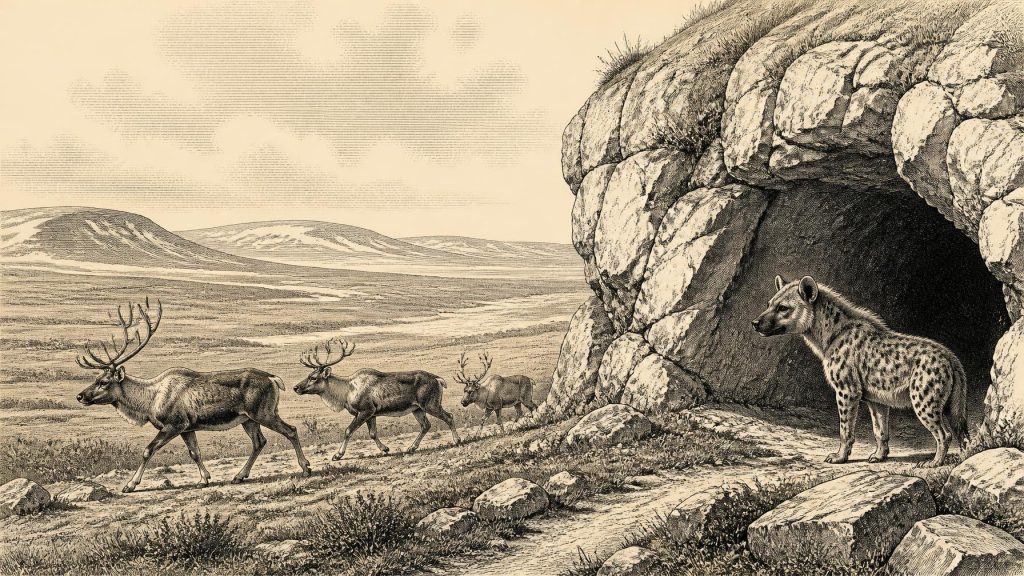
Castlepook is Ireland’s richest known pre-Last Glacial Maximum vertebrate archive. Its assemblage includes woolly mammoth, reindeer, giant deer, brown bear, wolf, fox, hare, lemming and spotted hyaena. These are not the remains of one herd, one season or one moment. They entered the cave, or were brought there, over a long period. Carnivores may have dragged carcass parts into some passages; animals could also have died in or near the cave; early excavators did not record every deposit to modern standards. The cave is consequently a time-averaged archive, not a frozen snapshot of a single ecosystem.
Radiocarbon dating reinforces that caution. Older programmes produced determinations suggesting that parts of the Castlepook fauna were near 30,000 radiocarbon years old. Re-dating using improved bone pretreatment has shown that several earlier results were substantially too young, in some cases by thousands of radiocarbon years. The revised work places important elements of the southern Irish cave fauna more securely within MIS 3 and suggests that giant deer and spotted hyaena may have disappeared locally before the Last Glacial Maximum, around 40,000 calibrated years before present. Individual bones still require individual assessment; no single Castlepook date should be treated as the date of its entire fauna.
The hyaena skull is particularly significant because hyaenas are evidence both of predation and of a functioning scavenger guild. A large predator and bone-accumulator could only persist where prey and usable territory existed. Together with mammoth, reindeer and deer, it indicates that at intervals southern Ireland supported enough open-country biomass for sizeable mammals and their predators. It does not, however, prove that all recorded species lived side by side, nor that every animal was present in County Cork at 30,767 BCE exactly.
Open Ground, Wet Hollows and Caves
The fauna points towards open, cold habitats often compared with tundra-steppe or mammoth-steppe environments elsewhere in Ice-Age Europe. Such terms are useful shorthand, but Ireland’s conditions were probably mosaics rather than a uniform plain. Exposed mineral ground, grasses and herbs, dwarf shrubs, seasonally wet hollows, snow patches and sheltered limestone country could have existed close together. The balance changed repeatedly as temperature, precipitation, ice margins and sea level shifted.
Evidence from Derryvree in County Fermanagh adds an important, though geographically distant, perspective. There, organic sediments sealed beneath later glacial deposits preserve freshwater and wetland plant remains, including mosses, sedges, bogbean and aquatic species. These deposits demonstrate that at some points during the wider middle-to-late Midlandian sequence, northern Ireland contained unfrozen freshwater environments and vegetation capable of supporting a cold-climate biota. Their precise dating and correlation remain difficult, and they cannot furnish a detailed map for County Cork or identify conditions in the exact nominal year. Yet they decisively complicate any image of Ireland as nothing but continuous ice.
At Castlepook, the combination of herbivores, carnivores and cave sediments suggests an exposed landscape in which animals travelled through a changing corridor between western Britain, Ireland and the European mainland. Mammoths and giant deer evoke large-bodied grazers and browsers; reindeer were adapted to cold, open country; lemmings and hares indicate smaller-scale habitats and food webs. Brown bears and wolves show that the fauna was not simply a list of Arctic specialists. The ecological evidence is richer than the human evidence, but it remains patchy and selective: caves favour the preservation of bones, especially those accumulated by carnivores or protected from weathering.
People: Possibility, Not Population
The question of people is the most compelling and the least securely resolved. A reindeer bone from Castlepook has been reported as bearing a mark interpreted as damage made by a sharp stone tool during butchery, and has been associated in public discussion with an age of about 33,000 years ago. If the interpretation and chronology are confirmed, it would indicate a human visit to Ireland during MIS 3 and would be of major importance.
For present purposes, however, the strongest conclusion must remain limited. The bone is not accompanied by a securely associated lithic assemblage, hearth, living floor, human remains or a modernly excavated occupation layer. Castlepook’s old collections and disturbed deposits make contextual arguments difficult. A possible butchery trace can support the possibility of a brief Upper Palaeolithic incursion by a small mobile party; it cannot establish a permanent community, a population size, a migration route, or continuous occupation. Nor does it reveal language, kinship, leadership, ritual or learning.
If people did reach Ireland during a favourable interval, their economy would most plausibly have been highly mobile hunting and scavenging, using portable stone technologies and responding to animal movements. That is an inference from the wider Upper Palaeolithic world and the reported bone modification, not direct evidence for a Castlepook camp. There is no basis for describing farms, trade networks, craft specialisation or regular exchange in Ireland at this date. Nor can the presence of mammoth or hyaena bones be read as proof that people hunted either species.
No Politics, but a Changing Region
Political affairs and diplomacy leave no trace at this depth of Irish time because no political communities are archaeologically demonstrable. Conflict is likewise unrecorded: predators competed for prey, and carnivore tooth marks or broken bones may document feeding, but they are not evidence of human warfare. Religion and culture cannot be reconstructed from the known Irish material. Caves sometimes held special significance for later societies, yet there is no sound basis for assigning ceremony or symbolism to Castlepook’s MIS 3 fauna.
Regional change, by contrast, is central. Ireland occupied a shifting ecological frontier. Climatic oscillations repeatedly altered vegetation, ice extent, sea passages and animal access. Faunas colonised during some intervals, disappeared during others, and their fragmentary remains survived only where caves or sediment basins protected them from later erosion. This was a world in which environmental change was more historically visible than social continuity.
What Can Be Said Responsibly
Around the modern label of 30,767 BCE, Ireland should be understood as part of the Late Pleistocene North Atlantic margin: cold, variable, mostly open in its non-glaciated areas, and linked ecologically—though not necessarily continuously by dry land—to neighbouring regions. Castlepook Cave near Doneraile preserves the strongest evidence for its animal life, including the skull of a spotted hyaena and remains of mammoth, reindeer and other species. Derryvree preserves complementary evidence that freshwater and wetland habitats existed during parts of the wider glacial sequence.
What cannot responsibly be claimed is equally important. No exact Irish event occurred “in” this year as far as the evidence can show. No named inhabitants, settlement, kingdom, battle, religion or economy can be recovered. A reported cut-marked reindeer bone makes human presence possible and potentially transformative for Irish prehistory, but it remains far short of proof of enduring occupation. The proper history of this date is therefore not a story of a nation awaiting its chronicles, but of an Ice-Age landscape whose caves, bones, plants and sediments preserve rare, hard-won glimpses of life before the ice advanced again.
Primary Sources
- Castlepook Cave, County Cork: County Geological Site Report
- A reconsideration of the radiocarbon dating of the Marine Isotope Stage 3 fauna from southern Ireland
- The Irish Quaternary Fauna Project
- Spotted Hyena Skull
- Guide to the National Museum of Ireland – Natural History
- Late Pleistocene chronostratigraphy and ice sheet limits, southern Ireland
- Dimensions and chronology of the last ice sheet in Western Ireland
- Timing and pace of ice-sheet withdrawal across the marine–terrestrial transition west of Ireland during the last glaciation
- Last Glacial Maximum cirque glaciation in Ireland and implications for the extent of the Irish Ice Sheet
- The problem of a late quaternary landbridge between Britain and Ireland
- Deglaciation, Earth crustal behaviour and sea-level changes in the determination of insularity: A perspective from Ireland
- Ireland: Submerged Prehistoric Sites and Landscapes
- A stratigraphic framework for abrupt climatic changes during the Last Glacial period based on three synchronized Greenland ice-core records: refining and extending the INTIMATE event stratigraphy
- IntCal20 Northern Hemisphere radiocarbon age calibration curve (0–55 cal kBP)
- The Exploration of Castlepook Cave, County Cork, Being the Third Report from the Committee Appointed to Explore Irish Caves
- Pleistocene vertebrates in the British Isles
- Occurrence of mammalia relicts at site Castlepook Cave
- New insights on the fauna of Ireland’s Younger Dryas and Early Holocene from Alice & Gwendoline Cave
- Archaeological excavations at Castlepook Cave, Co. Cork, 2022
- Advances in Irish Quaternary Studies
- Episodic speleothem deposition tracks the terrestrial impact of millennial-scale last glacial climate variability in SW Ireland
- Proceedings: Postglacial Colonisation Conference