The Castlepook Faunal Mosaic30768 BCE
Circa 30,768 BCE, Ireland formed part of an unstable late Pleistocene environment, rather than a datable historical moment. Expanding ice, fluctuating climate, altered coastlines and open tundra created varied, poorly preserved habitats. Castlepook Cave in County Cork contains remains of mammoth, reindeer, giant deer, carnivores and other cold-stage animals, accumulated over separate periods, often through scavenging and natural processes. A marked reindeer femur may indicate stone-tool butchery and potentially Ireland’s earliest human activity, but proves neither settlement nor population. Derryvree deposits in Fermanagh demonstrate tundra wetland between glacial episodes. Evidence supports ecological complexity, but not claims about society or culture.
Dateline
Modern calendar-year precision is not available for Ireland at 30,768 BCE. The label is a retrospective convenience, roughly equivalent to 32.7 thousand calendar years before the archaeological reference year of 1950, not a date that anyone then living could have recorded. No Irish settlement, journey, conflict or individual can responsibly be assigned to this particular year. The evidence consists instead of radiocarbon determinations with margins of error, calibrated ranges, cave deposits, animal bones, buried sediments and the traces left by ice. Together they illuminate an Ireland within the later part of the Pleistocene, not an episode in a historical chronicle.
At this depth in time, the central question is not what occurred in one year but what conditions made life, animal movement and perhaps occasional human visits possible. Ireland was part of north-western Europe’s changing Ice Age world. Its familiar modern landscape of wooded fields, towns and enclosed coasts did not exist. Climate fluctuated sharply over centuries and millennia; ice masses expanded and retreated; vegetation responded; and animal populations entered, disappeared and returned. The surviving record is sparse, regional and often disturbed, but it is far from empty.
A Date Within a Changing Ice Age
Thirty millennia before the present, Ireland lay in the closing part of Marine Isotope Stage 3, the long, unstable cold interval preceding the full Last Glacial Maximum. It is tempting to picture a simple march towards an island buried beneath ice, but the science describes a more uneven process. Ice-sheet growth, sea level, ocean circulation and climate did not change everywhere at the same pace. Recent work on the British–Irish Ice Sheet stresses that its extent before and around 30,000 years ago remains harder to reconstruct than its later retreat. Major expansion was under way, yet local conditions could differ markedly across Ireland.
That uncertainty is important. Around 30,768 BCE, no map can reliably identify the exact edge of ice, the temperature of a particular Irish valley, or the route of a herd in a given season. The island may have contained cold, open and habitable ground in some areas while ice, persistent snowfields or harsh periglacial conditions dominated others. Later glaciation also removed or rearranged much evidence. The archaeological silence of many places therefore cannot demonstrate that neither animals nor people had ever reached them.
Radiocarbon dating brings its own caution. A result expressed in radiocarbon years BP is not a calendar date: atmospheric carbon levels changed through time, so dates must be calibrated against independently dated records. The older the sample, the broader and sometimes more complicated the calendar range can be. A date from a bone establishes the approximate time at which that animal died; it does not automatically date a mark on its surface, identify where it was killed, or prove a prolonged human presence. These distinctions matter especially in caves, where sediment, water, scavengers and earlier excavators can mix material from different periods.
Castlepook’s Deep Archive
The most important Irish evidence relevant to this broad era comes from Castlepook Cave, also known as Mammoth Cave, near Doneraile in north County Cork. Its limestone passages have yielded a remarkable Pleistocene fauna. The collection includes reindeer, woolly mammoth, giant deer, brown bear, wolf, Arctic fox, hare, lemmings and spotted hyaena. These animals were not necessarily contemporaries in one living landscape, nor were they recovered from a single secure layer. They represent repeated episodes spread across a substantial span of the Late Pleistocene. Yet collectively they show that Ireland supported a far richer cold-stage animal community than the modern island.
The cave was not a village. It was a natural feature that could serve at different times as a carnivore den, a shelter, a trap, a drainage route and a place where bones accumulated after transport by animals or water. Spotted hyaena remains are particularly significant. Their presence, together with gnawed and broken bones, indicates predation and scavenging rather than a straightforward human hunting camp. Older excavations removed large quantities of material before modern recording standards existed. This makes Castlepook scientifically precious but difficult to interpret: its fossils are evidence of changing ecological communities, not a neatly preserved snapshot.
Some directly dated Castlepook remains belong to the period before the Last Glacial Maximum, while re-dating has shown that several earlier radiocarbon assessments were too young. The practical result is a warning against using the cave’s fauna as if every specimen belonged to one narrow horizon. Woolly mammoth bone, for example, documents the animal’s occurrence in Ireland during the wider cold stage; it does not permit the claim that mammoths stood outside Castlepook in 30,768 BCE. Likewise, reindeer establish the availability of suitable open-country habitat and animal movement, but not the exact size or permanence of a herd.
The Reindeer Femur Question
One Castlepook find has transformed discussion of Ireland’s earliest possible human history: a reindeer femur fragment bearing a deep surface mark. Zooarchaeological examination has interpreted the mark as consistent with cutting or chopping by a sharp stone tool during the processing of a fresh carcass. The bone has been reported as about 33,000 years old, and County Cork heritage interpretation places it broadly around 31,000 BCE. If the modification is confirmed as human-made, it would represent extraordinarily early evidence for human activity in Ireland, long before the better-established post-glacial record.
Its importance should not be diluted, but neither should its limitations. The femur does not come from a modern excavation of an intact occupation surface. No associated hearth, dwelling, stone-tool assemblage, burial, food-preparation floor or repeated camp of comparable age has yet been identified in Ireland. The mark may indicate that one or more people butchered or otherwise processed a reindeer; it cannot establish whether they lived locally, arrived seasonally, crossed only once, or took the animal into the cave. It is evidence for a possible act, not proof of a population.
The responsible description of society at this time is therefore necessarily modest. If people were present, they would have belonged to mobile Upper Palaeolithic hunter-gatherer communities operating within a wider European landscape, where knowledge of game, weather, stone resources and routes was essential. That is an inference from the archaeological context of contemporary north-west Europe, not a direct description of a named Irish group. There is no evidence from Ireland itself for political institutions, territorial rulers, diplomacy, formal trade networks, ritual monuments, artistic traditions or systems of learning at this date. Absence of evidence cannot settle every question, but it firmly rules out detailed stories about tribes, chiefs or settlements.
Open Ground and Buried Wetlands
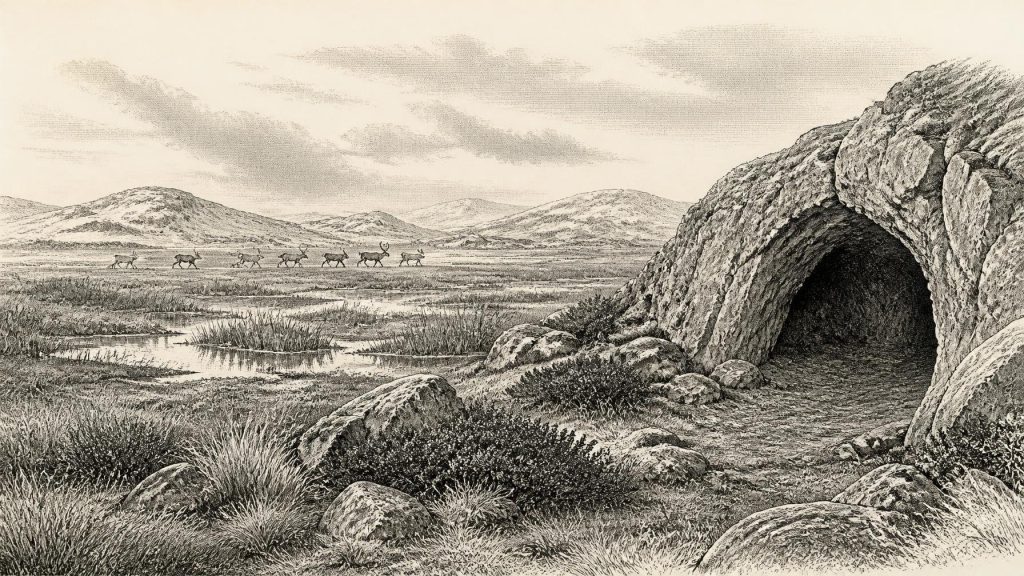
Environmental evidence from County Fermanagh provides a useful, though not year-for-year, comparison. At Derryvree near Maguiresbridge, roadworks exposed organic silts and fine sands trapped between two glacial tills within a drumlin. The classic investigation obtained a radiocarbon determination of 30,500 radiocarbon years BP, with a substantial uncertainty, and identified flora and fauna characteristic of open tundra under periglacial conditions. The deposit records a freshwater environment with vegetation able to survive severe cold, later overridden or enclosed by renewed glacial activity.
Derryvree does not supply a weather report for Castlepook, and its radiocarbon age should not be converted casually into the calendar year 30,768 BCE. Its value is broader. It demonstrates that, during the Middle Midlandian part of the last glaciation, at least one Fermanagh locality supported open wetland and tundra vegetation between episodes of ice deposition. Ireland was thus environmentally varied and dynamic. Frost action, sparse plant cover, shallow waters, sedges and cold-adapted communities could coexist with regions where ice was advancing or where the evidence has since been erased.
This open country had an economy of energy rather than agriculture. There were no farms, crops, livestock, fields, roads or markets. Animals found food in grasses, herbs, mosses, lichens and wetland vegetation; predators followed prey; scavengers exploited carcasses. For people, if the Castlepook mark proves anthropogenic, reindeer would have offered meat, fat, hide, sinew, bone and antler. Yet no Irish evidence from this period demonstrates how such materials were shared, stored, exchanged or fashioned. “Trade” is too strong a word for what can be shown. Mobility, rather than commerce, is the more defensible framework.
Island, Frontier and Evidence
Ireland’s position on the western margin of Europe shaped both opportunity and uncertainty. Lower global sea levels altered coastlines, while ice and shifting marine channels influenced possible connections with Britain and the continent. But a lowered sea level did not automatically create an easy land route, and there is no securely dated Irish trail of camps to map a migration. Any people reaching Ireland would have negotiated a changing landscape in which water barriers, exposed shelves, rivers, ice fronts and animal movements mattered. The Castlepook evidence makes such contact plausible; it does not reveal the route.
There was no “Ireland” in the political or cultural sense later attached to the island. There were landscapes, animal populations and perhaps small groups whose movements left little durable trace. Religion, language, kinship and stories may have existed wherever people existed, but none can be recovered specifically from Irish evidence of this age. A cave bone cannot tell us what its handler believed, spoke or remembered. The archaeological discipline is to preserve that boundary between evidence and attractive imagination.
The significance of 30,768 BCE lies precisely in this restraint. Ireland around this notional year was neither a historical blank nor a knowable society. Castlepook preserves a complex faunal mosaic from a cold, open world; Derryvree preserves buried evidence of tundra wetland and periglacial life; ice-sheet research explains why the map was changing and why so much has vanished. The marked reindeer femur may hold the earliest known sign of people on the island. For now, it is best understood as a provocative trace at the edge of the record: enough to require further investigation, not enough to manufacture a lost Irish prehistory.
Primary Sources
- A Middle Midlandian Freshwater Series at Derryvree, Maguiresbridge, County Fermanagh, Northern Ireland
- The Irish Quaternary Fauna Project
- A Reconsideration of the Radiocarbon Dating of the Marine Isotope Stage 3 Fauna from Southern Ireland
- Heritage Artefacts of County Cork
- The Timing and Magnitude of the British–Irish Ice Sheet Between Marine Isotope Stages 5d and 2: Implications for Glacio-Isostatic Adjustment, High Relative Sea Levels and ‘Giant Erratic’ Emplacement
- Pattern and Timing of Retreat of the Last British-Irish Ice Sheet
- Growth and Retreat of the Last British–Irish Ice Sheet, 31,000 to 15,000 Years Ago: the BRITICE-CHRONO Reconstruction
- Timing, Pace and Controls on Ice Sheet Retreat: an Introduction to the BRITICE-CHRONO Transect Reconstructions of the British-Irish Ice Sheet
- Trimlines, Blockfields and the Vertical Extent of the Last Ice Sheet in Southern Ireland
- Maximum Extent and Readvance Dynamics of the Irish Sea Ice Stream and Irish Sea Glacier Since the Last Glacial Maximum
- New Data for the Last Glacial Maximum in Great Britain and Ireland
- The IntCal20 Northern Hemisphere Radiocarbon Age Calibration Curve (0–55 cal kBP)
- IntCal
- On the Cave of Castlepook, Near Doneraile, Co. Cork
- New Insights on the Fauna of Ireland’s Younger Dryas and Early Holocene from Alice & Gwendoline Cave
- Irish Quaternary Association Field Guide 16
- Mammoth Cave, Castlepook, County Cork
- Spotted Hyena Skull
- Geology Collections, National Museum of Ireland
- Castlepook Cave, Co. Cork, 2022 Excavation Report
- Reconstruction and 36Cl Based Geochronology of the Deglaciation of Central Ireland
- The Late Quaternary History of East-Central Ireland