Castlepook’s Mammoth Corridor30656 BCE
Around 30,656 BCE, Ireland was a climatically unstable Late Pleistocene landscape rather than a recorded society. Derryvree, County Fermanagh, preserves freshwater sediments between glacial tills, indicating locally ice-free, treeless tundra wetlands with grasses, sedges, mosses, juniper and cold-water plants during a broad MIS 3 interval. Castlepook Cave, County Cork, yielded disturbed remains of mammoth, reindeer, giant deer, wolves, foxes, bear and spotted hyaena, demonstrating episodic animal occupation. A marked reindeer femur may indicate stone-tool butchery, but lacks supporting occupation evidence. No political, religious, economic or settled human life can be securely reconstructed; evidence instead reveals fragmented environments, fauna and uncertainty.
Dateline
The label 30,656 BCE is useful only as a modern point of reference. No person in Ireland recorded a year, ruler, battle or seasonal occurrence at this depth of time, and archaeology cannot identify an event that happened in that particular calendar year. In the conventional archaeological reckoning, it falls about 32,605 years before AD 1950, within the Late Pleistocene and broadly within Marine Isotope Stage 3, a climatically unstable part of the last Ice Age. The responsible history of Ireland at this point is therefore a history of deposits, bones, pollen, insects, ice and uncertainty—not a year-by-year political narrative.
The closest illuminating Irish evidence comes from two very different archives. At Derryvree, near Maguiresbridge in County Fermanagh, freshwater sediments survived between two layers of glacial till. At Castlepook Cave, near Doneraile in north County Cork, antiquarian excavations recovered a remarkable, but disturbed, collection of animal remains. Together they show that parts of Ireland could support cold-adapted plants and mammals during intervals of the Late Pleistocene. They do not show that the island was uniformly ice-free, permanently inhabited, or politically organised in any recoverable sense.
A Date With Broad Edges
Derryvree supplies the best environmental window close to this notional date. Road works in 1969 cut through a drumlin and exposed silts and fine sands containing organic material between two distinct tills. The published radiocarbon determination, Birm-166, was 30,500 radiocarbon years before present, with a substantial laboratory uncertainty of +1,170 and −1,030 years. “Before present” means before AD 1950, and a radiocarbon age is not itself a calendar age. Changes in atmospheric carbon-14 mean that it must be calibrated, while the age range becomes broader rather than magically precise.
Frequently cited calibration of the Derryvree determination places the deposit broadly around 36,900–31,700 calibrated years BP, or approximately 34,950–29,750 BCE. The modern label 30,656 BCE lies within that wide interval, but it cannot be attached to a particular water level, plant, animal or generation at the site. More recent calibration curves refine the scientific framework, yet they do not convert a single conventional measurement into an annual diary. The proper conclusion is modest: Derryvree documents an ice-free freshwater environment in part of Fermanagh during a broad late-MIS 3 interval relevant to this date.
Water Between the Tills
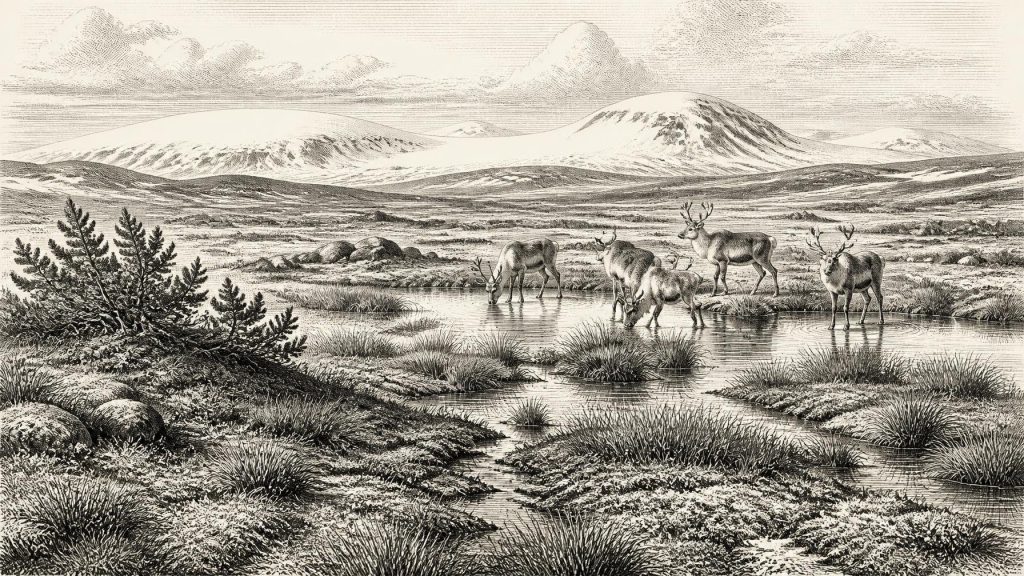
The Derryvree material is especially valuable because its biological remains were sealed below later ice-borne sediment. Pollen, plant macrofossils, mosses and insect evidence pointed to a treeless, open tundra or muskeg landscape, with shallow pools, wet ground and plant-rich margins. Grasses, sedges, herbs and juniper formed important elements of the reconstructed vegetation. Mosses flourished in wetter places. The freshwater setting included plants associated with cold, nutrient-rich pools, among them bogbean and water-milfoil recorded from the deposit.
This was not a modern Irish bog transplanted into the past. It was a periglacial mosaic: exposed ground, seasonally severe cold, standing water, sedge and moss vegetation, and little or no tree cover. Winters were harsh. The exact temperature, precipitation and snow cover cannot be read directly from one layer of silt, but the combined flora and insect fauna support an interpretation of open, cold conditions. Sparse vegetation on drier ground would have left soil vulnerable to frost action and wind, while wet hollows could remain surprisingly productive during the growing season.
Derryvree also warns against easy maps of an entirely frozen or entirely green Ireland. The sediments show that an ice-free local landscape existed before the later till was laid down. They do not demonstrate that every county was ice-free at the same time. Ice-sheet margins advanced and retreated, local glaciers and larger ice masses responded unevenly, and later ice could remove older surfaces altogether. Much of the evidence from this period has therefore been eroded, redeposited, drowned by later sea-level change, or hidden beneath younger deposits.
Castlepook’s Animal World
Far to the south, Castlepook Cave preserves Ireland’s most important assemblage for the pre-Last Glacial Maximum mammal world. The cave’s finds include woolly mammoth, reindeer, giant deer, wolf, fox, Arctic fox, bear and spotted hyaena. Revised radiocarbon work has strengthened the case that several elements of the southern Irish fauna belonged to MIS 3, rather than to a much later phase. In particular, the updated dates indicate that giant deer and spotted hyaena may have disappeared locally before the Last Glacial Maximum.
The list should not be turned into a single illustrated scene in which every species stood together on one afternoon. Cave deposits accumulate over time, and Castlepook’s deposits were disturbed by natural processes and by early twentieth-century excavation. A bone proves that an animal, or part of one, reached the cave; it does not establish where the animal lived, how abundant it was, or the exact date on which it died. Nevertheless, the assemblage securely changes the scale of the Irish story. Ireland was not an empty, featureless fringe of the Ice Age world. At favourable moments it was reached by substantial herbivores and formidable carnivores.
Woolly mammoth and reindeer are consistent with a cold, open setting containing grassland, herb-rich ground and seasonal movement routes. Spotted hyaenas are equally significant. Their presence strongly suggests carnivore use of the cave and helps explain why bones may have been dragged in, chewed, broken or scattered. Castlepook was not automatically a human shelter simply because it is a cave. It was part of an animal landscape in which predators, scavengers, deaths, water movement and sediment accumulation all shaped what survives for archaeologists.
The Reindeer Femur Question
A single reindeer femur from Castlepook has made this period central to the debate over Ireland’s earliest human presence. The bone bears a deep linear mark interpreted by palaeozoologist Ruth Carden and presented in County Cork heritage material as a cut or chop made by a sharp stone tool during the butchery of fresh bone. That material places the specimen broadly at about 31,000 BC. If the interpretation is sustained, it is potentially the earliest evidence that people handled animal remains in Ireland, vastly older than the well-established post-glacial record.
Its importance requires unusual caution. The cave did not yield a securely sealed Palaeolithic occupation floor alongside this bone. There is no associated stone-tool assemblage, hearth, built shelter, burial, repeated butchered bone concentration or human DNA that can identify a resident group. A radiocarbon determination dates the animal bone, not the instant at which a surface mark was made. Moreover, distinguishing a stone-tool cut from carnivore damage, sediment abrasion or excavation damage is a specialist taphonomic judgement. The femur is best described as serious but limited proposed evidence of human action, not proof of a settled Irish population.
If people did reach Ireland in this broad period, the most that can responsibly be inferred is a brief presence by highly mobile Upper Palaeolithic hunter-gatherers, perhaps linked to the pursuit or processing of reindeer. Their route remains unknown. Lower sea levels changed coastlines, but neither the Derryvree deposits nor the Castlepook bone establishes a particular land bridge, crossing point or season of travel. Nor can Irish evidence identify their language, ancestry, social identity, technology beyond the possible sharp tool, or relation to groups documented elsewhere in Europe.
No Kingdoms, No Trade Record
There were no recoverable political affairs in Ireland at this date: no named communities, chiefs, territorial boundaries, diplomacy or warfare. Absence of evidence is not proof that humans never entered the island, but it is decisive against inventing an Irish society from later prehistoric models. The same restraint applies to religion and learning. No shrine, grave, image, ritual deposit, inscription or teaching tradition can be assigned to this period in Ireland. Caves should not be called sacred places merely because later societies often treated caves as meaningful.
There is likewise no evidence for an Irish economy of farming, herding, pottery production, metalwork, long-distance exchange or maritime trade. The island’s documented economic potential was ecological rather than institutional: freshwater, wetland plants and roaming large mammals. If the Castlepook modification was human-made, it indicates animal processing, not a trade network. The strongest lesson from the evidence is that survival in a cold and changing landscape depended on mobility, seasonality and access to living resources—yet even this is an inference from environment and wider European comparison, not a fully excavated Irish camp.
An Island of Fragments
For 30,656 BCE, Ireland is best understood as a changing north-western landscape at the edge of the European Ice Age world. Derryvree offers direct evidence of cold open wetlands and freshwater habitats; Castlepook records a striking animal community and a tantalising possible trace of human butchery. Both archives are exceptional because later glaciation and erosion erased so much else. Their value lies not in supplying a false certainty, but in showing how much can be learned from a few protected layers of silt and bone—and how firmly the limits of that knowledge must be kept in view.
Primary Sources
- A Middle Midlandian Freshwater Series at Derryvree, Maguiresbridge, County Fermanagh, Northern Ireland
- A Middle Midlandian Freshwater Series at Derryvree, Maguiresbridge, County Fermanagh, Northern Ireland
- Palaeoecology
- Figure 6.— The Subdivision of the Quaternary Period in Ireland
- Trimlines, Blockfields and the Vertical Extent of the Last Ice Sheet in Southern Ireland
- A Reconsideration of the Radiocarbon Dating of the Marine Isotope Stage 3 Fauna From Southern Ireland
- The Irish Quaternary Fauna Project
- Occurrence of Mammalia Relicts at Site Castlepook Cave
- New Insights on the Fauna of Ireland's Younger Dryas and Early Holocene From Alice & Gwendoline Cave
- Growth and Retreat of the Last British–Irish Ice Sheet, 31,000 to 15,000 Years Ago: the BRITICE-CHRONO Reconstruction
- Pattern, Style and Timing of British–Irish Ice Sheet Advance and Retreat Over the Last 45,000 Years: Evidence From NW Scotland and the Adjacent Continental Shelf
- Maximum Extent and Readvance Dynamics of the Irish Sea Ice Stream and Irish Sea Glacier Since the Last Glacial Maximum
- Growth, Dynamics and Deglaciation of the Last British-Irish Ice Sheet: the Deep-Sea Ice-Rafted Detritus Record
- Character of Advance and Retreat of the Southwest Sector of the British-Irish Ice Sheet During the Last Glaciation
- The IntCal20 Northern Hemisphere Radiocarbon Age Calibration Curve (0–55 cal kBP)
- IntCal20 Northern Hemisphere Radiocarbon Age Calibration Curve (0-55 kcal BP)
- Prehistoric Details
- Heritage Artefacts of County Cork
- 2022:564 – Castlepook Cave, Castlepook South, Cork
- Mammoth Cave
- Ireland Through Geological Time
- Geology of Ireland
- Introduction to the Late Quaternary and Holocene of Northern Ireland
- Pleistocene Vertebrates in the British Isles