Derryvree’s Silent Waters30657 BCE
At 30,657 BCE, Ireland’s history is environmental rather than human, as no secure evidence demonstrates settlement, society or activity. During the unstable Late Pleistocene, ice margins, low sea levels and periglacial landscapes changed repeatedly. Derryvree, County Fermanagh, preserves freshwater silts between glacial tills, dated to this period, showing an interval of pools, wetlands, sedges, mosses and cold-adapted open vegetation. Its deposits reveal local conditions, not an island-wide scene. Cave remains indicate that varied cold-stage fauna, including mammoth, reindeer, bears and predators, reached Ireland intermittently. Later glaciation destroyed much evidence, making Derryvree a crucial record of changing habitats before human occupation.

Dateline
The label 30,657 BCE is a modern way of locating a point in deep time, not a year that anyone in Ireland recorded or could now be recovered from an archaeological layer. It is roughly 32,600 calendar years before AD 1950, the conventional reference point for ‘before present’ dates. At that depth, radiocarbon determinations carry sizeable uncertainties and their calibrated equivalents commonly span centuries or millennia. No settlement, burial, hearth, named people, political event or annual sequence can be assigned to this particular year. The most responsible history is therefore of Ireland during a broad Late Pleistocene interval, rather than a narrative of events in one calendar year.
That interval belongs broadly to Marine Isotope Stage 3, a long and climatically unstable part of the last Ice Age. Ireland was not yet in the better documented Last Glacial Maximum, whose fullest British–Irish ice-sheet development came later, principally after about 27,000 years ago. Yet the island and its surrounding seas were already part of a highly changeable glacial world. Ice margins advanced and retreated; sea level was far below modern levels; exposed land, shallow seas, glaciers and periglacial ground formed a shifting north-west European frontier. The evidence is fragmentary, but it is not empty.
A Calendar Year Without a Chronicle
For this period, archaeology cannot provide politics, diplomacy or conflict in the usual historical sense. There are no known Irish communities, leaders, territories, monuments or material signs of collective institutions that can be placed at 30,657 BCE. Nor is there evidence from which to reconstruct religion, language, kinship, artistic practice, trade or an economy of human production. Such absences should not be turned into a story of certainty: later ice repeatedly eroded, redeposited and buried older landscapes, making survival of campsites exceptionally unlikely. But absence is still important evidence. It means that later Mesolithic ways of life—houses, microlithic tools, fishing places and repeated occupation—must not be projected back more than twenty millennia.
The National Museum of Ireland accordingly treats the Mesolithic, beginning around 8000 BCE, as the first period for which human settlement is securely demonstrated. A possible late Upper Palaeolithic human trace, a cut-marked brown-bear kneecap from Alice and Gwendoline Cave in County Clare, is dramatically later, dating to about 10,800–10,500 BCE. It neither proves nor suggests a settled human population in Ireland around 30,657 BCE. For the present date, an Irish human presence remains unproven.
Fresh Water Between the Tills
The closest and most informative Irish environmental archive is at Derryvree, near Maguiresbridge in County Fermanagh. Roadworks in 1969 cut through a drumlin and revealed a remarkable sequence: a thick lower till, freshwater silts and fine sands rich in organic remains, and a second thick till above them. Till is the unsorted sediment deposited directly by glacier ice. The basic order is therefore secure. Ice had occupied the locality; later, an interval occurred in which standing or slow-moving fresh water and wetland life could persist; subsequently, glacier ice again covered or overran the area and sealed the deposit.
Organic material from the freshwater sediments produced the conventional radiocarbon determination Birm-166: 30,500 radiocarbon years before present, with an uncertainty of approximately +1,170 and −1,030 years. A radiocarbon age is not a calendar age. Atmospheric carbon-14 varied greatly during the Ice Age, so results must be calibrated against independently dated records. Modern calibration does not turn Birm-166 into a precise point: it gives a wide calendar range, broadly within the later part of the 37,000–32,000 calibrated-years-before-present interval. The nominal date 30,657 BCE lies within the broad chronological horizon that Derryvree can illuminate, but no individual sedge, insect, pool or season there can be assigned to it.
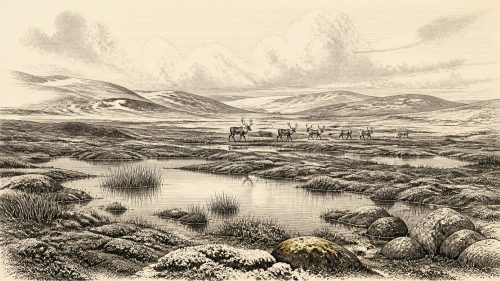
This distinction matters. Derryvree is direct evidence for local freshwater conditions between phases of glaciation, not a map of the entire island at one moment. It demonstrates that at least part of Fermanagh supported water, sediment accumulation and a cold-adapted biological community during this prolonged interval. The wider image of an open, windswept periglacial landscape is an interpretation supported by the fossil assemblage and by comparison with related deposits, rather than an observation made at a particular date.
A Treeless Wetland Landscape
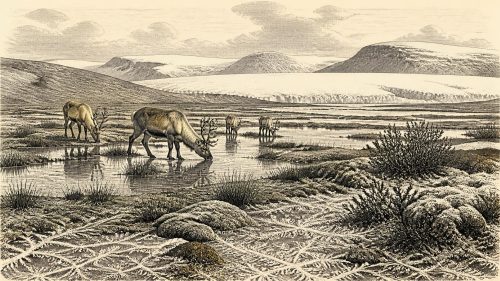
Plant macrofossils, pollen and insect evidence from Derryvree make the buried basin unusually vivid. The recorded flora includes mosses and sedges, mountain-avens, dwarf willow, lesser clubmoss, bogbean and water-milfoil. Some grew in, beside or near shallow fresh water; others are characteristic of cold, open ground. Together they indicate a mosaic rather than a uniform white wilderness: pools and wet margins, saturated mossy ground, patches of low vegetation and exposed, frost-affected terrain. Trees were absent locally or extremely scarce. This was not the later wooded Ireland familiar from the early Holocene.
Seasonality must have been demanding. Long cold periods, repeated freezing and thawing, short growing seasons and strong winds would have shaped water levels and vegetation. The fine sediments preserve a quiet depositional setting, but the enclosing tills remind us that this quiet was temporary on geological timescales. What may have looked like a modest wetland in one sheltered Fermanagh basin existed within a region where ice could return, reshape drainage and erase much of the evidence of what had come before.
At the island scale, the precise outline and thickness of ice remain debated. Marine deposits on Ireland’s western coast indicate substantial glacial loading during portions of the period between roughly 40,000 and 19,000 calibrated years ago. More recent British–Irish Ice Sheet reconstructions begin around 31,000 years ago precisely because earlier constraints are sparse and often carry broad errors. The best conclusion for 30,657 BCE is not that Ireland was either wholly ice-covered or wholly open. Rather, it was a region of marked local variation and rapid long-term change, in which ice-free or lightly glaciated environments could coexist with expanding ice centres and ice-influenced coasts.
Animals in a Fragmentary Record
Irish cave deposits provide another window, although one that must be handled carefully. Castlepook Cave, near Doneraile in north Cork, is the richest known Irish site for Pleistocene vertebrate remains. Its assemblage has included woolly mammoth, reindeer, giant deer, brown bear, wolf, fox, Arctic fox, mountain hare, lemmings and spotted hyaena. Such animals show that Ireland was connected, at least intermittently and ecologically, to the wider cold-stage fauna of north-west Europe. It was not a land devoid of large mammals.
Yet Castlepook is not a calendar-year wildlife census. Bones accumulated over long periods, water and carnivores moved some material, and much early excavation took place before modern recording methods. Species in a cave list need not have lived side by side, and a mammoth bone in Cork does not prove mammoths were present beside the Derryvree wetland in Fermanagh in 30,657 BCE. The sound inference is more limited but significant: during the wider Middle and Late Pleistocene, Ireland could receive and support a varied cold-stage fauna, including large herbivores and their predators or scavengers.
This animal evidence gives an indirect sense of ecological relationships. Reindeer and mammoth imply broad feeding ranges; hares, Arctic foxes and lemmings reinforce the image of cold climates and open habitats. Spotted hyaena remains show that carnivores, as well as herbivores, reached Ireland. But the routes, timing and permanence of each population are unresolved. Lower global sea level exposed more land around the Irish and British coasts, but it did not automatically create an easy or continuous land bridge to Ireland. Changing channels, coasts, ice and water crossings made movement contingent.
No Known Society, No Known Exchange
It is tempting to imagine people following those animal herds, as Upper Palaeolithic groups did elsewhere in Europe. That would be speculation in an Irish context. There are no secure stone-tool industries, butchered assemblages, dwelling sites, graves or artworks from Ireland at this date. The much-discussed incisions on a reindeer bone from Castlepook have not established a firm human presence: the circumstances of recovery and interpretation do not meet the standard needed to create a 30,000-year-old Irish social history.
Accordingly, there is no evidence for farming, exchange networks, seafaring, territorial conflict or diplomacy. There is no basis for identifying ritual places or systems of belief. The economic history of this moment is environmental rather than human: freshwater plants produced seasonal growth; herbivores browsed and grazed; predators and scavengers used carcasses and shelter; ice and meltwater redistributed sediment. These processes made the conditions under which people might later have travelled or lived, but they are not evidence that people did so then.
The Importance of What Survived
Derryvree’s importance lies in its restraint. A small freshwater deposit between glacial tills preserves evidence of life during an otherwise elusive Irish Ice-Age interval. It shows that Ireland’s past was not a simple sequence of total ice cover followed by sudden human colonisation. There were shifting habitats, open-water refuges or local basins, cold-adapted vegetation and animal movements across a changing region. At the same time, the sequence warns against false precision. It cannot reveal the weather on a day in 30,657 BCE, the identity of a herd, or the actions of a human group.
For Ireland at this date, the most meaningful historical development was environmental instability itself. The freshwater world at Derryvree was created in the interval between glacial episodes and preserved because later ice buried it. Its silts, seeds and insects are not a forgotten Irish village. They are rarer and, for this deep past, more reliable: a record of the living landscape from which all later Irish history would eventually emerge.
Primary Sources
- A Middle Midlandian Freshwater Series at Derryvree, Maguiresbridge, County Fermanagh, Northern Ireland
- Radiocarbon Constraints on the History of the Western Irish Ice Sheet Prior to the Last Glacial Maximum
- Growth and Retreat of the Last British–Irish Ice Sheet, 31,000 to 15,000 Years Ago: the BRITICE-CHRONO Reconstruction
- Timing and Pace of Ice-Sheet Withdrawal Across the Marine–Terrestrial Transition West of Ireland During the Last Glaciation
- The Timing and Magnitude of the British–Irish Ice Sheet Between Marine Isotope Stages 5d and 2
- Reconstructing the Last Irish Ice Sheet 2: A Geomorphologically-Driven Model of Ice Sheet Growth, Retreat and Dynamics
- The IntCal20 Northern Hemisphere Radiocarbon Age Calibration Curve (0–55 cal kBP)
- A Stratigraphic Framework for Abrupt Climatic Changes During the Last Glacial Period Based on Three Synchronized Greenland Ice-Core Records
- The Irish Quaternary Fauna Project
- Pleistocene Vertebrates in the British Isles
- Castlepook Cave: County Geological Site Report
- New Insights on the Fauna of Ireland's Younger Dryas and Early Holocene from Alice & Gwendoline Cave
- First Evidence of a Late Upper Palaeolithic Human Presence in Ireland
- Prehistoric Details
- Our Ancient Landscapes: Hunter-Gatherers in Ireland
- Prehistory
- Freshwater Organic Deposits and Stratified Sediments Between Early and Late Midlandian (Devensian) Till Sheets, at Aghnadarragh, County Antrim, Northern Ireland
- Marine Geophysical Evidence for Late Pleistocene Ice Sheet Extent and Recession off Northwest Ireland
- Advance and Retreat of the Marine-Terminating Irish Sea Ice Stream into the Celtic Sea During the Last Glacial: Timing and Maximum Extent
- Ireland: Submerged Prehistoric Sites and Landscapes
- Irish Cave Exploration
- The Marine δ18O Record Overestimates Continental Ice Volume During Marine Isotope Stage 3