Fermanagh’s Buried Mossland30385 BCE
Around 30,385 BCE, Ireland lay within the fluctuating cold conditions of Marine Isotope Stage 3, not a precisely dated historical year. At Derryvree, County Fermanagh, organic silts between glacial tills preserve evidence of treeless tundra, wetland pools, mosses, sedges and hardy plants, showing temporary ice-free habitat. Southern cave deposits demonstrate Late Pleistocene populations of reindeer, giant deer, bears, wolves and other animals, though dates and assemblages require caution. A cut-marked reindeer bone from Castlepook may indicate human activity, but confirms neither settlement nor society. No political, cultural or economic history is known. Environmental change and advancing ice dominated Ireland’s landscape.
Dateline
Modern calendar-year precision is not available for Ireland at this depth of time. “30,385 BCE” is a useful point on a modern timeline, approximately 32,334 years before the radiocarbon reference year of 1950, but it cannot identify something that happened in one knowable Irish year. No contemporary written calendar, settlement sequence or annually resolved archaeological record exists. The responsible approach is therefore to place the date within broad, calibrated ranges and ask what geological and biological evidence can say about Ireland in this part of the Late Pleistocene.
That evidence places the island within Marine Isotope Stage 3, an unstable interval of the last Ice Age before the Last Glacial Maximum. Ireland was neither uniformly like the familiar green island of later millennia nor necessarily a single unbroken ice sheet at every moment. Its climate, vegetation, animal populations and ice margins altered repeatedly on timescales far longer than a human year. For this particular point, the most illuminating evidence comes from a buried organic deposit at Derryvree, near Maguiresbridge in County Fermanagh, and from cave-fauna archives in the south. Together they offer a cautious glimpse of a cold, open and changing Irish landscape.
A Date Within a Range
The Derryvree evidence was exposed in a road cutting through a drumlin in 1969. There, organic silts and sands containing moss detritus lay between two tills: deposits left by separate advances of glacier ice. A conventional radiocarbon result, BIRM-166, gave an age of 30,500 ± 1,200 radiocarbon years before present. Radiocarbon years are not calendar years. They must be calibrated because atmospheric carbon-14 has varied through time, and a determination also carries an uncertainty range. Published discussion has placed this organic horizon broadly between about 36,900 and 31,700 calibrated years before present.
The modern date 30,385 BCE falls only broadly within that late part of the calibrated window. It should not be converted into an exact “Derryvree year”, nor should the sample be treated as a timestamp for every part of Ireland. The dated material records when organic matter accumulated in one local basin; the deposits above and below it show that ice conditions changed before and after. Yet it is exceptionally valuable because it demonstrates that, during this broad interval, at least part of north-central Ireland supported an exposed freshwater or wetland environment rather than being continuously overridden by the final major ice advance.
The Derryvree Landscape
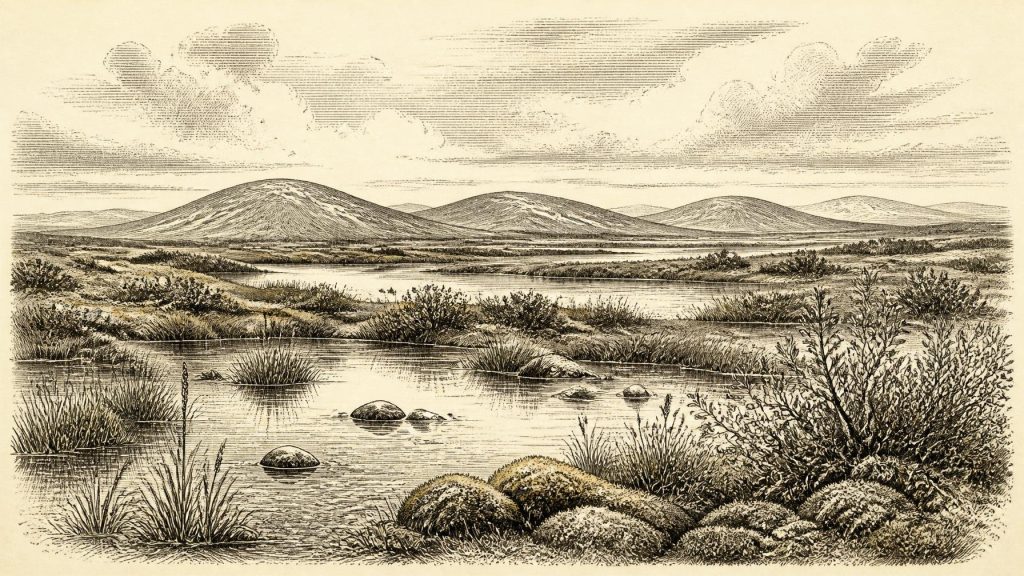
Plant and invertebrate remains from the organic silts point to treeless tundra and a periglacial setting: ground subject to severe seasonal freezing and thawing on the margins of glaciation. Mosses are prominent, while the plant evidence includes sedges, dwarf willow, mountain avens, bogbean and aquatic water-milfoil. These are not the components of closed woodland. They indicate a mosaic of damp ground, shallow freshwater, sedge margins and sparsely vegetated open land, with a brief but productive growing season.
Such a reconstruction is evidence-based, but it must remain local. Derryvree does not allow historians to paint every valley, upland and coast in identical colours. It does, however, show that the climatic world of Ireland around this time could contain wet hollows and pools amidst cold grass-and-moss tundra. The organic layers were later sealed beneath glacial deposits, preserving a landscape that would otherwise have been erased. The drumlin visible today is thus not simply a landform: it contains a compressed record of environmental opportunity between episodes of ice cover.
The implications for settlement are geographical rather than social. Open terrain would have offered routes for grazing animals and, if people entered the island, movement across exposed country. But neither pollen nor plant macrofossils can tell us whether humans were present. They reveal habitat, not inhabitants. Even the coastlines cannot be reconstructed with simple certainty: lower global sea level changed the configuration of the Irish Sea region, while the weight of ice also affected local relative sea level. Ireland’s connections with Britain and the continental shelf were changing problems of terrain, water and ice, not fixed borders.
Animals, Caves and Uncertainty
Southern Irish caves provide another kind of evidence. The Irish Quaternary Fauna Project established that a diverse suite of large mammals reached Ireland during the Late Pleistocene, including reindeer, giant deer, brown bear, wolf, hare, Arctic fox and, in some deposits, spotted hyaena and mammoth. Castlepook Cave near Doneraile, County Cork, is especially important because its extensive bone collections include fauna assigned to Marine Isotope Stage 3, the broad climatic stage relevant to this article.
These caves should not be mistaken for ordinary occupation sites. Carnivores, natural deaths, water, sediment movement and early excavators all contributed to their contents. Bones of different ages can be mixed within a cave system, while older radiocarbon determinations have been reassessed as improved pretreatment methods became available. Recent redating has shown that some earlier Castlepook dates underestimated the true age of bones by several thousand radiocarbon years. Consequently, the fauna proves that suitable animals occurred in Ireland during parts of this long period, but it seldom supplies a neat, island-wide census for one point in time.
A reindeer femur from the old Castlepook collections has attracted particular attention because a deep incision has been interpreted as a fresh-bone cut mark made by a sharp stone tool. County Cork heritage publications present it as possible evidence that Upper Palaeolithic hunters processed a reindeer roughly 33,000 years ago. If that interpretation and its chronological association are confirmed, it would be of great importance: a rare sign of human action in Ireland long before post-glacial settlement is securely documented.
It remains a claim requiring caution, not a licence to populate Ireland with a known hunting community in 30,385 BCE. The age of an animal bone is not a precise date for the making of its mark; one bone is not a campsite; and Castlepook has not yielded a securely associated hearth, dwelling floor, stone-tool assemblage or repeated butchery area of this age. The National Museum of Ireland still appropriately describes the Palaeolithic human record as lacking clear proof. The reindeer femur is best understood as a major research question, not evidence for an established Irish population.
No Polities, No Proven Diplomacy
There is no responsible basis for describing political affairs, rulers, territories, warfare, diplomacy or law in Ireland at this date. There are no names, monuments, graves or settlement plans from which to infer them. Nor can a particular animal population be turned into an ethnic group. If small human parties did reach the island, they would have belonged to wider Upper Palaeolithic worlds known elsewhere in north-west Europe, but their routes, numbers, language, kinship arrangements and duration of stay in Ireland are unknown.
The same restraint applies to everyday society. A cut-marked bone, if humanly modified, would suggest carcass processing and therefore practical knowledge of animal anatomy, sharp stone technology and food acquisition. It would not establish a permanent camp, a seasonal round or a stable population. There is no evidence for farming, herding, pottery, metalworking, built villages, long-distance Irish trade, formal religion, art or learning institutions. These absences are not proof that every human act is impossible; they are the limits of the surviving record.
Economy as Ecology
The only economy that can be securely described is the ecological one. Plants, freshwater and grazing animals formed interdependent systems in which seasonal productivity was constrained by cold. Reindeer are particularly evocative because they are adapted to open northern environments, while giant deer and other herbivores indicate that Ireland could sustain substantial browsers and grazers during favourable phases. Carnivores and scavengers, represented in cave faunas, were part of the same food web. Their remains attest to animal movement and survival, not to a human-managed landscape.
For potential hunter-gatherers, an animal-rich tundra could have offered meat, hides, bone, antler and fuel opportunities, but this is an inference from comparative Upper Palaeolithic archaeology rather than a documented Irish economy. Nothing demonstrates exchange networks across the Irish Sea, the deliberate movement of raw materials, or regular maritime travel. The sensible historical picture is one of possible, episodic access to a harsh western peninsula or island, not a settled commercial landscape.
Ice Was the Dominant Regional Power
The largest development was environmental change. Derryvree’s wetland horizon lies between glacial tills, making it a reminder that ice repeatedly altered the extent of habitable ground. By the later Last Glacial Maximum, conventionally placed around 26,000 to 19,000 years ago, much of Ireland was covered by the Irish component of the British–Irish Ice Sheet. At 30,385 BCE that maximum still lay ahead, but its approach cannot be reduced to a single dramatic advance on one date. Recent research stresses both evidence for earlier ice-sheet growth and considerable uncertainty about its scale, timing and regional pattern before the maximum.
The buried mossland at Fermanagh therefore matters more than any invented event. It records a cold interval when freshwater, sedges, mosses and hardy flowering plants persisted in an ice-age basin. Cave bones show that large mammals entered or survived in Ireland during the wider period. Together they show an island in transition: environmentally connected to north-west Europe, capable at times of supporting wildlife, and perhaps briefly visited by people, yet without evidence for enduring human society. The history of this date is not one of kings or battles. It is the history of a vulnerable tundra landscape before the expanding ice reshaped it once again.
Primary Sources
- Prehistoric Details
- Geology of Ireland
- Quaternary
- The timing and magnitude of the British–Irish Ice Sheet between Marine Isotope Stages 5d and 2: implications for glacio-isostatic adjustment, high relative sea levels and ‘giant erratic’ emplacement
- Pattern and timing of retreat of the last British-Irish Ice Sheet
- Last Glacial Maximum cirque glaciation in Ireland and implications for reconstructions of the Irish Ice Sheet
- Trimlines, blockfields and the vertical extent of the last ice sheet in southern Ireland
- Radiocarbon constraints on the age of the maximum advance of the British–Irish Ice Sheet in the Celtic Sea
- Early deglaciation of the British-Irish Ice Sheet on the Atlantic shelf northwest of Ireland driven by glacioisostatic depression and high relative sea level
- Quaternary deposits and glacial stratigraphy in Ireland
- The Irish Quaternary Fauna Project
- A reconsideration of the radiocarbon dating of the Marine Isotope Stage 3 fauna from southern Ireland
- Phylogeographic, ancient DNA, fossil and morphometric analyses reveal ancient and modern introductions of a large mammal: the complex case of red deer (Cervus elaphus) in Ireland
- First Evidence of a Late Upper Palaeolithic Human Presence in Ireland
- Heritage Artefacts of County Cork
- Archaeological Heritage of County Cork
- Castlepook Cave Excavation, County Cork
- New Insights on the Fauna of Ireland’s Youngest Pleistocene Deposits from Alice and Gwendoline Cave, County Clare
- Palaeoecology
- The Subdivision of the Quaternary Period in Ireland
- Ireland Before 3000 B.C.
- Dimensions and chronology of the last ice sheet in western Ireland