Maguiresbridge Freshwater Record30384 BCE
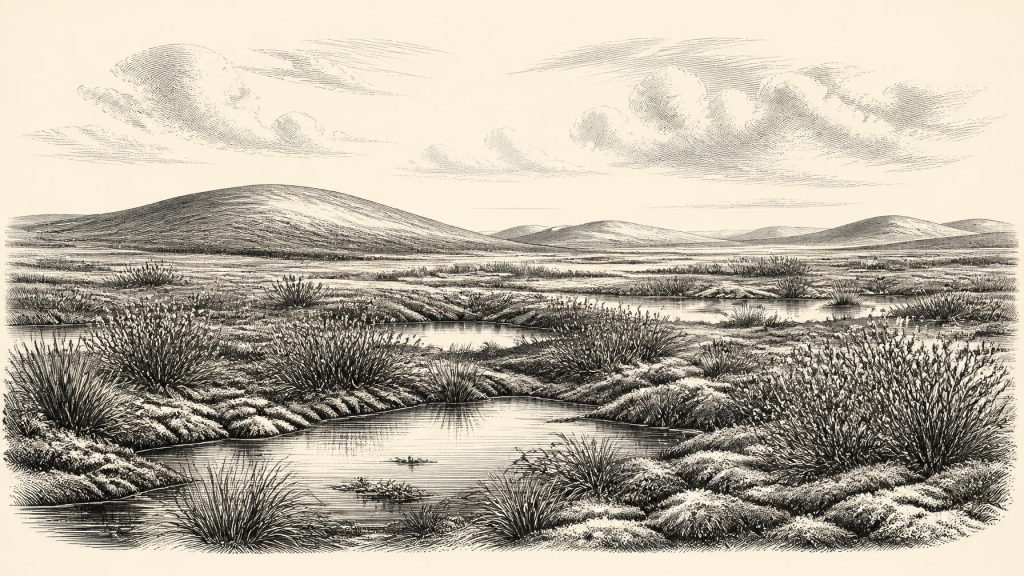
Around 30,384 BCE, Ireland has no recoverable annual history; evidence instead describes a changing Marine Isotope Stage 3 environment. At Derryvree, County Fermanagh, freshwater organic sediments between tills, radiocarbon-dated broadly to 34,950–29,750 BCE, record a local interval between glaciations. Plants and insects indicate treeless, cold wetlands, open ground and shallow water. Cave faunas, including reindeer, mammoth, giant deer, bear and hyaena, show links with wider European ecosystems but cannot establish contemporaneous populations. Ice cover varied regionally and climatically. No secure human settlement, tools or society is known. The record documents dynamic water, vegetation, animals and advancing ice, not human events.
Dateline
The label 30,384 BCE is a modern chronological convenience, not a recoverable Irish year. No annal, settlement layer or dated event can identify a particular season, person or occurrence at this depth in time. In simple terms it corresponds to roughly 32.3 thousand calendar years before AD 1950, within the later part of the Pleistocene. The responsible frame is therefore a broad one: Ireland during Marine Isotope Stage 3, while climates shifted sharply and the British–Irish Ice Sheet was developing unevenly. The evidence is environmental and fragmentary, not a year-by-year historical record.
A Broad Date, Not a Moment
The closest major Irish archive is the Derryvree deposit near Maguiresbridge, County Fermanagh. Exposed during roadworks through a drumlin, it consisted of freshwater silts, fine sands and organic material lying between two thick tills: unsorted sediments deposited directly by glacier ice. The sequence establishes an important order of events. Ice had covered the locality; an interval followed in which freshwater and wetland sediments accumulated; and later ice or ice-derived debris sealed the deposit beneath another till.
Organic material from Derryvree gave the conventional radiocarbon determination BIRM-166, 30,500 radiocarbon years before present, with a large uncertainty of approximately a millennium. A radiocarbon age is not identical to a calendar age. Changes in atmospheric carbon-14 mean that it must be calibrated, and the result is a probability range rather than a pinpoint. Published calibrations place the Derryvree deposit broadly at about 36.9–31.7 thousand calibrated years before present, or approximately 34,950–29,750 BCE. Thus 30,384 BCE falls within a broad interval relevant to the deposit, but cannot be assigned to one particular layer, pool, plant or generation.
Fresh Water Between Glaciers
Derryvree is unusually valuable precisely because later glaciation buried it. Its freshwater sediments preserve a local window onto an Ireland often erased or rearranged by moving ice. They are direct evidence that, at some point within their wide date range, water stood or moved slowly in this part of Fermanagh and that organic matter accumulated around it. They are not evidence that the whole island was simultaneously ice-free, nor that the modern topography, shorelines or drainage pattern already existed.
The plant and insect assemblages indicate a treeless, cold and open setting often described as tundra or muskeg. Such words are ecological comparisons, not claims that a modern Arctic landscape was reproduced exactly in Ireland. The safest reconstruction is of shallow fresh water, saturated margins, exposed mineral ground and low vegetation, with conditions shaped by severe winters, brief growing seasons, frost action and seasonal meltwater. In favourable hollows, however, life was more than a sparse veneer on bare ground. Pools, mossy margins and sedge-rich wet ground could support a productive local food web.
Fossil remains include sedges, grasses and mosses alongside cold-tolerant plants. Mountain-avens, dwarf willow and lesser clubmoss point towards open ground and a severe climate; bogbean and water-milfoil indicate freshwater habitats. These remains should not be treated as a complete botanical inventory of Ireland. Sediment preserves some organisms better than others and represents the immediate catchment of a small basin. Nevertheless, the combination is strong evidence against forest and for a patchwork of wetland and low, cold-stage vegetation in the Derryvree locality.
Ice Was Advancing, But Not Uniformly
At this broad horizon, Ireland lay within a North Atlantic world of abrupt climatic oscillation. Greenland ice cores record repeated millennial-scale shifts between colder stadials and milder interstadials, and speleothems from Crag Cave in County Kerry show that episodes favourable to calcite growth in south-west Ireland coincided broadly with such ameliorations. Yet neither archive lets historians assign weather to 30,384 BCE itself. Their value lies in demonstrating that climatic stability was not the norm.
Nor is there a single uncontested map of Irish ice cover for this time. Recent reconstructions generally place the principal growth of the last British–Irish Ice Sheet between roughly 31,000 and 26,000 years ago, while other evidence from western Ireland points to substantial earlier glacial loading and changing ice margins. The difference is not merely technical. It means that one must avoid imagining either a wholly ice-covered island or an uncomplicated open Ireland. Conditions varied between regions and changed through time. Derryvree proves a local non-glacial freshwater interval; it does not settle the precise extent of every Irish ice mass in one named calendar year.
Animals in a Changing Country
Caves in southern Ireland, especially Castlepook Cave near Doneraile in County Cork, provide a separate and equally cautionary record. Their Late Pleistocene bone assemblages include animals associated with cold, open or mixed environments: reindeer, woolly mammoth, giant deer, brown bear and spotted hyaena among them. Modern redating has shown that several older cave radiocarbon measurements were too young, placing parts of this fauna earlier in Marine Isotope Stage 3 and suggesting that some species may have disappeared locally before the Last Glacial Maximum.
These bones demonstrate that Ireland formed part of a wider north-west European ecological zone in which large mammals and predators could reach or persist on the island during suitable phases. They do not prove that every species was alive together, that all ranged beside the Derryvree wetland, or that an intact herd passed through Ireland in 30,384 BCE. Cave deposits accumulate over long periods. Carnivores can drag in bones; water can move them; excavations undertaken more than a century ago did not always record their positions to modern standards. Taphonomy—the study of what happened to remains after death—is therefore central to any interpretation.
Even with those limits, the evidence allows a vivid but restrained picture. Reindeer and giant deer would have found forage in open plant communities; mammoth and hyaena attest a wider fauna unlike that of modern Ireland. Predation, scavenging, trampling, freezing and thawing were among the forces shaping the landscape. This was an environment in which mobility mattered, for animals as much as for any people who may have approached its shores.
The Human Question
There is no securely excavated house, hearth, burial, stone-tool assemblage or stratified campsite in Ireland dated to around 30,384 BCE. There is no basis for naming an Irish population, language, polity or territory. Consequently, political affairs, diplomacy, warfare, formal religion, art, learning, trade and social rank cannot responsibly be reconstructed. There were certainly no farms, fields, domestic livestock, pottery-making communities, roads or permanent villages evidenced for this period. The visible economy is an environmental one: sediment entering water, plants growing in short summers, herbivores grazing, and predators or scavengers exploiting carcasses.
A reindeer femur from Castlepook Cave has been reported as bearing a possible human-made incision and has been presented publicly as evidence for very early human activity. It is an important prompt for further study, not a foundation for a detailed narrative. Its cave context derives from old excavations, the mark is limited, and no associated toolkit, hearth or occupation surface has established a human presence in the exact period represented by this article. The distinction matters: a possible cut mark on one bone is not proof of a settled hunting community, still less of a continuous population.
If people did visit Ireland during favourable phases of this long interval, they would have belonged to Upper Palaeolithic hunter-gatherer worlds already established elsewhere in Europe. The animals, fresh water, hides, bone and seasonal plant resources visible in the Irish record could have been useful to mobile groups. But this is an inference from the wider European context and ecological possibility, not direct evidence for Irish camps or lifeways. The surrounding seas were lower than today because water was locked in global ice sheets, yet the exact coastlines, crossings and land connections available at any given moment remain uncertain.
An Environmental History
The most important development around this notional date was not a king’s accession, battle or migration. It was the changing relationship between water, vegetation and ice. At Derryvree, a freshwater basin briefly preserved the traces of life between episodes of glaciation. At Castlepook and other caves, animal bones preserve evidence for a far wider Ice Age fauna. At Crag Cave, calcite growth records episodes when liquid water again circulated underground. Together, these archives reveal an Ireland that was environmentally dynamic, regionally varied and often inhospitable, but not uniformly lifeless.
For 30,384 BCE, then, the honest historical record is a landscape rather than a society. Its evidence comes from silts beneath drumlins, seeds and mosses in old sediment, cave bone assemblages and calibrated laboratory dates. These remains can illuminate cold wetlands, open ground, animal movement and approaching glaciation. They cannot supply the invented certainties of named leaders, wars or a settled Irish people. Their value is greater than that: they preserve a rare, scientifically testable glimpse of Ireland long before written history and long before continuous human occupation can be demonstrated.
Primary Sources
- A Middle Midlandian Freshwater Series at Derryvree, Maguiresbridge, County Fermanagh, Northern Ireland
- Figure 6: The Subdivision of the Quaternary Period in Ireland
- References and Recommended Reading
- Freshwater Organic Deposits and Stratified Sediments Between Early and Late Midlandian (Devensian) Till Sheets, at Aghnadarragh, County Antrim, Northern Ireland
- Aghnadarragh
- Mammoth and Musk Ox ESR-Dated to the Early Midlandian at Aghnadarragh, County Antrim, Northern Ireland, and the Age of the Fermanagh Stadial
- A Reconsideration of the Radiocarbon Dating of the Marine Isotope Stage 3 Fauna from Southern Ireland
- The Irish Quaternary Fauna Project
- First Evidence of a Late Upper Palaeolithic Human Presence in Ireland
- New Insights on the Fauna of Ireland's Younger Dryas and Early Holocene from Alice & Gwendoline Cave
- Episodic Speleothem Deposition Tracks the Terrestrial Impact of Millennial-Scale Last Glacial Climate Variability in SW Ireland
- A Stratigraphic Framework for Abrupt Climatic Changes During the Last Glacial Period Based on Three Synchronized Greenland Ice-Core Records: Refining and Extending the INTIMATE Event Stratigraphy
- The IntCal20 Northern Hemisphere Radiocarbon Age Calibration Curve (0–55 cal kBP)
- The IntCal20 Approach to Radiocarbon Calibration Curve Construction: A New Methodology Using Bayesian Splines and Errors-in-Variables
- Radiocarbon Constraints on the History of the Western Irish Ice Sheet Prior to the Last Glacial Maximum
- Growth and Retreat of the Last British–Irish Ice Sheet, 31,000 to 15,000 Years Ago: the BRITICE-CHRONO Reconstruction
- The Timing and Magnitude of the British–Irish Ice Sheet Between Marine Isotope Stages 5d and 2: Implications for Glacio-Isostatic Adjustment, High Relative Sea Levels and ‘Giant Erratic’ Emplacement
- Behavioural Tendencies of the Last British–Irish Ice Sheet Revealed by Data–Model Comparison
- Growth, Dynamics and Deglaciation of the Last British-Irish Ice Sheet: the Deep-Sea Ice-Rafted Detritus Record
- New Data for the Last Glacial Maximum in Great Britain and Ireland
- BSBI: Menyanthes trifoliata
- BSBI: Salix herbacea
- BSBI: Selaginella selaginoides