Castlepook Pleistocene30347 BCE
Around 30,347 BCE, Ireland lay within an unstable cold phase preceding the Last Glacial Maximum, not a dateable historical moment. Growing ice sheets, low sea levels and changing coastlines shaped a largely open, treeless landscape. Buried Fermanagh sediments demonstrate local freshwater wetlands supporting tundra vegetation before later glaciation. Southern caves, especially Castlepook, preserve remains of mammoth, reindeer, giant deer, bears, wolves, Arctic foxes and hyaenas, though poorly recorded contexts and revised dating prevent precise contemporaneous reconstruction. No securely dated human settlement, artefacts or burial belongs to this period. Ireland’s evidence instead records variable Ice Age habitats, fauna and encroaching ice.
Dateline
30,347 BCE is a modern chronological label, not a year for which Irish archaeology can recover an event. No calendar, ruler, settlement or human life can be placed in Ireland on that precise point. In scientific terms, the date falls at about 32,300 calibrated years before present, subject to the substantial uncertainty inherent in converting a BCE number into late-Pleistocene chronologies. The responsible frame is therefore a broad interval in Marine Isotope Stage 3, during the unstable climatic descent towards the Last Glacial Maximum, rather than a single year. Radiocarbon ages from this depth of time require calibration and can produce wide calendar ranges; revised pretreatment methods have also altered the apparent ages of several Irish cave specimens.
A Landscape Approaching Major Glaciation
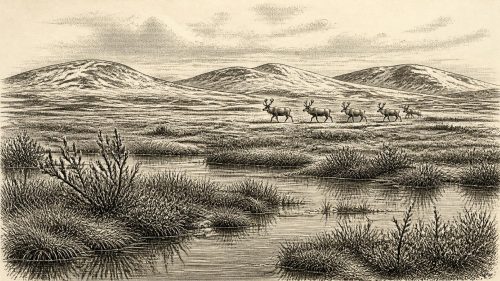
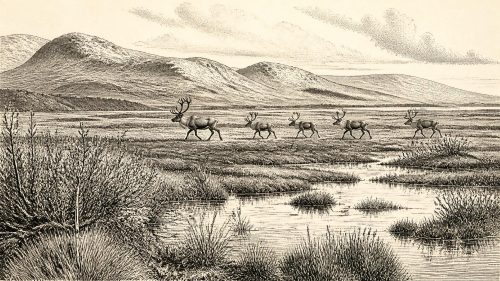
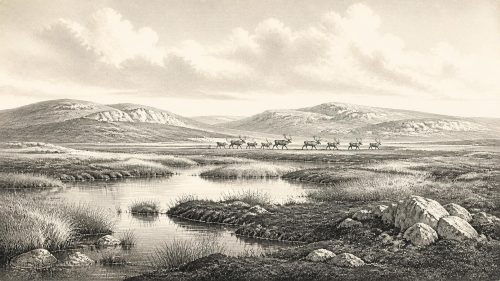
Ireland at this approximate time was not the green, wooded island familiar today. It lay within the wider north-west European ice-age world, where climate swung sharply between comparatively milder interstadials and severe cold phases. The British–Irish Ice Sheet had not yet reached its later maximum extent, conventionally reconstructed by about 27,000 years ago, but ice masses were growing and landscapes could change quickly. A precise map for 30,347 BCE would overstate the evidence: glacier margins did not advance as a neat, simultaneous wall across the island, and dating control is uneven. Yet the broad setting is clear. Much of Ireland was cold, open and treeless or nearly so, while local relief, exposure, water supply and the proximity of ice strongly shaped what plants and animals could survive.
Sea levels were far lower than at present because immense quantities of water were held in northern ice sheets. The outlines of the Irish coast and Irish Sea basin were consequently very different. It would nevertheless be rash to turn this fact into a simple story of a permanent land bridge or an easy route for people and animals. Changing shorelines, rivers, marine channels, ice fronts and seasonal conditions all mattered. Ireland’s later separation from Britain and its distinctive post-glacial fauna show why access must be treated as a changing ecological and geographical problem, not merely a question of distance on a modern map.
What the Fermanagh Sediments Suggest
One of the most revealing, if difficult, bodies of evidence comes from buried sediments beneath drumlins near Derryvree and Maguiresbridge in County Fermanagh. Organic silts and fine sands there were sealed beneath later glacial deposits. Their famous radiocarbon determination, BIRM-166, was reported as 30,500 radiocarbon years before present, with a wide error range. That is not an exact equivalent of 30,347 BCE, and it must not be made into one. After calibration, it represents an earlier and broad time window rather than a dateable episode. Still, the deposit is directly valuable because it proves that, before later ice overrode the ground, a freshwater or wetland environment existed in part of north-central Ireland.
Plant remains from such inter-till deposits indicate cold-climate vegetation associated with wet ground and open tundra conditions: sedges, mosses, aquatic plants and hardy herbs or dwarf shrubs rather than closed forest. This was not lifeless snow desert. During favourable seasons, shallow water, saturated margins and exposed mineral ground could support a mosaic of plant communities. The evidence is local, however. A buried wetland in Fermanagh cannot be assumed to describe every valley, upland or coast across Ireland. Its importance lies in demonstrating environmental possibility: pockets of open ground and fresh water could persist within a wider landscape becoming increasingly dominated by cold and advancing ice.
The Cave Fauna of Southern Ireland
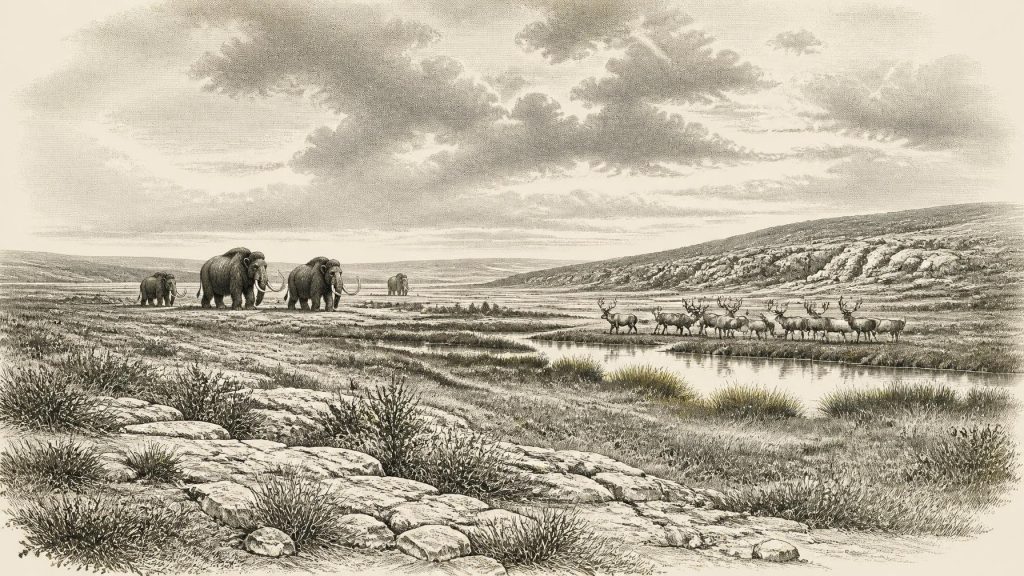
Southern Irish caves provide the other principal window. Castlepook Cave near Doneraile in County Cork, above the Blackwater valley, produced an exceptional collection of Late Pleistocene animal bones during early twentieth-century excavation. The assemblage has included woolly mammoth, reindeer, giant deer, brown bear, wolf, Arctic fox, lemmings and spotted hyaena. These remains establish that Ireland, or at least suitable parts of its southern landscape, supported a strikingly varied cold-stage fauna during the wider Middle Pleniglacial period. Mammoths and reindeer evoke open grazing country; hyaenas and wolves indicate carnivore guilds capable of exploiting large herbivores and carrion. Caves were not settlements by default: they could serve as carnivore dens, traps, temporary refuges, places into which water carried bones, or repositories accumulated over many millennia.
That last qualification is essential. The old Castlepook collection was excavated before modern standards of stratigraphic recording, and bones from separate periods were sometimes mixed or poorly located. More importantly, a 2020 re-dating programme found that some earlier radiocarbon results from Castlepook were too young by roughly 5,000 to 12,000 radiocarbon years. Its authors concluded that certain mammals, notably giant deer and spotted hyaena, may have disappeared locally before about 40,000 calibrated years ago. Consequently, an animal bone once casually described as ‘about 33,000 years old’ cannot automatically be used as a snapshot of 30,347 BCE. Castlepook illuminates the kind of fauna and habitats present in pre-Last Glacial Maximum Ireland, but its individual specimens need modern dating and secure context before they can be assigned to narrower intervals.
People: Possibility Is Not Proof
The most important historical conclusion is also the most restrained: there is no securely demonstrated human settlement, camp, hearth, tool assemblage or burial in Ireland that can be assigned to this date. The National Museum of Ireland continues to state that clear Palaeolithic human presence has not been demonstrated, although this formulation is complicated by later discoveries and ongoing debate. A cut-marked brown-bear kneecap from Alice and Gwendoline Cave in County Clare provides proxy evidence for human activity in the terminal Pleistocene, calibrated to roughly 12,810–12,590 years before present. That discovery is very significant, but it is around twenty millennia later than the date considered here.
Claims for much earlier activity in Munster must likewise be handled carefully. A reindeer femur from Castlepook has been interpreted by some researchers as bearing a stone-tool cut mark, potentially indicating human processing of fresh bone. Yet direct dating dates the animal bone, not necessarily the incision; the old cave context is disturbed; and an isolated modified specimen would not reveal a resident population, a camp site, language or social organisation. It is therefore reasonable to say that brief human visits to pre-glacial Ireland remain a research possibility, not that Ireland possessed a known Upper Palaeolithic society in 30,347 BCE. Recent excavation at Castlepook sought surviving deposits precisely because better context is needed to resolve such questions.
No Politics, Trade or Religion in the Record
There is no evidence on which to build an Irish political history for this period. No communities, territories, leaders, conflicts, alliances or diplomatic contacts are identifiable. Nor can archaeology presently support statements about religion, ritual, learning, artistic tradition or exchange networks within Ireland. Even if occasional hunters crossed the changing lands and waters of north-west Europe, no Irish artefact scatter or occupation surface has been securely linked to them. The absence is meaningful: it distinguishes what the evidence can establish from what a vivid Ice Age narrative might tempt us to invent.
Everyday life can therefore be discussed only through the animal and environmental record. Large grazers would have moved through open landscapes according to forage, weather and perhaps seasonal migration; predators followed prey; caves occasionally preserved the aftermath. Freshwater hollows and sedge margins offered biological productivity during short growing seasons, while exposed ground and severe winter conditions imposed sharp limits. This was a changing ecosystem, not a nation or a settled cultural landscape. In the centuries and millennia after this nominal date, accelerating cold and ice-sheet growth would repeatedly erase, bury and rearrange earlier surfaces, helping to explain why the archaeological record is so sparse.
Evidence Beneath Later Ice
The best picture of Ireland around 30,347 BCE is thus assembled from fragments: sub-till wetland sediments in Fermanagh, cave bones in Cork and Waterford, ice-sheet reconstructions, and improved radiocarbon science. These sources agree on a cold, environmentally variable island-world containing at least some open habitats and an impressive Pleistocene fauna. They do not yield a year-specific Irish event. Future work—careful cave excavation, ultrafiltered radiocarbon dating, sediment micromorphology, palaeoproteomics and ancient DNA where preservation permits—may refine this picture. For now, the honest history is one of mammoths, reindeer, wetlands, carnivores and encroaching ice, with humanity still unproven at this particular point in Ireland’s deep past.
Source References
Hover over a number to see the source. Select it to open the source.

- [1] New insights on the fauna of Ireland’s Younger Dryas: An investigation of Alice and Gwendoline Cave, Co. Clare
- [2] A reconsideration of the radiocarbon dating of the Marine Isotope Stage 3 fauna from southern Ireland
- [3] First evidence of a Late Upper Palaeolithic human presence in Ireland
- [4] The Irish Quaternary Fauna Project
- [5] Prehistoric Details
- [6] 2022:564 – Castlepook Cave, Castlepook South, Cork
- [7] Quaternary Site Descriptions
- [8] The colonization of Ireland: A human ecology perspective
- [9] Pattern and timing of retreat of the last British-Irish Ice Sheet
- [10] Growth and retreat of the last British–Irish Ice Sheet, 31,000 to 15,000 years ago: the BRITICE-CHRONO reconstruction
- [11] The timing and magnitude of the British–Irish Ice Sheet between Marine Isotope Stages 5d and 2
- [12] The IntCal20 Northern Hemisphere radiocarbon age calibration curve (0–55 kcal BP)
- [13] Dimensions and chronology of the last ice sheet in Western Ireland
- [14] Deglaciation chronology of the Donegal Ice Centre, north-west Ireland
- [15] Sedimentology and chronology of the advance and retreat of the last British-Irish ice sheet on the continental shelf west of Ireland
- [16] Oscillating retreat of the last British-Irish Ice Sheet on the continental shelf offshore Galway Bay, western Ireland
- [17] Phylogeographic, ancient DNA, fossil and morphometric analyses reveal ancient and modern introductions of a large mammal: the complex case of red deer (Cervus elaphus) in Ireland
- [18] Occurrence of mammalia relicts at site Castlepook Cave
- [19] Preliminary assessment of the archive of faunal remains from excavated Irish cave sites
- [20] Heritage Artefacts of County Cork
- [21] The Mesolithic in Ireland: when was it?
- [22] Pleistocene glaciations in Ireland
Primary Sources
- New insights on the fauna of Ireland’s Younger Dryas: An investigation of Alice and Gwendoline Cave, Co. Clare
- A reconsideration of the radiocarbon dating of the Marine Isotope Stage 3 fauna from southern Ireland
- First evidence of a Late Upper Palaeolithic human presence in Ireland
- The Irish Quaternary Fauna Project
- Prehistoric Details
- 2022:564 – Castlepook Cave, Castlepook South, Cork
- Quaternary Site Descriptions
- The colonization of Ireland: A human ecology perspective
- Pattern and timing of retreat of the last British-Irish Ice Sheet
- Growth and retreat of the last British–Irish Ice Sheet, 31,000 to 15,000 years ago: the BRITICE-CHRONO reconstruction
- The timing and magnitude of the British–Irish Ice Sheet between Marine Isotope Stages 5d and 2
- The IntCal20 Northern Hemisphere radiocarbon age calibration curve (0–55 kcal BP)
- Dimensions and chronology of the last ice sheet in Western Ireland
- Deglaciation chronology of the Donegal Ice Centre, north-west Ireland
- Sedimentology and chronology of the advance and retreat of the last British-Irish ice sheet on the continental shelf west of Ireland
- Oscillating retreat of the last British-Irish Ice Sheet on the continental shelf offshore Galway Bay, western Ireland
- Phylogeographic, ancient DNA, fossil and morphometric analyses reveal ancient and modern introductions of a large mammal: the complex case of red deer (Cervus elaphus) in Ireland
- Occurrence of mammalia relicts at site Castlepook Cave
- Preliminary assessment of the archive of faunal remains from excavated Irish cave sites
- Heritage Artefacts of County Cork
- The Mesolithic in Ireland: when was it?
- Pleistocene glaciations in Ireland