The Greenagho Lakebed30348 BCE
30,348 BCE is a modern label rather than a precise Irish date. Evidence from Greenagho and Derryvree in Fermanagh comprises organic lake sediments sealed beneath till, indicating cold open wetlands with freshwater plants, insects and animals before advancing ice. During Marine Isotope Stage 3, Ireland experienced severe but regionally variable glaciation; the full ice-sheet extent came later. Cave faunas, notably at Castlepook, demonstrate diverse large mammals, including reindeer, horse, mammoth and predators, though deposits are complex. A cut-marked reindeer bone tentatively suggests human butchery, not settlement. No political, cultural or economic structures are recoverable; environmental change dominates this deep past.
Dateline
30,348 BCE is a modern chronological label, not a recoverable year in Ireland’s past. No Irish calendar, written record, named community or datable event can be assigned to it. In simple arithmetic it lies 32,297 years before the conventional archaeological present of AD 1950, but that does not turn it into a precise archaeological date. At this depth of time, radiocarbon determinations carry substantial uncertainties and must be calibrated against changing atmospheric carbon levels. The responsible view is therefore regional and approximate: Ireland around the early thirty-third millennium before present lay in the later part of Marine Isotope Stage 3, during a climatically unsettled phase of the last Ice Age and close to the growth of the last Irish Ice Sheet.
Dating a Landscape, Not a Year
The closest evidence does not provide a diary entry for 30,348 BCE. It consists of sediments, plant remains, insect fragments, animal bones and glacial landforms, each formed over periods far longer than a single year. The most important northern archive is Derryvree, near Maguiresbridge in County Fermanagh. Road-cutting in 1969 exposed organic silts and fine sands trapped between two distinct tills within a drumlin. The deposit produced the conventional radiocarbon determination BIRM-166, 30,500 radiocarbon years BP, with a large laboratory range of +1,170 and −1,030 years. A later published calibration cited for this material gives an approximate range of 36.9–31.7 thousand calibrated years BP.
That is the appropriate scale on which to place the nominal year: within a broad late-Pleistocene interval, not at a pinpoint in time. A second Fermanagh site, Greenagho near Belcoo, yielded lacustrine organic material beneath till, dated to 32,500 ± 300 radiocarbon years BP and calibrated in later discussion to roughly 37.2–35.7 thousand years BP. Greenagho is older than the point considered here, but it is valuable evidence that parts of inland Ireland had supported lakes, vegetation and animal life before expanding ice buried those deposits. Together, the sites show why apparent calendar precision is misleading: their scientific value lies in sequence and environmental change.
Ice Growing Across Ireland
Ireland was entering a decisive transformation. Reconstructions of the last Irish Ice Sheet generally infer that the island was largely ice-free until about 32,000 years ago, after which ice expanded and thickened. But the word “about” matters. Ice did not advance as a single, instantaneous wall across a uniform island. Mountain ice, lowland ice, margins linked to Scottish ice, local meltwater basins and marine outlets changed at different rates. The full offshore extent associated with the Last Glacial Maximum was reached much later, broadly between about 27,000 and 23,000 calibrated years BP in different sectors.
For 30,348 BCE, the best interpretation is therefore an island undergoing increasingly severe glaciation, with the extent of ice varying by region and still debated in detail. It would be unsafe to depict every valley as buried beneath a continuous ice sheet at this exact notional date; equally, it would be wrong to imagine modern Ireland’s green, wooded terrain. The growing ice sheet was already one of the strongest forces shaping the island’s future record. It eroded earlier surfaces, displaced drainage, laid down till and later concealed rare organic horizons beneath drumlins. Much evidence for any human activity on open ground may have been destroyed or deeply buried in the process.
Fermanagh’s Open Wetlands
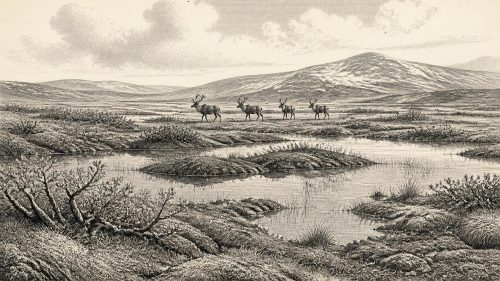
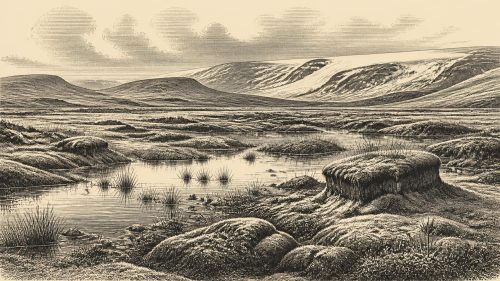
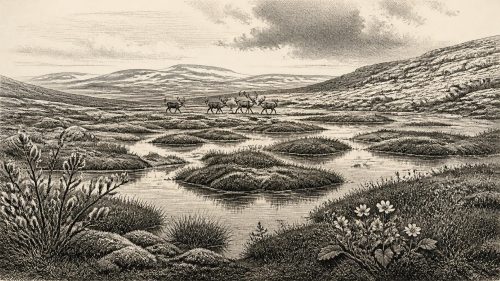
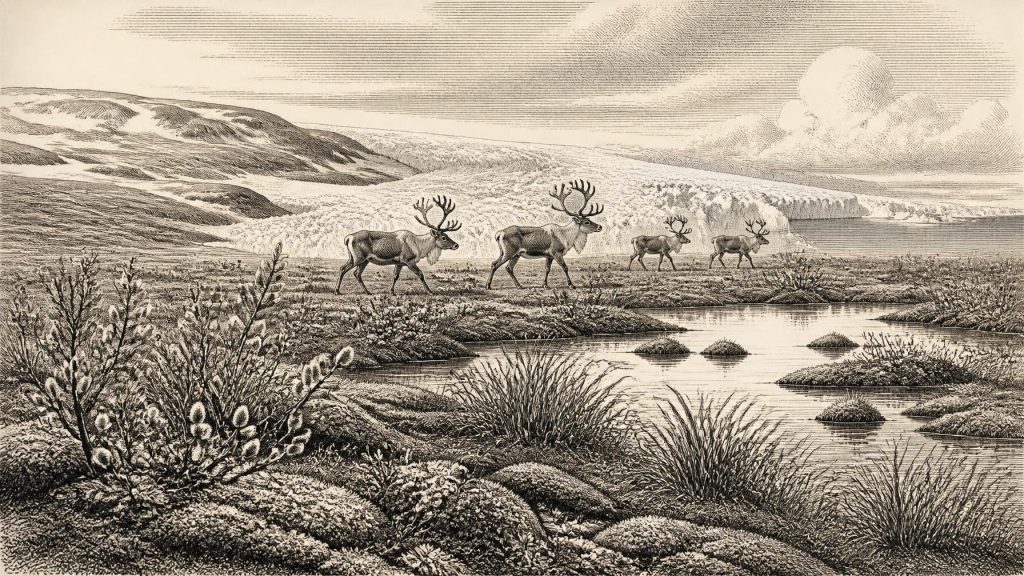
Derryvree offers the clearest local picture of an ice-age habitat. Its organic sediments contained plant and animal remains interpreted as evidence for open tundra and a periglacial climate. “Periglacial” does not mean permanently sterile. It describes ground affected by intense cold, frost action and seasonal thaw near an ice mass. The Derryvree flora included grasses and sedges, herbs, juniper and dwarf willow, with mosses and aquatic or wet-margin plants. Finds of bogbean (Menyanthes trifoliata), mountain avens (Dryas octopetala) and alternate water-milfoil are particularly informative. They indicate that cold, open ground was interspersed with freshwater, damp mossy margins and shallow pools.
The insects and plant macrofossils suggest a muskeg-like wetland mosaic rather than a featureless polar desert. Summer light could sustain short bursts of biological productivity: sedges at the water’s edge, mosses, flowering herbs, invertebrates and the animals that fed among them. Winters, however, were harsh, and the growing season was brief. This was a treeless or near-treeless country in which exposure to wind, frost and changing water levels mattered profoundly. It is evidence from one protected Fermanagh basin, not a complete map of the whole island, but it is the most secure glimpse of a living Irish environment near this era.
Animals in a Changing Country
Animal bones from Irish caves show that Late Pleistocene Ireland supported a richer large-mammal fauna than the modern island. The Irish Quaternary Fauna Project found evidence for mammals arriving between at least about 45,000 and 20,000 years ago. Castlepook Cave, near Doneraile in north County Cork and long known as Mammoth Cave, has been especially important. Its assemblage includes remains attributed to woolly mammoth, reindeer, horse, giant deer, brown bear, wolf, arctic fox, mountain hare, lemmings and spotted hyaena. Not all were necessarily alive at the same moment, and their remains were accumulated through complex natural processes.
That qualification is essential. Caves can be dens used by carnivores, traps into which animals fall, shelters into which bones are dragged, and conduits for water and sediment. Many Irish cave collections were recovered in antiquarian excavations, before modern standards of stratigraphic recording. Improved bone pretreatment and radiocarbon methods have also shown that some earlier dates for Castlepook fauna were too young, in some instances by thousands of radiocarbon years. Castlepook is consequently powerful evidence for a long and changing Ice Age fauna, but it cannot supply a neat annual census of animals in County Cork in 30,348 BCE.
Still, the faunal record establishes an important ecological reality. Reindeer and horse were suited to open, cold environments; mammoth and giant deer indicate a landscape capable, at least in suitable phases and places, of supporting large grazing or browsing mammals; hyaenas and wolves point to a predator guild far removed from historic Ireland. Seasonal movement is plausible for some animals, but the Irish evidence does not yet reconstruct exact migration routes or herd calendars for this date.
The Castlepook Human Question
The most striking possible human evidence relevant to this period is a reindeer femur from Castlepook Cave. Ruth Carden’s assessment, presented in County Cork’s heritage publication, identifies a deep mark on the bone as damage made by a sharp stone tool during butchery. The object has been publicly associated with an age of about 31,000 BCE. If the mark is correctly interpreted, it indicates that people handled a reindeer carcass in Ireland during the Upper Palaeolithic, far earlier than the formerly accepted post-glacial settlement record.
Its significance should neither be dismissed nor exaggerated. A marked bone records one possible act of carcass processing; it does not prove a village, a permanent population or even that the animal was killed beside the cave. The bone may have been transported after butchery by hyaenas or wolves. No securely associated Palaeolithic stone-tool assemblage, hearth, dwelling surface, burial, human skeleton, artwork or midden has yet been published from Ireland for this horizon. Nor is the date of the animal’s death necessarily the exact date on which the mark was made. Castlepook is best understood as a serious and tantalising indication of human presence or activity, still requiring corroboration.
No Politics, But a Human Geography
There is no evidence from Ireland around this time for political institutions, leaders, warfare, diplomacy, territories or named peoples. There is likewise no basis for claiming farming, stock-keeping, pottery, metalworking, long-distance trade or organised religion. The absence is not a failure of imagination; it is the limit of the surviving record. If people visited Ireland, their economy would most plausibly have involved highly mobile hunter-gatherer use of animal and plant resources, but that is an inference from wider Upper Palaeolithic lifeways rather than a demonstrated Irish social system.
Lower global sea levels altered the outlines of the Irish and British landmasses and exposed areas now under the sea. Yet changing coastlines alone do not demonstrate a walkable land bridge, a regular crossing route or trade between communities. The precise relationship between ice, sea, shelves and possible routes around Ireland remained variable. The presence of large mammals proves that movement into Ireland had occurred at some point; it does not identify how, when or whether people followed the same paths.
Culture and learning are equally beyond direct recovery. A cut-mark, if human-made, implies practical knowledge of sharp stone tools and animal anatomy. Beyond that, claims about language, identity, ritual or social organisation would be speculation. The period’s true historical importance lies elsewhere: the environmental archives show Ireland poised between biologically productive cold landscapes and the destructive expansion of ice. Greenagho and Derryvree preserve brief evidence of waters, plants and small creatures that survived before till sealed them away. Castlepook preserves the possibility that people briefly entered that world. Around 30,348 BCE, Ireland’s story is not one of recorded events, but of a landscape becoming harder to inhabit and harder for later generations to know.
Primary Sources
- Middle Midlandian Freshwater Series at Derryvree, Maguiresbridge, County Fermanagh, Northern Ireland
- Middle Midlandian Freshwater Series at Derryvree, Maguiresbridge, County Fermanagh, Northern Ireland
- Middle Midlandian Interstadial Deposits at Greenagho, Near Belcoo, County Fermanagh, Northern Ireland
- Freshwater Organic Deposits and Stratified Sediments Between Early and Late Midlandian (Devensian) Till Sheets, at Aghnadarragh, County Antrim, Northern Ireland
- Quaternary Deposits and Glacial Stratigraphy in Ireland
- The Last Irish Ice Sheet: Extent and Chronology
- Trimlines, Blockfields and the Vertical Extent of the Last Ice Sheet in Southern Ireland
- The Deglaciation of the Western Sector of the Irish Ice Sheet from the Inner Continental Shelf to its Terrestrial Margin
- Growth and Retreat of the Last British-Irish Ice Sheet, 31,000 to 15,000 Years Ago: the BRITICE-CHRONO Reconstruction
- A Reconsideration of the Radiocarbon Dating of the Marine Isotope Stage 3 Fauna from Southern Ireland
- The Irish Quaternary Fauna Project
- New Insights on the Fauna of Ireland’s Younger Dryas and Early Holocene from Alice & Gwendoline Cave
- Heritage Artefacts of County Cork
- Last Glacial Maximum Cirque Glaciation in Ireland and Implications for Reconstructions of the Irish Ice Sheet
- Marine Isotope Stage 3 Sea Level Fluctuations: Data Synthesis and New Outlook
- Dansgaard–Oeschger Events in Climate Models: Review and Baseline Marine Isotope Stage 3 Protocol
- Exploring Controls of the Early and Stepped Deglaciation on the Western Margin of the British-Irish Ice Sheet
- Menyanthes trifoliata: Fossil Record in Fermanagh
- Dryas octopetala: Fossil Record in Fermanagh
- Advances in Irish Quaternary Studies