Costello’s Constitutional Turn1948 CE
In 1948, Fianna Fáil lost its Dáil majority after sixteen years, enabling John A. Costello to lead the First Inter-Party Government, supported by Clann na Poblachta, Labour and others. The coalition addressed post-war housing, welfare, health, employment and agricultural trade, while Ireland joined European recovery co-operation and concluded a British trade agreement. Costello’s September Canadian announcement preceded the Republic of Ireland Act, enacted in December. Although effective only in 1949, it repealed the External Relations Act, ended the Crown’s remaining external role and authorised presidential functions. Partition remained unchanged, while An Taisce’s foundation and Olympic return suggested national civic renewal.
Dateline
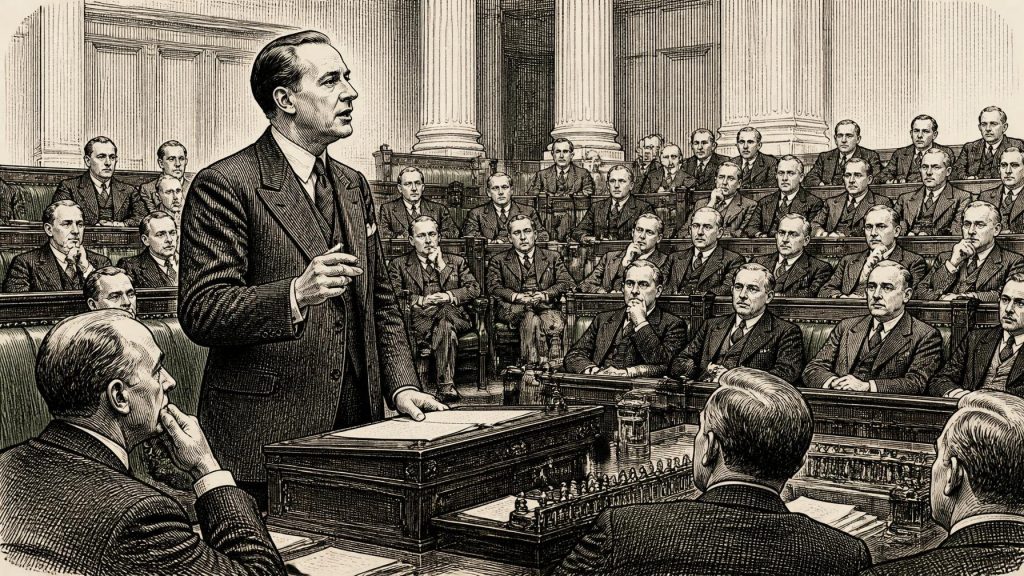
In 1948 Ireland’s most consequential development was not a completed constitutional transformation but the decision to make one. A general election ended sixteen years of Fianna Fáil government; a politically improbable coalition took office; and, before the year closed, the Oireachtas enacted the Republic of Ireland Act. That Act did not take effect until Easter Monday 1949, so it would be wrong to say that Ireland became a republic during 1948. Yet the year decisively settled the legislative course: the final statutory role of the British Crown in the State’s external relations would end, and the State could be described as the Republic of Ireland.
An Election for Change
The general election of 4 February produced a result that altered the political map without delivering an outright winner. Éamon de Valera’s Fianna Fáil remained by far the largest party, with 68 seats, but it no longer commanded a Dáil majority. The campaign had taken place in a country still emerging from the restrictions and shortages of the Emergency. The immediate post-war years had brought poor harvests, rationing, weak industrial employment and continued emigration. These pressures gave force to the widespread demand to remove a government that had been in office since 1932.
The election also confirmed the arrival of Clann na Poblachta, the new republican party led by barrister Seán MacBride. It won ten seats: fewer than its organisers had hoped, but enough to make it indispensable to an alternative administration. Its support came from people dissatisfied with Fianna Fáil for varied reasons: former republicans, younger voters, some urban workers and others who wanted more vigorous action on housing, health, rural development and partition. The party’s presence made 1948 something more than a routine change of ministry. It brought a generation shaped by the aftermath of the revolutionary period into the Cabinet room, alongside politicians associated with very different traditions.
Negotiations among Fine Gael, Clann na Poblachta, Labour, National Labour, the Clann na Talmhan party and independents created the First Inter-Party Government. The arrangement was held together principally by its desire to displace Fianna Fáil, rather than by a single ideological programme. Richard Mulcahy, Fine Gael’s leader and former commander of the National Army, could not secure Clann na Poblachta’s acceptance as Taoiseach, a reminder that Civil War memories remained politically potent. John A. Costello, a senior counsel and Fine Gael TD without Mulcahy’s military past, became the compromise choice. On 18 February the Dáil elected him Taoiseach by 75 votes to 68. MacBride became Minister for External Affairs; the 32-year-old Noël Browne, also of Clann na Poblachta, became Minister for Health.
Government and the Household
The coalition inherited a State in which grand constitutional language coexisted with very practical shortages. Overcrowded and poor-quality housing remained an everyday reality for many families, in Dublin and other towns as well as in the countryside. The Housing (Amendment) Act, passed early in 1948, gave housing authorities further powers over the demolition and conversion of dwellings, regulated the use of premises as multiple dwellings, and widened grants and lending arrangements. Its provisions reveal the character of the problem: they addressed overcrowding, deteriorating houses, small dwellings, labourers’ cottages and the difficulty of financing new homes. In allocating local-authority houses, the legislation directed particular attention to families in one-room dwellings, condemned houses and homes affected by tuberculosis.
Health was therefore a social question as well as an administrative portfolio. Browne’s appointment mattered because tuberculosis was a grave national concern, linked in public understanding to poverty, overcrowding and inadequate treatment. The controversial Mother and Child Scheme belongs chiefly to the years that followed and should not be treated as an event of 1948. What can securely be placed in this year is the formation of the new ministry under Browne and the prominence of health, hospital provision and TB in public expectations of the coalition. The Health Act of 1947 already provided the statutory background; the incoming government had yet to turn broad promises into a settled programme.
Other 1948 legislation likewise shows a government and legislature concerned with the machinery of ordinary life. The Social Welfare Act adjusted pension and assistance arrangements, while the Nurses Registration Act and measures on sanitary services, agricultural rates, trade unions and workmen’s compensation formed part of a busy statute book. These laws did not transform living standards overnight. They do, however, show that the year’s historical importance was not confined to the constitutional question. The work of rebuilding homes, regulating employment and extending the capacity of public services was inseparable from the post-war politics that had carried the coalition into office.
Exports, Europe and Recovery
Economic policy remained constrained by Ireland’s dependence on the British market, especially for farm produce, and by the wider European shortage of dollars, machinery and supplies. This did not prevent the new government from seeking better terms. Irish and British ministers met in London in June, and a new trade agreement was signed in Dublin on 31 July. It came into force in August. The agreement covered quantities and prices for specified agricultural exports during the period from July 1948 to June 1952. Britain sought more cattle, eggs and potatoes and hoped to restore imports of bacon, butter, sheep and lamb; Ireland sought an expanded outlet for produce and a more secure external position. For farmers and exporters, the agreement placed the recovery of livestock and food exports at the centre of the national economy.
At the same time Ireland entered the institutional world of European recovery. On 19 January an interdepartmental committee met in Dublin to prepare for the European Recovery Programme, commonly called Marshall Aid. Its minutes show officials calculating immediate import needs from the Western hemisphere and judging that Ireland’s greatest gain might be indirect: recovery in Britain, France and western Germany would improve the economic setting on which Irish trade depended. The Organisation for European Economic Co-operation was established on 16 April 1948 to administer the wider European programme. Ireland’s participation was significant. A neutral State, heavily tied to Britain in trade and currency, was nonetheless drawn into new patterns of western European consultation, statistics, planning and technical co-operation.
The Canadian Announcement
Constitutional uncertainty had persisted since the External Relations Act of 1936. Under that arrangement, the King performed limited functions in the conduct of Ireland’s external relations, notably in accrediting diplomatic representatives, while the 1937 Constitution established the presidency and named the State Éire in Irish and Ireland in English. Different governments and observers interpreted the resulting relationship with the Commonwealth differently. In 1948 Costello’s government chose to remove the ambiguity by repealing the 1936 Act.
During an official visit to Canada, Costello publicly stated on 7 September that the government intended to repeal the External Relations Act. The setting gave the announcement an international resonance and later encouraged colourful stories about an impulsive diplomatic slight. The surviving record instead shows a more serious and complex process, involving ministers, officials and discussions with Commonwealth governments. Costello and MacBride presented the intended change as compatible with friendly co-operation, even if it meant formal separation from the Commonwealth. The manner of the announcement caused surprise, particularly in Britain, but the underlying constitutional issue had long been live in Irish political life.
The Republic of Ireland Bill was introduced in the Dáil on 17 November. Debate was intense because the measure touched the meaning of independence, the legacy of the Treaty and the unresolved partition of the island. Government speakers argued that a republic should have its President, not the British monarch, exercise its external executive functions. De Valera and Fianna Fáil did not oppose republican status in principle, but challenged aspects of the government’s presentation and timing. The resulting Act, signed on 21 December, repealed the External Relations Act, declared that the description of the State should be the Republic of Ireland, and enabled the President to exercise executive authority in external relations on the advice of the government. It did not amend the constitutional name of the State, and it did not alter the border.
Partition and Public Culture
That last point was crucial. The Act concerned the twenty-six-county State’s constitutional position; it could not settle the partition question. In Northern Ireland, Sir Basil Brooke’s Unionist government treated the southern decision as confirmation of its own constitutional outlook. On 20 November Brooke met British prime minister Clement Attlee at Chequers. The meeting belongs firmly to 1948; the later Ireland Act at Westminster does not. Still, the discussion helped lay the ground for the stronger statutory assurance of Northern Ireland’s place in the United Kingdom enacted in 1949. Thus a measure intended in Dublin to clarify sovereignty also sharpened the political division between the two jurisdictions.
There were quieter signs of cultural and civic renewal. An Taisce, the National Trust for Ireland, was founded in 1948 amid concern that post-war development might damage landscapes, historic buildings and amenities. The botanist Robert Lloyd Praeger became its first president that September. Ireland also returned to the Olympic Games at London after an absence since 1932; Letitia Hamilton won a bronze medal in the painting competition, the last Olympic arts contest. Such episodes were modest beside the republican legislation, but they reflected a society looking beyond wartime scarcity: towards recreation, international presence and the protection of a shared natural and built inheritance.
By December 1948, then, Ireland had not yet crossed the constitutional threshold that later commemorations would mark in 1949. But it had chosen the route. Costello’s fragile coalition joined practical measures on housing, welfare, trade and recovery to a decision of exceptional symbolic weight. The State entered the next year with its economy still exposed, partition still entrenched and its government dependent on a narrow, diverse alliance. It also entered with an Act on the statute book that made the end of the old external constitutional arrangement inevitable.
Primary Sources
- The Republic of Ireland Act, 1948
- The Republic of Ireland Bill, 1948—Second Stage, Dáil Éireann, 24 November 1948
- The Republic of Ireland Bill, 1948—Second Stage, Seanad Éireann, 9 December 1948
- Nomination of Taoiseach, Dáil Éireann, 18 February 1948
- Costello, John Aloysius, Dictionary of Irish Biography
- MacBride, Seán, Dictionary of Irish Biography
- Dillon, James Mathew, Dictionary of Irish Biography
- Interdepartmental Committee on the European Recovery Program: Minutes of First Meeting, 19 January 1948
- Meeting with Mackenzie King Regarding Ireland and the Commonwealth, 23 September 1948
- Costello’s Forthcoming Visit to Canada, 12 June 1948
- Anglo-Irish Economic Discussions: Minutes, 17 June 1948
- Trade Agreement between the Government of Ireland and the Government of the United Kingdom, Dublin, 31 July 1948
- Trade Agreement between the Government of the United Kingdom and the Government of Ireland, United Nations Treaty Series
- The Organisation for European Economic Co-operation (OEEC)
- Marshall Plan (1948), National Archives
- Housing (Amendment) Act, 1948
- Small Dwellings Acquisition Act, 1899 (Maximum Sum) (No. 2) Order, 1948
- Social Welfare Act, 1948
- Ireland through the Decades: 1940s and 1950s Healthcare
- Noel C. Browne, Houses of the Oireachtas Member Profile
- History, An Taisce – The National Trust for Ireland
- London 1948, Olympics Ireland
- Ireland Becomes a Republic, UK Parliament
- Eire Relations with Commonwealth, House of Commons, 25 November 1948
- Chronology of Key Events 1800 to 1967, CAIN
- The Republic of Ireland Bill, 1948