Davitt, Cottages and Iveagh Baths1906 CE
In 1906, Liberal victory left John Redmond’s Irish Parliamentary Party hopeful but unable to secure Home Rule, while James Bryce pursued administrative reform. The Labourers (Ireland) Act empowered local authorities to build cottages and plots, laying foundations for rural security. Dublin’s Iveagh Trust Baths expanded washing and recreation facilities, and licensing legislation restricted drinking hours. University education remained divided after Catholic bishops rejected a mixed Trinity arrangement. Cultural nationalism gained visibility through Douglas Hyde and Peter O’Connor’s Athens protest. Michael Davitt’s death recalled the Land War generation. The year exposed constitutional, social, religious and national tensions while creating welfare institutions.
Dateline
In 1906 Ireland was not transformed by a single dramatic confrontation. It was, however, a year in which several long-running arguments acquired new institutional form: over the authority of Westminster, the condition of rural labourers, public health in Dublin, denominational control of education, and the meaning of Irish nationality. The Liberal victory in Britain raised hopes among constitutional nationalists, while new legislation and voluntary philanthropy addressed aspects of daily life that high politics often neglected. The death of Michael Davitt, meanwhile, gave the year an unmistakable sense of an earlier generation passing from the scene.
A Liberal Victory, Limited Leverage
The United Kingdom general election, held between January and February, produced a sweeping Liberal victory. In Ireland, John Redmond’s Irish Parliamentary Party retained the predominant position among nationalist electors, with 82 Irish Parliamentary members returned to Westminster. The result confirmed that Home Rule remained the principal constitutional aim of organised Irish nationalism. Yet it also altered the party’s circumstances. A Liberal government with a very large majority no longer needed Irish votes to survive in office, as earlier Liberal ministries had needed Parnell’s or Redmond’s support.
This was a source both of expectation and frustration. Nationalists had reason to hope for sympathetic administration after the Conservative–Unionist years, but there was no immediate Home Rule bill. William O’Brien urged nationalists early in the year to seek the greatest possible concessions from any British government, an approach which reflected the practical mood of those who hoped that material reforms could strengthen the country while the larger constitutional question remained unresolved. Redmond and his colleagues consequently had to judge each proposal on its merits, without mistaking administrative improvement for self-government.
James Bryce, chief secretary for Ireland throughout 1906, presided over this cautious Liberal opening from Dublin Castle. His department began inquiries into such matters as university education, railways, waterways, forestry, drainage, poor-law administration and congested districts. The scale of this agenda is revealing. Ireland’s problems were not reducible to Home Rule alone: communications, land, welfare, agricultural development and education all required attention. Bryce also allowed the coercive Peace Preservation (Ireland) Act, with its restrictions on arms, to lapse in the comparatively peaceful conditions of the time. By October, however, the draft of a proposed Irish council scheme was already disappointing nationalist leaders, who regarded its contemplated administrative powers as far too limited. The gulf between reform from Westminster and Irish self-government remained wide.
Cottages, Plots and Rural Security
The most consequential Irish measure enacted that year was the Labourers (Ireland) Act, which received royal assent on 4 August. It extended the powers of local authorities to provide cottages and plots for agricultural labourers, using part of the Ireland Development Grant. The measure did not instantly remake the countryside; it created powers, finance and procedures whose consequences would unfold over years. But it offered an important recognition that the labouring poor required something more durable than casual employment, overcrowded accommodation or dependence upon an employer’s goodwill.
The act belonged to the social aftermath of the land struggle. Tenant purchase under the Wyndham Land Act of 1903 was changing the ownership of farms, but agricultural labourers had little prospect of becoming substantial proprietors. Their needs were different: secure homes, small holdings of ground, and an escape from cabins which could be unhealthy, cramped or tied to a particular job. The 1906 act authorised provision on a scale intended to assist 25,000 labourers. Its importance therefore lay not merely in housing policy but in accepting that labourers, too, had a claim upon the resources and reforming machinery of the state.
For rural families, a cottage with a plot could mean space for vegetables, a pig, hens or a cow, and a steadier household economy. It could also lessen the vulnerability that came with lodging in a landlord’s or farmer’s property. None of this should be projected backwards as an accomplished fact in 1906: the famous landscape of council-built labourers’ cottages was still largely to come. But the statute of that year supplied a critical foundation for it. In that sense, it carried the unfinished social purpose of the land movement into a new field.
Bathing, Drink and Urban Welfare
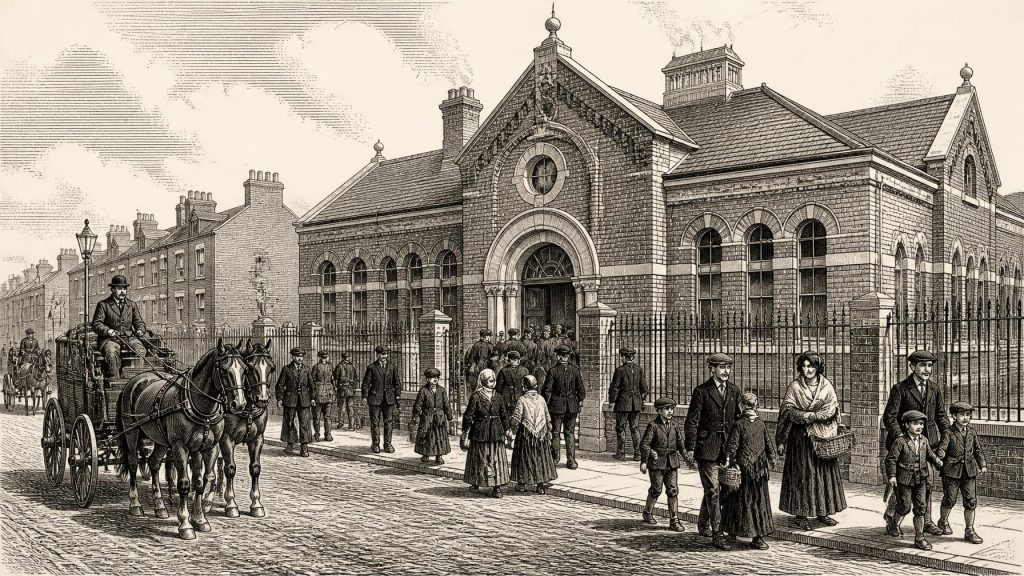
Urban reform was represented vividly in Dublin on 6 June, when the Iveagh Trust Public Baths opened on Bride Road in the Liberties. Established through the philanthropic resources of Edward Cecil Guinness, Lord Iveagh, the baths formed part of a wider programme of improved dwellings and amenities for working-class residents. Their red-brick and terracotta frontage was unusually elaborate for a public utility, but their purpose was practical: washing facilities, a swimming pool, changing rooms and cleaner conditions for people whose homes often lacked adequate sanitation or private bathrooms.
The baths should not be treated as a complete answer to urban poverty. Philanthropy did not alter low wages, insecure work or crowded streets by itself, and access was organised according to the social conventions of the day, including the separation of men and women. Nevertheless, the building conveyed an important Edwardian conviction: public health, recreation and personal cleanliness were legitimate civic concerns. In a city where domestic water and bathing facilities were unevenly available, the opening was a significant addition to ordinary urban life rather than simply an architectural event.
Questions of drink likewise entered legislation. Temperance advocates had pressed the Lord Lieutenant in May for Sunday closing, earlier Saturday closing and fewer licences. The Intoxicating Liquors (Ireland) Act 1906 subsequently reduced permitted hours, including Saturday closing and Sunday hours in the larger cities. Licensing was not a minor issue. The public house could be a social centre, workplace adjunct and meeting place, but excessive drinking was also identified by reformers with household hardship, ill-health and disorder. The act recorded the growing capacity of temperance politics to influence the rhythms of the week.
Education and Confessional Boundaries
Higher education exposed a fault-line that no administrative adjustment could easily remove. A royal commission on university education was appointed in June, while debate continued over whether Trinity College Dublin might provide a form of education acceptable to Catholics. On 1 August the Catholic hierarchy ruled out a mixed-denominational arrangement at Trinity. Its position followed a much older episcopal objection to mixed education, particularly where Catholic students would not be educated under Catholic authority in matters of faith and morals.
The dispute was about access and advancement as much as theology. Catholic Ireland wanted expanded university opportunity, but many bishops feared that a non-denominational solution would leave religious formation beyond their control. Trinity, meanwhile, defended its distinct identity. The issue would not be settled in 1906, but the year’s commission and controversy prepared the ground for the university settlement of 1908. At a more local level, St Eunan’s College opened in Letterkenny during September as a Catholic minor seminary. Its classical curriculum included Irish, Latin, Greek, history and geography, illustrating both clerical educational ambitions and the revived prestige of the Irish language.
Language, Sport and Public Identity
The cultural revival was also conspicuous. Douglas Hyde, founder and president of the Gaelic League, returned from a successful American fundraising and organising tour and received the freedom of Dublin in August. The honour marked the standing that the language movement had achieved beyond its original circle of enthusiasts. Hyde still presented the League as cultural rather than party-political, but encouraging Irish speech, literature and local historical consciousness inevitably changed how many people imagined the nation.
A striking, firmly dated demonstration of that imagination occurred far from Ireland. At the Athens Games on 27 April, the Waterford athlete Peter O’Connor won silver in the long jump while entered under the British team designation. In protest, he climbed the flagpole during the medal ceremony and displayed a green flag bearing a harp and the words Erin go Bragh. His action did not establish formal Irish sporting representation, and the status of the 1906 Athens meeting in later Olympic records has been debated. Its contemporary significance was clearer: Irish identity could be asserted publicly on an international stage even when the constitutional state remained the United Kingdom.
Davitt’s Last Farewell
The year’s most resonant death was that of Michael Davitt. He died in Dublin overnight on 30–31 May after blood poisoning followed a dental operation. Davitt had been a Fenian, founder of the Land League, agrarian organiser, parliamentarian and persistent critic of imperial war and social inequality. His final months had included an argument with the Catholic hierarchy over education, for he favoured free and secular education on a broad model. That disagreement itself shows how little Irish nationalism could be contained within one social or religious outlook.
Davitt had already become a figure of national memory when he died. Large crowds came to pay their respects in Dublin, and his body was brought by train to Mayo for burial at Straide. The mourning linked the political Ireland of 1906 to the Land War generation: a period in which mass organisation had challenged landlord power and taught rural communities to act collectively. The Labourers Act of the same year did not fulfil Davitt’s wider hopes, but it addressed one of the inequalities that his career had made impossible to ignore.
Thus 1906 deserves notice not for a dramatic break but for its accumulation of consequential beginnings and endings. Constitutional nationalism discovered the limits of a friendly Liberal majority; rural housing gained a new legislative basis; public welfare acquired tangible buildings and stricter regulation; educational division remained unresolved; and cultural nationalism found fresh public expression. Ireland’s future conflicts were not yet inevitable in the form they would take, but many of their institutions, loyalties and arguments were plainly visible.
Primary Sources
- 1906 General Election – Parties
- James Bryce
- Chief Secretary for Ireland
- Labourers (Ireland) Act 1906
- Labourers (Ireland) Act 1906 (1906 c. 37)
- Labourers (Ireland) Act 1906
- O'Brien, William
- Dublin, Bride Road, Iveagh Trust Public Baths
- Iveagh Trust Public Baths
- An Introduction to the Architectural Heritage of Dublin South City
- Intoxicating Liquor Act, 1927
- General Research Series 160: The Demand for Alcohol in Ireland
- Trinity College, Dublin
- History – About Trinity
- Anthony Traill (1838-1914), the First Provost to Confer Degrees on Women Graduates
- History
- Peter O’Connor Leaps to an Olympic Silver Medal in Athens, 1906
- The Olympic Council of Ireland
- Davitt, Michael
- Life of Michael Davitt
- Dr Douglas Hyde
- Thom's Irish Who's Who: Hyde, Douglas